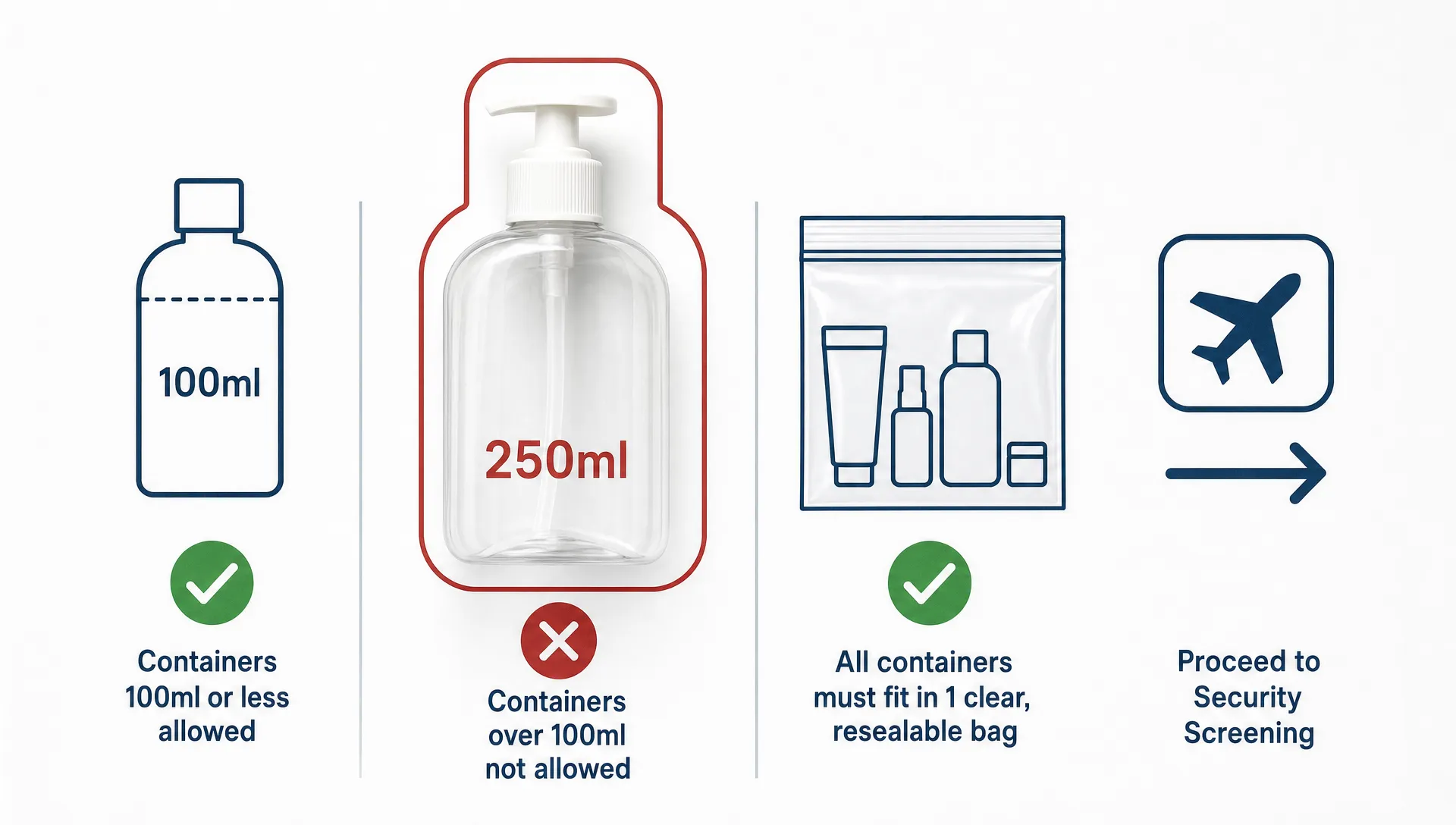
A half-empty shampoo bottle feels like it should be harmless. If there is only a little liquid left inside, why would airport security care that the label says 250ml? The answer is frustrating but simple: under the standard 100ml hand luggage rule, security usually checks the maximum capacity of the container, not the amount of liquid currently inside it.
That means a 200ml bottle with 50ml left can be treated the same as a full 200ml bottle. If the airport is applying the 100ml rule, it can be stopped, removed or thrown away unless it qualifies for an exception.
This catches travelers because it feels counterintuitive. At home, you judge a bottle by what remains. At airport security, the rule is normally based on what the container can hold.
The key rule: capacity matters more than contents
The standard airport liquid rule is not “you may carry up to 100ml of liquid in any bottle.” It is closer to this: each liquid, aerosol, gel, cream or paste must be in a container with a stated capacity of 100ml or less, and those containers must fit inside the required clear bag where that rule applies.
The TSA liquids rule, for example, refers to containers that are 3.4 ounces or 100 milliliters or less per item. The UK government hand luggage restrictions use similar container-based wording, saying containers must hold no more than 100ml.
So if your sunscreen tube says 150ml, a toothpaste tube says 125ml or a moisturizer pump bottle says 200ml, the fact that it is half-empty usually does not fix the problem. The label tells security the container is too large.
If you want a wider overview of the basic allowance, bag rules and what counts as a liquid, Liquid Limits has a separate guide on how much liquid is allowed in hand luggage.
Why airport security uses the bottle size
Airport screening needs rules that can be checked quickly, consistently and visually. Security officers cannot reliably confirm the true volume left in every bottle, tube, jar or aerosol passing through the checkpoint. A half-used toothpaste tube is especially hard to judge because its shape changes as it empties.
Container capacity is easier to verify. If the label says 100ml or less, it is usually straightforward. If the label says more than 100ml, the item is normally not compliant at airports using the 100ml rule. If the label is missing, faded or not in a recognizable format, the item may be treated as uncertain.
This is also why “it only has a bit left” rarely works as an argument at security. The officer is not only looking at the amount inside today. They are applying a rule written around the size of the container.
Half-empty bottles that often get stopped
The most common problem items are everyday toiletries that people try to finish during a trip. These are exactly the products travelers throw into a wash bag without rechecking the printed capacity.
| Item | Common mistake | Likely outcome under a 100ml rule |
|---|---|---|
| 200ml shampoo bottle with 50ml left | Judging by the liquid left, not the label | Can be stopped because the container is over 100ml |
| 150ml sunscreen tube half-used | Assuming a soft tube “looks small enough” | Can be stopped if the printed capacity exceeds 100ml |
| 125ml toothpaste nearly empty | Thinking the tube is now below 100ml | Can be stopped because the tube capacity is 125ml |
| 100ml travel bottle filled to the top | Using a compliant container | Usually acceptable if it fits the required liquids bag |
| 75ml face cream jar | Packing a small original container | Usually acceptable if it fits the required liquids bag |
| Large water bottle with a few sips left | Forgetting drinks count as liquids | Can be stopped unless emptied before screening |
A useful rule of thumb is this: if the printed capacity is above 100ml, do not pack it in hand luggage for a route where the 100ml rule may apply.
What if the bottle has no visible size label?
Unmarked containers can create a different problem. You might know your bottle is 100ml, but security may not. Some travel bottles have the capacity embossed on the bottom or printed on the side. Others look like generic plastic containers with no reliable marking.
If an officer cannot confirm the size and the container appears close to or above the limit, they may reject it. This is more likely with jars, pump bottles and silicone squeeze bottles because their true capacity is not obvious.
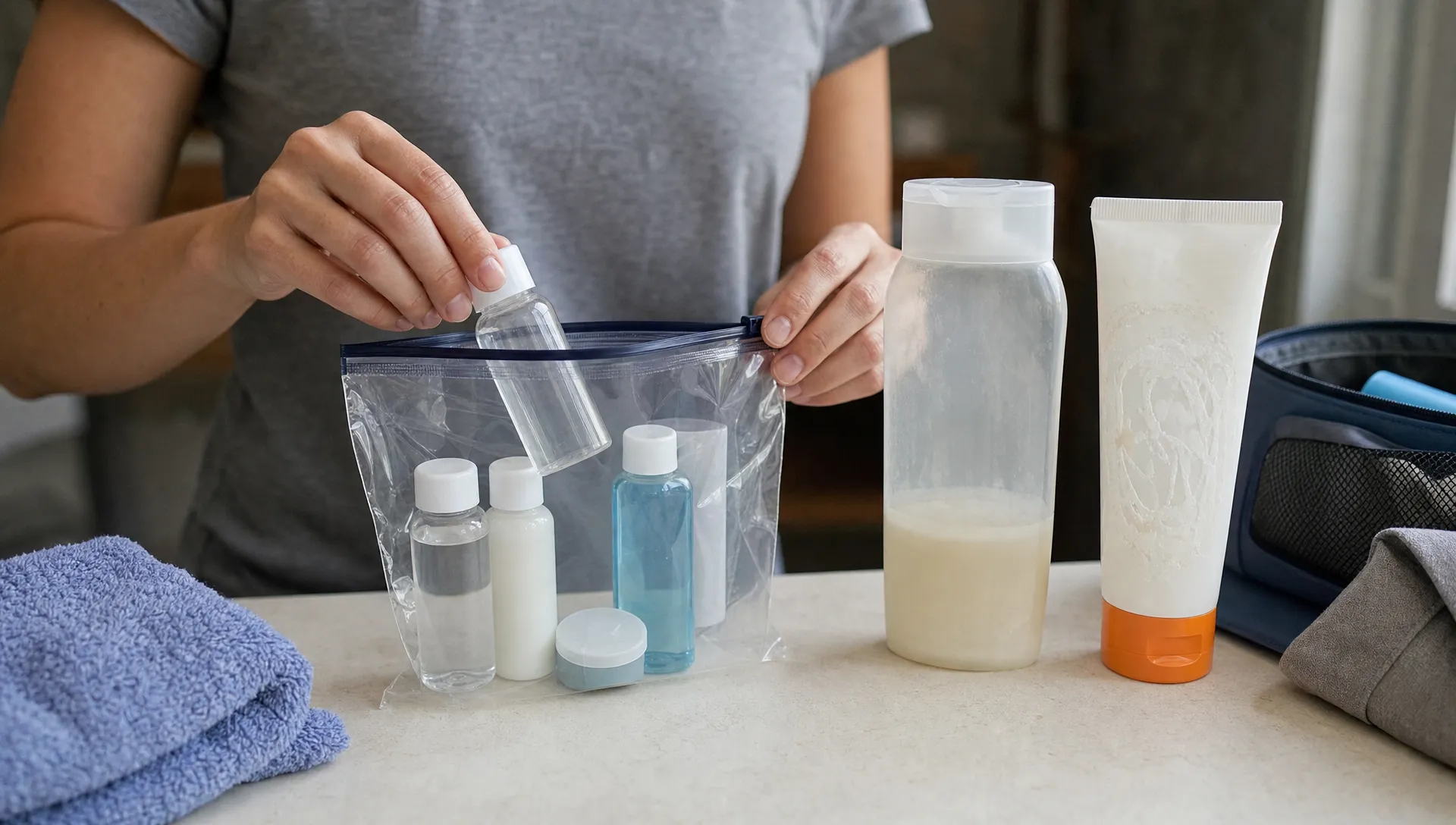
To reduce the risk, use travel bottles that clearly state “100ml” or a smaller amount. If you decant products at home, choose containers with permanent capacity markings rather than relying on handwritten stickers that can peel off, smudge or look unofficial.
For a deeper look at this exact packing issue, see our guide to container mistakes with the 100ml rule.
Does a larger liquid allowance change this?
Some airports have introduced newer screening equipment that can allow larger liquids in hand luggage. You may see references to 2L allowances at certain airports or terminals. The problem is that this is not universal, and your journey may involve more than one airport.
A round trip can also catch people out. Your departure airport might allow larger containers, but your return airport might still enforce 100ml. A connection can add another checkpoint where different rules apply. If one airport on your route uses the stricter limit, a half-empty 200ml bottle can still become a problem.
That is why relying on a general news headline about liquid rules is risky. Check the airport, the item and the route before packing. Liquid Limits is built for this exact situation: you can check airport liquid rules for your trip side by side, including return flights, source links and last-checked dates.
When a rule is unclear, the safer approach is to pack for the stricter 100ml limit. It may feel cautious, but it protects you from losing items at security.
Are there exceptions for medicine, baby food or special diets?
Yes, many airport liquid rules include exceptions for essential medicines, baby milk, baby food and liquids needed for special dietary requirements. These exceptions are not the same as ordinary toiletries, and they may require separate screening or supporting documentation.
Do not assume a half-empty oversized toiletry bottle will be treated like medicine. A prescription liquid in a larger container is a different situation from a 200ml shampoo bottle with 40ml left.
If you need to bring an exempt liquid, keep it accessible, declare it when required and check the rules for every airport in your journey. For medicine, carrying the prescription, label or a doctor’s note can help, depending on the airport and country.
How to pack so half-empty bottles do not get confiscated
The easiest fix is to stop packing based on what is left in the bottle. Pack based on the capacity printed on the container.
Before you zip your liquids bag, check these points:
- Every non-exempt liquid container should be 100ml or less if any airport on your route may apply the 100ml rule.
- The container should show its capacity clearly, ideally printed or embossed by the manufacturer.
- Larger bottles should go in checked luggage, be decanted into compliant travel bottles or be left at home.
- Drinks should be finished or emptied before security unless the airport specifically allows otherwise.
- Return flights and connections should be checked separately because the strictest airport may decide what you can keep.
For short trips, decanting is often better than carrying nearly empty full-size products. A 60ml travel bottle of shampoo is usually easier to clear than a 250ml bottle with a tiny amount remaining. It also saves space in the liquids bag, which can matter as much as the individual container limit.
Quick decision guide
If you are standing over your suitcase wondering whether a half-empty bottle can go in hand luggage, use this simple test.
| Question | If yes | If no |
|---|---|---|
| Does the container say 100ml or less? | It may be allowed if it fits the required bag | Do not pack it in hand luggage under the 100ml rule |
| Is the container clearly marked? | It is easier for security to verify | Consider using a marked travel bottle |
| Is it medicine, baby food or a special dietary liquid? | Check the exception rules and carry evidence if needed | Treat it like a normal liquid |
| Will every airport on your route allow larger liquids? | You may have more flexibility | Pack for the strictest 100ml rule |
This is the simplest way to avoid the “but it’s nearly empty” conversation at the checkpoint.
Frequently Asked Questions
Can I take a 200ml bottle in hand luggage if it only has 80ml left? Usually no if the airport is applying the 100ml hand luggage rule. The container capacity is 200ml, so it can be stopped even if the amount left inside is below 100ml.
Does the 100ml rule mean 100ml of liquid or a 100ml bottle? It generally means a container with a maximum capacity of 100ml or less. A larger bottle with less liquid inside is still a larger container.
Can I bring a half-empty toothpaste tube over 100ml? It can be refused if the tube capacity is printed as more than 100ml. Toothpaste is normally treated as a paste, so it falls under liquid rules at many airports.
What if my travel bottle is exactly 100ml? A 100ml travel bottle is normally acceptable under the standard rule if it fits in the required clear liquids bag and the airport has no additional restriction for that item.
Will airport security measure how much liquid is inside? Usually no. Security normally checks the container size, the item type and the applicable airport rule rather than measuring the remaining liquid in each bottle.
Can I empty a large water bottle and take it through security? In many airports, an empty reusable bottle is allowed because it does not contain liquid. Fill it after security where water refill points are available, but check local airport rules if unsure.
Check before you pack
Half-empty bottles are one of the easiest liquid-rule mistakes to avoid. If the container is over 100ml, do not rely on the amount left inside. Decant it, check it or pack it in checked luggage.
Before your next flight, use Liquid Limits to check the strictest cabin liquid rule for your airports, route and return journey. It can help you see whether you should pack for 100ml, whether a larger allowance may apply and where the official source information comes from.