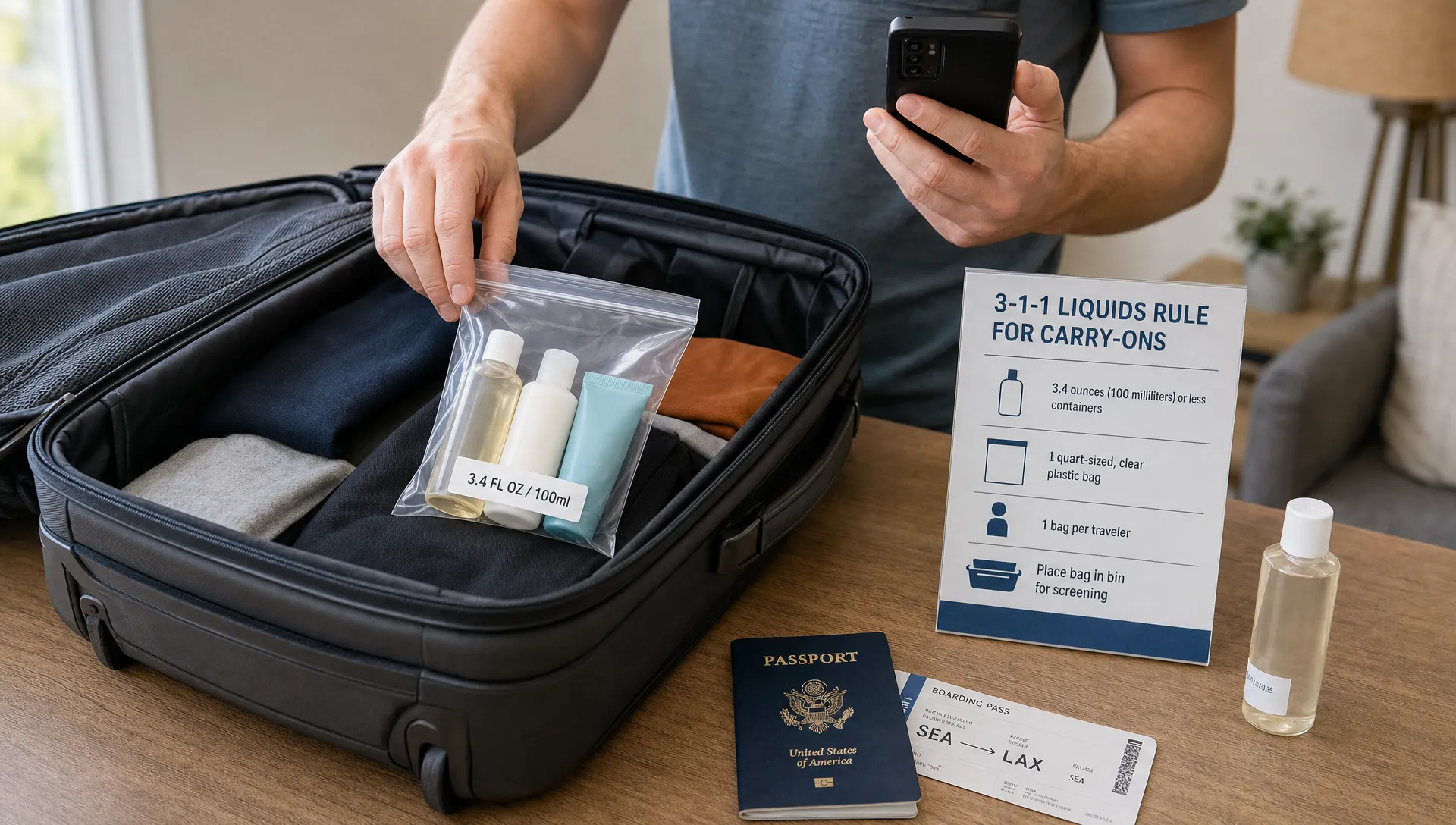
The 100ml liquid airport limit is one of the most familiar travel rules, but it is also one of the easiest to misunderstand. In most airports that still apply the standard rule, it means each liquid, gel, cream, paste or aerosol container in your cabin bag must hold 100ml or less. The rule is usually about the size printed on the container, not how much product is left inside.
That detail matters. A half-empty 150ml bottle is still a 150ml container at security. A 100ml travel bottle filled to the top is usually fine, provided it fits with your other liquids in the required clear bag where that bag rule applies.
Airport liquid rules are changing in some places because of newer screening technology, but the 100ml limit still matters in 2026. Many airports continue to enforce it. Some routes involve airports with different rules on the outbound and return trip. Transfers can also bring you back under the stricter limit, even if your first airport allowed more.
This guide explains what the 100ml limit means in practical packing terms, how it is enforced and how to avoid losing items at security.
What does 100ml mean at airport security?
At airport security, 100ml means the maximum container capacity allowed for most cabin liquids under the standard rule. In the United States, the Transportation Security Administration describes the equivalent as 3.4 ounces or 100 milliliters per container. In the United Kingdom, the government guidance for airports using the standard rule also states that liquids must be in containers holding no more than 100ml.
The key word is container. Security officers are not normally measuring the remaining shampoo, lotion or perfume inside. They look at the bottle, tube, jar or spray can. If the label says 125ml, 150ml or 200ml, it can be refused from hand luggage even when it is nearly empty.
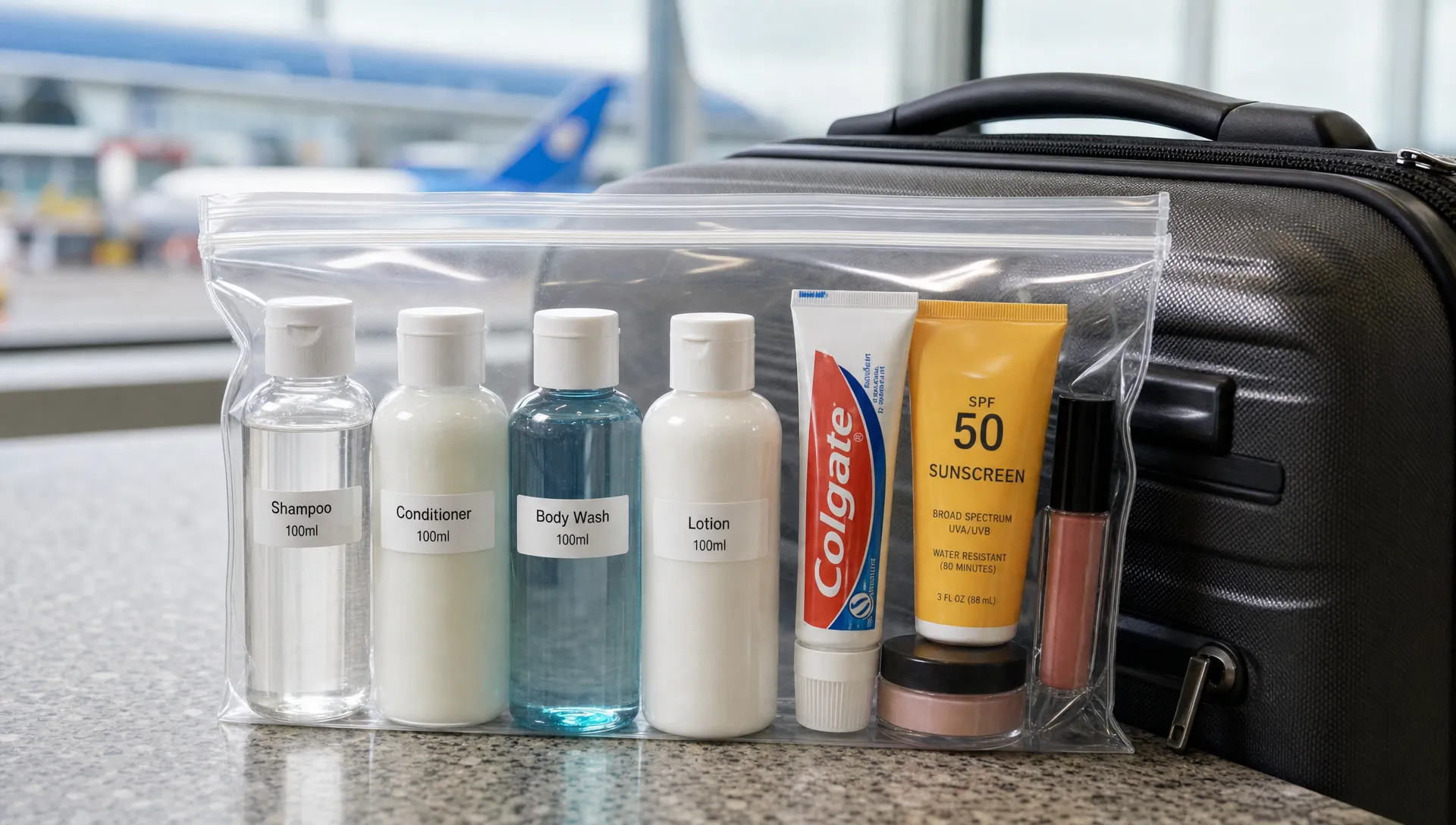
This is why airport shops sell small travel bottles. A reusable travel container marked 100ml can help, but it should be clearly labeled. An unmarked bottle may be accepted at some checkpoints and questioned at others, especially when it looks larger than 100ml.
100ml is not just for drinks
The word “liquid” sounds simple, but airport security uses it broadly. The 100ml limit commonly applies to items that can be poured, squeezed, spread, sprayed or smeared. That includes obvious liquids like water and perfume, plus many items travelers do not always think of as liquids.
Common examples include:
- Shampoo, conditioner, shower gel and body lotion
- Toothpaste, mouthwash and shaving gel
- Sunscreen, moisturizer and liquid foundation
- Mascara, lip gloss and cream makeup
- Hair gel, pomade and styling spray
- Deodorant sprays, roll-ons and aerosols
- Soups, sauces, honey, jam and soft cheese
Solid items are usually treated differently, but borderline products can still be screened as liquids if they have a gel, paste or cream texture. If you are packing something unusual, it is worth checking before you leave home rather than trying to argue the texture at the checkpoint. For a deeper breakdown of borderline toiletries, foods and cosmetics, Liquid Limits has a separate guide on what counts as 100ml of liquid at security.
The container limit vs the bag limit
The 100ml rule is only one part of the standard cabin liquid system. Many airports also require all 100ml containers to fit inside one clear, resealable plastic bag. The exact bag size can vary by country, but the common model is a clear bag of about 1 liter capacity.
Here is the difference:
| Rule | What it means | Common traveler mistake |
|---|---|---|
| Container limit | Each liquid container must be 100ml or smaller | Packing a half-empty 150ml bottle |
| Bag limit | Your small liquid containers must fit in the allowed clear bag | Bringing too many 100ml items |
| Screening rule | Liquids may need to be presented separately, depending on airport equipment | Leaving liquids buried in the bag when asked to remove them |
| Route rule | The strictest airport on your journey can decide what you can carry | Forgetting the return airport or transfer airport |
A traveler could pack ten 100ml items and still have a problem if the bag will not close. The standard rule is not “as many 100ml bottles as you want.” It is usually “containers up to 100ml, fitting inside the permitted liquids bag.”
Some airports with newer scanners may not require the same bag presentation, but that does not mean every airport on your trip has the same setup. If one airport on your route still requires the bag, pack so you can comply with it.
How much is 100ml in real life?
A 100ml container is small, but not tiny. It is enough for a short trip if you choose concentrated products or refill travel bottles carefully. It is about 3.4 US fluid ounces, which is why American guidance often refers to the “3-1-1” rule.
| Measurement | Approximate equivalent |
|---|---|
| 100ml | 3.4 US fluid ounces |
| 50ml | 1.7 US fluid ounces |
| 30ml | 1 US fluid ounce |
| 15ml | 1 tablespoon |
| 5ml | 1 teaspoon |
For toiletries, 100ml can often cover a few days to a week, depending on the product and how much you use. Sunscreen, contact lens solution and hair products run out faster than perfume or face serum. If you are traveling with family, each traveler’s liquids are usually assessed separately, but children still need to follow the checkpoint’s rules unless an exemption applies.
Why a half-empty larger bottle can still be refused
This is the most common misunderstanding. The 100ml airport liquid limit is designed for quick screening, so officers use the marked container size as the practical standard. A 200ml shampoo bottle with only a small amount left still has a 200ml capacity.
There are good reasons for this. Security staff cannot reliably verify the exact amount inside every opaque bottle, tube or jar during a busy screening process. The printed size gives them a clear rule that can be applied quickly.
If you want to bring the rest of a larger product, decant it into a clean 100ml travel container before packing. Make sure the container closes securely. Leaks are common in cabin bags because pressure changes and movement can force product out of loose caps. A small piece of plastic wrap under the lid can help, but the container still needs to meet the airport rule.
Do medicines, baby items and special diet products count?
Many airport systems allow exemptions for essential medicines, baby milk, baby food and special dietary items, but the details vary. These products may be allowed in quantities over 100ml when they are needed for the journey. You may need to present them separately and security may screen them in a different way.
Medicine is not a free pass for every health or beauty item. Prescription liquid medication, insulin, cooling gel packs used for medical needs and medically necessary nutrition are treated differently from ordinary toiletries. If you are carrying medicine over 100ml, bring documentation where possible, keep it accessible and check the rules for every airport on your route.
Baby food and milk rules are also route dependent. Some airports allow reasonable quantities for the journey, but officers may ask you to remove them from your bag for inspection. Frozen items can create extra questions if they partially thaw, because they may be treated as liquids or gels.
What about duty-free liquids?
Duty-free liquids can be allowed through security in specific circumstances, often when they are sealed in a tamper-evident security bag with the receipt visible. The problem is not usually the first flight. The problem is the next checkpoint.
If you buy a 1 liter bottle of perfume or spirits after security, then connect through another airport where you must be rescreened, that airport’s rules matter. If the item is not sealed correctly or the receipt is missing, it may be refused. Some countries and airports apply duty-free transfer rules differently, so high-value liquid purchases are worth planning carefully.
For simple direct flights, duty-free is usually less complicated. For connecting itineraries, especially international transfers, check before buying or pack liquids in checked baggage when that is allowed and practical.
Why some airports allow more than 100ml
Some airports have introduced advanced cabin baggage scanners that can assess liquids differently. In those locations, travelers may see rules that allow larger liquid containers, sometimes up to 2 liters. That does not mean the 100ml rule has disappeared everywhere.
Airport liquid rules depend on equipment, regulator approval, local policy, staff procedures and operational changes. A terminal may have different equipment from another terminal at the same airport. A temporary policy change can also bring back the 100ml rule with little notice.
The safest way to think about it is this: your trip is only as flexible as the strictest security checkpoint you will pass through. If your departure airport allows larger liquids but your return airport does not, you still need a plan for the return trip. If you are connecting, the transfer airport may be the one that matters most.
This is the reason Liquid Limits focuses on whole trips, not just single airports. Before you pack, you can use the trip liquid checker to compare airport rules for your route, including the return flight.
How to pack under the 100ml liquid limit
Packing for the 100ml rule is mostly about avoiding ambiguity. Security lines move faster when your liquids are easy to identify, separate and inspect.
Use these practical habits:
- Choose containers labeled 100ml or smaller
- Put larger toiletries in checked baggage if you need them at destination
- Keep liquids together in the required clear bag where applicable
- Swap liquid products for solid versions when convenient
- Check aerosols, gels and creamy foods instead of assuming they are exempt
- Review the return airport rule before buying full-size products abroad
Solid shampoo bars, stick deodorant, powder makeup and toothpaste tablets can reduce the number of liquid items you need. They are not always a perfect replacement, but they help when you travel with hand luggage only.
If you are flying with carry-on only for more than a few days, consider buying basic toiletries after arrival. This is often easier than trying to fit every product into one small bag, especially for beach trips where sunscreen can take up most of your allowance.
How airport security usually enforces the limit
In airports using the standard rule, security may ask you to remove your liquids bag from your cabin bag and place it in a tray. Officers may visually check container sizes, run the bag through the scanner and inspect anything that looks oversized or unclear.
Enforcement can vary. One airport may be strict about a slightly oversized toothpaste tube, while another may focus only on obvious breaches. You should not rely on leniency, especially if you have a tight connection. A delayed bag search can be more costly than replacing a product.
If an item is refused, you usually have limited options. You may be able to surrender it, return to check-in if time allows or mail it if the airport offers that service. In practice, most travelers lose the item. Packing correctly is the cheaper option.
For a broader explanation of how screening decisions are made at the checkpoint, see this guide to how the liquid rule at the airport really works.
The return flight is where travelers get caught
Many people check the rules for the outbound flight, then forget the return. This is risky if you are traveling from or through an airport with different liquid restrictions.
A common scenario looks like this: you depart from an airport with newer scanners and carry a larger liquid container. On the way home, your return airport still uses the 100ml rule. The same item that was fine on departure can be refused on return.
The same issue applies to souvenirs. Olive oil, wine, sauces, perfumes, cosmetics and snow globes can all create problems in cabin baggage. If you plan to bring liquid gifts home, check whether they need to go in checked baggage or be bought after security in a compliant sealed duty-free bag.
Round trips are where a route-based check is more useful than a single airport lookup. The strictest airport on the itinerary sets the practical packing limit.
Quick decision guide: can you take it in cabin baggage?
Use this simple check before putting any liquid-like item in your hand luggage.
| Question | If yes | If no |
|---|---|---|
| Is it a liquid, gel, cream, paste, spray or soft food? | Treat it as a liquid | It may not be subject to the liquid rule |
| Is the container 100ml or smaller? | It may be allowed under the standard rule | Put it in checked baggage or leave it out |
| Does it fit in the required clear bag? | It is more likely to pass | Reduce the number of liquid items |
| Is it medically necessary or for a baby? | Check exemption rules and present it separately | Follow the normal 100ml limit |
| Will you pass another security checkpoint? | Check that airport’s rule too | Your departure airport rule may be enough |
This guide does not replace official security decisions at the airport, but it helps you pack in the way most likely to pass without delays.
Frequently Asked Questions
Does 100ml mean per bottle or total? Under the standard airport liquid rule, 100ml usually means per container. Many airports also limit the total number of containers by requiring them to fit in one clear resealable liquids bag.
Can I take a 150ml bottle if it is half empty? Usually no. Security normally looks at the container capacity printed on the bottle, not the amount left inside. Decant the product into a 100ml container instead.
Is 100ml the same as 3.4 ounces? Yes, 100ml is approximately 3.4 US fluid ounces. That is why US airport guidance often refers to 3.4 oz containers.
Do airport liquid rules apply to checked baggage? The 100ml cabin liquid rule is mainly for hand luggage at security. Checked baggage has different rules, especially for aerosols, alcohol, batteries and hazardous goods.
Can airports allow 2L liquids now? Some airports with approved newer scanners may allow larger containers, but this is not universal. Check every airport on your route, including transfers and the return flight.
Check before you pack
The 100ml liquid airport limit is simple once you know what it really means: small containers, often in a clear bag and subject to the strictest checkpoint on your trip. The confusing part is that not every airport applies the same rule at the same time.
Before you zip your cabin bag, check your departure airport, return airport and any transfer points. Liquid Limits helps you compare the strictest liquid rule for your whole trip, with airport, item and route checks designed for real travel rather than guesswork.