The 100ml liquids in hand luggage rule looks simple until you are standing at security with a full-size moisturizer, a half-empty shampoo bottle, or a jar of peanut butter you forgot counts as a spread. Most confiscations are not caused by people deliberately ignoring the rule. They happen because travelers misunderstand how airports apply it.
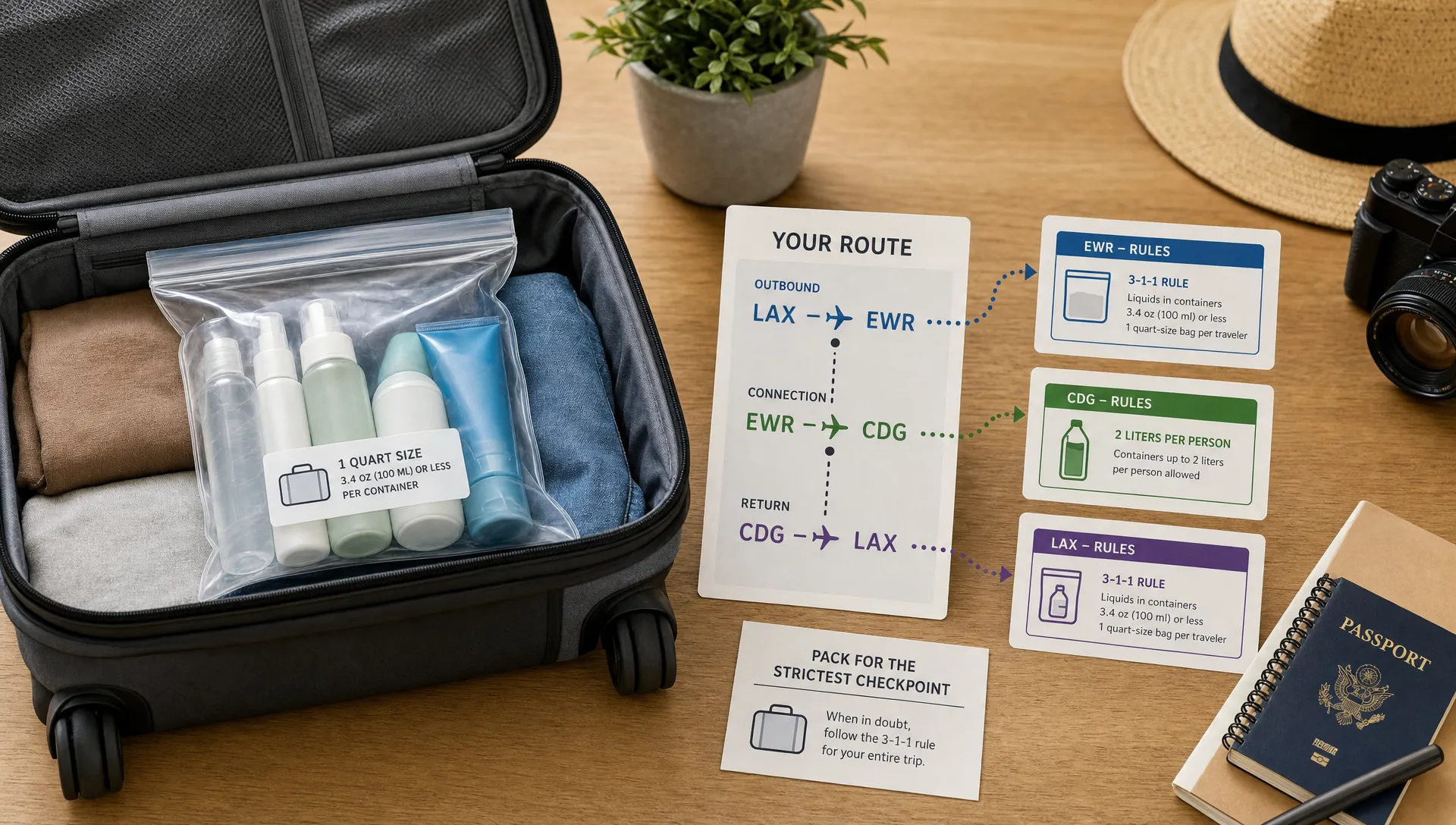
In 2026, the safest approach is still to pack for the strictest security checkpoint on your route unless you have verified information for every airport involved. Some airports have upgraded screening equipment, but rules are not applied uniformly worldwide, and a connection or return airport can be stricter than your departure airport.
Below are the most common mistakes to avoid before you zip your carry-on shut.
First, what does the 100ml rule usually mean?
At many airports, liquids, aerosols, gels, creams, and pastes in hand luggage must be in containers of 100ml or less. In the United States, the TSA describes this as the 3-1-1 liquids rule, which allows containers of 3.4 ounces or 100 milliliters in one quart-sized bag, with one bag per passenger.
In the UK, GOV.UK guidance similarly states that liquid containers in hand luggage must hold no more than 100ml and must fit in a single transparent, resealable plastic bag, with some exceptions.
The details can vary by airport and route, but the core mistake travelers make is thinking only about the liquid itself. Security usually looks at the container, the item type, the bag, and the checkpoint rules.
If you want a broader baseline before packing, Liquid Limits has a plain-English guide on how much liquid is allowed in hand luggage, but this article focuses specifically on the errors that cause problems at security.
Mistake 1: Packing a larger bottle because it is almost empty
This is the classic airport liquid mistake. A 200ml bottle with only 50ml of shampoo left inside is still usually treated as a 200ml container. The limit is based on container capacity, not the amount remaining.
That means the label matters. If the bottle says 150ml, 200ml, or 250ml, do not assume security will estimate what is inside and let it through. They usually will not.
The safer fix is simple: decant the product into a travel-size container marked 100ml or less, or buy a compliant mini version. If you use refillable bottles, choose ones with the capacity printed clearly on the container. Unmarked containers may still pass in some places, but they create avoidable uncertainty.
Mistake 2: Forgetting that creams, gels, pastes, and sprays count too
Many travelers think “liquid” means water, perfume, or shampoo. Airport liquid rules are broader than that. Toothpaste, mascara, sunscreen, hair gel, face cream, liquid foundation, lip gloss, and aerosols are all common examples of items that may need to follow the 100ml limit.
A good test is this: if it can be poured, squeezed, spread, sprayed, smeared, or behaves like a gel, treat it as a liquid for cabin screening.
| Item | Why it catches travelers out | Safer hand luggage choice |
|---|---|---|
| Toothpaste | It is a paste, not a solid | Use a 100ml or smaller tube |
| Mascara and liquid eyeliner | Makeup liquids are easy to overlook | Put them in your clear liquids bag |
| Sunscreen | Often packed in large beach-size bottles | Buy a travel-size version or pack it in checked luggage |
| Roll-on deodorant | It is not the same as a solid stick | Treat it as a liquid item |
| Hummus, peanut butter, and spreads | Spreadable foods may be treated like gels or pastes | Pack small compliant containers or place them in checked luggage |
| Hair spray and dry shampoo aerosols | Aerosols are commonly included in liquid rules | Check size limits and airline restrictions before packing |
For a more item-focused breakdown, see Liquid Limits' guide to liquids you can pack in cabin bags.
Mistake 3: Overstuffing the clear plastic bag
Even when every container is 100ml or less, your liquids can still cause problems if the bag is too full, too large, opaque, or impossible to close.
At many airports, the rule is not just “bring small bottles.” It is “bring small bottles that fit inside one clear, resealable liquids bag.” If you have to force the zip closed, balance items on top, or use multiple bags, you may be asked to remove items.
The easiest way to avoid this is to pack your liquids bag first, before the rest of your toiletries. If something does not fit, decide whether it should go in checked luggage, be replaced with a solid alternative, or be purchased after security.
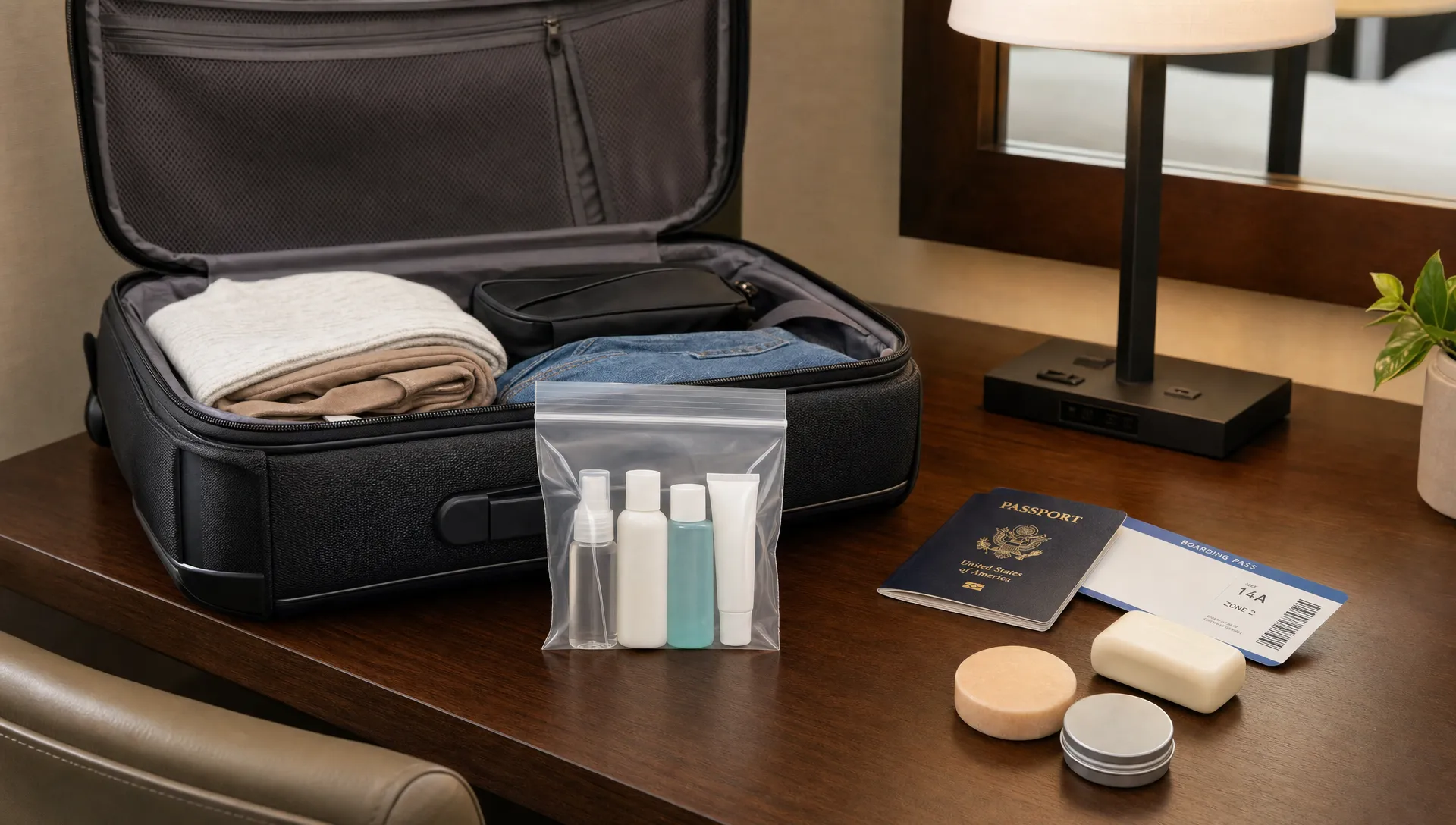
Solid toiletries can help reduce pressure on the bag. Shampoo bars, solid deodorant, bar soap, powder makeup, and solid perfume are often easier to travel with than liquid equivalents. You still need to check the rules for unusual items, but switching a few basics to solids can make the 100ml limit much less stressful.
Mistake 4: Hiding liquids deep inside your bag
Even if your liquids are compliant, packing them at the bottom of your backpack can slow you down. Some airports still require passengers to remove liquids for screening. Others may allow liquids to stay inside bags if they use newer scanners, but you cannot count on that for every airport.
Pack your clear bag where you can reach it quickly. A top pocket, front compartment, or easy-access pouch is better than burying it under clothes and electronics.
This is especially important if you are traveling with children, moving through a busy airport, or making a tight connection. A few seconds saved at security can make the process calmer for you and the people behind you.
Mistake 5: Checking only your departure airport
One of the biggest mistakes is assuming that the rules at your first airport are the only rules that matter. They are not.
Your route may include a transfer airport, a return airport, or a separate security screening after arrival in another country. If any checkpoint on your journey applies the 100ml rule, your cabin liquids need to survive that checkpoint too.
This is where travelers get caught. They depart from an airport with more relaxed screening, buy or keep larger liquids, then face a stricter transfer or return screening later. The item was allowed at one airport, but not at the next.
Before packing, check the full route, not just the first flight. With Liquid Limits, you can check airport liquid rules for a trip, including round trips where the return airport may apply different restrictions. The tool is designed to show stricter rules clearly, with source links and last-checked dates when available.
Mistake 6: Trusting old scanner news without checking current rules
You may have seen headlines about airports allowing larger liquids because of advanced CT scanners. That does not mean every airport on your route allows larger containers today.
Airport liquid rules have changed in stages, and in some places, temporary restrictions have been reinstated after technology rollouts. Even within the same country, the passenger experience can differ by airport, terminal, or security lane.
The practical rule is this: do not pack a 500ml shampoo bottle in your hand luggage just because you read that one airport has new scanners. Unless you have checked the specific airport and date, pack as if the 100ml rule applies.
This is also why “it worked last time” is risky. Your last trip may have involved a different airport, a different terminal, a domestic route, or a more relaxed screening setup. Security rules can change, and staff will apply the rule in force at that checkpoint.
Mistake 7: Assuming duty-free liquids are always safe on connections
Duty-free liquids can be allowed in cabin baggage under specific conditions, often when they are sealed in a security tamper-evident bag with proof of purchase. But that does not mean they are always trouble-free on connecting flights.
Problems can happen when you leave the secure area, pass through another screening checkpoint, have a long layover, or connect through an airport with different rules. If the seal is broken, the receipt is missing, or the item is not recognized under local procedures, you may lose it.
If you plan to buy perfume, alcohol, cosmetics, or other liquids after security, check whether you will face another screening before your final destination. When in doubt, buy at the last airport before your final flight, or place nonessential liquids in checked luggage on the way home.
Mistake 8: Packing medicines and baby items without preparation
Medicines, medical supplies, special dietary items, and baby food often have exceptions, but exceptions are not the same as “pack anything without questions.” You may need to declare the items, separate them for screening, or show that they are necessary for the journey.
If you need liquid medicine over 100ml, keep it in its original packaging where possible. Bring a prescription, doctor’s note, or pharmacy label if relevant. Do not decant prescription liquids into an unmarked bottle unless you have confirmed that doing so is acceptable for your route.
For baby milk, formula, sterilized water, and baby food, airports often allow reasonable quantities, but screening procedures vary. Pack these items together, keep them accessible, and allow extra time at security.
The main mistake is not bringing the item. The mistake is treating an exception like a normal toiletry and hiding it at the bottom of your bag. If it is medically or practically necessary, make it easy for security staff to inspect.
Mistake 9: Forgetting that checked luggage has different issues
A common solution is to move larger liquids into checked baggage. That works for many toiletries, but it is not a free pass for everything.
Checked bags can leak, break, or be delayed. Aerosols, alcohol, flammable items, and certain chemicals may also be restricted by airline or dangerous goods rules. If an item is essential on arrival, such as medication, you may not want it only in checked luggage.
For ordinary shampoo, conditioner, sunscreen, and body lotion, checked luggage is often the simplest option. Use leak-proof caps, place bottles in a sealed bag, and avoid packing fragile glass containers without padding.
For anything valuable, essential, pressurized, or unusual, check both airport security rules and airline baggage rules before deciding where it belongs.
Mistake 10: Waiting until the security line to sort everything out
The worst place to organize liquids is at the front of the security queue. You are rushed, other passengers are waiting, and you may not have space to repack neatly.
A better approach is to do a two-minute liquid audit before leaving for the airport. Put every possible liquid, gel, cream, paste, and aerosol in one place. Check each container size. Confirm what must go in the clear bag, what can move to checked luggage, and what can stay home.
Here is a simple pre-flight routine:
- Gather all toiletries, makeup, food spreads, sprays, medicines, and baby items.
- Remove any nonessential container larger than 100ml from your hand luggage.
- Place compliant liquids in one clear, resealable bag.
- Keep medicines and baby items separate and easy to declare if needed.
- Move large nonessential liquids to checked baggage if allowed.
- Check your departure, connection, and return airports before you travel.
- Leave extra space in the liquids bag for items you may buy before the trip.
This routine is not about being overly cautious. It is about avoiding the stressful moment when a security officer holds up your favorite product and asks whether you want to surrender it or go back.
A quick decision table for borderline items
When you are unsure whether something belongs in your liquids bag, use the stricter interpretation. The few seconds it takes to pack it correctly are better than losing it at security.
| Question | If the answer is yes | What to do |
|---|---|---|
| Is the container over 100ml? | It may be rejected even if partly empty | Put it in checked luggage or use a smaller container |
| Can the item be squeezed, sprayed, spread, or smeared? | It may count as a liquid, gel, cream, or paste | Pack it in the liquids bag |
| Is it needed for medical, dietary, or baby care reasons? | It may qualify for an exception | Keep it accessible and bring supporting information if relevant |
| Will you pass through another security checkpoint? | Rules may be stricter later | Pack for the strictest airport on the route |
| Did you buy it duty-free before a connection? | It may need sealed packaging and proof of purchase | Keep the sealed bag intact and check transfer rules |
Frequently Asked Questions
Can I bring a 100ml bottle that is filled to the top? Yes, if the container capacity is 100ml or less and it fits inside the required liquids bag. The issue is container size, not whether it is full.
Can I bring a 150ml bottle if there is only a little liquid left? Usually no. Airport security normally uses the capacity printed on the container, so a 150ml bottle can be rejected even if it is almost empty.
Does makeup count as liquid in hand luggage? Some makeup does. Mascara, liquid eyeliner, foundation, concealer, primer, cream blush, and lip gloss should generally be treated as liquids or gels. Powder makeup is usually easier to pack, but rules can vary.
Are medicines allowed over 100ml? Liquid medicines may be allowed over 100ml when they are needed for the trip, but you may need to declare them and provide supporting information. Keep them in original packaging when possible and check your route before flying.
Do I need to follow the 100ml rule if my airport has new scanners? Not necessarily, but you should verify the specific airport and route. If any departure, transfer, or return airport applies the 100ml rule, pack for that stricter checkpoint.
Check before you pack
The easiest way to avoid 100ml liquid mistakes is to stop guessing. Rules can differ by airport, route, item, and return journey, especially when newer scanners and local procedures are involved.
Before your next flight, use Liquid Limits to check the strictest cabin liquid rule for your whole trip. You can look up airports, routes, and specific items, with daily updates, verified source links, and last-checked dates where available. If a rule is unclear, Liquid Limits defaults to the stricter 100ml guidance, which is usually the safest way to pack without surprises.