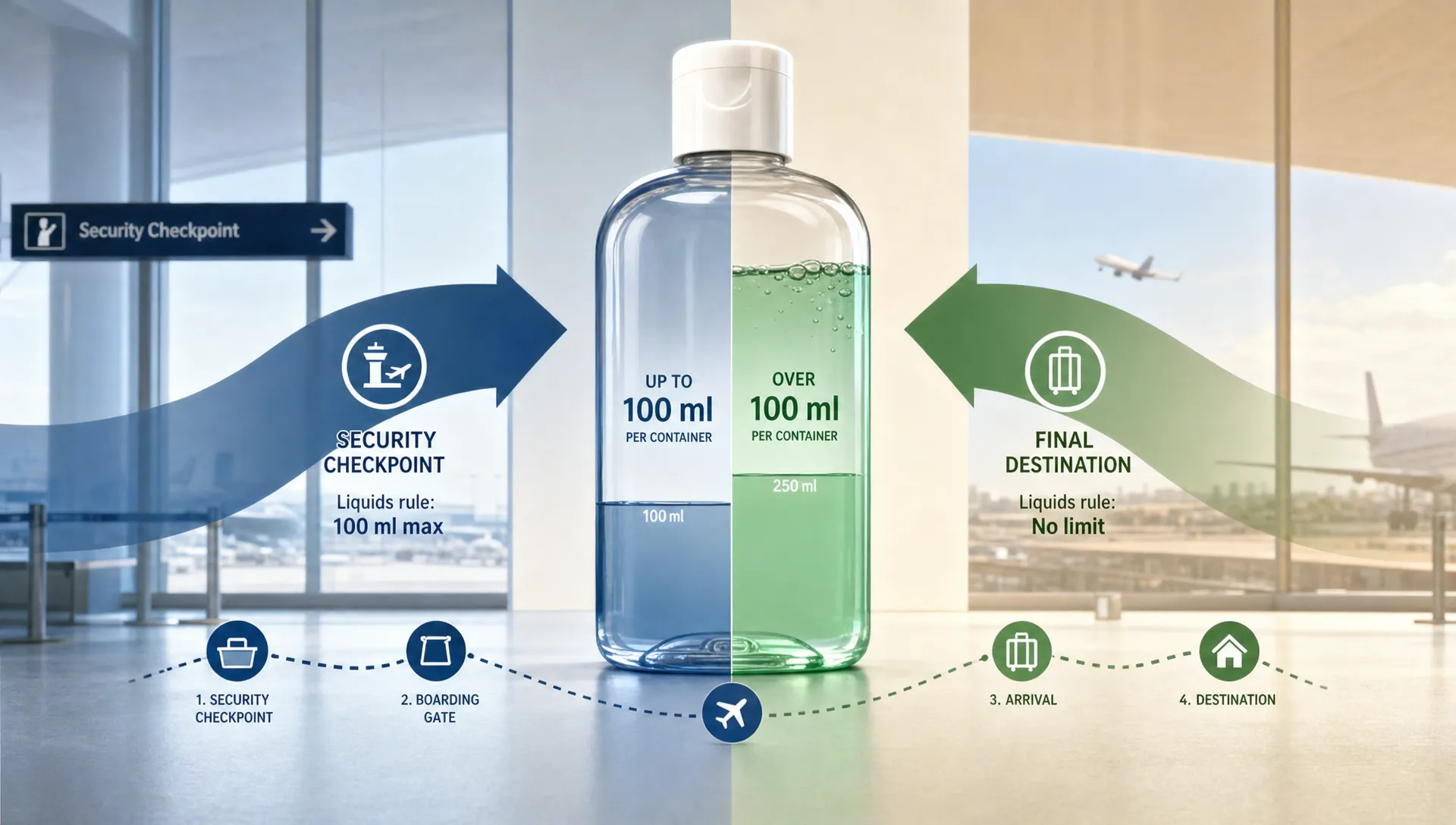
If you have flown in the last few years, you have probably seen headlines saying the airport 100ml rule is ending. Some airports have installed newer CT scanners, some security lanes no longer ask passengers to remove liquids, and a few locations have trialed larger liquid allowances.
That does not mean you can pack a full-size shampoo bottle for every trip in 2026.
The reality is more fragmented. The airport 100ml rule still matters because liquid rules are set and enforced at the security checkpoint you pass through, not by a global headline, your airline, or the most relaxed airport on your itinerary. A trip can include different rules on the outbound flight, a connection, and the return flight. If one checkpoint on that journey still uses the 100 ml limit, that is the rule that can decide whether your item gets through.
Quick answer: why the 100ml rule still matters
In 2026, the 100ml liquid rule remains relevant for five practical reasons:
- Many airports and terminals still enforce 100 ml container limits for cabin baggage.
- New scanners do not automatically mean bigger liquids are allowed for every passenger.
- Transfers, international connections, and return flights can put you through a stricter checkpoint.
- Airport rules can change faster than travel blogs, airline emails, or old forum posts.
- The rule covers more than water bottles, including gels, creams, pastes, aerosols, and many toiletries.
The safest packing strategy is simple: if you cannot verify every liquid checkpoint on your route, pack cabin liquids in containers of 100 ml or less, or put larger liquids in checked baggage.
What the airport 100ml rule actually means
The airport 100ml rule is the common cabin baggage restriction that limits liquids, aerosols, gels, creams, and pastes to containers of 100 ml or less, roughly 3.4 ounces. In many places, those containers must also fit inside a clear, resealable plastic bag.
In the United States, the Transportation Security Administration describes this as the 3-1-1 liquids rule: containers of 3.4 ounces or less, placed in one quart-sized bag, with one bag per passenger. In the UK, government guidance still tells passengers to check hand luggage restrictions before traveling, because liquids rules depend on the airport and current security requirements.
The key detail many travelers miss is that the limit is usually based on container size, not the amount left inside. A 200 ml bottle with only 50 ml of product remaining can still be rejected at a 100 ml checkpoint, because the container itself is larger than the allowed size.
The rule also applies to items that do not look like obvious liquids when you are packing at home. Toothpaste, sunscreen, mascara, hair gel, face cream, deodorant sprays, shaving foam, jam, and some food spreads can all be treated as liquids or gels at security.
Why newer scanners have not made the rule disappear
Modern CT scanners can give security officers a more detailed view of cabin baggage. That technology is one reason some airports have tested or introduced larger liquid allowances. But scanner technology is only one part of the system.
A checkpoint can relax liquid rules only when equipment, software, local regulations, operational procedures, staff training, and airport approval all line up. Even then, a relaxed policy might apply only in specific terminals or lanes. If another terminal at the same airport has older equipment, the passenger experience can be different.
Recent history has also shown that liquid restrictions can tighten again when regulators need more time to validate equipment performance. The European Commission, for example, announced temporary restrictions in 2024 for certain airports using C3 scanners, showing that scanner upgrades do not permanently remove security rules by themselves.
If you want the deeper technical background, Liquid Limits has a separate guide explaining why airports still use the 100ml rule. For most travelers, though, the practical takeaway is enough: do not assume new scanners mean unlimited liquids.
The rule that matters is the strictest checkpoint on your trip
The biggest 2026 packing mistake is checking only the airport you fly out of first.
Air travel is route-based. Your cabin bag may be screened more than once, especially if you have an international connection, change terminals, exit the secure area, or fly home from a different airport. A relaxed liquid rule at your departure airport does not protect a 250 ml bottle from being confiscated at a stricter transfer or return airport.
That is why the airport 100ml rule still matters even for travelers who regularly use modern airports. One relaxed checkpoint does not guarantee a relaxed journey.
| Travel situation | Why the 100ml rule can still matter | Safer approach |
|---|---|---|
| Round trip with different airports | Your return airport may enforce a stricter liquid limit than your outbound airport | Check both outbound and return rules before packing |
| International connection | You may need to clear security again after arriving or changing terminals | Keep essential liquids in 100 ml containers |
| Mixed airport technology | One terminal or lane may allow larger liquids while another does not | Follow the published rule for your exact airport and terminal |
| Duty-free purchase before a connection | Security rules at the next airport may affect whether the item can continue | Keep receipts and sealed bags, and verify transfer rules |
| Unclear or outdated information | Old articles or social posts may not reflect current local policy | Use a source with recent checks and official links |
This is also why Liquid Limits focuses on the full trip, not just a single airport. You can check airport liquid rules for your route and compare the stricter rule before you pack.
What travelers often misunderstand in 2026
The confusion around liquids has become worse because different messages are all partly true. Yes, some airports have upgraded scanners. Yes, some airports may allow larger liquids. Yes, many airports still enforce 100 ml. The problem starts when travelers apply one airport's rule to another airport.
Here are the most common assumptions that lead to problems at security.
| Assumption | Why it is risky | Better interpretation |
|---|---|---|
| “My airline says liquids are fine.” | Airlines do not usually control security screening rules | Check airport security rules, not just airline baggage rules |
| “The airport has CT scanners.” | Scanner presence does not always mean relaxed liquid limits | Look for the airport's current published liquids policy |
| “I flew with this bottle last month.” | Rules can vary by airport, terminal, lane, and date | Recheck close to departure |
| “It is only half full.” | Many checkpoints judge the container size | Use a container marked 100 ml or less |
| “My outbound airport allows it.” | Your connection or return airport may not | Plan around the strictest checkpoint |
How to pack when liquid rules vary by airport
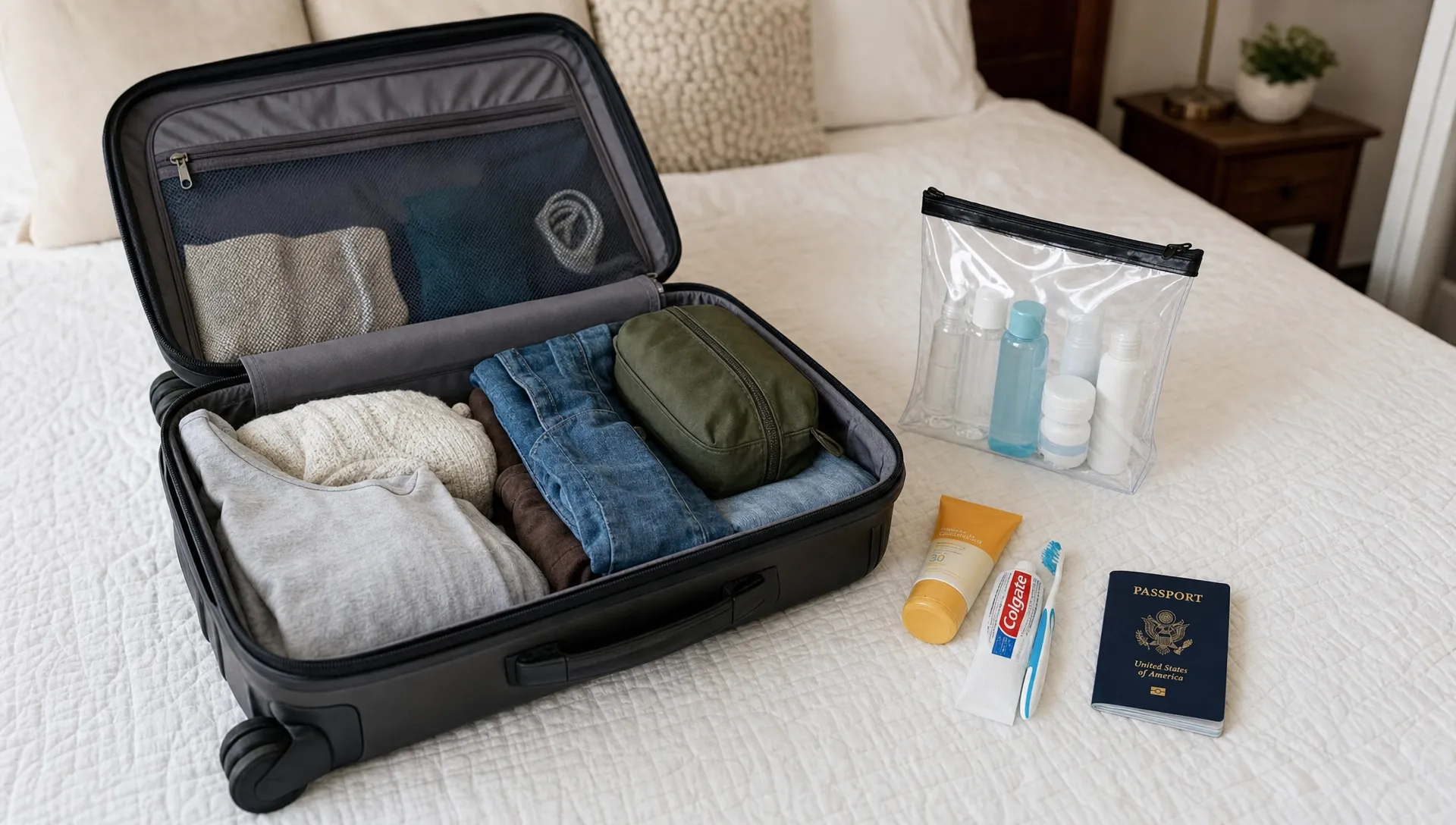
The goal is not to memorize every airport rule in the world. The goal is to pack in a way that matches the most restrictive part of your actual journey.
For important toiletries, medicines, cosmetics, or skincare, 100 ml containers remain the lowest-risk option for cabin baggage. They are widely accepted at standard checkpoints and reduce the chance of losing something expensive or hard to replace.
For larger liquids, checked baggage is usually the simpler choice if you are taking a checked bag anyway. Full-size shampoo, perfume over 100 ml, large sunscreen, wine, olive oil, and similar items are usually better placed in checked luggage, provided they comply with airline, customs, and dangerous goods rules.
When you must bring liquids in the cabin, use this simple approach:
- Pack essential non-exempt liquids in containers of 100 ml or less.
- Keep containers together in a clear resealable bag when required by the airport.
- Put larger non-essential liquids in checked baggage where allowed.
- Do not rely on a relaxed outbound rule unless your return and transfer airports also allow it.
- Recheck the rule shortly before travel, especially for multi-airport trips.
If you want a broader refresher on what normally counts as a liquid, the Liquid Limits guide to airport liquid limits for carry-ons in 2026 covers the standard categories and common exceptions.
What about medicines, baby supplies, and special items?
The 100ml rule is strict, but it is not the whole story. Many airports provide exemptions or special screening for medically necessary liquids, baby milk, baby food, and certain dietary items. These items may be allowed in quantities above 100 ml, but they often need to be declared at security and may be subject to additional screening.
Do not pack exempt items casually among ordinary toiletries and hope they pass unnoticed. Keep them accessible, bring supporting documentation when relevant, and check the rule for the airport you will actually use. The details can vary by country.
Duty-free liquids are another special case. Items bought after security may be allowed on board, especially when sealed in an official security tamper-evident bag with proof of purchase. But if you have a connection where you pass through another security checkpoint, the next airport's rules matter. A bottle that was legal to buy airside at Airport A can become a problem at Airport B if it is not packed, sealed, or documented correctly.
When larger cabin liquids may be possible
In 2026, larger cabin liquids may be possible at some airports with approved screening technology and published policies. Some may allow containers above 100 ml, sometimes up to a higher airport-specific limit. But this is not universal, and it should never be assumed from scanner photos, travel rumors, or one passenger's experience.
Before packing anything larger than 100 ml in hand luggage, verify three things.
First, check the rule for the exact airport where your bag will be screened. If you are connecting, check the transfer airport too. Second, confirm whether the rule applies to all passengers, terminals, and lanes, or only to certain areas. Third, look at your return flight. A bottle you take out may need to come back through a different airport with stricter rules.
This is where route-specific checking matters. A single-airport lookup can be helpful, but it does not always answer the question travelers actually have: “Can I keep this item in my cabin bag for the whole trip?”
Liquid Limits is built around that practical question. It checks airports, routes, and items, shows source links and last-checked dates, and defaults to the stricter 100 ml rule when information is unclear.
A simple 2026 rule of thumb
If your trip is simple, domestic, and you have verified that your departure and return airports both allow larger cabin liquids, you may be able to pack differently.
If your trip includes a connection, an international airport, a return from another country, a terminal change, or any uncertainty, treat the airport 100ml rule as still active. That one habit avoids most liquid-related security surprises.
The rule may feel outdated, especially when technology is improving. But for travelers, the question is not whether the rule will eventually disappear in more places. The question is what rule applies to your bag on the day you fly.
Frequently Asked Questions
Does the airport 100ml rule still apply in 2026? Yes, it still applies at many airports and checkpoints. Some airports may allow larger liquids with newer screening equipment, but the rule is not gone everywhere. Always check the airports on your actual route.
Is the 100ml limit based on the bottle size or the amount inside? At standard 100 ml checkpoints, the rule is usually based on container size. A larger bottle that is partly empty can still be rejected, even if it contains less than 100 ml of liquid.
Do airport liquid rules depend on the airline? Usually no. Airlines set baggage size, weight, and onboard policies, but liquid screening is controlled by airport security and national regulations. You need to check the airport rule.
Can I bring more than 100ml if the airport has new scanners? Only if that airport's current published policy allows it for your terminal and journey. New scanners do not automatically remove the 100 ml rule for every passenger or every route.
What is the safest way to pack liquids for a round trip? Check both outbound and return airports, plus any transfer airports. If any checkpoint is unclear or still uses the 100 ml limit, pack cabin liquids in containers of 100 ml or less.
Check before you pack
The airport 100ml rule still matters in 2026 because your trip is only as flexible as its strictest security checkpoint. A relaxed rule at one airport can be undone by a stricter rule on the way home.
Before you zip your carry-on, use Liquid Limits to check airport, item, and route-specific liquid rules with verified source links and recent update dates. It is a quick way to know whether your trip is a 100 ml trip, a larger-liquids trip, or one where the stricter fallback is the smarter choice.