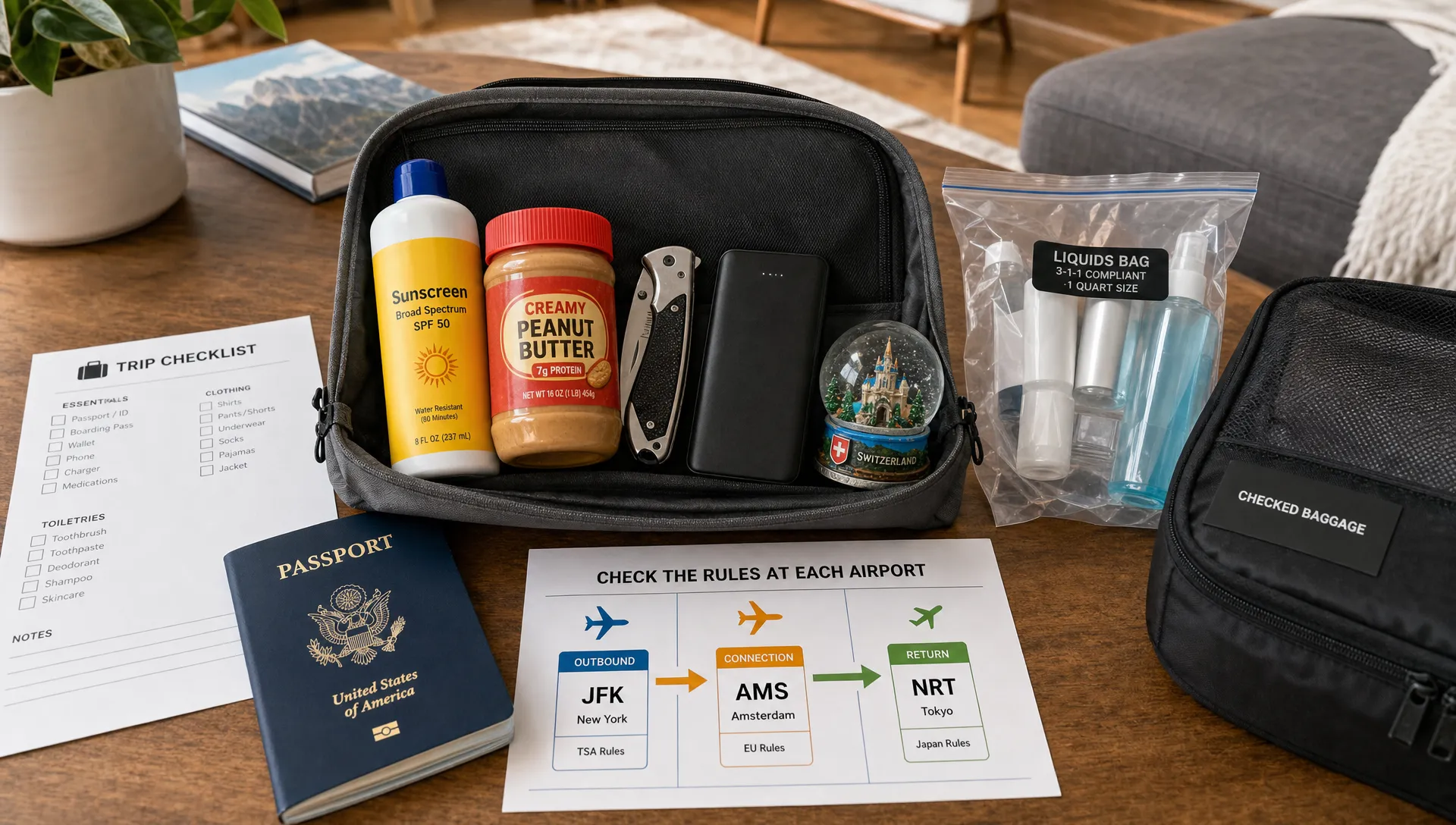
Airport security is not only checking whether an item is legal to own or useful for travel. It is checking whether that item is safe in the cabin, allowed at that specific checkpoint, packed correctly, and acceptable for the next airport on your trip.
That is why travelers still lose items they thought were fine: a full-size sunscreen, a pocketknife on a keychain, a jar of peanut butter, a power bank with no watt-hour label, or a souvenir snow globe bought before a connecting flight. Many of these are airport allowed items in some situations, but not in every bag, airport, or route.
This guide explains what security commonly rejects, why it happens, and how to pack so you are less likely to watch something get binned at the checkpoint.
Why airport allowed items still get rejected
The phrase airport allowed items can be misleading because most rules are conditional. An item may be allowed in checked baggage but not in carry-on. It may be allowed in the cabin only below a size limit. It may be accepted in one country and rejected in another. It may even be allowed by security but blocked later by airline safety rules, customs restrictions, or local airport procedures.
Official security sites reflect this conditional approach. The TSA, for example, maintains a searchable What Can I Bring? database, but it still notes that final decisions can rest with officers at the checkpoint. The UK government also separates hand luggage restrictions from hold luggage rules in its hand luggage guidance, which is a useful reminder that the bag you choose matters.
There is also a route problem. You might depart from an airport with one liquid policy, connect through a stricter airport, and return from somewhere else entirely. For a wider look at how security, airlines, aviation safety, and customs overlap, see Liquid Limits’ guide to airport rules that affect what you can pack.
In practice, checkpoint rejection usually comes down to one of five questions:
- Is it a liquid, gel, aerosol, paste, cream, or spread above the cabin limit?
- Could it cut, puncture, strike, restrain, ignite, explode, or release pressure?
- Is it packed in the correct bag, carry-on or checked?
- Does it need documentation, declaration, or separate screening?
- Is the rule different at the next airport on the itinerary?
What security commonly rejects
The table below covers the items most likely to cause problems at airport security. It is not a substitute for checking your airport and airline rules, but it shows the patterns behind most confiscations.
| Item type | Why it gets rejected | Safer packing choice |
|---|---|---|
| Full-size toiletries | Container exceeds the cabin liquid limit | Use travel-size containers or pack in checked baggage |
| Creams, gels, pastes, and sprays | Treated like liquids even when not pourable | Pack small containers and keep them accessible |
| Sauces, spreads, yogurt, and dips | Food texture counts as liquid-like | Put larger amounts in checked baggage |
| Pocketknives and multi-tools | Blades or sharp edges are not cabin-safe | Pack in checked baggage if permitted |
| Large tools | Could be used as impact or puncture objects | Check airline and airport rules, then pack hold luggage |
| Sports bats, clubs, and poles | Considered striking items | Pack as checked or sports baggage |
| Fuel, lighter fluid, and camping gas | Fire and explosion risk | Do not pack unless explicitly permitted |
| Oversized or unlabeled batteries | Fire safety and watt-hour concerns | Carry compliant spare lithium batteries in cabin packaging |
| Self-defense sprays and stun devices | Weapon restrictions vary widely | Leave at home unless rules clearly allow transport |
| Duty-free liquids before a transfer | Tamper bag or connection rules may fail | Confirm transfer airport rules before buying |
Liquids, gels, aerosols, creams, and pastes
Liquids are the most common reason airport security rejects otherwise ordinary travel items. Shampoo, sunscreen, toothpaste, face cream, mascara, perfume, hair gel, shaving foam, liquid makeup, and aerosol deodorant can all be treated under liquid rules.
At many airports, the familiar cabin rule is that containers must be 100 ml or 3.4 oz or smaller and fit within the permitted clear bag. Some airports use newer scanners and may apply different limits, but travelers should not assume a relaxed rule applies across the whole trip. If your return airport or connection still applies the stricter rule, that is the rule that matters for what you can keep.
The most common mistake is focusing on how much product is left rather than container size. A 200 ml bottle with only a small amount inside can still be rejected because the container itself exceeds the limit. Another common mistake is forgetting that pastes and semi-solid products are often treated like liquids. Peanut butter, hummus, soft cheese, jam, honey, and cosmetic balms may all be flagged.
If your main concern is toiletries and liquid-like products, this related guide explains airport security liquid limits for common items in more detail.
Food and drink that look harmless but fail screening
Solid snacks are usually less complicated than liquids, but food still causes problems. Security commonly rejects or inspects foods that can be poured, spread, squeezed, sprayed, or smeared. The texture matters more than the category.
A sandwich is normally easier than a tub of sauce. A sealed chocolate bar is easier than a jar of chocolate spread. Dry coffee or tea is usually easier than a bottled drink. Protein powder, spices, and other powders can be allowed, but they may need extra screening, especially when packed in large quantities or unlabeled containers.
International travel adds another layer. Even if security allows a food item through, customs or agriculture rules at arrival may restrict meat, dairy, fruit, seeds, plants, or fresh produce. Security approval is not the same as permission to import food.
Sharp objects, tools, and everyday blades
Small sharp objects are another common source of confusion because rules vary by country and item design. Travelers are often surprised when security rejects a tiny knife, a box cutter, a razor blade, craft scissors, corkscrew with blade, or multi-tool. These items can seem practical rather than dangerous, but in a cabin security context, sharp edges are treated conservatively.
Some scissors, razors, nail clippers, and grooming tools may be allowed depending on blade length, style, and local rules. But if you do not need the item during the flight, checked baggage is usually the safer choice. For multi-tools, the blade is often the problem. A tool that would be allowed without a knife can be rejected because one small fold-out blade changes the security category.
Tools also deserve attention. Screwdrivers, wrenches, pliers, drills, saws, and hammers may be rejected in carry-on because they can be used to puncture, pry, or strike. Size limits differ, and powered tools often raise extra questions because of batteries.
Batteries, power banks, and electronics accessories
Battery rules are less visible than liquid rules, but they matter. Lithium batteries can pose a fire risk if damaged, short-circuited, counterfeit, or packed incorrectly. For that reason, spare lithium batteries and power banks are generally expected to travel in carry-on baggage rather than checked baggage, with terminals protected from short circuit.
The FAA lithium battery guidance explains common U.S. limits, including watt-hour thresholds and airline approval requirements for larger batteries. Other authorities and airlines may apply their own procedures, so travelers carrying camera batteries, drone batteries, e-bike batteries, medical device batteries, or large power stations should check before packing.
Security may question a battery if it is swollen, damaged, homemade, unlabeled, unusually large, or packed loosely with metal objects. A power bank without clear capacity markings can be a problem because screeners and airline staff may not be able to verify whether it is within the permitted limit.
Sports, outdoor, and hobby gear
Sports and outdoor gear is often rejected because it looks like normal vacation equipment to the traveler but like a striking, piercing, or hazardous item to security. Baseball bats, golf clubs, hockey sticks, martial arts gear, ski poles, tent stakes, trekking poles, fishing hooks, ice axes, and climbing equipment can be restricted in the cabin.
Camping gear needs extra care. Empty water bottles are usually easy to carry through and refill after security, but fuel containers, camping gas, fire starters, lighter fluid, and some stove components are high-risk. Even if a fuel bottle is empty, odor or residue can cause rejection because flammable vapors may remain.
Hobby items can also be tricky. Craft knives, resin, solvents, paints, glues, blades, needles, and specialty tools may be restricted by liquid, sharp object, or hazardous material rules. If the item is expensive or hard to replace, do not guess at the checkpoint. Check airport, airline, and destination rules before you go.
Medicines, baby items, and accessibility supplies
Security rules usually provide exceptions for medically necessary liquids, baby milk, formula, baby food, and certain accessibility-related items. But exception does not mean no screening. These items may need to be declared, separated, tested, or verified.
Prescription medicines are often best kept in carry-on baggage because you may need them during travel and checked bags can be delayed. Keep them in original packaging when possible, and bring documentation for items that may look unusual, require syringes, need cooling packs, or exceed standard liquid limits. Rules differ by country, and some medicines that are legal in one place may be controlled in another.
Baby supplies are commonly allowed in reasonable travel quantities, but the exact process varies. Security may ask to inspect bottles, pouches, jars, or cooling accessories. Pack these items where you can remove them quickly, and leave extra time if you are traveling with infants, medical liquids, or assistive equipment.
Duty-free purchases and connecting flights
Duty-free liquids can be a trap. A bottle of perfume, cosmetics, wine, or spirits bought after security may be fine for a nonstop flight, but not always for a connection. If you pass through another security checkpoint, the item may need to be sealed in an approved tamper-evident bag with proof of purchase. Even then, acceptance can depend on the transfer airport and local procedure.
The safest approach is to check the rules for every security checkpoint on your itinerary before buying liquid duty-free items. This matters most for international connections and return flights, where the airport you depart from may not follow the same rule as the airport where you bought the item.
Carry-on or checked baggage: where common problem items belong
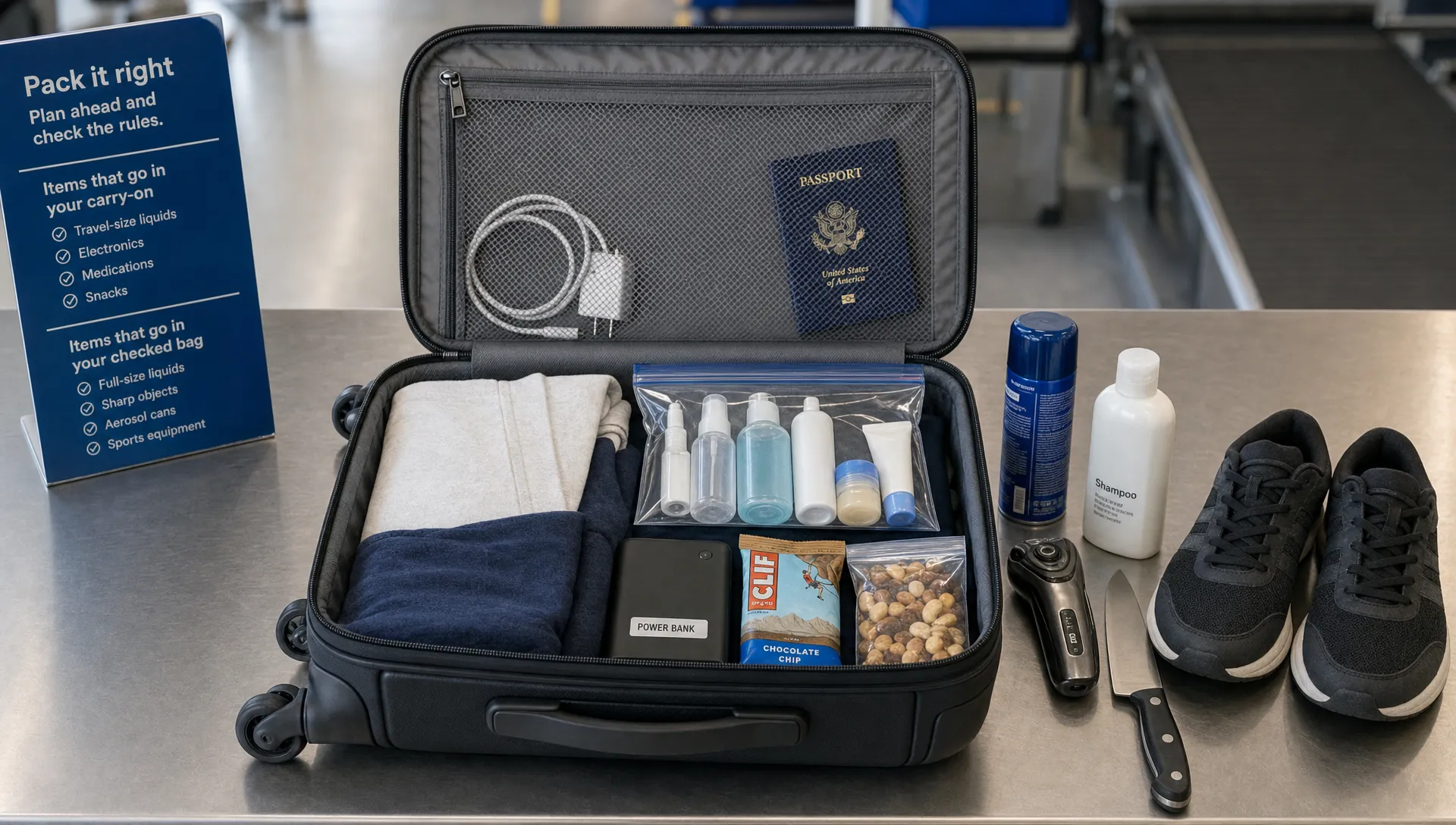
Some rejected items are not banned from flying altogether. They are simply in the wrong bag. This is where many travelers can avoid problems by deciding early what must stay with them and what should go in checked luggage.
| Item | Carry-on risk | Checked baggage consideration |
|---|---|---|
| Full-size shampoo or sunscreen | Usually rejected if over the cabin liquid limit | Often acceptable if sealed against leaks |
| Pocketknife | Commonly rejected | Often allowed, but check local and airline rules |
| Power bank | Usually belongs in carry-on if compliant | Often not allowed in checked baggage as a spare battery |
| Wine or spirits | Rejected at security unless compliant duty-free rules apply | Subject to airline, alcohol strength, customs, and leakage rules |
| Trekking poles or sports bats | Commonly rejected as cabin items | Usually treated as checked or sports equipment |
| Prescription medicine | Often allowed with screening if necessary | Risky if you need it during travel or your bag is delayed |
| Aerosol deodorant | Must meet liquid and aerosol limits | Airline dangerous goods limits may apply |
When in doubt, do not use checked baggage as a dumping ground for anything questionable. Some items are banned from both cabin and checked baggage, especially explosives, fuels, corrosives, and many flammable materials.
A practical packing method to avoid rejection
The best way to avoid confiscation is to pack by rule type rather than by room of the house. A toiletry bag, snack pouch, medicine kit, and electronics pouch may all contain items with different screening rules.
Use this quick method before you close your bag:
- Separate liquids, gels, aerosols, pastes, creams, and spreadable foods from true solids.
- Check container size, not just how much product is left inside.
- Move sharp tools, blades, and striking items to checked baggage only if rules permit.
- Keep power banks and spare lithium batteries in carry-on baggage with capacity labels visible.
- Pack medicines, baby supplies, and necessary liquids where you can declare them quickly.
- Check the strictest airport on the route, including the return flight and connections.
That last point is especially important. If one airport on your trip applies a 100 ml liquid rule, packing for a more generous airport at the start of the journey may still lead to problems later. Liquid Limits is built around this reality, helping travelers check liquid rules for airports, items, and routes before they pack.
Frequently Asked Questions
What airport allowed items are rejected most often? The most commonly rejected items are oversized liquids, gels, aerosols, pastes, spreadable foods, pocketknives, multi-tools, large tools, sports gear, fuel-related camping items, and non-compliant batteries or power banks.
Can security reject something that an official website says is allowed? Yes. Many official rules are conditional, and checkpoint officers may reject an item if they cannot verify it, if it appears unsafe, or if local procedures are stricter than expected.
Are liquid rules the same at every airport? No. Many airports still use the 100 ml or 3.4 oz cabin container limit, while some airports may have different procedures. Connections and return flights can apply different rules, so check the whole route.
Are power banks allowed through airport security? Power banks are commonly allowed in carry-on baggage when they meet capacity limits and are clearly labeled, but oversized, damaged, unlabeled, or airline-restricted batteries may be rejected.
Should medicine go in carry-on or checked baggage? Essential medicine is usually best kept in carry-on baggage so you can access it during travel and avoid problems if checked luggage is delayed. Bring documentation for unusual, controlled, refrigerated, or liquid medicines.
Do duty-free liquids always pass security? No. Duty-free liquids can fail at a connecting checkpoint if they are not sealed correctly, lack proof of purchase, exceed local limits, or are not accepted by the transfer airport.
Check before security makes the decision for you
Most airport security problems are predictable. If an item is liquid-like, sharp, pressurized, flammable, battery-powered, oversized, or only conditionally allowed, it deserves a rule check before it goes in your bag.
For liquids in particular, Liquid Limits helps you compare airport rules for your trip, including return flights where restrictions may differ. It provides airport, item, and route checks with verified source links, last-checked dates, and a stricter 100 ml fallback when rules are unclear.
Before you pack the full-size sunscreen, sauce jar, duty-free bottle, or specialty toiletry, check your route on Liquid Limits and pack for the strictest checkpoint you will face.