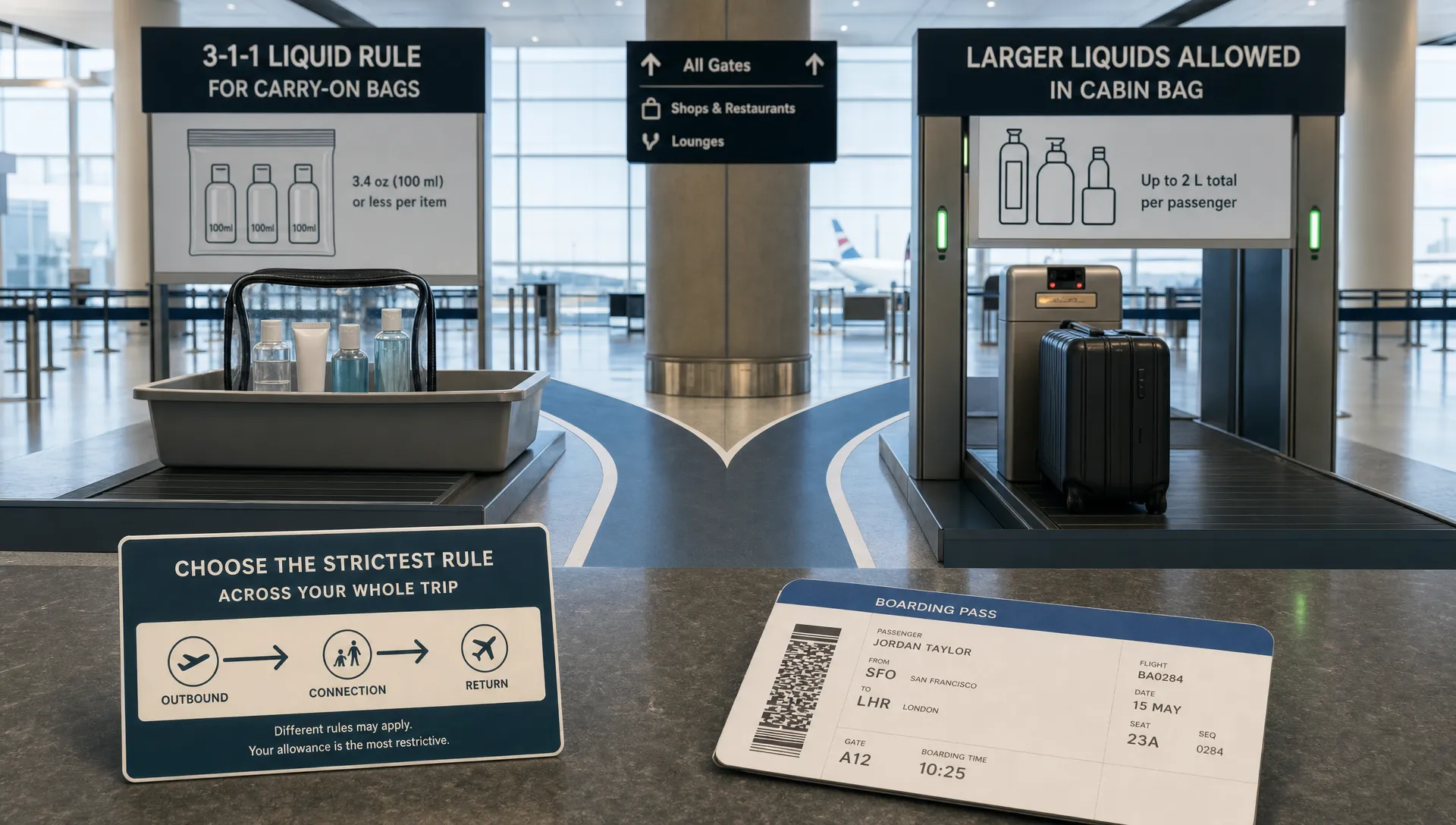
Airport hand luggage liquids in 2026 are not difficult because the basic rule changed overnight. They are difficult because the rules are no longer uniform. One airport may still apply the familiar 100ml container limit, another may use newer scanners with a larger allowance, and your return airport may follow a different policy from your departure airport.
The safest mindset is simple: the strictest security checkpoint on your trip decides what you can realistically pack in your cabin bag. That means you need to think beyond your airline and beyond your first flight, especially if you have a connection or are flying home from a different airport.
This guide gives you the practical version of the 2026 rules, what counts as a liquid, when exemptions apply, and how to pack so you do not lose toiletries, medicine, baby items, or duty-free purchases at security.
The 2026 rule in one sentence
Pack every non-exempt liquid, gel, cream, paste, aerosol, and spreadable item in containers of 100ml or less, place them in a clear resealable bag where required, and only rely on a larger allowance when your exact departure, transfer, and return airports confirm it.
That last part matters. In 2026, some airports publish different rules because of newer cabin baggage screening technology. But scanner rollouts can be terminal specific, paused, reversed, or limited by national rules. If one airport on your route still requires 100ml containers, you should pack for 100ml.
| Travel situation | Best 2026 packing decision |
|---|---|
| You are unsure which rule applies | Use 100ml containers and a clear resealable bag |
| Your outbound airport allows larger liquids | Check the return and any transfer airport before relying on it |
| You have a connection and must pass security again | Follow the strictest airport on the route |
| You are carrying medicine or baby items | Keep them separate and be ready for extra screening |
| You are buying duty-free liquids | Keep them sealed with the receipt and check transfer rules |
A key detail travelers still miss: the 100ml limit is usually based on container size, not how much liquid is left inside. A half-empty 200ml shampoo bottle can still be refused because the bottle itself is over the limit.
What counts as a liquid in hand luggage?
Airport security uses a broad definition. It is not just water, perfume, or shampoo. If an item can pour, spray, squeeze, smear, spread, or form a gel, it may be treated as a liquid for cabin baggage screening.
For a more item-focused breakdown, Liquid Limits has a separate guide to airport security liquid limits for common items, but the quick version is below.
| Item type | Common examples | Usually treated as a liquid? |
|---|---|---|
| Toiletries | Shampoo, conditioner, shower gel, toothpaste, lotion | Yes |
| Makeup | Mascara, liquid foundation, lip gloss, cream blush | Yes |
| Aerosols | Deodorant spray, hairspray, shaving foam | Yes, and aerosol rules may also apply |
| Food | Yogurt, jam, honey, peanut butter, sauces | Usually yes |
| Health items | Contact lens solution, liquid medicine, gels | Yes, with possible exemptions |
| Solids | Bar soap, solid deodorant, powder makeup | Usually no |
If you are deciding between two versions of the same item, the solid version is usually easier. A shampoo bar, stick deodorant, solid balm, or powder product can remove several items from your liquids bag.
The 100ml rule is still the safest global default
The familiar rule is still widely used in 2026: liquids in cabin baggage must be in containers of 100ml or less, often inside a single clear resealable plastic bag. The exact bag size and screening process can vary by country.
In the United States, the Transportation Security Administration describes this as the 3-1-1 liquids rule: containers of 3.4 ounces or 100ml or less, placed in one quart-sized bag, with one bag per passenger. Medically necessary liquids can be allowed in larger quantities, but they must be declared for screening.
In the United Kingdom, the government provides official hand luggage restrictions covering liquids, containers, and exceptions. UK rules have also been affected by scanner changes and temporary policy updates, which is exactly why checking the airport before travel is so important.
The important lesson is not that every country has identical wording. It is that 100ml remains the lowest-risk cabin packing standard across many international trips.
New scanners do not mean every airport allows 2 liters
Newer CT and C3 cabin baggage scanners can inspect bags in more detail than older X-ray systems. At some airports, that technology may allow travelers to keep liquids inside their bags or carry containers larger than 100ml. Some airports and national authorities have discussed or applied higher liquid allowances, often up to 2 liters.
But in real travel, the practical situation is mixed. A larger allowance may apply only in specific terminals, only after a full rollout, only for certain lanes, or only until a regulator changes the rule. Security staff will apply the rule in force at that checkpoint on that day.
| Common assumption | 2026 reality |
|---|---|
| All airports now allow 2 liters | False. Many still enforce 100ml |
| If my outbound airport allows it, my return airport will too | False. Return rules can be different |
| My airline decides the liquid rule | Usually false. Airport security and national rules matter more |
| A 250ml bottle is fine if it contains less than 100ml | Usually false. Container size matters |
| Duty-free liquids are always safe through connections | Not always. Transfer screening can still be a problem |
If you want the broader policy context, the Liquid Limits guide to airport liquid limits for carry-ons in 2026 explains how standard 100ml rules compare with newer scanner-based policies.
Why your route matters more than your first airport
Many travelers check the departure airport and stop there. That is where mistakes happen. Airport hand luggage liquids can be affected by every security checkpoint you pass through, not just the first one.
A direct round trip can still involve two different rules: one for the outbound airport and one for the return airport. A connecting trip can be more complicated if you leave the secure area, collect and recheck bags, transfer between terminals, or travel on separate tickets. In those cases, you may need to pass through security again with the liquids you bought or carried from the first flight.
The route-first approach is simple. Check your departure airport, any transfer airport where you might be screened again, and your return airport. If any one of them applies 100ml, pack your cabin liquids as if the whole trip applies 100ml.
This is also where a route-based tool helps. Before you pack, you can use Liquid Limits to check the stricter liquid rule for your whole trip, including the return flight, item-specific guidance, source links, and last checked dates.
A practical packing plan for 2026
The best packing strategy is boring, but it works: prepare for the strictest rule, then treat any larger allowance as a bonus rather than a guarantee.
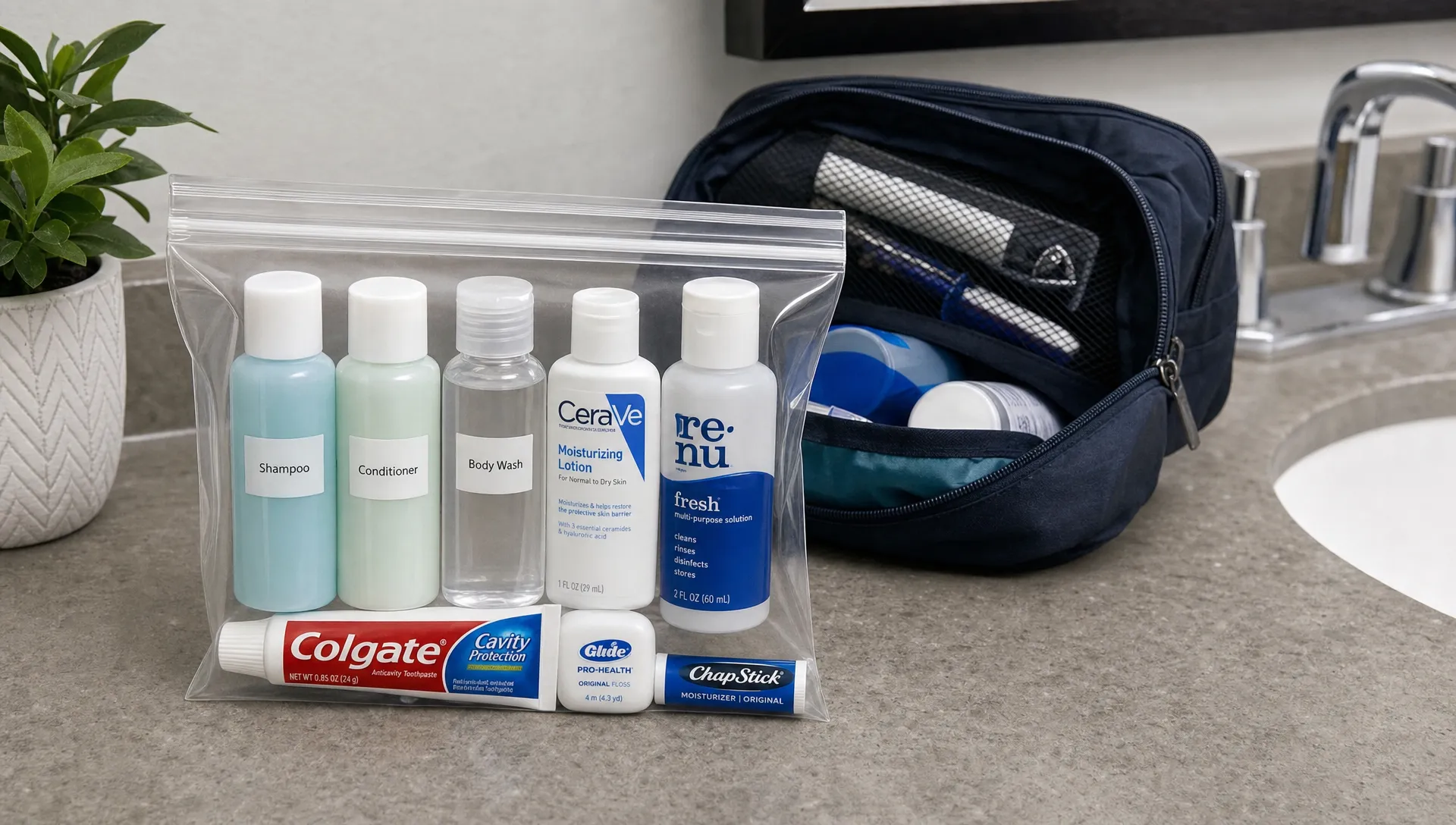
Use containers that are clearly marked 100ml or less. If you decant products into reusable travel bottles, choose bottles with visible capacity labels. Security officers need to assess the container quickly, and an unmarked bottle can create delays even if it is small.
Keep your liquids accessible. Even at airports where you no longer need to remove liquids from your bag, another airport on the same trip may still require it. A clear bag near the top of your cabin bag can save time and prevent repacking at the tray area.
Consider replacing liquids with solids where possible. Solid shampoo, bar soap, stick deodorant, toothpaste tablets, powder dry shampoo, and balm-style products can reduce your liquid load. This is especially useful for long trips where a small 100ml allowance feels restrictive.
Put full-size products in checked baggage when allowed and when you do not need them during the flight. Wrap caps, use leakproof pouches, and remember that some items, especially aerosols, flammables, and chemicals, may have separate dangerous goods restrictions even in checked baggage.
Medicines, baby food, and other exemptions
Most liquid rules include exemptions for essential items, but exemptions are not the same as unlimited permission. These items may be allowed above 100ml, but they can be inspected separately, tested, or questioned by security staff.
Medicines and medical liquids are commonly allowed in reasonable quantities when needed for the journey. This can include liquid medication, gels, cooling packs, sprays, and medical nutrition. Keep them separate from your regular toiletries and carry prescriptions, labels, or supporting documentation where possible.
Baby milk, formula, breast milk, sterilized water, and baby food are often allowed above the standard liquid limit when traveling with a baby or young child. Security may ask to screen the items separately. Rules vary by country, so check your exact airport if you are carrying larger quantities.
Special dietary liquids may be allowed when medically necessary, but do not assume that ordinary drinks, protein shakes, or meal replacements will qualify. If the item is not medically necessary, it is safer to buy it after security or pack it in checked baggage.
Contact lens solution is easy to forget. It is a liquid. If you do not need a larger bottle for medical reasons, use a 100ml travel-size bottle or pack the larger bottle in checked baggage.
Duty-free liquids need extra care on connecting flights
Duty-free perfume, alcohol, cosmetics, and creams can create confusion because they are bought after security. On a simple direct flight, they are usually easier to carry. On a connecting journey, they can become a problem if you pass through security again.
Many airports use secure tamper-evident bags for duty-free liquids. Keep the item sealed inside that bag, keep the receipt visible, and do not open the bag before your final destination. If you leave the airport, transfer on separate tickets, or need to clear security again, the next checkpoint may apply its own rules.
The safest duty-free approach is to check the full route before buying large liquids. If your connection or return airport enforces 100ml and you must be rescreened, a full-size bottle may be refused unless local transfer rules protect it.
Cabin bag or checked bag: where should liquids go?
Not every liquid belongs in hand luggage. If you do not need it during the journey and it is allowed in checked baggage, checking it can simplify security. But checked baggage is not a loophole for hazardous products.
| Item | Cabin bag approach | Checked bag approach |
|---|---|---|
| Shampoo and toiletries | Use 100ml containers unless larger rule is confirmed | Usually easier for full-size bottles |
| Perfume | Use 100ml or less, or duty-free rules if bought airside | Pack carefully to prevent leaks and breakage |
| Sunscreen | Travel size for cabin, especially beach arrivals | Full-size bottle is often better checked |
| Liquid medicine | Keep in cabin if needed during travel | Avoid checking essential medicine if possible |
| Baby milk or food | Carry what is needed and expect screening | Extra supplies may go checked if practical |
| Aerosols | Must follow liquid and aerosol safety rules | Check airline and dangerous goods restrictions |
For essentials, cabin baggage is usually better. For convenience items, checked baggage may be easier. For restricted or hazardous items, check the airline and airport guidance before packing at all.
Pre-flight checklist for airport hand luggage liquids
Use this checklist before every trip in 2026, especially if you are traveling internationally or connecting through a major hub.
| What to check | Why it matters |
|---|---|
| Departure airport liquid rule | This is your first security checkpoint |
| Transfer airport rules | You may be screened again during a connection |
| Return airport rule | The return flight can have stricter limits |
| Item-specific status | Some foods, cosmetics, and gels surprise travelers |
| Exemption documents | Medicine and baby items may need separate screening |
| Duty-free transfer rules | Large purchases can fail at a later checkpoint |
| Last checked date | Liquid rules can change with scanner rollouts and policy updates |
If you cannot verify a larger allowance from a current airport or government source, pack as if the 100ml rule applies. It is not the most exciting advice, but it is the advice most likely to get your bag through security without losing anything.
Frequently Asked Questions
How many 100ml bottles can I take in hand luggage? It depends on the airport's bag rule, but the usual limit is not a fixed number of bottles. The containers must be 100ml or less and must fit inside the required clear resealable bag when that bag rule applies.
Can I bring a 200ml bottle if it is half empty? Usually no. Security normally looks at the container capacity, not the amount left inside. A 200ml bottle can be refused even if it contains less than 100ml.
Do liquid rules apply to domestic flights? Yes, if you pass through airport security. Domestic and international flights can both be subject to cabin baggage liquid restrictions, although the exact rules depend on the country and airport.
Are makeup and toiletries counted as liquids? Many are. Mascara, liquid foundation, lip gloss, creams, gels, sprays, toothpaste, and lotions are commonly treated as liquids. Powder makeup, solid deodorant, and bar soap are usually easier to pack.
What if my airport says larger liquids are allowed but my connection does not? Pack for the stricter airport if you will pass through security again. A larger bottle allowed at your first airport may still be refused at a later checkpoint.
Should I trust my airline's liquid rules page? Use it as a starting point, but confirm with airport or government security guidance. Airlines control baggage size and weight policies, while airport security rules often determine what liquids can pass through screening.
Check your liquid rules before you pack
In 2026, the safest way to manage airport hand luggage liquids is to check the exact trip, not just the general rule. Your outbound airport, return airport, connection, item type, and scanner status can all affect what is allowed.
Liquid Limits helps travelers check airport liquid rules before flying, with route checks, airport lookups, item-specific guidance, verified source links, daily updates, and last checked dates. When a rule is unclear, it defaults to the stricter 100ml guidance so you can pack with fewer surprises.