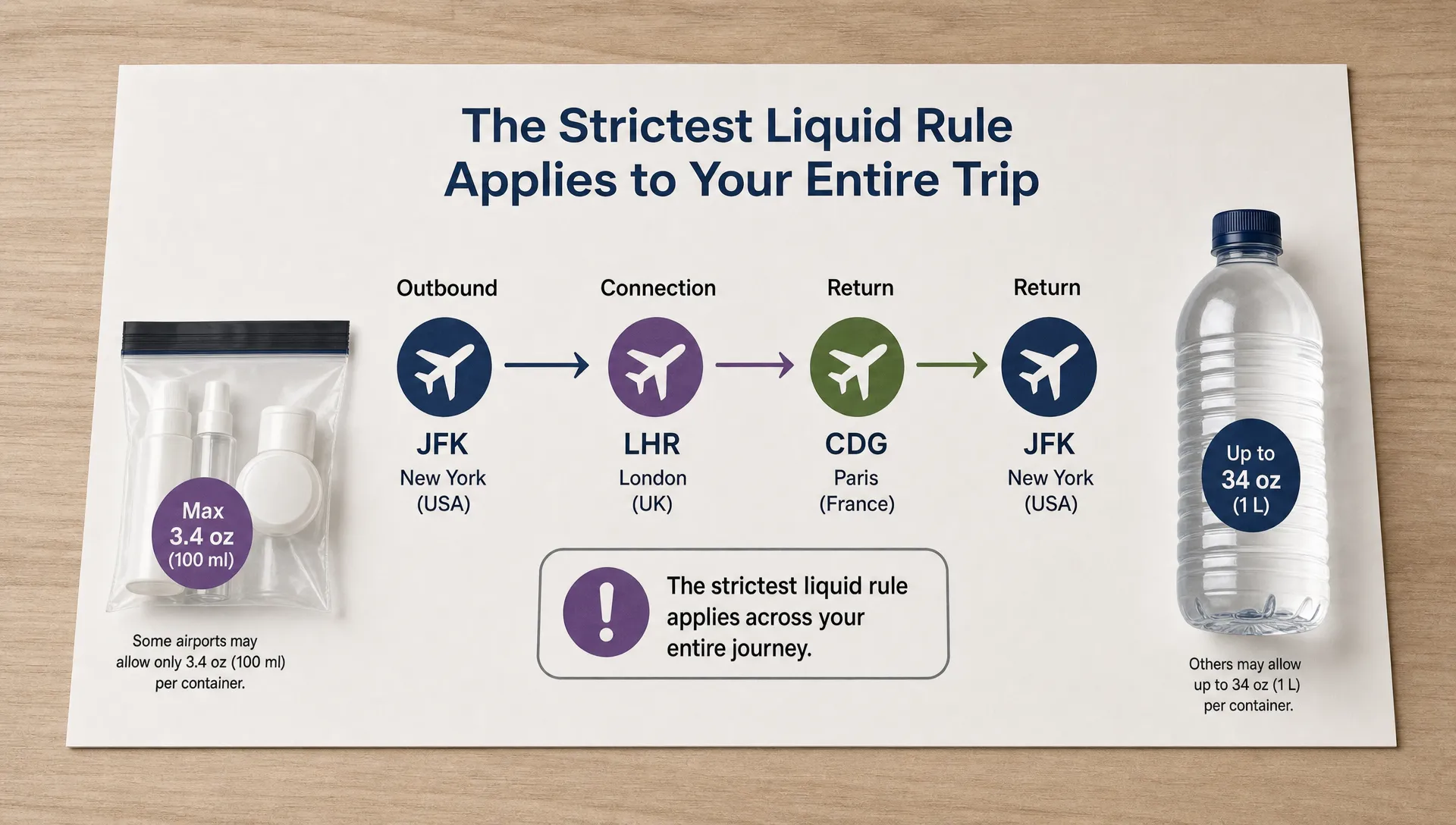
Packing for airport security gets much easier when you separate your bag into three groups: items security usually allows, items that need special packing and items that belong in checked baggage or should stay home. If your real question is, what can I take through airport security, the answer depends on the item, the airport and sometimes the exact checkpoint you use.
The biggest source of trouble is not always an obviously banned item. It is often a normal travel item packed in the wrong size, the wrong bag or the wrong form. A full-size shampoo, a jar of peanut butter, a large snow globe or a power bank in checked luggage can slow you down or lead to confiscation.
This airport security packing list focuses on what can go through screening in cabin baggage. It also flags items that may be allowed only with limits, exceptions or local rules.
The quick airport security packing list
Use this as a first pass before you pack. Security officers make the final decision at the checkpoint, and rules vary by country, but this covers the patterns most travelers run into.
| Item category | Usually okay through screening | Main thing to check | Safer packing choice |
|---|---|---|---|
| Toiletries | Travel-size liquids, solid toiletries, disposable razors | Liquid size limits, razor blade type | Put liquids in a clear bag, pack loose blades in checked baggage |
| Food | Solid snacks, sandwiches, fruit for domestic trips | Creamy, spreadable or gel foods may count as liquids | Pack sauces, jars and spreads in checked baggage |
| Drinks | Empty reusable bottle | Filled bottles are usually not allowed through standard screening | Fill after security |
| Medication | Pills, inhalers, medically necessary liquids | Screening exceptions and local documentation expectations | Keep in cabin baggage and easy to remove |
| Baby items | Formula, breast milk, baby food and cooling packs | Extra screening may apply | Keep together and declare if asked |
| Electronics | Phones, tablets, laptops, cameras and chargers | Whether laptops must come out at that airport | Keep large electronics easy to access |
| Batteries | Installed batteries and spare lithium batteries in cabin baggage | Watt-hour limits, terminals protected | Keep power banks in carry-on, not checked baggage |
| Sharp items | Nail clippers and some small scissors in some airports | Blade length and local security rules | Pack anything sharp in checked baggage if unsure |
| Sports gear | Some balls, helmets and small accessories | Clubs, bats, poles, stakes and blades | Check bulky or club-like items |
| Duty-free liquids | Sealed duty-free liquids in approved security bags on some routes | Connections, receipts and tamper-evident packaging | Confirm before connecting or returning |
This table is a guide, not a guarantee. U.S. travelers can search the TSA What Can I Bring database, but international trips add another layer because the return airport may apply a different liquid rule than your departure airport.
Liquids, gels, creams and aerosols
Liquids are the category most likely to create confusion because airport security does not only mean water, perfume and shampoo. Creams, gels, pastes, sprays, foams, lotions, mascara, lip gloss, soft cheese, jam and similar textures can all be treated as liquids or liquid-like items.
In many standard checkpoints, cabin liquids must be in containers of 100 ml or 3.4 ounces or less and fit inside a small clear bag. The TSA liquids rule describes this as the 3-1-1 rule in the United States. Other countries often use a similar 100 ml container limit, but bag size, scanner procedures and exceptions can differ.
Some airports use newer scanners and may allow larger liquids, sometimes with limits such as 2 liters. Do not assume that applies to your whole trip. A connection, return flight or different terminal can put you back under the stricter 100 ml rule. If you want a route-specific answer, Liquid Limits can help you check the strictest liquid rule for your trip before you pack.
A useful test is simple: if the item can be poured, sprayed, spread, smeared, squeezed or scooped, treat it as a liquid unless your airport clearly says otherwise. For more examples, the Liquid Limits guide to common items airport security treats as liquids is a good companion to this broader packing list.
Toiletries and personal care items
Most toiletries can go through airport security if they are packed in the right form. Solid toiletries are often the easiest option because they avoid liquid limits. Solid deodorant, bar soap, solid shampoo, toothpaste tablets and solid perfume usually create fewer issues than gels, creams and sprays.
The tricky part is that familiar bathroom items may fall into different rule categories. A stick deodorant is not treated the same way as an aerosol deodorant. A disposable razor is usually treated differently from loose razor blades. Nail scissors can be fine in one country and questioned in another.
| Toiletry item | Carry-on screening guidance | Packing tip |
|---|---|---|
| Shampoo, conditioner and shower gel | Must follow the applicable liquid limit at standard checkpoints | Use travel-size containers or solid bars |
| Toothpaste | Usually treated as a paste or gel | Keep it with other liquids if under the size limit |
| Deodorant | Solid sticks are usually easier, gels and aerosols may count as liquids | Choose solid for the least friction |
| Makeup | Mascara, liquid foundation and lip gloss often count as liquids | Powder makeup is usually simpler |
| Razors | Disposable razors are commonly allowed, loose blades are not | Put loose blades in checked baggage |
| Nail clippers | Commonly allowed but may still be inspected | Avoid sharp specialty tools in cabin baggage |
| Perfume and cologne | Liquid rule applies | Check bottle size, not just remaining amount |
Container size matters. A 150 ml bottle with only 50 ml left can still be rejected at many airports because the container is larger than the limit. If you are flying through a strict 100 ml checkpoint, transfer the product into a compliant container or pack it in checked baggage.
Food and drinks
Solid food usually goes through airport security without much trouble. Sandwiches, crackers, chocolate bars, cookies, dry snacks and many baked goods are common carry-on items. Security concerns start when the food behaves like a liquid, gel or paste.
Peanut butter, hummus, yogurt, salsa, honey, jam, soft cheese, soup and sauces are often treated as liquids. That means they may need to meet the same cabin liquid size limit as toiletries. If you bought a large jar as a gift, checked baggage is usually the safer place for it.
Drinks are simpler. A full bottle of water, soda, juice or coffee is usually not allowed through standard screening unless it fits a medical or baby exception. Bring an empty bottle and fill it after security. Frozen items can be complicated because they may be allowed only if completely frozen when screened, and partially melted items can be treated as liquids.
International food rules are separate from airport security. You might get a snack through screening and still be unable to bring it into another country because of customs or agriculture rules. Fresh fruit, meat, dairy and seeds deserve extra caution on international trips.
Medication, medical devices and accessibility items
Medication should usually stay in your cabin bag, not your checked bag. Checked luggage can be delayed, lost or exposed to temperatures that are bad for some medicines. Pills, capsules and tablets are usually straightforward at screening, but liquid medication, injectable medication and cooling supplies may need extra attention.
Many security systems allow medically necessary liquids above the normal cabin liquid limit, but you may need to present them separately and allow extra screening. Keep labels visible where possible, bring prescriptions or a doctor note for controlled medication and check local rules for international travel.
Medical devices such as inhalers, CPAP machines, glucose monitors, insulin pumps and mobility aids can go through screening, though procedures vary. If an item cannot go through an X-ray machine or needs special handling, tell security staff before screening starts.
Baby formula, breast milk, toddler drinks, baby food and cooling packs often have exceptions, but they may be tested or inspected. Pack these items together so you can show them quickly instead of searching through your bag while the line waits.
Electronics, chargers and batteries
Phones, tablets, laptops, cameras, headphones, gaming devices and chargers can usually go through airport security. The question is how they must be screened. Some airports still ask travelers to remove laptops and large electronics from bags. Others use scanners that allow electronics to stay inside. Follow the instructions at the checkpoint, even if your last airport handled it differently.
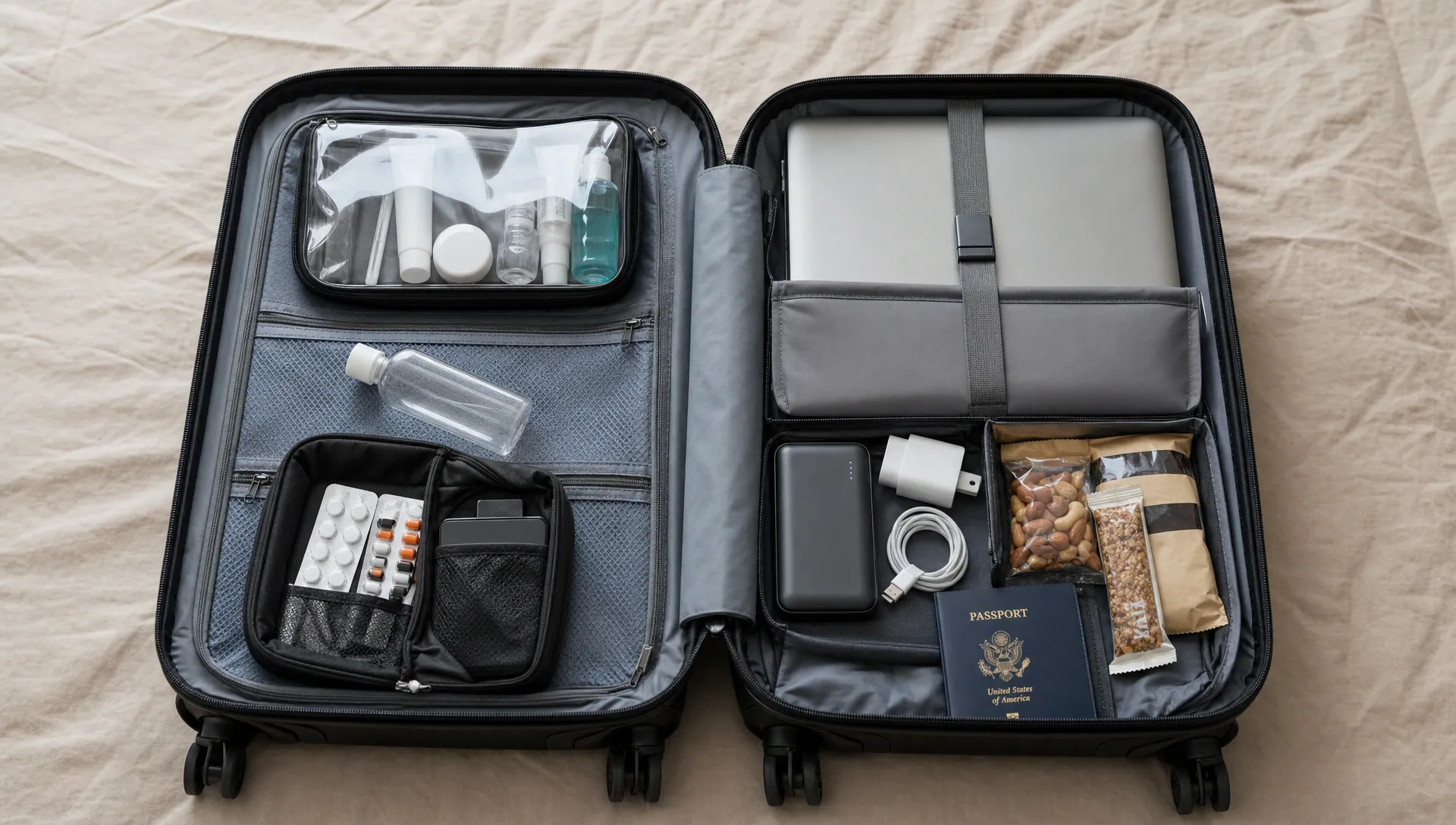
Lithium batteries deserve special attention because they are a flight safety issue, not just a checkpoint convenience issue. Power banks, spare lithium batteries and battery charging cases should generally travel in cabin baggage. Loose spare batteries should have terminals protected so they cannot short-circuit. The FAA PackSafe guidance is a useful reference for U.S. rules on batteries, aerosols and other hazardous materials.
E-cigarettes and vapes are another common packing mistake. They are generally not allowed in checked baggage because of battery fire risk and must not be used or charged on board. Rules on liquids for vape cartridges can also apply, especially when they are carried separately.
Sharp items, tools and household objects
Sharp and tool-like items are where common sense and checkpoint rules do not always match. A small pair of scissors may be allowed under one system but rejected under another. A corkscrew without a blade may be treated differently from a corkscrew with a small knife. A multi-tool may be rejected because it includes a blade, even if you only wanted the screwdriver.
If an item can cut, stab, puncture or be used as a weapon, pack it in checked baggage unless you have confirmed it is allowed in cabin baggage for every airport on your trip.
| Item | Carry-on advice | Why it gets flagged |
|---|---|---|
| Pocket knife | Do not pack in cabin baggage | Blades are generally not allowed through screening |
| Multi-tool | Avoid in cabin baggage | Hidden blades or sharp edges can trigger rejection |
| Scissors | Small scissors may be allowed in some places | Blade length rules vary |
| Corkscrew | Avoid models with blades in cabin baggage | Blade attachment can make it prohibited |
| Screwdrivers and small tools | Rules vary by length and airport | Tools can be treated as potential weapons |
| Knitting needles and crochet hooks | Often allowed but not guaranteed everywhere | Local discretion and material can matter |
Household chemicals, strong solvents, fuel, paint, fireworks and many compressed gas items are not normal travel items. Some are banned from both cabin and checked baggage. If you are moving, camping or carrying equipment for work, do not assume it can fly just because it fits in a suitcase.
Sports gear, outdoor equipment and souvenirs
Sports equipment is often rejected in cabin baggage because it can be used as a striking weapon. Baseball bats, golf clubs, hockey sticks, cricket bats, lacrosse sticks and similar items belong in checked baggage. Ski poles, hiking poles, tent stakes and fishing rods may also be restricted at security, depending on airport procedures and airline policy.
Camping equipment creates its own problems. Empty water bottles and clean cooking utensils are usually easy. Fuel canisters, lighter fluid and flammable camping chemicals are a different story and may be prohibited entirely. If an item contains fuel or has ever contained fuel, check the rule before you leave for the airport.
Souvenirs can surprise travelers because they are often liquids, sharp objects or realistic replicas. Olive oil, wine, hot sauce, perfume, snow globes and jars of local food are liquid-rule items. Decorative knives, toy weapons and replica firearms can be rejected or create serious delays. Wrapped gifts may be opened for inspection, so leave final wrapping until after you arrive.
Duty-free liquids and connecting flights
Duty-free liquids are not a universal pass through security. Many airports allow larger duty-free liquids only when they are sealed in an approved tamper-evident security bag with the receipt visible. Even then, a connecting airport may inspect or reject the item if the bag is damaged, the receipt is missing or the route does not meet local requirements.
This matters most on trips with connections and return flights. A bottle bought after security at your departure airport may still need to pass another checkpoint during a connection. If that next airport applies stricter cabin liquid rules, your duty-free purchase can become a problem.
The safest approach is to check the liquid rules for the full route, not just the airport where you start. That includes outbound flights, layovers and the return journey.
Remember that airport security is only one rule layer
Airport screening is not the only system that affects what you can pack. Airlines set cabin bag size and weight rules. Aviation safety rules control dangerous goods. Customs and agriculture rules control what you can bring into a country. Local airport procedures determine how screening is actually run that day.
That is why two travelers can pack the same item and have different outcomes. One might be flying domestically with no connection. The other might be connecting internationally through a stricter airport, carrying the same item in a larger container or flying an airline with tighter baggage rules. Liquid Limits covers this broader issue in its guide to airport rules that affect what you can pack.
Before you leave for the airport
A five-minute bag check before you leave home can prevent most security problems. Focus on the items that are hardest to replace and the items most likely to be questioned.
- Put your liquids bag near the top of your carry-on if your airport still requires removal.
- Move full-size toiletries, sauces, jars and bottles to checked baggage or leave them home.
- Keep medication, baby items and medical liquids together so they are easy to present.
- Carry power banks and spare lithium batteries in cabin baggage with terminals protected.
- Empty your water bottle before screening.
- Remove knives, multi-tools, oversized scissors and sharp souvenirs from cabin baggage.
- Keep laptops and large electronics accessible in case the checkpoint asks you to remove them.
- Do not wrap gifts until after arrival if security may need to inspect them.
If you are still unsure about an item, ask two questions. Could this item be treated as a liquid, weapon or hazardous material? Does my return airport or connection apply a stricter rule than my departure airport? If either answer is yes, check before packing it in your cabin bag.
Frequently Asked Questions
What can I take through airport security in my carry-on? You can usually take travel-size liquids, solid toiletries, medication, baby items, electronics, chargers, solid food, empty bottles, documents and normal clothing through airport security. Sharp items, oversized liquids, hazardous materials and weapon-like objects are the main problem categories.
Can I take toiletries through airport security? Yes, most toiletries can go through screening if they follow the liquid rules. Liquids, gels, creams, pastes and aerosols usually need to be in small containers at standard checkpoints. Solid toiletries are often easier.
Can I bring food through airport security? Solid food is usually allowed, but spreadable, creamy, gel-like or saucy foods may count as liquids. A sandwich is usually simpler than a jar of peanut butter or a tub of hummus.
Can medication be over 100 ml at airport security? Medically necessary liquids are often allowed above normal liquid limits, but they may need to be presented separately and screened. Keep labels, prescriptions or medical documentation with you, especially for international travel.
Do power banks go in carry-on or checked baggage? Power banks and spare lithium batteries should generally go in carry-on baggage, not checked baggage. Protect loose battery terminals and check airline or aviation safety limits for larger batteries.
What happens if my return airport has different liquid rules? Pack for the stricter rule unless you can confirm otherwise. A larger liquid allowed on your outbound trip may be rejected on the return if that airport still applies the 100 ml limit.
Check your route before you pack
The safest packing list is the one matched to your actual trip. Before you close your bag, use Liquid Limits to check airport liquid rules for your route, including the return flight. It shows the strictest cabin liquid rule side by side, with verified source links and last-checked dates, so you can pack with fewer surprises at screening.