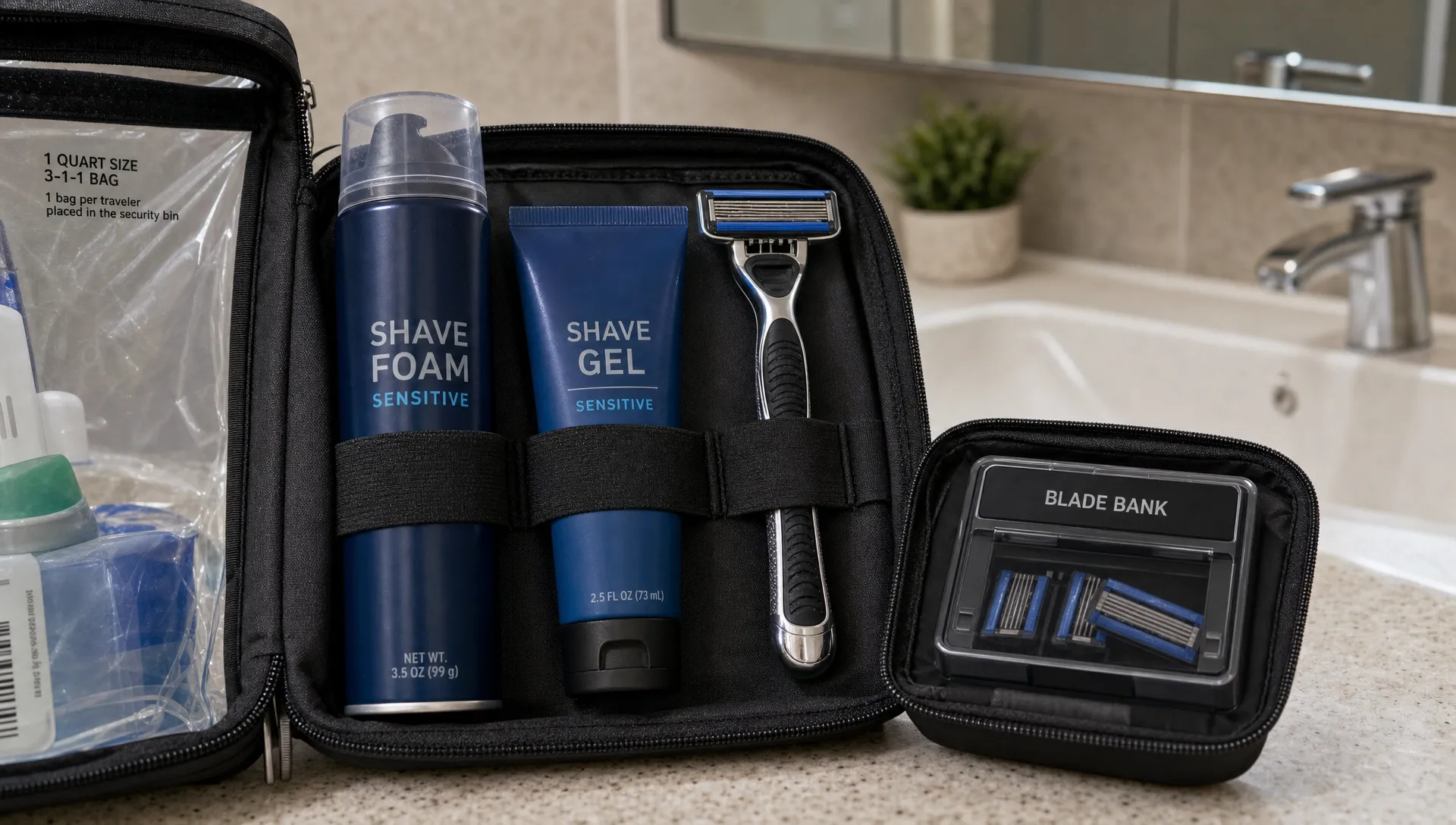
Airport toiletries rules are usually simple once you separate toiletries into three groups: aerosols, razors and gels. Aerosols and gels are treated as liquids or liquid-like items, so cabin size limits matter; razors are treated mainly as sharp objects, so the blade style matters. The confusing part is that airport security rules are not the only layer. Aviation safety, airline policies and return airports can all affect what makes it through without a delay.
If you are packing for one short domestic flight, the standard 100 ml carry-on rule may be enough to guide you. If you have a connection, an international leg or a return flight from a different airport, it is smarter to check the strictest rule across the full trip. Liquid Limits can help you check liquid rules by airport, item and route before you pack, including cases where the return airport follows a different limit.
Quick airport toiletries rules for aerosols, razors and gels
Most screening problems happen because travelers mix up three different rule types: the liquids rule, the sharp objects rule and the dangerous goods rule. A 75 ml aerosol deodorant, a disposable razor and a 90 ml hair gel may all be fine in a carry-on, but each one is allowed for a different reason.
| Toiletry item | Carry-on bag | Checked bag | Main catch |
|---|---|---|---|
| Aerosol deodorant, hairspray, shaving foam | Usually allowed if each container is 100 ml or 3.4 oz or less and fits in your liquids bag | Usually allowed if it is a toiletry aerosol and within dangerous goods limits | Pressurized aerosols have both security and aviation safety rules |
| Disposable razor or cartridge razor | Usually allowed | Allowed | The blade must be fixed in a disposable or cartridge head |
| Safety razor blades or straight razors | Usually not allowed in carry-on bags | Usually allowed | Loose or removable blades are treated as sharp objects |
| Hair gel, shower gel, aloe gel, gel deodorant | Usually allowed if each container is 100 ml or 3.4 oz or less and fits in your liquids bag | Allowed in normal toiletry quantities | Container size counts, not the amount left inside |
For most travelers, airport toiletries rules come down to this: liquids and gels belong in the liquids bag, safe everyday razors can usually stay in your carry-on and larger aerosols are better packed in checked baggage if your airline allows them.
Aerosols: small containers in carry-on, larger ones in checked bags
Aerosols include products that spray from a pressurized can, such as deodorant spray, hairspray, dry shampoo, shaving foam, body spray and some sunscreen sprays. At security, these are normally treated as liquids because the contents are liquid, foam or mist.
The TSA liquids rule limits carry-on liquids, aerosols and gels to containers of 3.4 oz or 100 ml or less, placed in one quart-sized bag. Many countries use a very similar 100 ml container rule, though bag size and inspection procedures can vary.
Carry-on aerosol checklist
With sprays, airport toiletries rules overlap with aviation safety rules: the item needs to pass the checkpoint size limit and it also needs to be a normal toiletry, not a hazardous household or industrial product. A travel-size hairspray is different from spray paint, insecticide or a large butane refill.
Use this quick check before placing aerosols in your cabin bag:
- The printed container size is 100 ml, 3.4 oz or smaller.
- The cap or nozzle is protected so it will not spray accidentally.
- The product is a personal care item, such as deodorant, hairspray or shaving foam.
- It fits in your resealable liquids bag with your other liquids and gels.
- The label is readable enough for a screener to identify the item if needed.
Checked bag aerosol limits
Checked baggage gives you more room, but aerosols are still regulated because pressurized containers can leak, burst or spray accidentally. The FAA PackSafe guidance for aerosols says medicinal and toiletry aerosols are limited to a total of 2 kg or 2 L per person, with each container no larger than 0.5 kg or 500 ml, and release valves must be protected.
That limit is useful even if you are not flying in the United States because many airline dangerous goods policies are based on similar aviation safety principles. Still, airlines and countries can differ, so check before packing multiple full-size spray products.
Razors: the handle is fine, the blade decides the rule
Razors cause confusion because they sit in a toiletry bag but are not toiletries in the liquids sense. Security cares less about the grooming purpose and more about whether the blade can be removed, exposed or used as a sharp object.
Disposable razors and cartridge razors are usually accepted in carry-on bags because the blades are fixed into a plastic head. Electric razors are also usually allowed in hand luggage. A safety razor handle may be allowed if the blade is removed, but loose double-edge blades normally need to go in checked baggage. Straight razors are generally treated like knives and should not be packed in a carry-on.
The UK government’s hand luggage restrictions also distinguish between permitted cartridge-style razors and restricted razor blades, which is a helpful reminder that blade type matters internationally, not just in TSA screening.
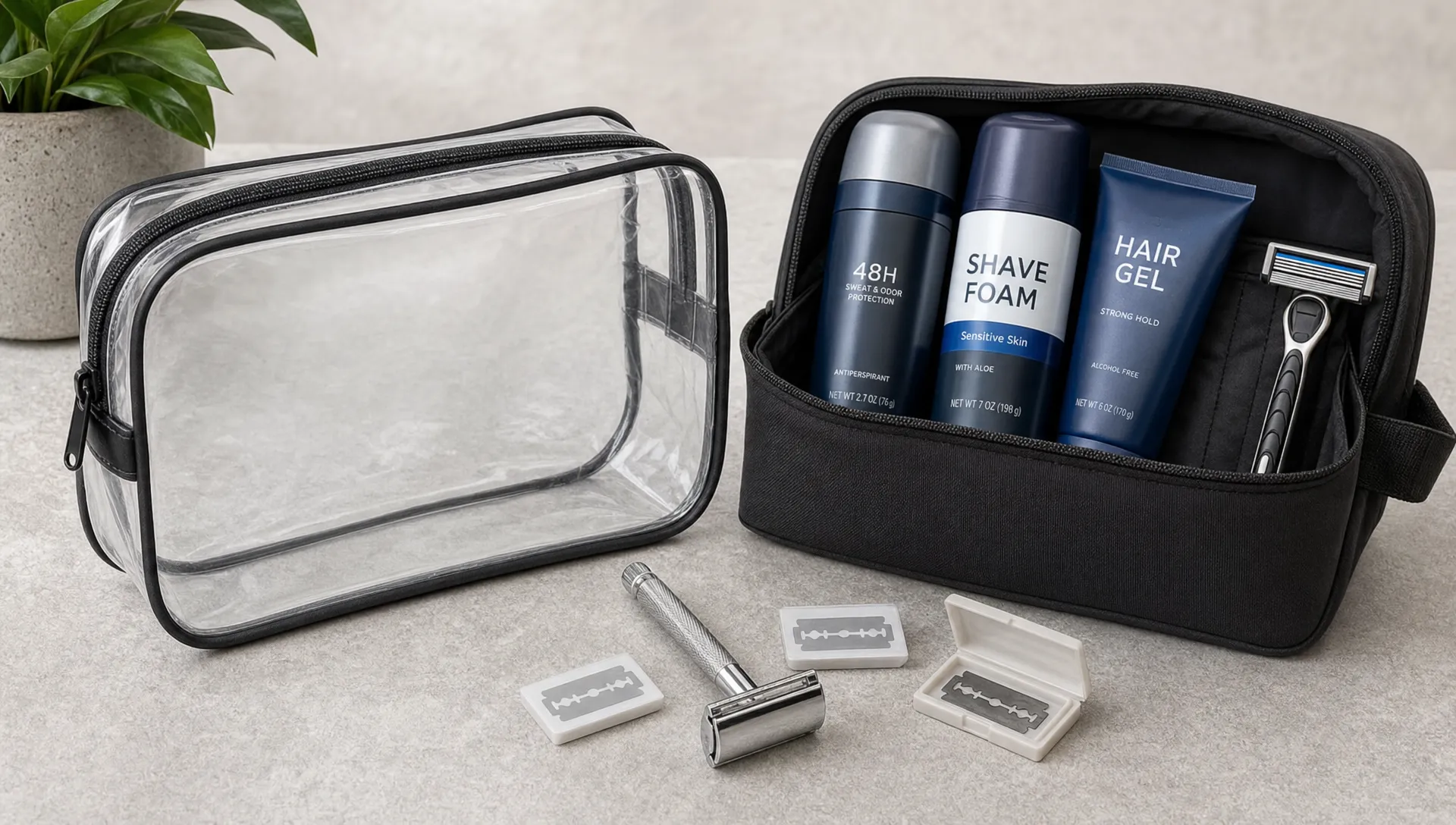
If you travel with a safety razor, pack the handle in your carry-on only if you have removed the blade. Put spare blades in checked luggage, preferably in their original packaging or a secure blade bank. If you are not checking a bag, use a disposable or cartridge razor until you arrive.
Gels: airport toiletries rules treat texture as a liquid
Gels are often the items people underestimate. Hair gel, shower gel, shaving gel, aloe vera gel, gel deodorant, gel face masks and similar products are usually treated as liquids at airport security. If it can smear, spread, squeeze or flow, assume it belongs in the liquids bag.
The key detail is container capacity. A 150 ml tube that is half empty is still a 150 ml container, so it may be rejected at a 100 ml checkpoint. Transfer gel products into travel containers marked 100 ml or less, then place them with your other liquid toiletries.
For a broader breakdown of product textures, Liquid Limits has a separate guide to security liquid rules for creams, gels and sprays. That distinction helps with borderline items such as balm, paste, mousse, roll-on deodorant and thick cosmetic products.
What about medical gels and essential products?
Some medically necessary gels may be treated differently from ordinary toiletries. For example, a prescribed topical gel or a medical gel pack may be allowed in reasonable quantities, but you should keep it separate, declare it if asked and bring documentation when possible. Do not assume a cosmetic gel will qualify for the same treatment.
If you need a gel product during the flight, pack the smallest practical amount in your carry-on and put the rest in checked baggage. This keeps your liquids bag easy to inspect and reduces the chance of a secondary search.
Routes matter more than many travelers expect
On multi-airport trips, airport toiletries rules can change between your outbound and return flights. One airport may use newer screening equipment or a temporary local policy, while another may still enforce the classic 100 ml container limit. If your journey has a connection, you may also need to pass security again after arrival or before boarding the next flight.
This matters most when travelers rely on a relaxed rule at the first airport and then get caught on the way home. A 200 ml gel, large sunscreen spray or full-size shaving foam might pass at one location only to be rejected later. The safest approach is to pack for the strictest airport in your route, not the most permissive one.
Liquid Limits is built around that problem. It shows rules side by side for routes and return trips, includes source links and defaults to the stricter 100 ml rule when a rule is unclear. You can also review broader travel liquid guidelines for airports and return trips if your itinerary includes several airports.
A simple packing system for aerosols, razors and gels
The easiest way to follow airport toiletries rules is to divide your toiletry kit into three zones before you leave home. This is faster than sorting items at the checkpoint and helps you notice oversized products while you can still repack them.
| Packing zone | What goes there | Why it helps |
|---|---|---|
| Liquids bag | Travel-size aerosols, gels, creams, pastes and roll-ons | Keeps all 100 ml liquid-like toiletries ready for screening |
| Loose carry-on toiletry pouch | Disposable razor, cartridge razor, electric razor, toothbrush, solid soap, solid deodorant | Separates non-liquid grooming items from the liquids bag |
| Checked bag | Full-size aerosols, spare safety razor blades, straight razor, large gels | Keeps restricted or oversized items out of the checkpoint |
If you do not check luggage, switch to solids where possible. Solid deodorant, bar soap, shampoo bars and shaving soap can free up space in the liquids bag. They are also less likely to leak during pressure changes or rough baggage handling.
Common mistakes that get toiletry bags flagged
Most toiletries are not unusual, but small packing errors can slow you down. Airport screeners see these items all day, so the issue is usually not the product itself. It is the size, container type, blade type or unclear category.
| Mistake | Why it causes trouble | Better choice |
|---|---|---|
| Packing a 150 ml gel tube that is almost empty | Security checks the container size, not the remaining amount | Use a marked 100 ml travel container |
| Putting full-size shaving foam in a carry-on | Aerosol foam counts as a liquid-like item | Pack a 100 ml can or place the full-size can in checked baggage |
| Bringing loose safety razor blades in hand luggage | Removable blades are sharp objects | Put blades in checked baggage or use a cartridge razor |
| Forgetting aerosol caps | Nozzles can discharge accidentally | Replace caps or tape the trigger if appropriate |
| Assuming the return airport has the same rule | Local equipment and policies can differ | Check both outbound and return airports before packing |
A final practical point: security officers make the final decision at the checkpoint. Good packing reduces risk, but it does not override local law, airline dangerous goods rules or officer discretion.
Frequently Asked Questions
Do airport toiletries rules count aerosol deodorant as a liquid? Yes. Aerosol deodorant is usually treated as a liquid or aerosol at security, so it should be 100 ml or 3.4 oz or less for carry-on travel and packed in your liquids bag.
Can I bring a razor in my carry-on toiletry bag? Disposable razors, cartridge razors and electric razors are usually allowed in carry-on bags. Loose safety razor blades and straight razors should usually go in checked baggage.
Are gels allowed through airport security? Yes, but ordinary cosmetic gels must normally follow the liquids rule. Use containers of 100 ml or less and pack them in the required clear resealable bag if your airport uses that system.
Can I pack full-size aerosols in checked luggage? Often yes, if they are medicinal or toiletry aerosols and within airline dangerous goods limits. Protect the nozzle and avoid packing non-toiletry aerosols such as spray paint, fuel, insecticide or industrial products.
What if one airport allows larger liquids but my return airport does not? Pack for the stricter airport. A larger toiletry may pass one checkpoint and still be refused later, especially on return flights or itineraries with connections.
Check before you close your toiletry bag
Aerosols, razors and gels are easy to pack correctly once you know which rule applies to each item. Keep small sprays and gels in the liquids bag, choose carry-on friendly razors and move full-size or blade-related items to checked baggage when needed.
Before you leave for the airport, use Liquid Limits to check your specific airports, items and route. It is especially useful when your return flight may follow a stricter rule than your departure airport.