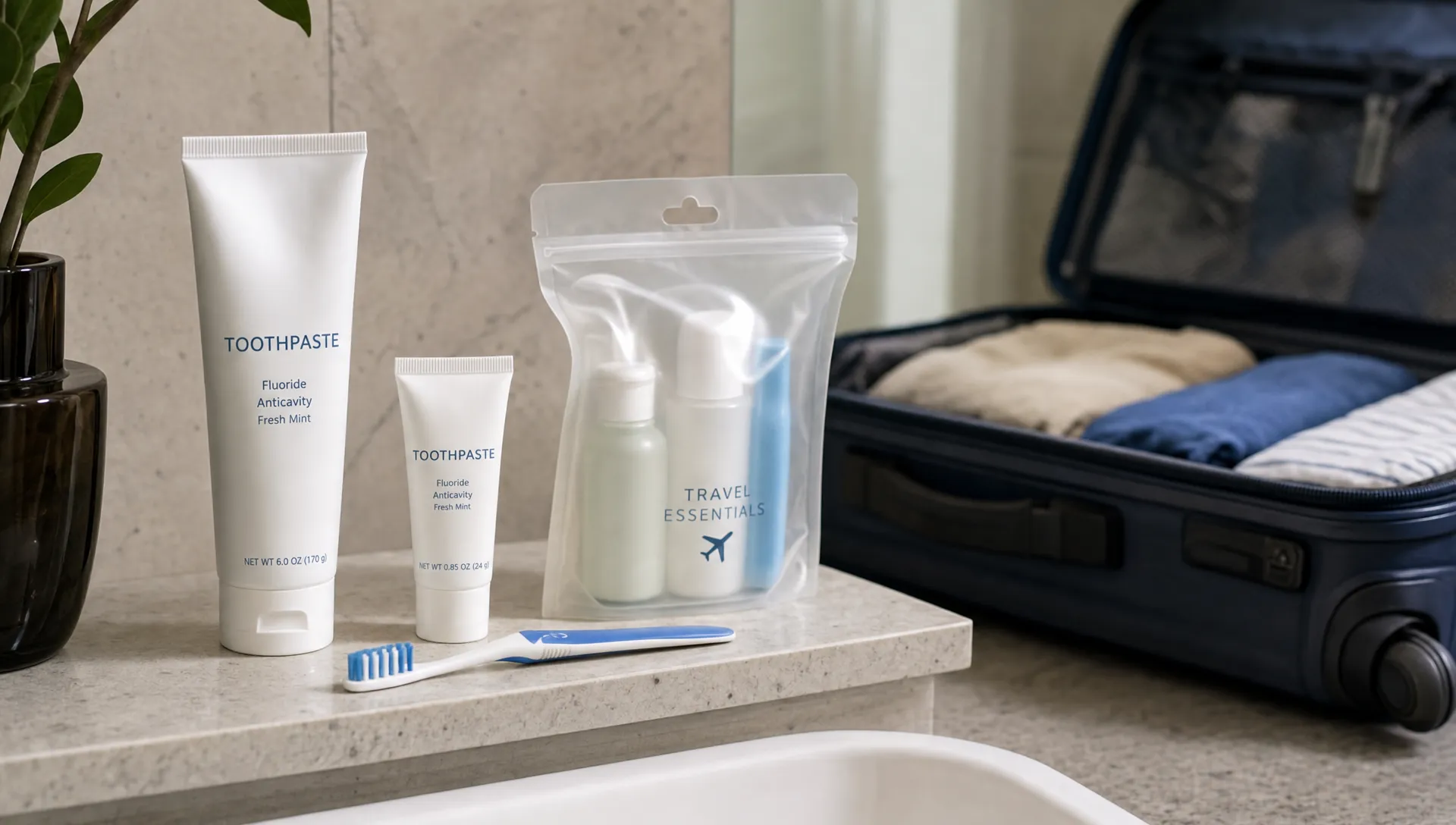
Toothpaste is one of the easiest toiletries to forget about until you are standing at airport security. It feels harmless, it is not a drink, and a half-used tube looks small enough. But at most checkpoints, toothpaste is treated as a paste, which means it usually follows the same cabin rules as liquids, gels, creams, and aerosols.
The short version: toothpaste is allowed in carry-on bags if the tube is within the airport’s liquid limit, usually 100 ml or 3.4 oz, and packed in the required clear liquids bag when that rule applies. Larger tubes are best packed in checked luggage.
The details matter because airport toothpaste rules are enforced by container size, bag rules, local screening procedures, and sometimes your return airport. Here is how to pack it without losing your favorite tube at the checkpoint.
Does toothpaste count as a liquid at airport security?
Yes, toothpaste normally counts as a liquid-like item for airport security purposes. Security rules usually group together liquids, aerosols, gels, creams, and pastes. Toothpaste falls into the paste category, so it is screened like shampoo, lotion, shaving gel, and similar toiletries.
The TSA’s liquids rule states that carry-on liquids, gels, and aerosols must be in containers of 3.4 oz or 100 ml or less, and fit in a quart-sized bag. Many UK and European airports use a similar 100 ml container limit, although exact bag procedures can vary by airport and scanner setup.
That means the question is not only “Can I bring toothpaste?” It is also “How big is the tube, where am I flying from, and will I be screened again on the way home or during a connection?”
If you want a simple yes-or-no answer for toothpaste in cabin baggage, Liquid Limits has a dedicated guide on whether toothpaste is allowed in hand luggage. This article goes deeper into tube size, bag placement, and what actually happens at security.
Carry-on toothpaste tube size: what is allowed?
At airports using the standard liquid rule, your toothpaste tube must usually be 100 ml / 3.4 oz or smaller to go in your cabin bag.
The most important point is that security officers normally look at the container capacity, not how much toothpaste is left inside. A half-empty 125 ml tube is still a 125 ml container. A nearly empty full-size tube may still be refused because the printed size is above the limit.
| Toothpaste tube label | Carry-on under 100 ml rule? | What to know |
|---|---|---|
| 25 ml, 50 ml, 75 ml, or 90 ml | Yes | Usually fine if it fits in your liquids bag. |
| 100 ml or 3.4 oz | Yes | This is typically the maximum allowed size. |
| 125 ml or 150 ml | No | Too large for airports enforcing the 100 ml rule, even if partly used. |
| Full-size family tube | No | Pack it in checked luggage or buy a travel-size tube. |
| Tube with unclear size marking | Risky | Security may reject it if the capacity cannot be verified. |
In the United States, many travel toothpaste tubes are labeled 3.4 oz or less. In Europe and the UK, tubes are more often labeled in milliliters. Some toothpaste packaging uses grams or weight ounces, which can be confusing because the liquid rule is usually expressed in volume. If the marking is unclear, the safest choice is a small tube clearly labeled 100 ml / 3.4 oz or under.
Do not rely on the phrase “travel size” alone. Most travel-size toothpastes are compliant, but security officers generally enforce the printed container size, not the marketing language on the package.
Does toothpaste need to go in the clear liquids bag?
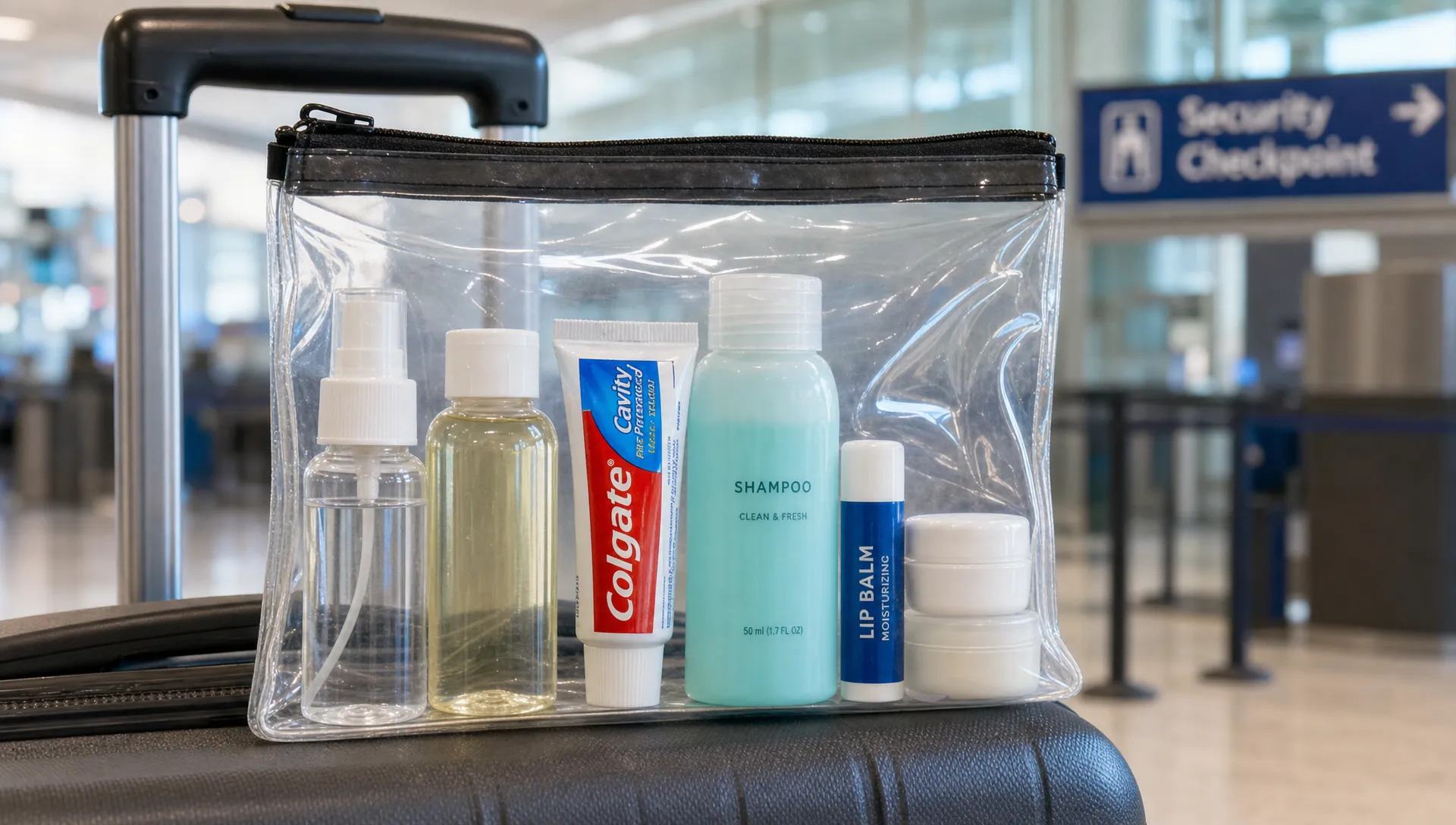
At airports still using the standard liquids setup, yes. Toothpaste should go in your clear, resealable liquids bag with your other liquid-like toiletries.
In the US, the familiar 3-1-1 rule means each passenger may bring liquids in containers of 3.4 oz or less, packed in one quart-sized bag. In the UK, the government hand luggage guidance describes a single transparent, resealable plastic bag, with containers no larger than 100 ml. Many EU airports also use the 100 ml container limit with a clear resealable bag, although screening technology and procedures are not identical everywhere.
A practical way to think about it is this: if you would put shampoo, face cream, or gel deodorant in the liquids bag, put toothpaste there too.
Your toothpaste is less likely to cause delays if you:
- Pack it in the clear bag before you reach the tray area.
- Keep the size label visible if possible.
- Do not overfill the liquids bag so it can still close.
- Put the liquids bag near the top of your carry-on.
- Split toiletries across passengers if you are traveling as a family.
Some airports with newer scanners may not require you to remove liquids from your bag, and a small number may permit larger liquid containers. But this is not universal, and rules can change. If your trip includes multiple airports, a connection, or a return flight from a different country, packing toothpaste to the stricter 100 ml standard remains the least stressful option.
What happens if security checks your toothpaste?
Toothpaste checks are usually routine. If an officer flags your bag, they may open the carry-on, inspect the tube, verify the size, swab the item, or ask you to remove it from the bag. This does not automatically mean you did anything wrong.
Common reasons toothpaste gets checked include an oversized tube, a tube not packed in the liquids bag, unclear labeling, a crowded toiletry pouch, or inconsistent rules between airports. Dense toiletry bags can also make X-ray images harder to read, which may trigger a manual inspection.
If the tube is compliant, you usually get it back. If it is too large for the local rule, you may have to surrender it, place it in checked luggage if you have time and access, or leave the checkpoint to make other arrangements. At most airports, security staff will not measure how much paste is left inside. The printed tube size is what matters.
For a broader explanation of why toiletries get stopped, see Liquid Limits’ guide to liquids at airport security and what gets flagged.
Checked luggage rules for toothpaste
Checked luggage is the easiest place for regular-size toothpaste. The 100 ml cabin liquid limit applies to items you take through the passenger security checkpoint, not to ordinary toiletries packed in checked baggage.
For most travelers, a standard toothpaste tube in checked luggage is fine. The main issue is leakage, not security. Cabin pressure changes, rough baggage handling, and loose caps can leave paste on your clothes.
Pack checked toothpaste carefully by tightening the cap, placing the tube in a small sealed bag, and keeping it away from delicate fabrics. If the tube is nearly empty, squeezing out excess air before closing it can reduce the chance of bursting or leaking.
Toothpaste is not the same as an aerosol, flammable cosmetic, or pressurized toiletry. Still, if you are packing unusual dental products, whitening chemicals, or large quantities, check the item-specific rule before you fly.
Airport toothpaste rules can change by route
One of the most common packing mistakes is checking only the departure airport. Toothpaste may be fine on your outbound flight but become a problem on the return if the airport uses stricter screening rules.
For example, you might depart from an airport that allows larger liquids with advanced scanners, then return from an airport still enforcing the 100 ml rule. Or you might buy a larger toothpaste tube after security during a trip, then face another screening point during a connection. If that tube is over the allowed cabin size, it may not make it through the next checkpoint.
This is especially important for round trips, multi-city trips, and long layovers where you may leave the secure area. The strictest airport on your route is the rule that matters most for packing.
Liquid Limits is built for this exact problem. You can use the trip liquid checker to compare airport liquid rules for your route, including the return flight, with source links and last-checked dates. When a rule is unclear, the safer assumption is the stricter 100 ml limit.
What about toothpaste tablets, powders, and solid alternatives?
Toothpaste tablets are a useful workaround for travelers who want to save space in their liquids bag. Since they are dry tablets, they are generally treated as solids rather than liquids or pastes. Tooth powder may also avoid the liquids bag, although powders can still be inspected if security wants a closer look.
These alternatives are especially helpful if you travel with only a personal item, carry several cosmetics, or need to reserve liquids-bag space for medicine and skincare. They also reduce the risk of leaks.
That said, solid alternatives should still be packed neatly and kept in labeled packaging when possible. If an item is homemade, unmarked, or looks unusual on the X-ray, it may receive extra screening. A commercial package with a clear label makes the checkpoint process easier.
Is prescription or medical toothpaste exempt?
Prescription dental products, such as high-fluoride toothpaste prescribed by a dentist, may be treated differently if they are medically necessary for your trip. Many airport liquid rules allow medically necessary liquids, gels, or pastes in quantities above the standard limit, but you should not assume every product will be waved through without questions.
If you need prescription toothpaste in your cabin bag, keep it separate from your regular liquids, leave it in its original packaging, and carry the prescription label or supporting documentation if you have it. Tell security staff before screening if the tube is over the normal limit.
The key phrase is “medically necessary.” A regular sensitive toothpaste, whitening toothpaste, or preferred brand is usually not enough to qualify for an exemption if it exceeds the cabin liquid limit.
Quick packing rules for toothpaste
If you do not want to think about airport-by-airport differences, use this simple packing formula.
For carry-on only trips, bring one tube clearly labeled 100 ml / 3.4 oz or smaller and place it in your liquids bag. For checked-bag trips, put your full-size tube in checked luggage and carry a small backup only if you need it during the flight or immediately after landing. For round trips or connections, follow the strictest airport on the route, not the most relaxed one.
Here is a quick scenario guide:
| Travel situation | Best toothpaste choice | Why it works |
|---|---|---|
| Weekend carry-on only | 25 ml to 75 ml tube | Saves liquids-bag space and avoids size disputes. |
| Long trip with checked luggage | Full-size tube in checked bag | No need to use liquids-bag space. |
| International connection | 100 ml / 3.4 oz or smaller | Helps you pass rescreening at stricter airports. |
| Minimalist travel | Toothpaste tablets | Usually avoids the liquids bag. |
| Prescription dental product | Original packaging plus documentation | Helps explain medical need if questioned. |
Common toothpaste packing mistakes
The biggest mistake is packing a full-size tube because it is “almost empty.” Security rules usually do not work that way. If the container is too large, the remaining amount inside does not matter.
Another common mistake is putting toothpaste loose in a toiletry pouch while the clear liquids bag contains only obvious liquids like shampoo. Toothpaste still counts as a paste, so it belongs with the liquids where the bag rule is enforced.
Travelers also get caught out by return flights. They may buy a large tube at their destination, forget they are flying home with cabin baggage only, and lose it at the first checkpoint. If you need to buy toothpaste during the trip, choose a small tube unless you have checked luggage for the return.
Finally, do not assume every airport in the same country uses the exact same process. Scanner upgrades, temporary restrictions, and local procedures can affect whether liquids must be removed, how bag rules are enforced, and whether larger containers are accepted. Liquid Limits’ travel liquid guidelines for airports and return trips explain why the return airport matters as much as the outbound one.
Frequently Asked Questions
Can you bring toothpaste through airport security? Yes. Toothpaste is allowed through airport security, but in carry-on baggage it usually must be in a tube of 100 ml / 3.4 oz or less and packed in the required liquids bag.
Can I bring a half-empty large toothpaste tube on a plane? Not reliably. Security usually checks the container size, not how much toothpaste remains. A half-empty 125 ml or full-size tube may still be refused at airports enforcing the 100 ml rule.
Does toothpaste have to be in a plastic bag at the airport? At airports using the standard liquids rule, yes. Toothpaste should go in your clear resealable liquids bag with other liquids, gels, creams, and pastes.
Can toothpaste go in checked luggage? Yes. Regular-size toothpaste can usually go in checked luggage because the cabin liquid limit applies at the passenger security checkpoint. Pack it in a sealed bag to prevent leaks.
Are toothpaste tablets counted as liquids? Usually no. Toothpaste tablets are generally treated as solids, which makes them a useful option for carry-on travelers with limited liquids-bag space.
Can I take prescription toothpaste over 100 ml? Possibly, if it is medically necessary and allowed under the airport’s medical liquids rules. Keep it in original packaging, bring documentation if available, and declare it before screening.
Check toothpaste rules before you pack
Airport toothpaste rules are simple when you pack for the strictest checkpoint: choose a 100 ml / 3.4 oz tube or smaller for carry-on, place it in the liquids bag when required, and put larger tubes in checked luggage.
For trips with connections, different return airports, or changing scanner rules, check your exact route before you pack. Liquid Limits shows airport liquid rules side by side, including stricter fallback guidance when rules are unclear, so your toothpaste is one less thing to worry about at security.