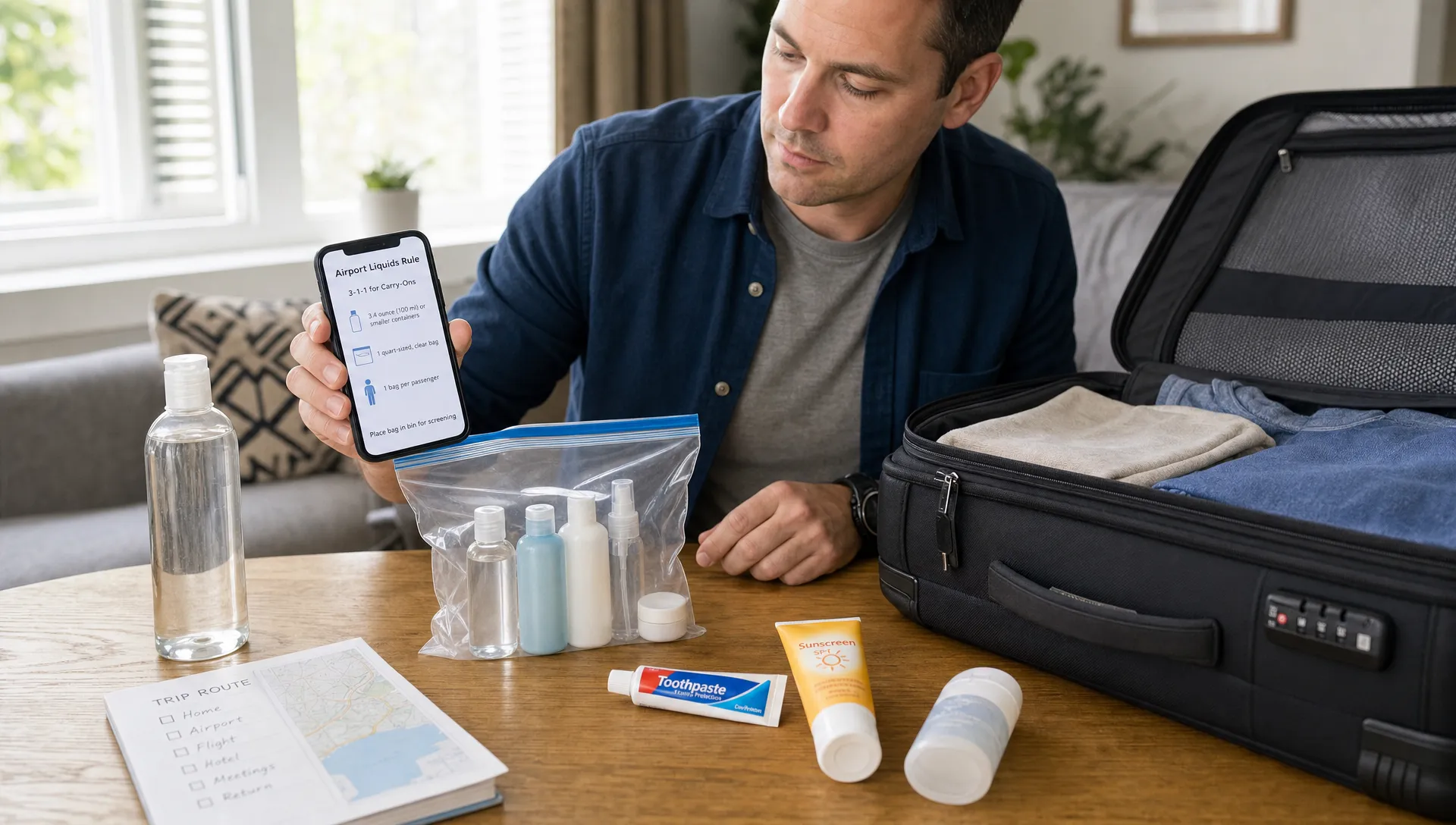
If you pack cabin bag liquids from memory, you are usually packing for one airport. A real itinerary can involve your departure airport, a transfer checkpoint, the airport where you start your return journey and sometimes a second connection on the way home. Any one of those checkpoints can apply the rule that decides whether your shampoo, sunscreen, perfume, sauce, baby food or duty-free bottle gets through.
The safest approach is simple: pack for the strictest airport on your route, not the easiest one. That matters more than ever because airports do not all update their screening technology at the same pace. Some lanes may allow liquids to stay in bags, some may still require a clear plastic bag and some rules may differ between outbound and return travel.
This guide shows how to build a route-based plan for cabin bag liquids so you can move through security without repacking at the scanner or losing items you meant to keep.
Start with the baseline: containers matter
For many travelers, the default cabin liquid rule is still the familiar 100 ml limit. In the United States, TSA's 3-1-1 liquids rule allows liquids, aerosols, gels, creams and pastes in containers of 3.4 oz or 100 ml or less, placed in one quart-sized bag. In the United Kingdom, the UK government's hand luggage guidance also explains the 100 ml container limit and the use of a transparent resealable plastic bag.
The key word is container. A half-empty 200 ml body lotion bottle usually fails the 100 ml rule because the bottle is larger than the allowed size. Security staff do not measure the remaining liquid inside. They check the size printed on the packaging or the apparent capacity of the container.
The same logic applies to travel minis, refillable bottles and sample pots. If the container is unmarked, unusually shaped or clearly too large, it can slow you down. For low-risk packing, use bottles that show their capacity and keep every nonexempt liquid, gel, cream, paste and aerosol at or below the strictest limit for your trip.
Your route decides the safest rule
Airline baggage pages can help with bag size and weight, but airport security rules decide what liquids you can carry through a checkpoint. That is why two people on the same airline can face different liquid rules if they start from different airports or connect through different countries.
The rule that matters most is the strictest checkpoint where your cabin bag will be screened. If your departure airport allows a larger liquid allowance but your transfer airport rescreens passengers under a 100 ml rule, your cabin bag still needs to survive the transfer. The same applies on the return journey. A relaxed outbound experience does not guarantee the same result when you fly home.
Before you close your bag, compare the airports on your whole itinerary. Liquid Limits was built for this exact problem: it helps travelers check airport, item and route liquid rules, including return flights, with source links and last-checked dates. If a rule is unclear, the safer default is the stricter 100 ml approach.
Map every checkpoint before you pack
A route-based liquid plan starts with a quick map of where your cabin bag might be screened. You do not need to become an aviation policy expert, but you do need to know which airports can touch your liquids.
- List your airports in travel order: Include your outbound departure airport, every connection airport, your return departure airport and any return connections.
- Identify likely rescreening points: International to domestic transfers, terminal changes and arrivals into some regions often require security screening again, even when you stay with the same airline.
- Check each airport rule separately: Do not assume the same country-wide rule applies in every terminal or that every airport has identical scanner procedures.
- Check the item, not just the category: Sunscreen, mascara, peanut butter, snow globes, hair gel, aerosols and liquid medicines can be treated differently from solid items.
- Apply the strictest clear rule: If one checkpoint on your route uses 100 ml limits, pack your cabin bag liquids as if every checkpoint uses 100 ml limits.
This method is especially useful for open-jaw trips, cruise connections, multi-city business travel and vacations where you buy toiletries or food gifts before flying home. If you only check the airport you leave from first, the return airport can become the expensive surprise.
Route scenarios that change how you should pack
The table below shows how different itineraries affect your liquid strategy. It is not a replacement for checking your exact airports, but it helps you spot the risk points before packing.
| Trip pattern | Where liquid problems usually happen | Safer packing choice |
|---|---|---|
| Direct round trip between two airports | Return airport has stricter rules than outbound airport | Pack cabin liquids to the stricter rule for both directions |
| One-stop trip with international connection | Transfer security rescreens your cabin bag | Keep nonexempt liquids in 100 ml containers unless every checkpoint clearly allows more |
| Outbound with checked bag, return with cabin bag only | Large toiletries bought during the trip must go through security | Buy travel sizes, use solids or leave space in checked baggage for the return |
| Duty-free purchase before a connection | Sealed bag may still be checked again at transfer security | Buy after final screening when possible or keep receipt and sealed tamper-evident bag |
| Multi-city itinerary | Different airports, terminals and screening systems apply | Check each airport on the route rather than relying on the first flight |
If you are unsure whether an item counts as a liquid at all, this plain-English guide to what counts as liquids on a plane can help you sort obvious solids from items that security may treat as gels, pastes or creams.
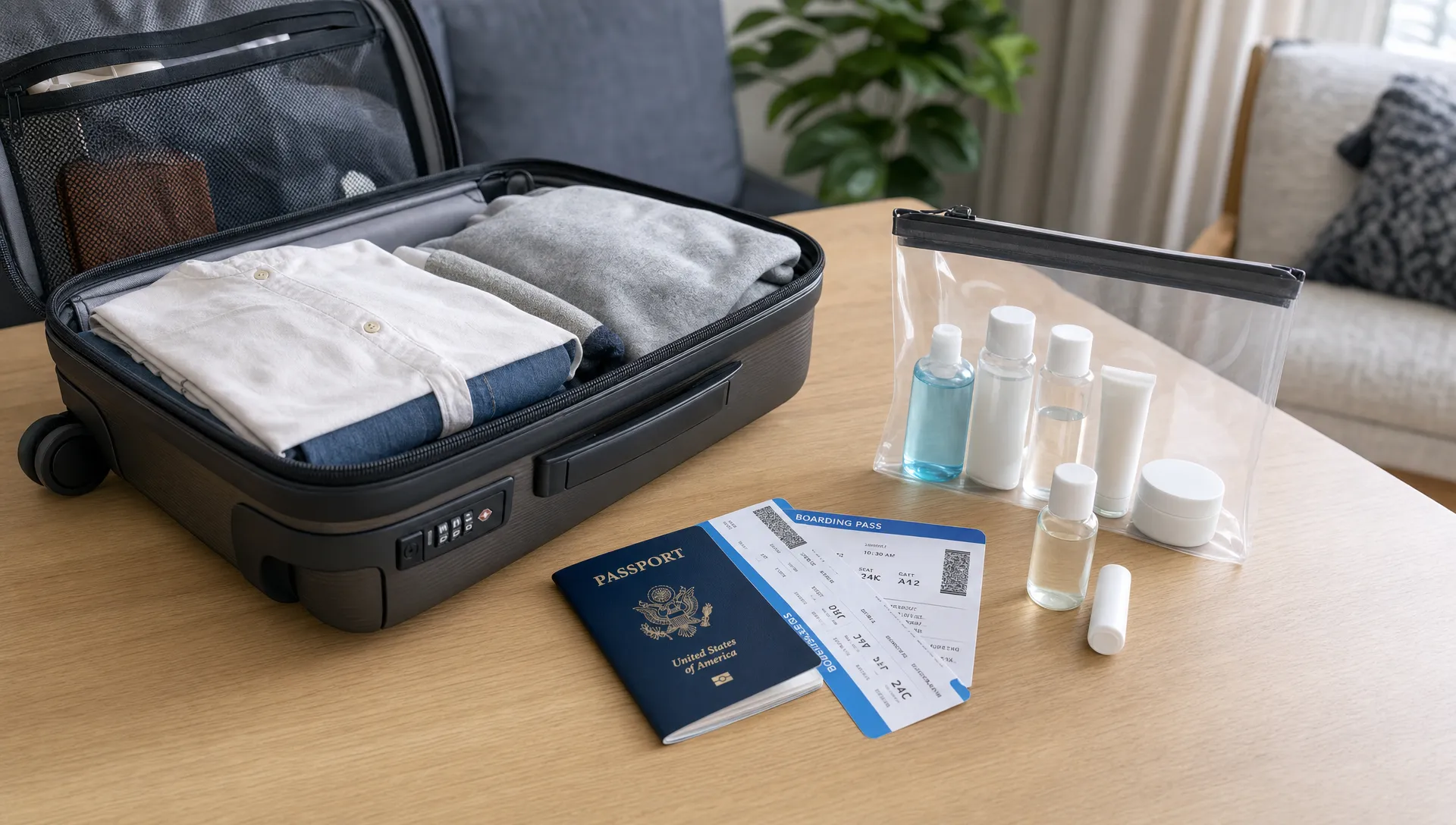
Pack your cabin bag around the strictest checkpoint
Once you know the strictest airport on your route, build your cabin bag around that rule. The goal is not to bring the maximum possible amount of liquid. The goal is to make every checkpoint boring.
Start with an essentials-only liquids kit. Keep toothpaste, deodorant, moisturizer, sunscreen, lip balm, contact lens solution, liquid makeup and any other daily-use item in compliant travel-size containers. Put them in one clear resealable bag if your route may require it, even if your first airport has newer scanners and does not ask you to remove liquids.
Then move everything nonessential out of the cabin bag. Full-size shampoo, conditioner, body wash, perfume, aftershave, hair products, skincare bottles and souvenir sauces belong in checked baggage when you have it. If you are flying cabin-only, consider solid alternatives such as bar shampoo, stick deodorant, solid cleanser and powder makeup. Solid items are not automatically problem-free in every case, but they usually avoid the classic liquid limit issue.
Refillable bottles are useful, but they need labels or visible capacity markings. A 100 ml refillable silicone bottle is usually easier to defend than an unmarked soft pouch. Avoid filling containers to the brim if leaks are likely, and keep your liquids bag near the top of your cabin bag so you can remove it quickly where required.
Watch the items travelers forget are liquids
The most common cabin bag liquid mistakes are not dramatic. They are ordinary items packed on autopilot. Mascara is a liquid or gel for screening purposes. So are lip gloss, liquid foundation, cream blush, hair wax, shaving gel and many roll-on products. Food can also catch travelers out, especially if it spreads, pours, squeezes or sloshes.
Peanut butter, jam, honey, soft cheese, yogurt, hummus, dips, sauces and pastes are frequent problem items because they feel like food, not toiletries. If you are bringing edible gifts, check whether they are solid enough for cabin baggage or whether they need to go in checked luggage. A sealed jar can still be a liquid, gel or paste in security terms.
Aerosols deserve extra attention because they are subject to both liquid screening rules and aviation safety restrictions. Small deodorant or hairspray aerosols may be allowed when they meet size and safety requirements, but full-size sprays are a poor fit for cabin-only travel. Large aerosol cans are better left at home or packed in checked baggage only when airline and safety rules allow them.
Handle exemptions carefully
Some liquids are treated as exceptions, especially medicines, baby milk, baby formula, baby food and items needed for special dietary requirements. These exceptions are real, but they are not a free pass for unrelated products.
For medicine, keep the item in original packaging when possible and carry a prescription, label or doctor note if the quantity is above the normal cabin liquid limit. Security staff may ask you to separate it from your standard liquids bag and declare it before screening. The same practical approach applies to medical gels, liquid nutrition and cooling packs used for medication.
For baby and toddler travel, pack only what you reasonably need for the journey and expect extra screening. Rules vary by country, airport and item type, so check the airports on your route rather than relying on another traveler's experience from a different airport.
Duty-free liquids are another special case. They are often sold in sealed security tamper-evident bags with receipts, but connections can complicate things. If you open the sealed bag, lose the receipt or pass through a transfer checkpoint that does not accept the purchase under local rules, the item can be refused. For high-value bottles, the safest option is to buy after your last security checkpoint when possible.
A low-stress setup for cabin bag liquids
The lowest-risk setup is practical rather than clever. Pack a small transparent liquids bag with only the items you need during the trip or immediately after landing. Put larger bottles in checked baggage. Bring an empty water bottle and fill it after security. Keep medicine and baby items separate, easy to remove and supported by documentation where relevant.
For toiletries you can replace cheaply at your destination, do not overpack. Buying toothpaste or shampoo after landing is often less painful than losing an expensive skincare product at transfer security. For short trips, sample sizes and solid alternatives can reduce your liquid count enough that your clear bag closes properly.
If you are traveling with family or colleagues, do not assume you can spread one person's liquids across everyone's bags at the security lane. Each traveler should be able to present their own compliant liquids if required. This avoids last-minute repacking when one bag is overfilled and another person has already gone through screening.
Common mistakes on multi-airport routes
A route with more than one airport gives small packing mistakes more chances to become real problems. These are the ones worth avoiding.
| Mistake | Why it fails | Better choice |
|---|---|---|
| Packing for the departure airport only | A connection or return airport may be stricter | Check the full route before packing |
| Bringing a half-empty large bottle | Container size can matter more than remaining liquid | Use containers marked 100 ml or less when required |
| Buying duty-free before a transfer | Transfer security may rescreen the item | Buy after the final checkpoint when possible |
| Treating food gifts as solids | Spreads, sauces and pastes may count as liquids | Pack them in checked baggage or choose solid gifts |
| Assuming new scanners apply everywhere | Scanner rollout differs by airport, terminal and lane | Use the strictest confirmed rule for the route |
When in doubt, the conservative choice usually saves time. A 100 ml travel bottle is rarely the most exciting packing solution, but it is widely recognized and easy for security staff to assess.
Frequently Asked Questions
Can I bring a 150 ml bottle if only 50 ml is left? Usually no. Under the standard 100 ml rule, the container size matters. A partly empty 150 ml bottle can still be refused because the container is over the limit.
Do cabin bag liquid rules apply on connecting flights? Yes, if your cabin bag is screened again during the connection. Some connections stay airside without rescreening, but many international transfers require another security check.
Are liquid rules the same at every airport? No. Airport rules and screening procedures can differ by country, airport, terminal and scanner type. Pack for the strictest airport on your route when rules differ.
Can I rely on an airport with newer scanners to allow larger liquids? Only if every checkpoint on your route clearly allows the same treatment. If any airport on the route still applies the 100 ml rule, use 100 ml containers for nonexempt cabin liquids.
What is the safest way to bring duty-free liquids through a connection? Keep the item sealed in its tamper-evident bag, keep the receipt and do not open it before your final security checkpoint. If possible, buy duty-free after your last screening point.
Check your route before you close your bag
Cabin bag liquids are easiest to manage when you stop thinking airport by airport at the last minute and check the whole route before you pack. The strictest checkpoint should set your plan, especially when you have connections, a return flight from a different airport or duty-free purchases.
Use Liquid Limits to check airport, item and route liquid rules side by side before you travel. For extra packing safeguards, this guide to avoiding security confiscation can help you spot the items most likely to cause trouble at the scanner.