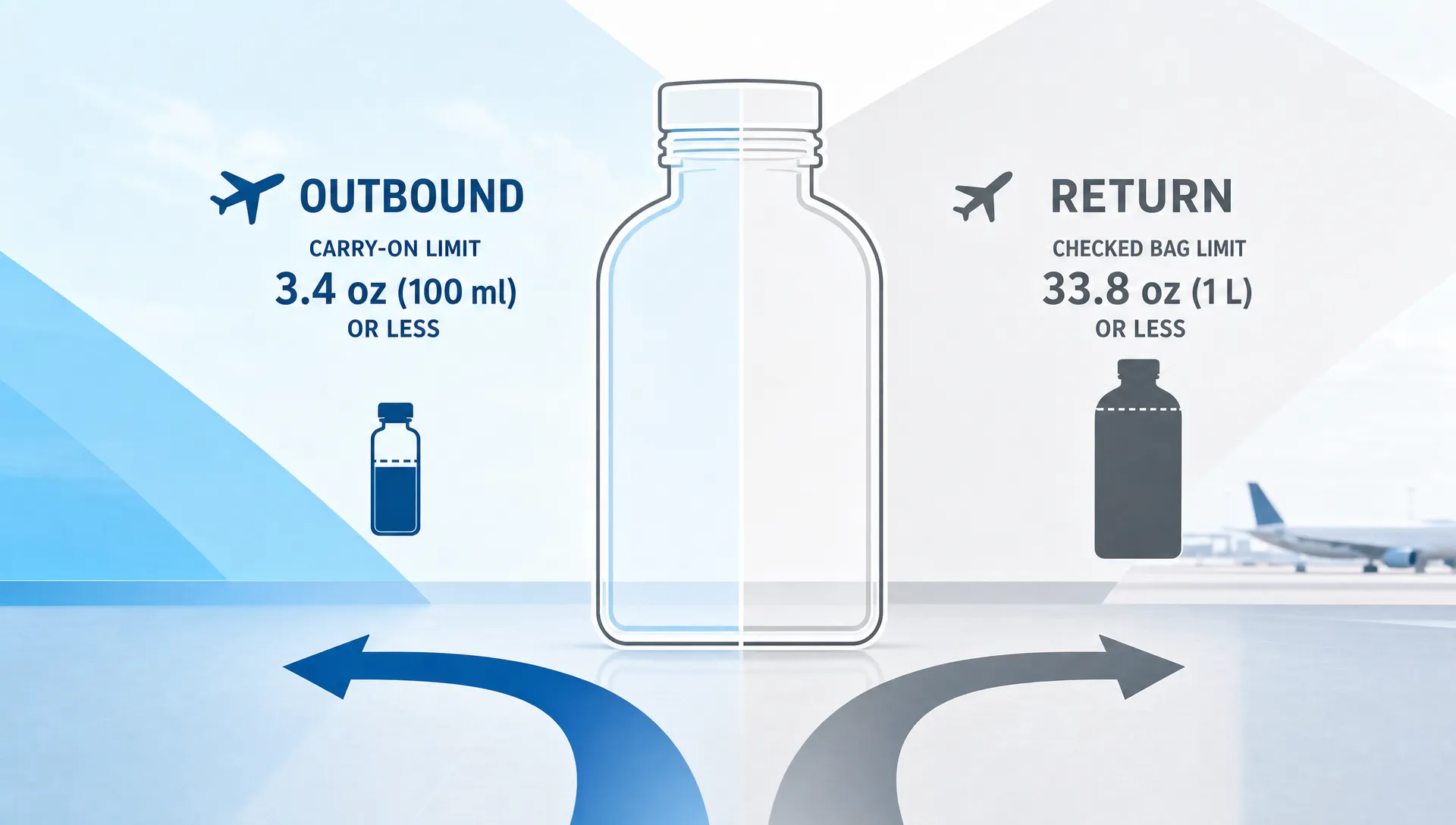
A direct flight can make cabin liquids feel simple: you pass through security once, board, and land. The return flight is where many travelers get caught out. Your outbound airport and your return airport may not apply the same cabin liquid limit, especially as scanner upgrades, temporary restrictions, and airport-specific rules continue to vary.
The key rule is this: cabin liquids are controlled by the security checkpoint you pass through, not by your airline ticket or the country you are flying to. For a round trip, that means you need to think about both directions before you pack.
The rule is set by the airport security checkpoint
Cabin liquid rules reset each time you enter an airport security screening area. If you fly directly from New York to Paris, the liquids in your cabin bag are checked at New York before departure. If you later fly directly from Paris back to New York, your cabin liquids are checked at Paris before the return flight.
That distinction matters because the outbound airport may allow one thing while the return airport does not. In many places, the familiar 100 ml rule still applies. In others, newer scanners may allow larger containers at certain checkpoints, sometimes up to 2 liters where local rules permit. These changes are not global, and they are not always consistent across every terminal or lane.
If you want the least risky approach, pack for the strictest rule on your full trip. Liquid Limits follows that same conservative principle when rules are unclear, defaulting to the stricter 100ml guidance rather than assuming a larger allowance.
For a broader foundation on the basics, this guide to key liquid restrictions when flying explains the standard cabin limits, checked baggage differences, and common exceptions.
What counts as cabin liquids?
Airport security uses a broad definition of liquids. It usually includes liquids, aerosols, gels, creams, pastes, and similar spreadable or pourable items. The TSA liquids rule, for example, covers liquids, gels, and aerosols in carry-on bags and limits them to 3.4 ounces, or 100 ml, per container under its 3-1-1 rule.
Common cabin liquids include shampoo, conditioner, body wash, toothpaste, perfume, sunscreen, moisturizer, foundation, mascara, lip gloss, shaving foam, deodorant sprays, hair gel, hand sanitizer, contact lens solution, honey, jam, peanut butter, and soft cheeses.
The container size matters. A 150 ml bottle with only a small amount left may still be refused at a 100 ml checkpoint because the bottle itself is too large. Decanting toiletries into clearly sized travel containers is safer than relying on how much product remains inside a full-size bottle.
Direct flights: which liquid rule applies?
For a simple direct flight with no connection and no extra screening, your cabin liquids are normally checked at the departure airport. The destination airport’s cabin liquid rule usually does not affect the liquids already in your bag when you arrive, because you are not taking them through departing security there.
There are a few important caveats. Some “direct” flights make a stop but keep the same flight number. If passengers leave the secure area, change aircraft, or are screened again, the second checkpoint can apply its own liquid rules. If you are unsure whether a stop involves rescreening, treat it like a connection and pack to the strictest likely rule.
Also remember that security liquid rules are separate from customs, agriculture, and duty rules. A liquid food item may pass cabin screening but still be restricted by arrival rules. Alcohol, perfume, and other products may also be subject to import limits at your destination.
Return flights: why the stricter rule wins
The return flight is a separate departure. That means the airport you fly home from gets to apply its own cabin liquid rules, even if your outbound airport allowed more.
This is where travelers often run into problems. You may leave from an airport that permits larger cabin liquids, buy full-size sunscreen or cosmetics at your destination, then return through an airport that still enforces the 100 ml limit. Unless those items are in checked baggage or qualify for an exception, they may be confiscated at security.
A round trip should be planned as two liquid checks, not one. Ask these two questions before you pack:
- What is the liquid rule at my outbound departure airport? This is the checkpoint that controls what you can carry onto the first flight.
- What is the liquid rule at my return departure airport? This is the checkpoint that controls what you can bring home in your cabin bag.
If the answers differ, pack for the stricter one. That is especially important if you are traveling cabin-only and cannot move larger liquids into checked luggage for the return.
| Trip situation | What usually matters | Safer packing choice |
|---|---|---|
| Direct outbound flight only | The departure airport security checkpoint | Follow that airport’s cabin liquid rule |
| Round trip with a return flight | The outbound and return departure checkpoints | Pack to the stricter of the two |
| Direct flight with a stop | Whether passengers are screened again | Assume the stricter rule if unclear |
| Airport with newer scanners | The exact airport, terminal, and current local policy | Verify before packing larger containers |
| Duty-free liquids on the way home | Sealed bag rules and any extra screening | Keep receipts and sealed bags intact |
A simple packing method for direct and return flights
The easiest way to avoid last-minute repacking is to plan your liquids before you decide what goes in your cabin bag. This is especially useful for weekend trips, business travel, and low-cost flights where you may not have checked baggage.
- Check your outbound airport rule: Look at the airport or government source for the airport where you first pass security.
- Check your return airport rule: Do the same for the airport you will depart from on the way home.
- Check the item type: Treat gels, creams, pastes, sprays, and spreadable foods as liquids unless an official source clearly says otherwise.
- Use the stricter limit: If either airport uses 100 ml, pack cabin liquids in containers of 100 ml or less.
- Plan purchases before you buy: If you buy full-size liquids during the trip, make sure you can check them, ship them, or leave them behind.
If your itinerary includes the UK, rules can be particularly airport-specific because scanner changes have been phased in unevenly. This overview of UK flight liquids rules for cabin bags is a useful starting point, but you should still verify the exact airport before departure.
Special cabin liquids: medicine, baby items, and duty-free
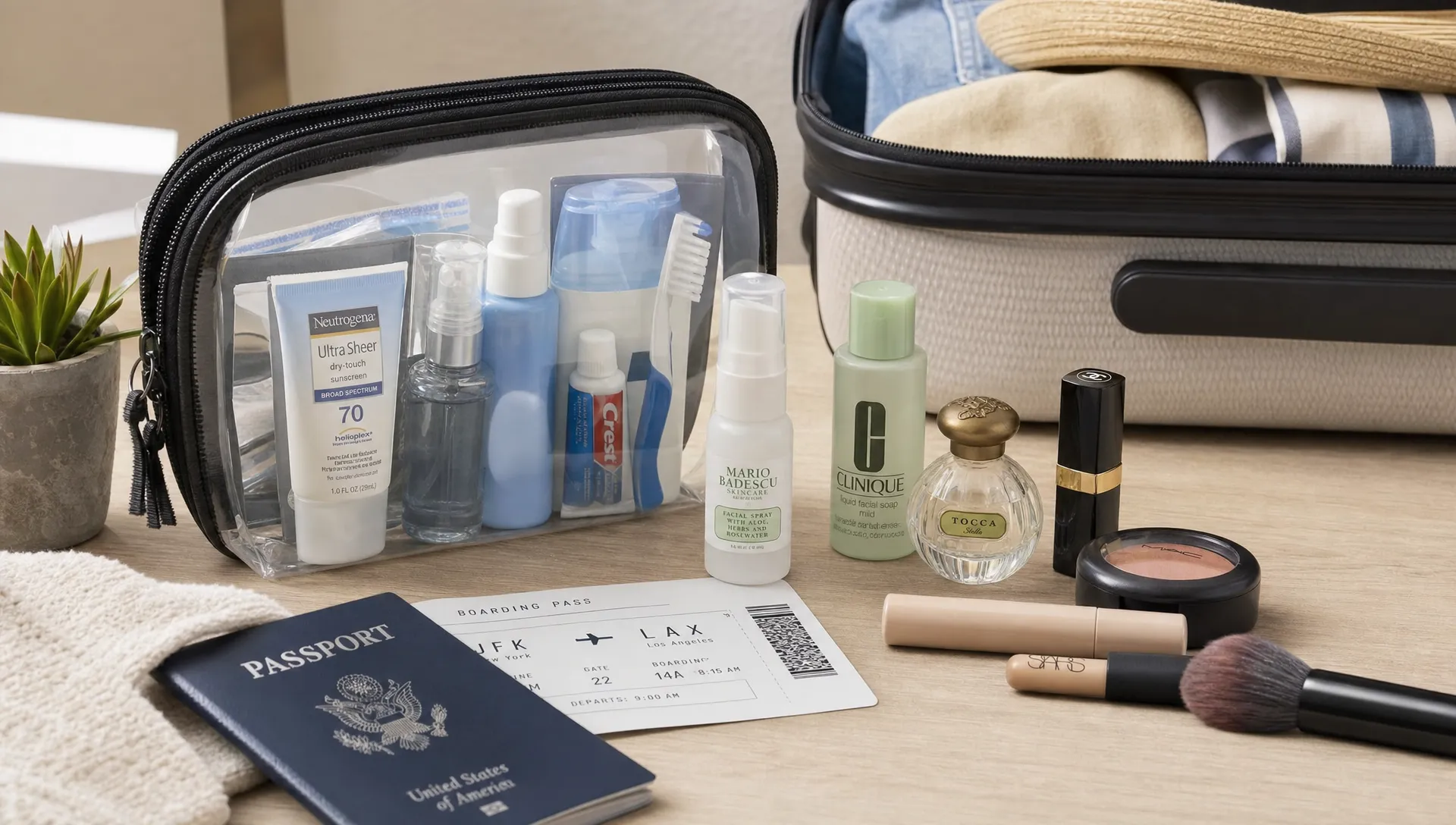
Some liquids are treated differently from ordinary toiletries, but exceptions still depend on the airport and the screening authority. Do not assume an exception applies everywhere in the same way.
| Item type | Typical treatment at security | Return flight tip |
|---|---|---|
| Essential medicines | Often allowed above 100 ml when medically necessary, with screening | Keep them separate and bring documentation when possible |
| Baby milk, formula, and baby food | Often allowed in reasonable quantities for the journey | Check the return airport’s family travel rules |
| Special dietary liquids | May be allowed when needed during travel | Carry only what you need and verify local guidance |
| Duty-free liquids | Often allowed if sealed in a security tamper-evident bag with receipt | Do not open the bag before your final security checkpoint |
| Contact lens solution | Usually treated as a liquid unless covered by a medical exception | Use travel-size bottles if you are unsure |
The UK government’s hand luggage restrictions also notes that containers must usually be 100 ml or less where the 100 ml rule applies, with limited exemptions for essentials such as medicines and special dietary requirements. The exact handling can vary, so official airport guidance is still worth checking before you fly.
Duty-free deserves special attention on return trips. A bottle bought after security on your outbound flight may be fine for that flight, but it may become a problem if you need to take it through security again later. Keep duty-free liquids sealed in the official tamper-evident bag, keep the receipt visible, and check whether your return or transfer airport accepts those bags.
When checked baggage is the better option
If you know you want to bring back full-size toiletries, wine, olive oil, cosmetics, or other liquid purchases, checked baggage is often the simplest solution. Cabin liquid limits are much stricter because they apply at the passenger security checkpoint.
Checked luggage does not normally follow the same 100 ml cabin liquid rule, but it is not a free-for-all. Airlines and aviation safety rules can still restrict certain items, especially aerosols, flammable products, high-strength alcohol, and pressurized containers. Fragile bottles also need careful packing to prevent leaks or breakage.
For cabin-only travel, assume you need travel-size containers for both the outbound and return flights unless you have confirmed that both airports allow larger cabin liquids. If only one direction allows larger containers, the stricter return leg still controls what you can bring home in your cabin bag.
Common direct and return flight examples
Consider a traveler flying direct from an airport that permits larger cabin liquids to an airport that still uses the 100 ml rule. The outbound flight may be smooth with a larger bottle in the cabin bag. On the return, that same bottle may be refused because the return departure airport has a stricter checkpoint.
Now consider the reverse. If your outbound airport uses the 100 ml rule but your return airport allows larger containers, you still need to pack small containers for the outbound journey. Once you arrive, you may be able to buy larger items for the return cabin bag, but only if the return airport’s current rule clearly allows them.
For a business traveler on a same-week round trip, the safest strategy is simple: keep toiletries under 100 ml for the whole journey. For a leisure traveler planning to shop at the destination, decide in advance whether you will check a bag on the way home. That decision can save expensive perfumes, skincare, food gifts, and local drinks from being surrendered at security.
How Liquid Limits helps you check the full trip
Because cabin liquid rules can vary by airport, item, direction, and date, checking only one airport is not enough for many round trips. Liquid Limits is built for that exact problem: it helps travelers compare the strictest cabin liquid rule for the whole trip, including the return flight.
You can use Liquid Limits to check airports, routes, and specific items before you pack. The guidance includes source links, last-checked dates, and daily updates, so you can see where the rule came from instead of relying on old travel forum posts or assumptions.
For trips where the official rule is unclear, the safer packing answer is usually the 100ml rule. That may feel conservative, but it is better than losing a full-size product at the return airport.
Frequently Asked Questions
Do cabin liquids rules change on the return flight? They can. Your return flight departs from a different airport, or at least a different security checkpoint, so that airport’s cabin liquid rule applies when you fly home.
Does the destination airport matter for a direct flight? Usually not for the liquids already in your cabin bag when you arrive. The departure airport security checkpoint controls what you can bring into the cabin. Arrival customs or import rules may still matter for certain goods.
Can I bring full-size liquids if my outbound airport allows 2 liters? Only if every security checkpoint where you carry that item allows it. If your return airport still applies the 100 ml rule, the full-size container may not be allowed in your cabin bag on the way home.
Are medicines limited to 100 ml in cabin bags? Essential medicines are often treated as an exception, but they may need separate screening and documentation. Check the rules for both your outbound and return airports before travel.
What happens if a direct flight includes a stop? If you stay in the secure area and are not screened again, the original departure rule may be the only cabin liquid check. If you leave the secure area or pass through security again, the next airport’s rule can apply.
Can I take duty-free liquids on a return flight? Sometimes, but only if they meet the relevant sealed bag and receipt requirements and are accepted by any later security checkpoint. Keep the bag sealed until you have passed your final screening point.
Check both directions before you pack
For direct flights, the departure airport rule usually controls your cabin liquids. For return flights, the return airport gets its own say. If the two rules differ, the strictest one is the one to pack for.
Before you close your suitcase, check your route, airports, and specific items with Liquid Limits. A one-minute check can help you avoid repacking at security, losing full-size products, or discovering too late that your return flight has stricter cabin liquid rules than your outbound trip.