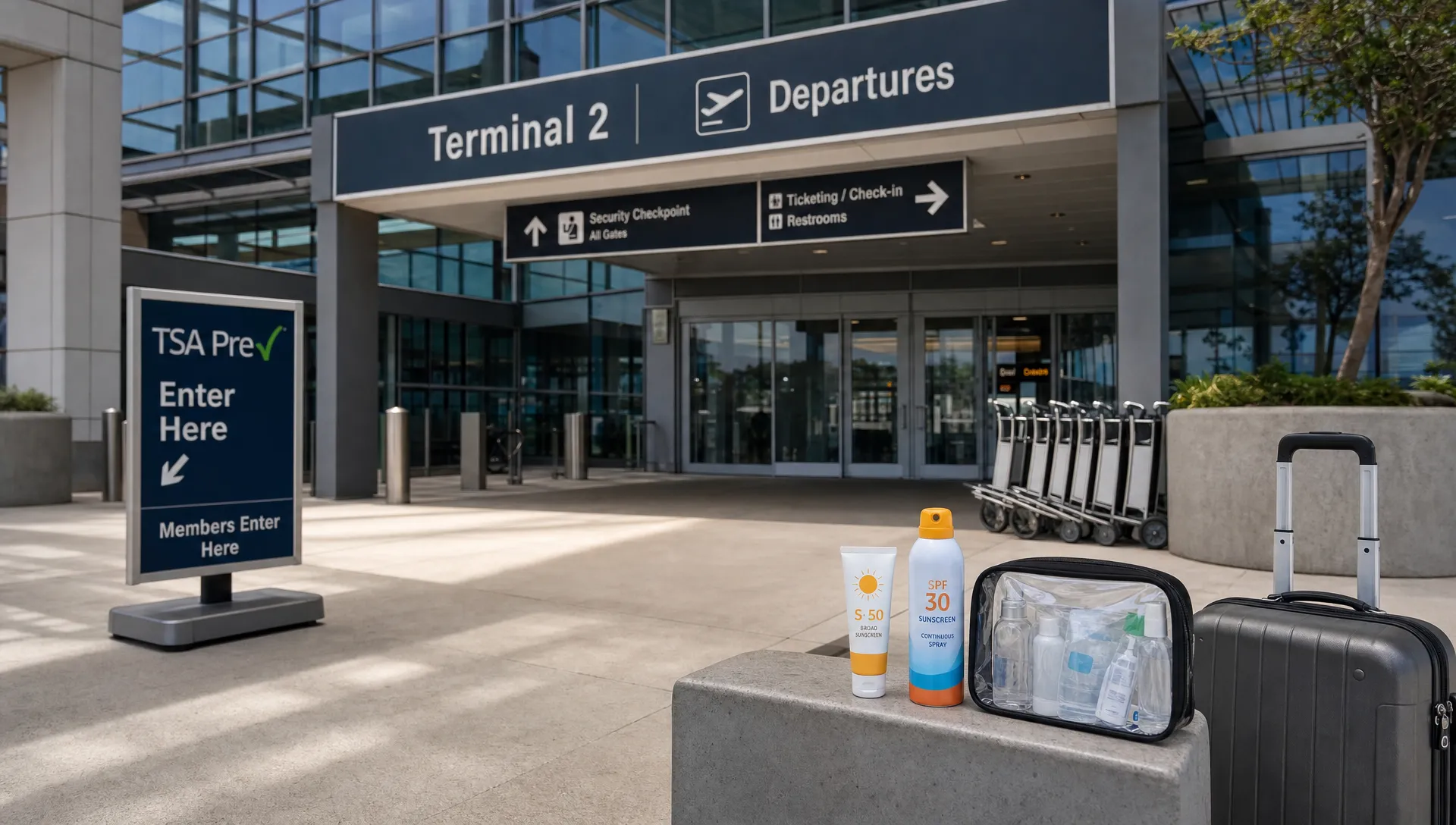
Yes, you can bring sunscreen in hand luggage, but most airports treat sunscreen as a liquid, gel, cream or aerosol. That means the usual cabin liquid rule applies: your sunscreen container normally must be 100 ml / 3.4 oz or smaller and fit inside your liquids bag.
The big exception is checked luggage. Full size sunscreen bottles are generally fine in checked bags, including larger lotions and many aerosol sprays, as long as they meet airline and hazardous materials limits. The other wrinkle is that liquid rules are changing at some airports with newer scanners, so one airport may allow more than another. If any airport on your route still applies the 100 ml rule, pack for that stricter limit.
The quick answer
For a typical flight, sunscreen in hand luggage is allowed if it is in a small travel size container. Security does not usually care whether the bottle is almost empty. The printed capacity of the container is what matters.
| Sunscreen type | Hand luggage | Checked luggage | What to know |
|---|---|---|---|
| Lotion, cream or gel sunscreen | Usually allowed up to 100 ml / 3.4 oz | Usually allowed in larger sizes | Must fit in your cabin liquids bag where the 100 ml rule applies |
| Aerosol sunscreen spray | Usually allowed up to 100 ml / 3.4 oz | Usually allowed with size and quantity limits | Keep the cap on and check airline rules for aerosols |
| Pump spray sunscreen | Usually treated as a liquid | Usually allowed in larger sizes | The same container size rule applies |
| Solid sunscreen stick | Usually allowed outside the liquids bag if truly solid | Allowed | If it is creamy, gel-like or balm-like, security may treat it as a liquid |
| Powder sunscreen | Usually allowed | Allowed | In the US, larger powders may need extra screening |
If you want the safest packing choice, bring a 100 ml sunscreen tube in your clear liquids bag and put any larger bottle in checked luggage.
Why sunscreen counts as a liquid at airport security
Airport security liquid rules are based on the physical form of the item, not on whether it is a cosmetic, medicine or beach product. Sunscreen lotion is spreadable. Sunscreen gel is a gel. Sunscreen spray is either a liquid spray or an aerosol. All of those fall into the same broad category as toiletries such as moisturizer, shampoo, toothpaste and foundation.
The TSA liquids rule in the United States says liquids, aerosols, gels, creams and pastes in carry-on bags must be in containers of 3.4 oz / 100 ml or less. The UK government’s hand luggage restrictions use the same 100 ml container limit at airports where standard liquid rules apply.
That container rule is the detail that catches people out. A 200 ml sunscreen bottle with only a small amount left inside is still a 200 ml container. It can be refused at security even if the remaining sunscreen is under 100 ml.
The 100 ml rule, 3.4 oz rule and changing airport scanners
For years, the standard cabin rule in many countries has been simple: liquids in containers of 100 ml / 3.4 oz or less, placed in a small transparent bag. In the US, this is known as the 3-1-1 rule. In the UK, EU and many other countries, travelers often see it described as the 100 ml liquids rule.
Some airports have introduced newer security scanners that can allow larger liquids, sometimes up to 2 liters. That does not mean you can assume your sunscreen is fine everywhere. These rules vary by airport, terminal, date, destination and sometimes by whether your bag is being screened at the start of the trip or during a connection.
This is where round trips become awkward. You might depart from an airport with relaxed liquid screening, then return through an airport that still enforces 100 ml. You might also connect through a stricter airport after buying a large bottle airside. For route-specific checks, Liquid Limits can show the stricter rule for your full journey, including the return flight, through its trip liquid checker.
If the rules are unclear, the safest assumption is still 100 ml. That is also the default Liquid Limits uses when an airport’s current liquid policy cannot be verified.
How to pack sunscreen in hand luggage
Start with the container size. Choose sunscreen that is clearly marked 100 ml / 3.4 oz or smaller. If you decant sunscreen into a travel bottle, use a container with its capacity printed on it or clearly labeled, because an unmarked bottle can create extra questions at security.
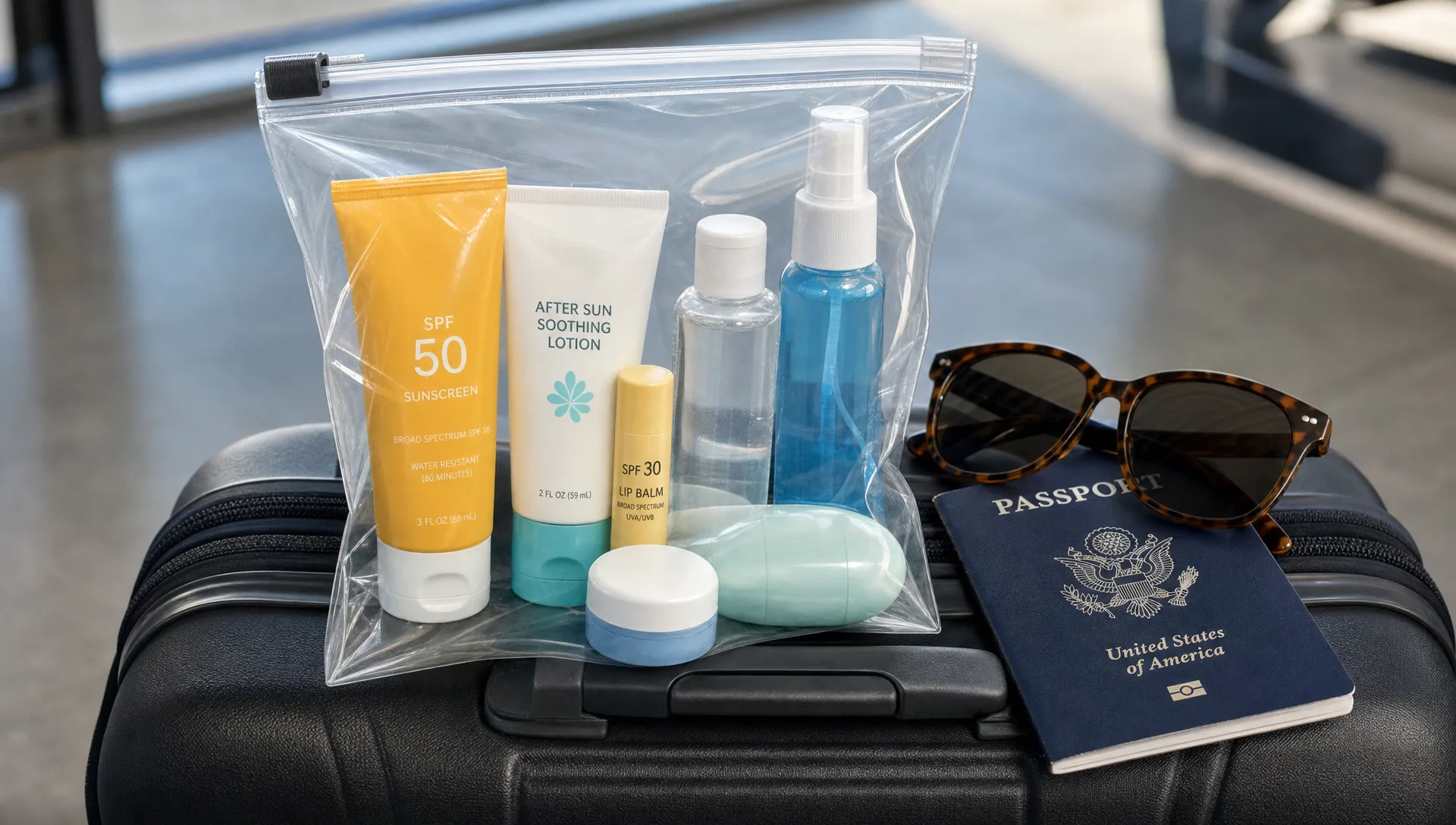
Put lotion, cream, gel, spray and roll-on sunscreen in your liquids bag where required. Many airports still expect all liquid toiletries to fit inside a single transparent, resealable bag. Do not bury sunscreen at the bottom of your carry-on, especially if the airport still requires liquids to be removed for screening.
For leak prevention, squeeze excess air out of soft tubes, tighten caps and place the sunscreen inside a small reusable pouch or plastic bag. Cabin pressure changes can make poorly sealed bottles leak, and sunscreen is particularly annoying to clean from clothes, electronics or travel documents.
A good hand luggage setup for a short trip is simple: one 100 ml face or body sunscreen tube, one small lip balm with SPF and a solid sunscreen stick for touch-ups. For a beach holiday, pack your full size bottle in checked luggage or plan to buy one after arrival.
What about sunscreen sprays and aerosols?
Spray sunscreen is allowed on many flights, but it needs a little more attention than a regular tube. In cabin baggage, aerosol sunscreen is usually covered by the same liquid limit, so the can must be 100 ml / 3.4 oz or smaller when the standard rule applies.
In checked luggage, larger toiletry aerosols are usually permitted within safety limits. The US Federal Aviation Administration’s PackSafe guidance for aerosols states that medicinal or toiletry aerosols in checked bags are limited to a total of 2 kg or 2 liters per person, with each container no larger than 0.5 kg or 0.5 liters. Release valves must be protected by a cap or other suitable means.
Airlines and countries can apply their own restrictions, especially for pressurized, flammable or unusually large products. If your sunscreen spray is a normal personal care aerosol and the can is not damaged, it is usually straightforward. If you are packing several aerosols for a long trip, check your airline’s dangerous goods page before flying.
Can you bring enough sunscreen for a beach trip?
A single 100 ml tube may not be enough for a week in strong sun. The American Academy of Dermatology says most adults need about 1 ounce of sunscreen to cover exposed skin, and sunscreen should be reapplied about every two hours when outdoors, as well as after swimming or sweating. That amount adds up quickly.
For longer trips, you have a few practical options:
- Pack full size sunscreen in checked luggage and keep a 100 ml tube in your hand luggage for the travel day.
- Buy sunscreen after arrival, especially if you are going to a resort area where familiar SPF products are easy to find.
- Use solid sunscreen sticks for face, ears and touch-ups, then use lotion for larger areas.
- Split travel size tubes between travelers, as each passenger usually has their own liquids allowance.
- Check your exact route before relying on a larger bottle in cabin baggage.
If you are flying from the UK to a sunny European destination, rules can look familiar but the details still matter. For example, the Liquid Limits route page for sunscreen from the UK to Spain explains the security, baggage and customs angle for that specific journey. A return or onward route can be different, such as sunscreen from France to the UK, which is why checking the whole trip is safer than checking only your departure airport.
Can medical sunscreen be exempt from the liquid limit?
Some travelers need specific sun protection because of a medical condition, medication sensitivity, recent treatment or a dermatologist’s instructions. Security agencies often have separate processes for medically necessary liquids, but regular holiday sunscreen should not be packed on the assumption that it will qualify for an exemption.
If you genuinely need a specific sunscreen for medical reasons, carry supporting documentation where possible and declare it at security before screening. Keep it separate from your standard liquids bag. Even then, allow extra time, because officers may need to inspect it.
For most travelers, the simpler approach is to keep cabin sunscreen at 100 ml or less and pack larger quantities in checked luggage.
Can you buy sunscreen after security?
Yes, buying sunscreen after security is usually fine. Shops after security commonly sell toiletries in larger sizes, especially in airports serving holiday destinations. The catch is onward screening.
If you have a direct flight and no further security checks, a full size bottle bought airside is usually low risk. If you have a connection, especially an international one, you may need to pass through security again. At that point, your newly purchased 200 ml sunscreen could be treated like any other oversized liquid unless it is packed in an official sealed tamper-evident bag and accepted by the connecting airport.
Duty-free rules are designed mainly for sealed purchases, but acceptance can vary. Keep receipts and do not open sealed bags before your final destination. If the item is ordinary sunscreen rather than a duty-free purchase in a sealed security bag, do not assume it will survive a connection.
Common sunscreen packing mistakes
The most common mistake is packing a full size bottle in hand luggage because it is nearly empty. Security checks the container size, not the amount left inside.
Another mistake is forgetting that sunscreen spray counts too. A 150 ml aerosol can is not cabin-compliant at airports enforcing the 100 ml rule, even if it feels small compared with a regular bottle.
Travelers also get caught by return flights. They buy a large sunscreen bottle abroad, use half of it, then try to bring it home in cabin baggage. If the return airport uses the 100 ml rule, the bottle belongs in checked luggage or it may be confiscated.
Finally, do not assume that every airport in the same country applies the newest liquid rules. Scanner rollouts have been uneven, and temporary restrictions can be introduced. Checking the latest airport-specific rule before you pack is much easier than repacking at security.
Sunscreen in hand luggage checklist
Before you leave for the airport, run through this quick check:
| Question | Safe answer |
|---|---|
| Is the sunscreen container 100 ml / 3.4 oz or smaller? | Yes, for standard cabin liquid rules |
| Is it in the liquids bag if required? | Yes |
| Is any full size bottle packed in checked luggage? | Yes |
| Is aerosol sunscreen capped and within airline limits? | Yes |
| Have you checked the return airport and connections? | Yes |
| Is medical sunscreen declared separately if over the limit? | Yes, with documentation where possible |
If you are unsure about one airport on your journey, pack as if the 100 ml rule applies. It is the least risky option and usually the easiest way to get through security without losing your sunscreen.
Frequently Asked Questions
Can I bring 200 ml sunscreen in hand luggage? Usually no. At airports using the standard liquid rule, sunscreen in hand luggage must be in a container of 100 ml / 3.4 oz or smaller. A 200 ml bottle should go in checked luggage unless your exact airport and route allow larger liquids.
Does sunscreen count as a liquid on a plane? Lotion, cream, gel, roll-on and spray sunscreen are normally treated as liquids, gels, creams or aerosols at airport security. Solid sunscreen sticks are usually different if they are truly solid.
Can I take sunscreen spray in my carry-on? Yes, if it meets the cabin liquid size limit. At standard airports, that means the spray container must be 100 ml / 3.4 oz or smaller and fit in your liquids bag.
Can sunscreen go in checked luggage? Yes, full size sunscreen can usually go in checked luggage. Aerosol sunscreen is also usually allowed as a toiletry aerosol, but quantity and container size limits apply.
Does sunscreen stick need to go in the liquids bag? A truly solid sunscreen stick usually does not need to go in the liquids bag. If the product is soft, creamy or gel-like, security may treat it as a liquid.
Can I bring sunscreen on an international flight? Yes, but the strictest airport on your route matters. Departure, connection and return airports may apply different cabin liquid rules, so check the full journey before packing.
Check your sunscreen rule before you pack
Sunscreen is allowed on flights, but the right packing choice depends on the container, product type and airports on your route. If you want a fast answer for your exact trip, use Liquid Limits to check sunscreen rules by airport, item and route, including the return flight. It shows the stricter cabin liquid rule side by side with verified sources and last-checked dates, so you can pack without guessing.