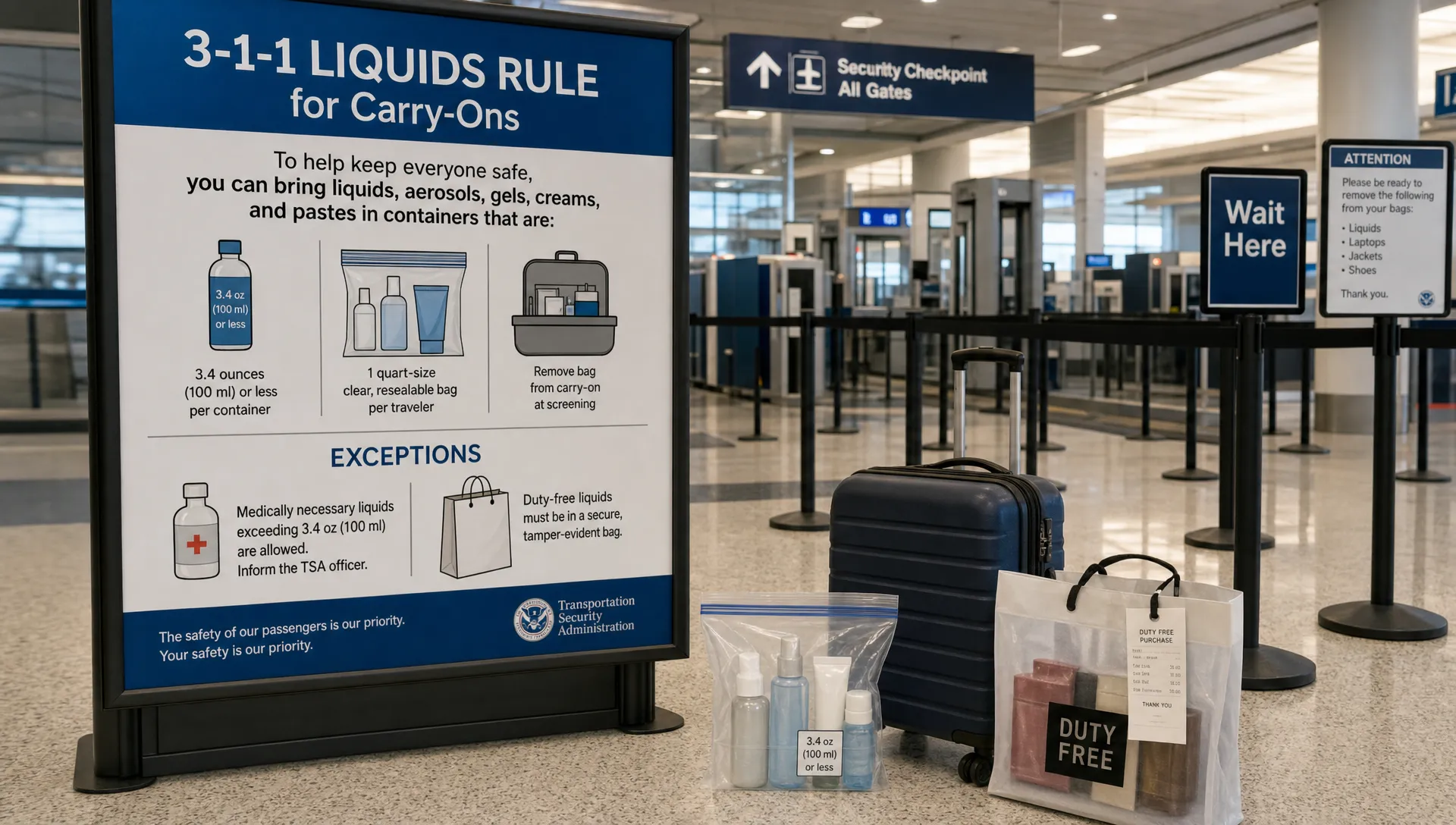
Most travelers know there is a liquid rule. Fewer travelers remember that the rule is applied at the security checkpoint in front of them, not the one they flew through last month, not the airline they booked, and not necessarily the airport they started from.
That is why carry-on liquid limits still catch people out. The mistake is rarely a full-size shampoo bottle sitting proudly on top of the bag. It is usually something smaller and easier to miss: a half-used 200 ml sunscreen, a jar of peanut butter, a duty-free bottle during a connection, a medicine exemption packed too deep, or a return airport with stricter screening than the outbound flight.
This guide focuses on the traps, not just the basic rule. If you want the foundational version, see this clear refresher on how much liquid is allowed in hand luggage. If you already know the 100 ml rule, use the sections below to avoid the details that still cause delays, repacking, and confiscation.
The rule everyone thinks they know
In many airports, the practical cabin rule is still this: liquids, aerosols, gels, creams, and pastes must be in small containers, often no larger than 100 ml or 3.4 oz, and they may need to fit inside a clear resealable liquids bag.
The exact wording varies by country. The TSA liquids rule in the United States uses the familiar 3-1-1 format: 3.4 oz containers, one quart-sized bag, one bag per passenger. The UK government hand luggage guidance and the European Commission guidance on liquids, aerosols, and gels also explain restrictions and exemptions, although local airport procedures can differ.
The part travelers miss is that liquid limits for carry on luggage are not only about the item. They are also about the airport, route, transfer point, screening equipment, and current local instructions. In 2026, some airports have modern scanners and different processes, but that does not mean every passenger on every route can bring large liquids through security.
When in doubt, pack for the strictest checkpoint on the whole trip.
Why carry-on liquid limits still catch travelers out
Liquid rules feel universal, but they are not experienced universally. A traveler may fly out of an airport with relaxed screening, connect somewhere with the standard 100 ml limit, then return from an airport that has different bag presentation rules. That same bottle can be allowed, questioned, or confiscated depending on where it is screened.
Security rules can also change faster than packing habits. Airports may introduce new scanners, pause relaxed rules, apply them only in certain terminals, or require passengers to follow the older 100 ml process when a lane is unavailable. The traveler sees one airport marketing message about new technology and assumes the old rules are gone everywhere. They are not.
There is also a classification problem. Most people understand that water, perfume, and shampoo are liquids. Fewer people think of mascara, lip gloss, hummus, jam, snow globes, soft cheese, hair gel, toothpaste, or spray deodorant as items that may fall under liquid, aerosol, gel, paste, or cream restrictions. If it can be spread, squeezed, sprayed, poured, smeared, or has a gel-like texture, security may treat it as a liquid-type item.
For a deeper item-by-item overview, this guide to common items airport security treats as liquids is useful before you pack toiletries, food gifts, cosmetics, or travel snacks.
The mistakes that cause the most airport surprises
Packing for the outbound flight only
The most common trap is checking the airport you leave from and forgetting the return. This is especially risky on city breaks and multi-country trips where the return airport is not the same as the outbound airport. You may depart from a checkpoint that allows a smoother process, then return through a terminal still applying the stricter 100 ml container rule.
A smart packing rule is simple: if one airport on your trip requires 100 ml containers, pack your cabin liquids that way from the beginning. It avoids buying full-size items abroad that you cannot bring back in your carry-on.
Trusting the airline instead of the airport
Airlines set baggage size, weight, and onboard policies. Airport security controls what passes through screening. Your airline app may remind you about cabin bag dimensions, but it may not tell you the exact liquid rule at your departure checkpoint.
If an airline page and an airport security page seem to conflict, check the airport and official security authority first. For liquids, the person making the decision is at the checkpoint.
Forgetting that container size matters
A half-empty 200 ml bottle is still a 200 ml container. This catches travelers constantly with sunscreen, face wash, contact lens solution, and premium skincare. The rule is normally based on the maximum capacity printed on the container, not the amount left inside.
If the container is too large, decant it into a travel-size bottle before leaving home. Do not rely on being able to explain that it is almost empty.
Treating gel-like foods as snacks, not liquids
Food is one of the easiest categories to misjudge. Solid chocolate, crackers, and sandwiches are usually less of a liquid-rule issue. Spreadable, creamy, semi-liquid, or jarred foods are different.
Think carefully about foods such as nut butter, honey, jam, yogurt, dips, sauces, soft cheese, and soups. Even if they are sealed gifts, security may treat them like liquid or gel items in cabin baggage. If the container exceeds the local cabin limit, checked baggage is usually safer.
Assuming duty-free liquids are always safe
Duty-free liquids can be allowed under specific conditions, often involving a sealed tamper-evident bag and proof of purchase. The problem appears during connections. A bottle bought after security at one airport may need to pass another security checkpoint before your next flight.
If the seal is broken, the receipt is missing, the transfer country has stricter rules, or the item cannot be verified, it may not make it through. This matters most on long-haul routes with international connections.
Hiding medicines and baby items at the bottom of the bag
Medicines, baby milk, baby food, and special dietary liquids may qualify for exemptions in many jurisdictions, but exemptions do not mean no screening. You may be asked to present the items separately, explain the need, or allow additional checks.
Keep essential exempt items accessible. For prescription medicines, original packaging and supporting documentation can help, especially for international travel. Never pack medically necessary liquids in a way that forces you to unpack your entire bag under pressure.
Believing new scanners remove all restrictions
Modern CT scanners can make liquid screening easier, and some airports have changed their passenger process where approved. But scanner rollouts are uneven. A single airport may have different equipment by terminal, lane, destination type, or operational status.
Do not assume that a relaxed rule at one airport applies to your next airport. Also do not assume it applies on your return. If the rule is unclear, the safer packing choice is still 100 ml containers in a clear bag.
Bringing the right liquids in the wrong place
Sometimes the issue is not whether the item is allowed, but where you packed it. Cabin liquids need to be available for screening if the airport requires presentation. Checked baggage can take larger toiletries, but it has its own safety rules for aerosols, flammables, alcohol, and dangerous goods.
A large bottle of shampoo is usually a checked-bag item. A large aerosol or high-strength alcohol may need extra checking before it goes anywhere. Liquids are not automatically fine just because they are outside your carry-on.
| Scenario | What catches travelers out | Safer move |
|---|---|---|
| Half-used sunscreen | The bottle capacity is over 100 ml | Use a 100 ml travel bottle or check it |
| Return flight from another airport | The return checkpoint is stricter | Pack to the strictest airport on the route |
| Duty-free bottle during a transfer | Another security screening may apply | Keep it sealed with receipt and check transfer rules |
| Peanut butter or jam | Spreadable food may count as a liquid or gel | Put larger jars in checked baggage |
| Medicine over 100 ml | Exemptions may require separate screening | Keep it accessible with documentation if relevant |
| Airport with new scanners | Not every lane or route may use relaxed rules | Verify the specific airport and terminal before packing |
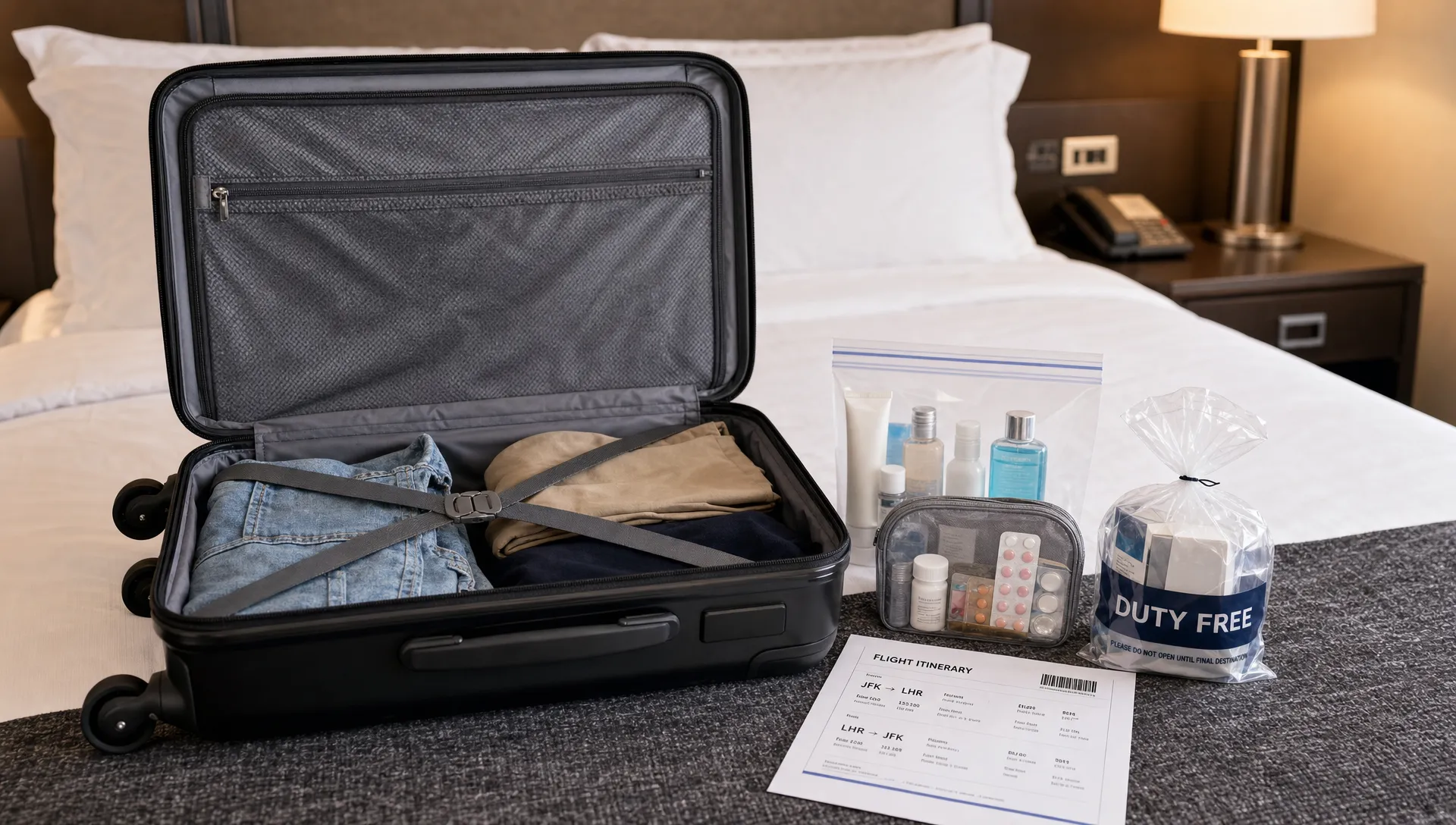
A practical way to pack for the strictest checkpoint
The easiest way to avoid liquid problems is to stop thinking of your trip as one flight. Think of it as a chain of screening points. Your packing only works if it passes the strictest link in that chain.
Before you zip your cabin bag, check these points:
- Each departure airport, including the return airport
- Any airport where you must clear security again during a connection
- Whether your specific item is treated as a liquid, gel, aerosol, cream, or paste
- Whether medicine, baby food, or special dietary items need separate screening
- Whether duty-free purchases will remain sealed and valid through transfers
This is also where route-based checking matters. Looking up only a country-level rule can miss local differences. Looking up only the outbound airport can miss the return. Looking up only the item can miss the fact that one airport on the itinerary is stricter.
Liquid Limits is built around that problem. You can check your trip on Liquid Limits by airport, item, or route, including round trips where the return flight may have different restrictions. The tool shows verified guidance, source links, and last-checked dates, and it defaults to the stricter 100 ml rule when the rule is unclear.
What belongs in your carry-on, and what is better checked
There is no perfect packing list for every traveler, but there is a reliable decision pattern. Keep small essentials in your carry-on, move full-size liquids to checked baggage when possible, and never place mission-critical medicine somewhere you cannot access it.
| Item type | Carry-on approach | Checked-bag approach |
|---|---|---|
| Daily toiletries | Use containers within the local cabin limit | Pack full-size bottles if airline and safety rules allow |
| Cosmetics | Treat creams, gels, mascara, and gloss as liquid-type items | Check larger products or non-essential duplicates |
| Food gifts | Carry only solid items or compliant small containers | Check jars, sauces, spreads, and liquids |
| Medicines | Keep necessary amounts accessible for screening | Avoid checking essential medicine when possible |
| Baby supplies | Keep what is needed for the journey accessible | Pack extra supplies in checked baggage if suitable |
| Duty-free liquids | Keep sealed with receipt and check connection rules | Consider buying at the final airport if transfer risk is high |
For frequent flyers, the best habit is to maintain a small ready-to-go liquids kit. Use clearly labeled travel bottles, leave extra space in the clear bag, and replace products before they leak or lose their labels. Security staff should not have to guess the size of a container.
International trips add another layer of admin
Liquid rules decide what can pass through airport security. Border rules decide whether you can enter or transit a country. They are separate checks, but travelers often experience them as one stressful pre-flight problem.
If you manage travel for customers, groups, or employees, it helps to separate packing compliance from entry compliance. Services that simplify travel visa administration exist because border paperwork can be just as route-specific as airport liquid rules. For individual travelers, the lesson is the same: check security rules and entry requirements before the airport day, not at the counter.
Quick examples that show why the details matter
A traveler flying New York to London with no checked bag may pass TSA with a compliant quart bag, buy a large skincare product in London, and then discover the return airport requires the 100 ml cabin limit. The product is not wrong. The packing plan is.
A family connecting through a major hub may bring baby milk correctly, but pack it underneath coats and electronics. The item may be allowed, yet the screening process becomes stressful because it is not easy to present separately.
A business traveler may rely on an airport with new scanners at home, then connect through an older terminal abroad. The full-size toiletries that were fine at the first checkpoint may not be fine at the second.
In each case, the fix is not complicated. The traveler needed to check the whole route, identify the strictest rule, and pack exceptions so they are easy to screen.
Frequently Asked Questions
What are the usual liquid limits for carry-on luggage? In many airports, liquids, aerosols, gels, creams, and pastes in carry-on bags must be in containers of 100 ml or 3.4 oz or less, often inside a clear resealable bag. Some airports may have different procedures, so check the actual departure and transfer airports.
Does the 100 ml rule mean the amount left in the bottle? Usually no. The container capacity is what matters. A half-empty 200 ml bottle can still be rejected because the bottle itself is over the limit.
Can I bring full-size liquids if an airport has CT scanners? Only if that airport, terminal, and checkpoint are officially applying rules that allow it. Scanner technology does not automatically remove liquid limits on every route or at every lane.
Do medicines count as liquids? Liquid medicines may be treated as liquids for screening, but many places allow medically necessary amounts as an exemption. Keep them accessible, declare or present them when required, and carry supporting documentation when it may help.
Are duty-free liquids allowed through connecting flights? Sometimes, but they usually need to remain sealed in an approved tamper-evident bag with proof of purchase, and connection rules can vary. If you must clear security again, check the transfer airport before buying.
Check before security decides for you
Carry-on liquid limits are easy to follow when you know the exact checkpoint rule. They are frustrating when you rely on memory, airport rumors, or an outbound-only search.
Before your next trip, check the airports, items, route, and return flight. If any part of the journey is unclear, pack to the stricter 100 ml rule. It is the simplest way to protect your toiletries, gifts, medicines, and duty-free purchases from last-minute surprises at security.