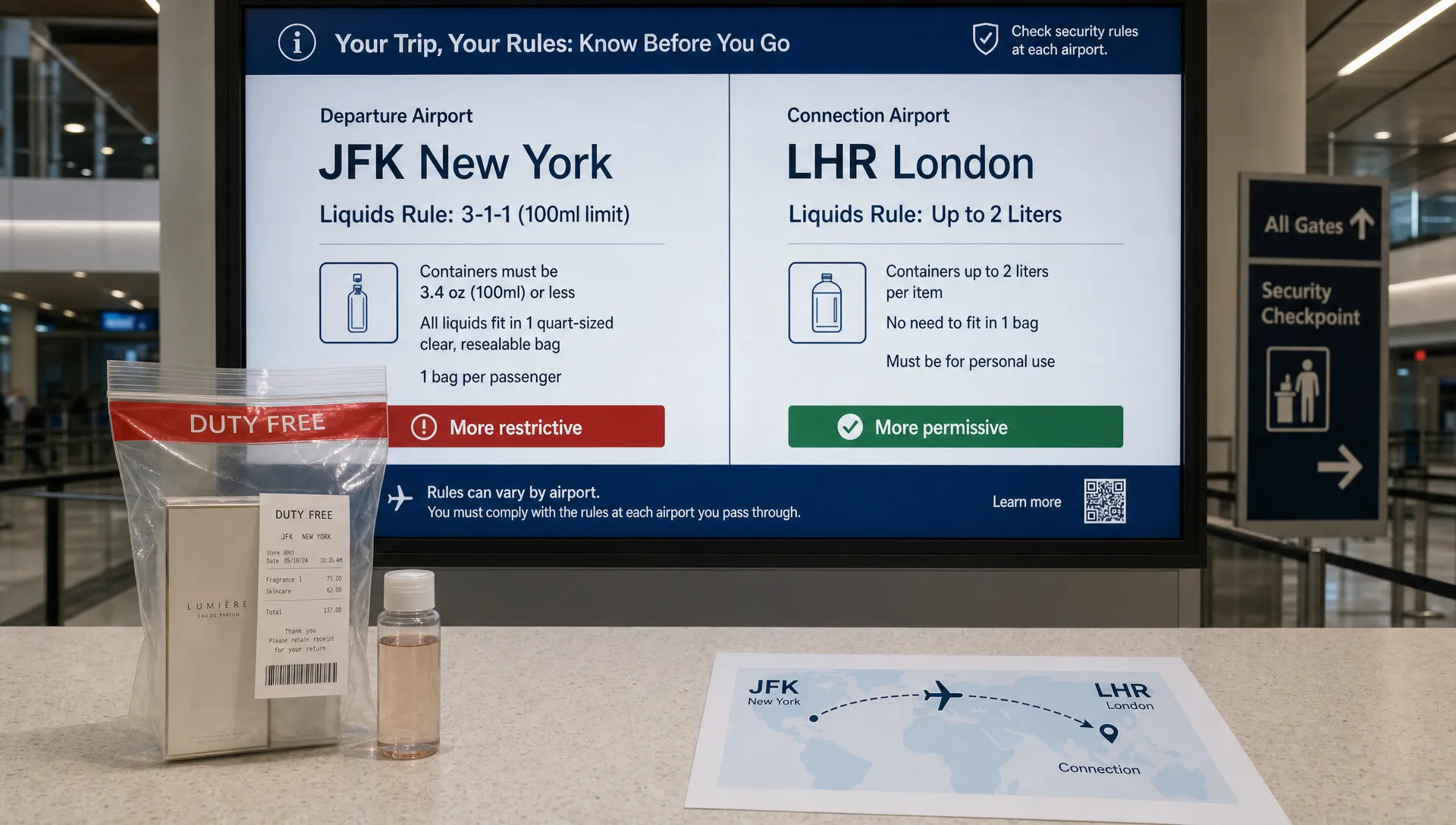
Most travelers think they understand carry-on luggage liquid restrictions until a half-used bottle of shampoo, a jar of peanut butter, or a sealed duty-free bag gets questioned at security. The problem is rarely that people ignore the rules completely. More often, they read the rule in the wrong way.
The liquid rule is not just about “small toiletries.” It is about container size, screening airport, transfer airports, item texture, exemptions, and sometimes the return journey. If any one of those pieces is misunderstood, a perfectly normal item can become a bin-side surrender.
Below are the liquid restrictions travelers most often misread, and how to interpret them before you pack.
Why these rules are so easy to misread
Airport liquid rules look simple when summarized as “100ml” or “3.4oz.” In practice, that shorthand hides several details. The TSA liquids rule, for example, covers liquids, aerosols, gels, creams, and pastes in travel-sized containers of 3.4 ounces or 100 milliliters or less. Many other countries use similar wording, often with a clear resealable bag requirement.
But similar does not mean identical. Some airports have newer screening technology and may allow larger liquids at certain checkpoints. Other airports still apply the classic 100ml limit. A route with a departure, connection, and return airport can involve more than one rule, and the strictest checkpoint is usually the one that matters most.
That is why reading the rule as a single universal number can lead to mistakes. If you want the bigger picture first, Liquid Limits has a plain-English guide to hand luggage liquid restrictions that explains the basic rule before you get into the common misreads below.
The carry-on liquid mistakes at a glance
| What people think the rule means | What it usually means | Why it matters |
|---|---|---|
| “My bottle only has 50ml left.” | The container must usually be 100ml or less, regardless of what is left inside. | A nearly empty 200ml bottle can still be refused. |
| “It is not a drink, so it is not a liquid.” | Gels, creams, pastes, aerosols, and spreadables often count. | Toothpaste, mascara, sunscreen, and jam may be restricted. |
| “The airline approved my bag, so liquids are fine.” | Airlines set baggage size and weight rules, while security applies liquid screening rules. | Your cabin bag can meet airline rules and still fail security. |
| “This airport has new scanners, so I can bring big bottles.” | Scanner rules vary by airport, terminal, checkpoint, and date. | A 2L-friendly airport on one trip may not help on your connection or return. |
| “Duty-free is always allowed.” | Duty-free liquids often need to stay sealed in an approved security bag with proof of purchase. | Transfer screening can still create problems. |
| “Medicines are exempt, so no screening applies.” | Essential medicines may be allowed above 100ml, but they can still require inspection. | You may need to separate them and allow extra time. |
| “The rule applies only on the outbound flight.” | Return and connecting airports may apply different restrictions. | A bottle bought abroad may not pass on the way home. |
Misread 1: the 100ml limit is usually about container size
This is the mistake that catches even careful travelers. The standard rule is generally based on the capacity printed on the container, not the amount of liquid remaining inside it.
If your 200ml face wash is half empty, it is still a 200ml container. If your 150ml perfume bottle has only a few sprays left, it may still be too large for a checkpoint applying the 100ml rule. Security officers usually do not measure what remains inside, because the rule is designed around container capacity.
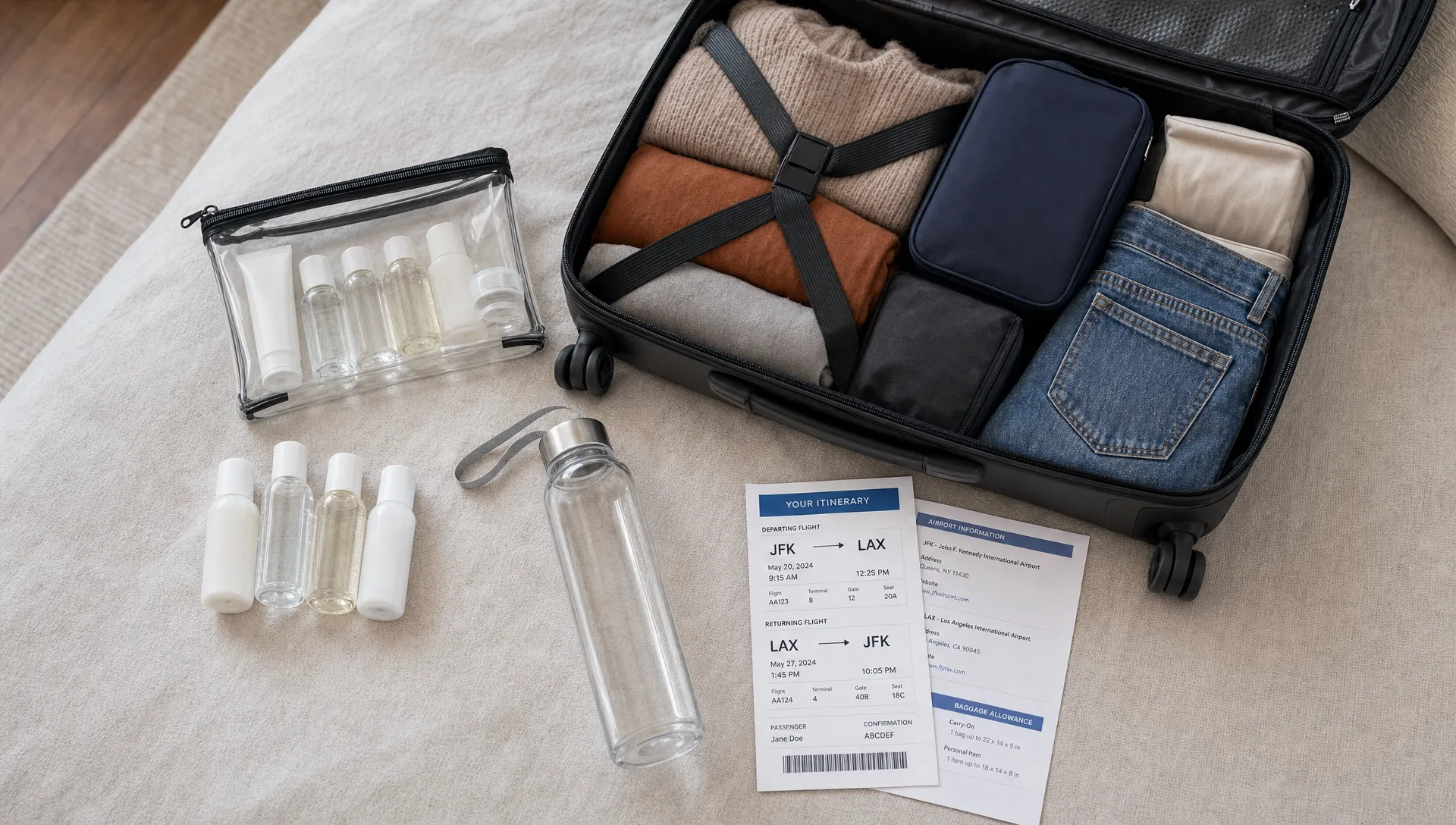
The practical fix is simple: decant liquids into bottles clearly marked 100ml or smaller. If the bottle has no capacity label, choose one that does. Unmarked containers can slow screening, especially in airports where staff apply the rule strictly.
This also explains why “travel size” can be misleading. Some travel toiletries are 120ml, 125ml, or 150ml. They look small, but they may not meet the 100ml requirement.
Misread 2: the plastic bag is not just for organization
Many travelers treat the clear liquids bag as a neat packing trick. At many airports, it is part of the rule.
In the U.S., the TSA’s “3-1-1” shorthand means containers of 3.4oz or less, placed in one quart-sized bag, with one bag per passenger. In the UK, the government hand luggage restrictions commonly refer to containers of no more than 100ml inside a single transparent resealable plastic bag holding no more than 1 liter.
The exact bag size language can differ, but the idea is similar: your small containers usually need to fit comfortably in a clear, resealable bag. Overstuffing the bag, carrying several liquid bags, or hiding bottles across multiple pockets can cause delays or refusals.
A good test is whether the bag can close without stretching. If it cannot, reduce what you pack or move non-essential liquids to checked luggage.
Misread 3: “liquid” includes more than water, shampoo, and perfume
Airport liquid restrictions are broader than the everyday meaning of liquid. Security rules usually include items that can be poured, squeezed, spread, sprayed, smeared, or gelled.
Commonly misread items include:
- Toothpaste, mouthwash, shaving gel, hair gel, and styling cream.
- Mascara, liquid eyeliner, lip gloss, foundation, concealer, and cream blush.
- Sunscreen, insect repellent, aftershave, deodorant sprays, and aerosols.
- Peanut butter, honey, jam, hummus, soft cheese, sauces, and pastes.
- Snow globes, liquid-filled souvenirs, and gel ice packs that are not fully frozen.
This is where travelers often get frustrated, because an item may not “feel” like a liquid. A jar of peanut butter does not spill like water, but it is spreadable. A tube of toothpaste is not a drink, but it is a paste. A mascara wand looks like makeup, but the product is a liquid cosmetic.
If an item changes shape to its container, can be smeared, or is dispensed as a gel, cream, spray, or paste, treat it as a liquid unless the airport specifically says otherwise.
Misread 4: newer scanners do not create one global rule
Some airports use advanced CT cabin baggage scanners that can, in certain circumstances, allow passengers to keep liquids in bags or carry larger containers. This has made liquid rules more confusing, not less.
The mistake is assuming that one modern airport changes the rules for your whole trip. It does not.
A route can include multiple screening points. You may depart from an airport with relaxed rules, connect through a stricter airport, then return from a different airport that applies the 100ml limit. Even within the same country, implementation can differ by airport and terminal. Rules can also change when regulators adjust security requirements.
This is why travelers should plan by checkpoint, not by rumor. If one part of your journey applies the 100ml rule, pack as if the 100ml rule applies to the whole route unless you are certain you will not be rescreened.
For multi-airport trips, the safest approach is planning around the strictest security checkpoint on your route, especially when you have a return flight or self-transfer.
Misread 5: exemptions are real, but not automatic
There are important exemptions for certain items, especially medicines, baby food, baby milk, infant formula, and special dietary needs. These can often exceed the usual 100ml limit when they are necessary for the journey.
The misread is thinking “exempt” means “do whatever you want.” It usually does not. Exempt items may need to be presented separately, screened by security staff, opened for inspection, or verified in some way. Airports may also use wording such as “reasonable quantity,” which leaves room for judgment.
If you are carrying medically necessary liquids, keep them easy to access. Do not bury them at the bottom of your cabin bag. Prescriptions, labels, or doctor documentation can help, especially internationally, although requirements vary by country and item.
For baby supplies, pack only what you reasonably need for the journey and possible delays. If you are flying with a child, these exemptions are usually more flexible than standard toiletries, but they are still subject to screening.
Misread 6: duty-free liquid is not a magic exception
Duty-free purchases can be one of the most confusing parts of carry-on liquid rules. Many travelers assume that once a bottle is bought airside, it is cleared forever. That is not always how it works.
Duty-free liquids are often allowed when they are packed in a sealed security tamper-evident bag, sometimes called a STEB, with the receipt visible inside. The issue arises when you connect through another airport and have to pass through security again. If the bag is opened, damaged, missing a receipt, or not accepted by the transfer airport, the item may be refused.
This matters most for alcohol, perfume, cosmetics, and specialty liquids bought during international travel. If you have a direct flight, the risk is usually lower. If you have a connection, especially across different countries or security regimes, check the transfer airport’s current rule before buying.
A simple rule of thumb: if losing it would be expensive or upsetting, do not assume duty-free will survive every connection.
Misread 7: “carry-on approved” does not mean “security approved”
Airlines and airport security answer different questions.
Your airline decides whether your bag is the right size, weight, and fare type for the cabin. Airport security decides whether the contents can pass the checkpoint. These systems overlap during your travel day, but the rules are not the same.
This is why a cabin bag can be accepted at check-in or boarding but still contain liquids that security will not allow. It is also why airline customer service pages may not be the best source for detailed liquid screening rules. They may summarize common guidance, but the airport and national security authority are more relevant at the checkpoint.
When in doubt, follow the strictest official source for the airport where you will be screened.
Misread 8: checked luggage and carry-on are not interchangeable rules
Many liquids that are restricted in carry-on bags can go in checked luggage, but that does not mean checked bags are rule-free. Flammable items, certain aerosols, high-proof alcohol, chemical products, and pressurized containers may be restricted or banned in checked baggage too.
For normal toiletries, checked luggage is often the easiest solution if you need full-size bottles. Seal caps tightly, place bottles in leakproof bags, and consider pressure changes during flight. For high-value skincare or medication, checked luggage may not be wise because bags can be delayed or lost.
The best packing decision depends on the item:
- Put everyday full-size toiletries in checked luggage when allowed.
- Keep essential medicines in carry-on, separated for screening if over 100ml.
- Carry an empty reusable water bottle through security, then fill it after screening.
- Avoid buying large liquids before a connection unless you know transfer rules.
A simple way to read the rule before every trip
Instead of asking “Can I bring liquids?” ask a more specific question: “Can this item, in this container, pass every security checkpoint on my route?”
That question forces you to check the parts most people miss. What is the container capacity? Does the item count as a liquid, gel, cream, paste, or aerosol? Will you be screened only once, or again during a connection? Are you returning from an airport with stricter rules? Is the item exempt, or just something you would rather keep in your cabin bag?
For the least stressful packing, use this quick method:
- Pack standard toiletries in containers marked 100ml or less.
- Use one clear resealable liquids bag unless your airport clearly says otherwise.
- Treat gels, creams, pastes, aerosols, and spreadable foods as liquids.
- Check departure, transfer, and return airports, not just the first flight.
- If a rule is unclear, assume the stricter 100ml version.
Liquid Limits is built around that stricter-route mindset. You can check airport rules, item-specific guidance, and routes with daily updates, source links, and last-checked dates. When a rule is unclear, the safer default is the stricter 100ml interpretation.
Frequently Asked Questions
Do carry-on liquid restrictions apply to the amount left in the bottle or the bottle size? They usually apply to the container size. A 200ml bottle with only 50ml remaining can still be refused at a checkpoint using the 100ml rule.
Does makeup count as a liquid in carry-on luggage? Some makeup does. Mascara, liquid eyeliner, foundation, concealer, lip gloss, and cream products are commonly treated as liquids, gels, or creams. Solid powder products are generally different, but local rules can still vary.
Can I bring an empty water bottle through airport security? In most cases, yes. An empty reusable bottle is usually allowed through security and can be filled after the checkpoint. It must be empty when screened.
Are medicines allowed above 100ml? Medically necessary liquids may often exceed 100ml, but they should be separated for screening and may be inspected. Carry labels or documentation when possible, especially for international trips.
Can I bring duty-free alcohol on a connecting flight? Sometimes, but it depends on transfer screening rules. Keep it sealed in the official tamper-evident bag with the receipt visible, and check the connection airport before buying.
What should I do if one airport says 2L and another says 100ml? Pack for the stricter airport unless you are certain you will not pass through that checkpoint with the liquid. For round trips and connections, the strictest rule is usually the safest planning standard.
Check the strictest liquid rule before you pack
The easiest way to avoid misreading carry-on liquid restrictions is to check the exact trip, not just a generic rule. Use Liquid Limits to compare liquid rules for your airports, items, route, and return flight before you pack your bag.