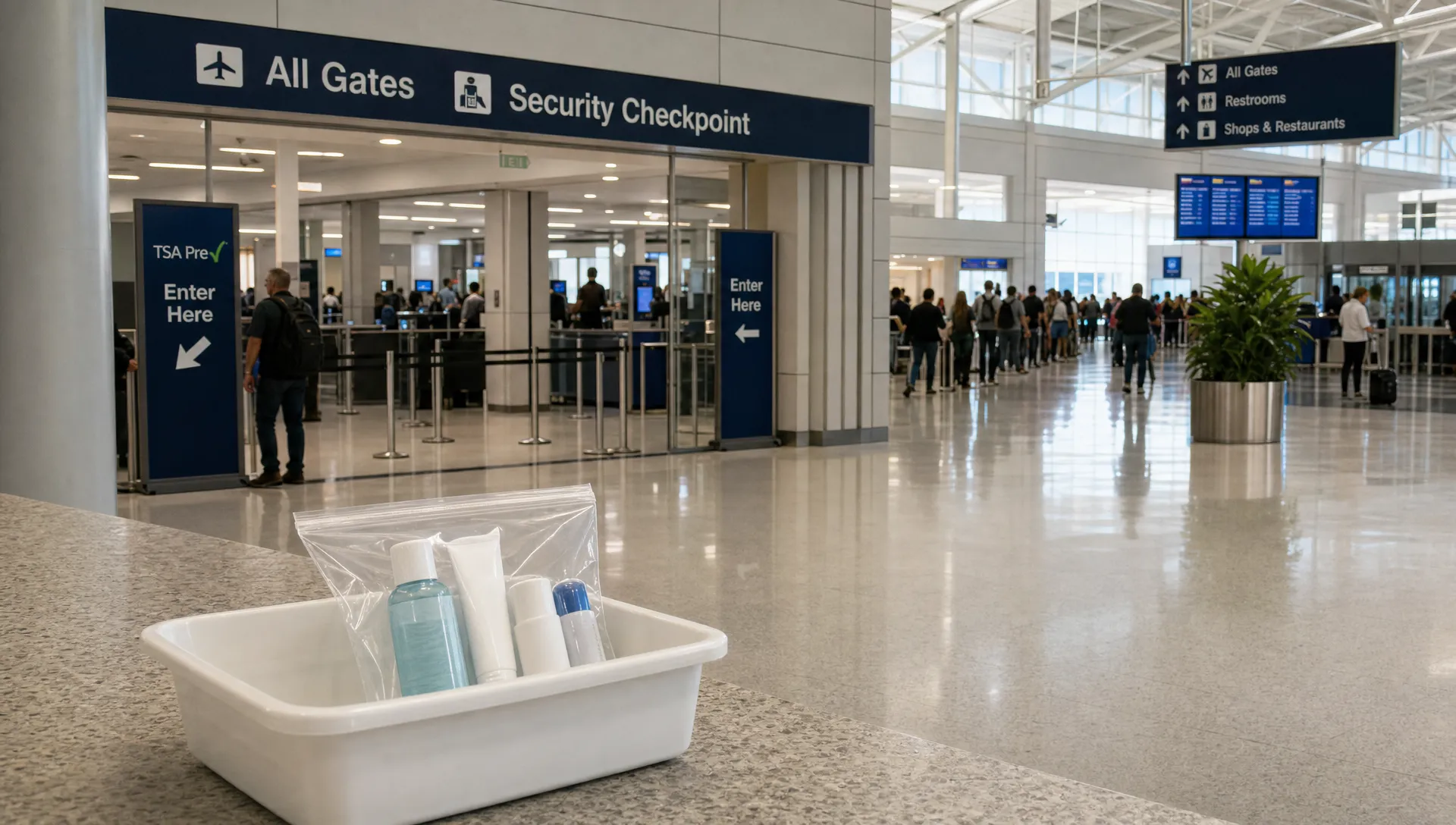
The most common carry-on luggage 100ml mistake is deceptively simple: travelers think security is judging how much liquid is left. At many airport checkpoints, officers are judging the container.
That means a 150ml shampoo bottle with only a spoonful left can still be treated as too large. A 4 fl oz sunscreen may look close enough, but it is usually about 118ml. A reusable travel bottle with no volume marking can create an avoidable conversation at the tray table.
If your goal is to get through security without losing toiletries, perfume, cosmetics or expensive skincare, start with the container before you think about the product.
The 100ml rule is a container rule first
Under the familiar airport liquids rule, liquids, aerosols and gels in cabin baggage are often limited to containers of 100ml or 3.4 fl oz each. In the United States, the TSA liquids rule describes this as 3.4 ounces or 100 milliliters per item, packed in a quart-sized bag. In many other countries, the rule is expressed as 100ml containers in a transparent resealable liquids bag.
The exact wording and bag size can vary by country, airport and scanner type. Some airports have introduced newer CT scanners with more generous limits, but travelers should not assume those rules apply to every checkpoint on a route. If you need the broader basics, Liquid Limits has a simple guide to hand luggage liquid rules that explains the standard setup without overcomplicating it.
For container mistakes, remember this principle: the printed capacity of the bottle matters more than the amount still inside it.
Mistake 1: Packing a half-empty bottle over 100ml
This is the classic mistake. You have a 200ml conditioner bottle that is nearly empty, so it feels wasteful to decant it. At security, the officer usually cannot verify the remaining amount with precision. They can verify the container label.
A bottle marked 125ml, 150ml, 200ml or 250ml is generally not compliant at a 100ml checkpoint, even if it is visibly almost empty. The same applies to tubes of toothpaste, face wash, sunscreen, lotion and shaving gel.
The safest fix is simple: decant what you need into a properly marked 100ml or smaller travel container before you leave home. If the product is expensive or hard to replace, do not gamble on a larger original bottle.
Mistake 2: Assuming 3.4 fl oz and 4 fl oz are basically the same
For US travelers, the ounce labels on toiletries are a common source of confusion. A bottle labeled 3 fl oz is usually fine for a 100ml checkpoint. A bottle labeled 3.4 fl oz is the standard TSA-friendly size. A bottle labeled 4 fl oz is not close enough, because 4 fl oz is roughly 118ml.
This matters for sunscreen, body wash, contact lens solution, setting spray and hair products sold in travel sections. Many small-looking bottles are designed for hotel stays, gym bags or handbags, not necessarily airport security.
When shopping for travel minis, read the actual capacity label. Do not rely on shelf placement, packaging claims or the word “travel.”
Mistake 3: Using refillable bottles with no capacity marking
Reusable silicone bottles are convenient, but some have no clear volume printed on the container. Others come in sets where the size is listed only on the packaging you threw away months ago.
At a strict checkpoint, an unmarked bottle can be harder to defend. Security staff may allow it if it is obviously small, but you are relying on discretion. That is not ideal when you are late, traveling internationally or connecting through a stricter airport.
Choose refillable bottles with permanent markings such as 30ml, 50ml, 75ml or 100ml. If the marking is printed on a removable label, it may peel off after a few washes. Embossed or molded markings are better.
Mistake 4: Filling a 100ml bottle so full it leaks or looks suspicious
A 100ml container is allowed at many checkpoints, but filling it to the brim is still poor packing. Cabin pressure changes, temperature shifts and squeezing inside your bag can make liquids expand or leak. A bulging bottle can also slow inspection if it looks overfilled or messy.
Leave a small air gap at the top, especially for shampoo, cleanser, lotion and oils. Use containers with secure caps, then place them inside the required clear liquids bag. For products that stain or smell strongly, such as hair dye, tanning drops or essential oils, add extra protection or pack them in checked baggage if possible.
Mistake 5: Forgetting that jars, tins and tubes count too
Many travelers think “liquid” means something that pours. Airport liquid rules usually cover a wider group: gels, creams, pastes, lotions, sprays, aerosols and semi-liquid foods. That means the container rule can apply to items that do not look like liquids at first glance.
Common examples include mascara, lip gloss, gel deodorant, toothpaste, balm in a soft pot, peanut butter, jam, cream cheese, hair wax and face masks. Solid stick deodorant is often treated differently from gel or aerosol deodorant, but rules can vary.
If you are unsure whether an item belongs in your liquids bag, check a reliable source before packing. Liquid Limits has a useful breakdown of which liquids are allowed in carry-on luggage, including items travelers often misclassify.
Mistake 6: Trusting “sample size” without checking the label
Sample sachets and mini jars are usually small enough, but not always easy to inspect. A flat sachet of hair mask might not show volume clearly. A luxury skincare sample may be marked in grams rather than milliliters. A tiny jar can look harmless, but if several are loose in your bag, security may still ask you to place them with your liquids.
Samples are best packed together in the clear liquids bag, not scattered through pockets. If an item has no visible size and you would be upset to lose it, pack a backup plan.
A related problem is combining many tiny containers until the clear bag no longer closes. At airports that enforce the bag rule, each container may be under 100ml, but the total must still fit in the permitted resealable bag.
| Container type | Likely outcome at a 100ml checkpoint | Why it causes issues |
|---|---|---|
| 50ml perfume bottle | Usually allowed if it fits in the liquids bag | Clearly under the container limit |
| 100ml shampoo travel bottle | Usually allowed if marked and bagged correctly | At the common maximum size |
| 118ml or 4 fl oz sunscreen | Usually not allowed | Over the 100ml or 3.4 fl oz limit |
| 150ml toothpaste tube, half empty | Usually not allowed | Container capacity is over the limit |
| Unmarked refillable bottle | May be questioned or refused | Capacity is unclear |
| 75ml jar of face cream | Usually allowed if treated as a liquid or cream | Creams normally count under liquid rules |
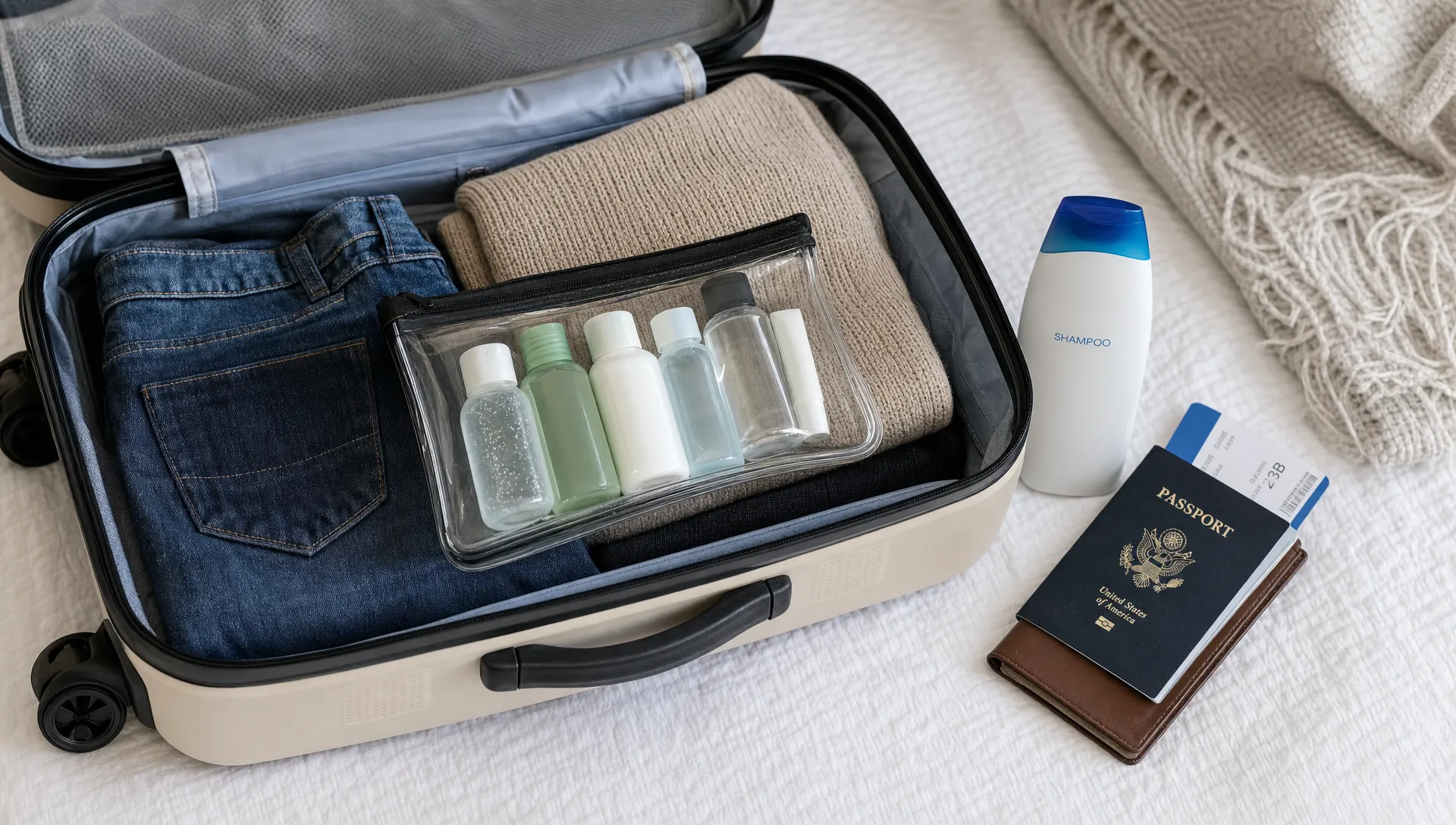
Mistake 7: Ignoring the cap, pump or spray mechanism
The container is not only the bottle body. Pumps, spray tops and caps can affect how practical the item is at security and in your bag. A 100ml pump bottle with a tall nozzle might not fit neatly in your liquids bag. A spray bottle without a locking cap can leak. An aerosol can may need a protective cap to prevent accidental release.
Aerosols also deserve extra care because airline and security rules may treat them differently depending on the product. Toiletry aerosols such as deodorant or shaving foam are commonly allowed within the liquid size limit, but flammable, industrial or non-toiletry aerosols can be restricted. If the label has hazard symbols, read it before packing.
For short trips, simpler containers are often better: screw-cap bottles, small jars with tight lids and solid alternatives where they work for you.
Mistake 8: Buying the right size but packing it in the wrong place
A compliant 100ml container can still cause a delay if it is buried in your carry-on. At airports that require liquids to be removed for screening, you may need to pull out the clear bag quickly. If your containers are loose in a toiletry pouch, side pocket or makeup case, repacking at the conveyor belt becomes stressful.
Pack your liquids bag near the top of your carry-on until you know whether it must be removed. If your airport uses scanners that allow liquids to stay inside the bag, follow the local instructions at the checkpoint. Do not argue based on what happened at another airport last month.
The UK government hand luggage guidance is a good example of why local rules matter: airports can have different equipment and passengers are told to check before they travel.
Mistake 9: Assuming your return airport uses the same rule
Container mistakes often appear on the return flight. You flew out through an airport with newer screening and no one cared about a larger bottle. Then you return through an airport that still enforces 100ml containers. Suddenly, the sunscreen you bought on vacation is a problem.
This is especially common on round trips, multi-city itineraries and connections through different countries. The liquid rule you face is not always the rule at your departure airport only. It can also be the rule at a transfer checkpoint or the rule on the return leg.
Before packing, check the strictest airport on your whole trip. If any security checkpoint on your route applies the 100ml rule, pack as if the 100ml rule applies to the cabin bag.
Mistake 10: Treating duty-free bags as a universal exception
Liquids bought after security are often allowed onto the first flight, but duty-free is not a magic pass for every connection. If you have a transfer where you go through security again, larger liquids may need to be in an approved sealed security bag with proof of purchase. Even then, acceptance depends on local rules and the condition of the sealed bag.
Do not open sealed duty-free liquids before your final security screening. Keep the receipt inside the bag if provided. If you are connecting internationally, check the rules for the transfer airport before buying large perfumes, spirits, skincare or olive oil.
If losing the item would ruin your day, consider buying it at your final destination or packing it in checked luggage where allowed.
A container-first packing checklist
Use this quick check before closing your carry-on. It catches most 100ml rule problems before the airport does.
- Check every liquid, gel, cream, paste, spray and aerosol container for its printed capacity.
- Remove anything over 100ml or 3.4 fl oz if your route includes a 100ml checkpoint.
- Use refillable bottles with clear permanent size markings.
- Keep all small containers in the required clear resealable liquids bag where that rule applies.
- Leave a little space inside refillable bottles to reduce leaks.
- Pack medicines, baby items and special dietary liquids separately so you can declare them if required.
- Recheck the return airport and transfer airports, not just your outbound departure airport.
This checklist is intentionally conservative. It is designed for the stricter version of the rule, because that is the version most likely to cause confiscations.
What about medicine, baby formula and special dietary liquids?
Many security systems allow exceptions for medically necessary liquids, baby milk, baby food and special dietary items. These exceptions are not the same as regular toiletries. They may be allowed above 100ml, but they often need to be declared, screened separately or supported by documentation.
Do not hide exception items inside your normal liquids bag and hope they pass unnoticed. Keep them accessible, tell security staff what they are and check the airport or national authority guidance before travel. If a medicine must stay cold or remain in original packaging, plan that before you pack the rest of your liquids.
For ordinary toiletries, cosmetics and snacks, assume the standard container rule applies unless you have confirmed otherwise.
Frequently Asked Questions
Can I bring a 150ml bottle if it only has 50ml left? Usually no at a 100ml checkpoint. The rule is normally based on the container capacity, not the amount of liquid remaining inside.
Is 3.4 fl oz the same as 100ml for airport security? It is the common US equivalent used for the carry-on liquids rule. A container labeled 3.4 fl oz is generally treated as compliant, but 4 fl oz is over the usual limit.
Do refillable travel bottles need a label? A clear size marking is strongly recommended. Unmarked bottles may be accepted at some checkpoints, but they are more likely to be questioned because the capacity is not obvious.
Do creams and pastes count as liquids? In many airport screening systems, yes. Toothpaste, face cream, gel deodorant, mascara, lotion and similar items usually fall under liquids, aerosols and gels rules.
Can I take larger liquids if my departure airport has new scanners? Sometimes, but do not assume the same allowance applies to your transfer or return airport. If any airport on your route still enforces 100ml containers, pack for that stricter rule.
Check the strictest rule before you pack
The easiest way to avoid container mistakes is to check your whole trip, not just one airport. Liquid Limits helps travelers compare airport liquid rules for routes, items and return flights, with daily updates, source links and last-checked dates.
If a rule is unclear, Liquid Limits defaults to the stricter 100ml guidance so you can pack with fewer surprises at security. Before you decant, discard or buy travel minis, check the route and make sure your containers match the strictest checkpoint you will face.