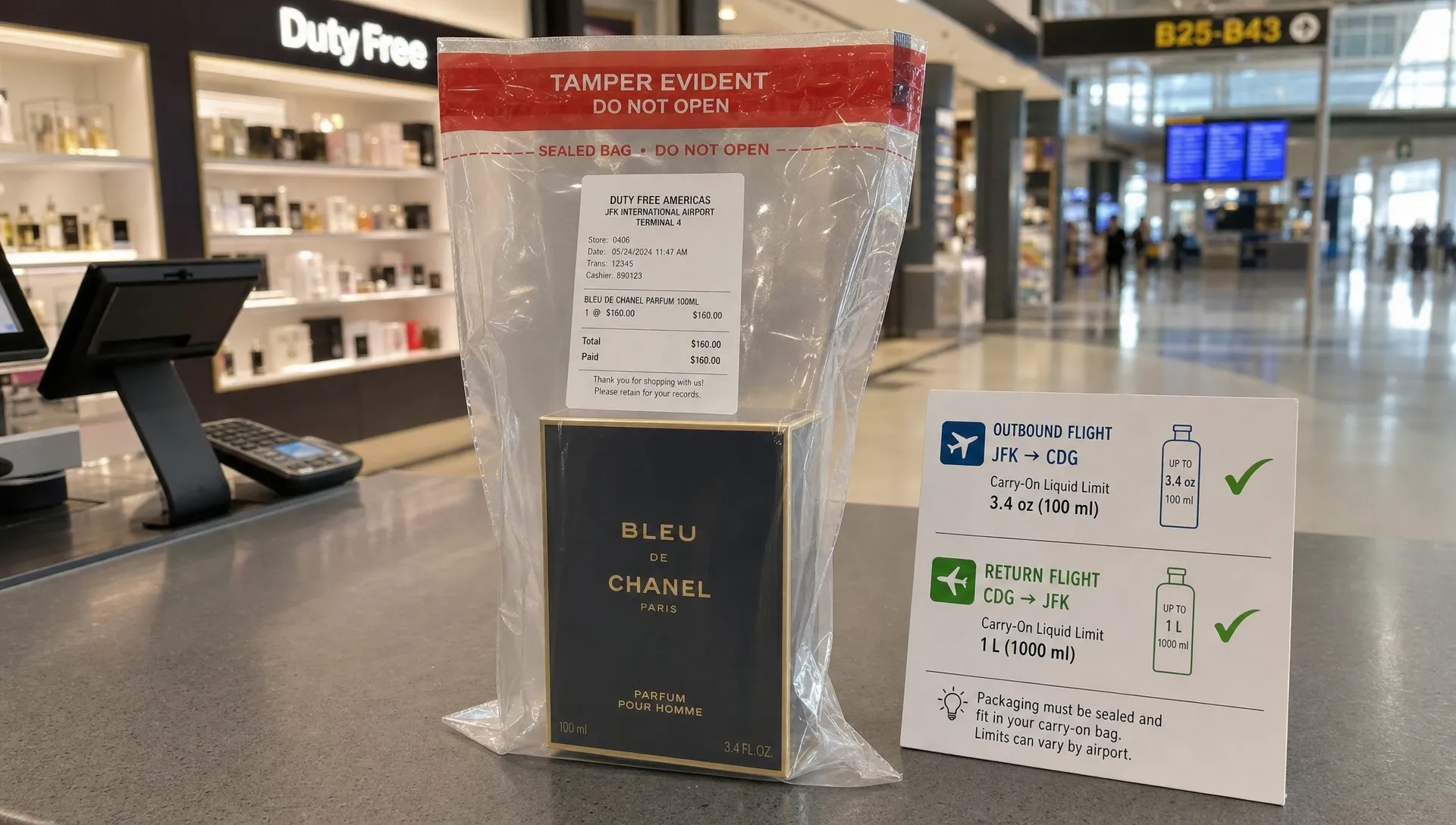
Duty-free feels like the safe zone of airport shopping. You have already passed security, the bottle is sold inside the airport, and the cashier often seals it in a special bag. So why do some travelers still lose duty-free perfume, spirits, cosmetics, or wine at a later checkpoint?
The short answer is that duty-free liquids are not automatically exempt from airport liquid rules. They are often allowed because of a specific security exception, usually involving a sealed tamper-evident bag, a visible receipt, and successful screening at any transfer airport. If one part of that chain breaks, security can still stop the item.
This matters most on connecting flights, round trips, separate tickets, and routes where airports apply different liquid limits. A bottle that is fine on your first flight can become a problem when you pass through security again.
The duty-free liquid rule in plain English
In most airport systems, large liquids in cabin baggage are restricted unless they fit the standard small-container rule or qualify for an exemption. Duty-free purchases can qualify for that exemption when they are bought airside or on board and kept in a sealed security bag.
That bag is commonly called a STEB, short for Security Tamper-Evident Bag. It is the clear plastic bag used by airport shops and airlines to show that the bottle has not been opened or altered since purchase.
Official rules vary by country, but the basic idea is similar. The TSA guidance for duty-free liquids says larger duty-free liquids may be allowed through a U.S. checkpoint when they are in a secure tamper-evident bag, show no signs of tampering, have proof of purchase, and can be screened. The EU air security rules also refer to liquids bought at airports or on board being carried in sealed security bags. The UK hand luggage restrictions give similar advice for duty-free liquids kept sealed with the receipt visible.
The key word is “may.” Security staff can still inspect, test, reject, or confiscate a duty-free liquid if it does not meet the local checkpoint requirements.
When duty-free liquids are usually allowed
Duty-free liquids are least likely to cause trouble when your trip is simple: you buy after security, board a nonstop flight, and do not pass through another security checkpoint before leaving the airport at your destination.
They are also more likely to be accepted on connections when all of the following are true:
- The item was bought at an airport shop after security or on board an aircraft.
- The shop sealed it in an approved transparent tamper-evident security bag.
- The receipt is inside the bag or clearly visible.
- The bag has not been opened, torn, punctured, or resealed.
- The purchase is recent enough for the country where you are screened.
- The liquid can be screened successfully by airport security equipment.
If any of these conditions are missing, the item may be treated like an ordinary liquid in carry-on baggage. That usually means it must comply with the local container limit, often 100 ml or 3.4 oz, unless the airport has a different rule.
For a refresher on the baseline rules, see this guide to liquid restrictions when flying, then apply the duty-free exception on top of those basics.
Why duty-free liquids still get stopped
The most common mistake is assuming “duty-free” means “security-approved everywhere.” It does not. Duty-free is a tax and customs concept. Airport liquid screening is a security concept. They overlap, but they are not the same rulebook.
A bottle can be perfectly legal to buy duty-free and still fail at the next checkpoint.
| Reason it gets stopped | What it means in practice | How to reduce the risk |
|---|---|---|
| The bag was opened | Security can no longer verify the item stayed sealed after purchase. | Do not open the STEB until your final destination. |
| The receipt is missing | The checkpoint may not be able to confirm when and where you bought it. | Keep the receipt sealed inside the bag or clearly visible. |
| The bag is damaged | Tears, punctures, broken seals, or tape can look like tampering. | Carry the bag separately and avoid squeezing it into a packed backpack. |
| The airport cannot clear the item | Some bottles, packaging, or contents may alarm during screening. | Accept that final approval is always at the checkpoint. |
| You pass through another security checkpoint | Transfer screening can apply new rules, even if the first airport allowed the item. | Check every airport on your route, not just the departure airport. |
| The purchase is too old | Some authorities require recent proof of purchase, such as TSA’s 48-hour condition. | Avoid buying large cabin liquids too early in a multi-day itinerary. |
| It is no longer a duty-free purchase in practice | A bottle bought on your outbound trip and carried home days later is usually just a regular liquid. | Pack it in checked baggage for the return flight, if allowed. |
The last point surprises many travelers. If you buy a large perfume bottle in Paris, use it during your trip, then try to carry it home in hand luggage from another airport, it no longer benefits from the sealed duty-free exception. It is simply a liquid over the cabin limit.
Connections are where most problems happen
A nonstop flight is straightforward. A connection is where duty-free liquids become unpredictable.
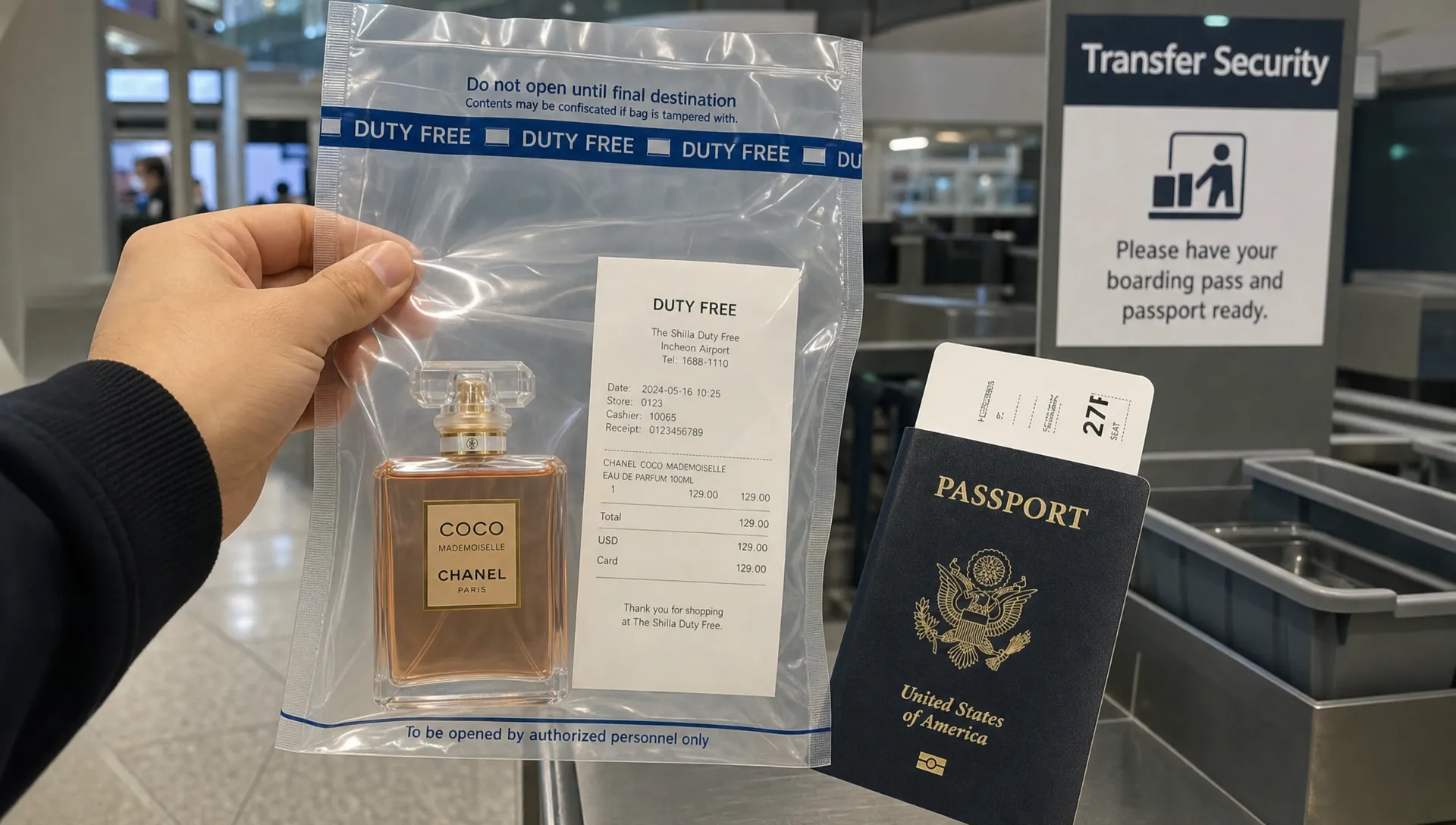
If you connect through an airport that requires another security check, your sealed purchase may be screened again. This can happen when you change terminals, enter a new security zone, arrive internationally and connect domestically, travel on separate tickets, or leave the secure area during a layover.
In some cases, the sealed bag is accepted after inspection. In other cases, the airport may not accept the bag, may not be able to verify the receipt, or may require the item to pass additional screening. If it fails, it can be stopped even though it was bought legally.
This is especially important when your trip includes airports with different cabin liquid limits. One airport may allow larger containers because of newer screening equipment, while another may still apply the stricter 100 ml rule. For route planning, it is safer to think in terms of the strictest checkpoint you will face, not the most generous one.
The U.S. connection scenario travelers often miss
A common example is an international flight into the United States with a domestic connection afterward. In many U.S. arrival processes, travelers collect checked baggage, clear customs, recheck baggage, and then pass through TSA screening again for the domestic flight.
TSA does allow certain duty-free liquids over 3.4 oz in tamper-evident bags when the conditions are met. But if you have access to your checked bag before rechecking it, the lower-risk move is often to place the sealed bottle into checked baggage at that point, assuming the item is permitted in checked luggage and packed safely.
This is not because the TSA exception does not exist. It is because any cabin liquid still has to pass checkpoint screening. If your bottle alarms, the bag looks damaged, or the proof of purchase is not acceptable, you may not be able to take it through.
Duty-free alcohol has extra rules
Alcohol adds another layer because aviation safety rules can apply in addition to liquid screening rules. Many spirits sold duty-free are within ordinary alcohol ranges, but very high-proof alcohol can be restricted or prohibited on aircraft.
As a general safety rule, alcoholic beverages over 70% alcohol by volume are not allowed on many flights, including in checked baggage under U.S. rules. Alcohol between 24% and 70% may also be subject to quantity limits when packed in checked luggage. Airline and country rules can vary, so do not assume every bottle in a duty-free shop is automatically suitable for every onward flight.
There is also a customs difference. “Duty-free” does not mean “unlimited.” Your destination country may still have limits on how much alcohol, perfume, or other goods you can bring in without paying duty or tax. Customs allowances are separate from whether the bottle can pass security in your carry-on.
What about perfume, cosmetics, and skincare?
Perfume, creams, lotions, oils, serums, liquid makeup, and gel cosmetics are all treated as liquids or liquid-like items at many checkpoints. Buying them duty-free can help only if they remain sealed in the official security bag and meet the local duty-free liquid conditions.
A 150 ml perfume bottle in a sealed duty-free bag may be allowed through a transfer checkpoint. The same bottle loose in your purse two days later will usually be treated as an oversized cabin liquid.
This is why expensive cosmetics are worth planning around. If you are connecting, ask the shop whether your purchase will be sealed for transfer and whether the receipt will remain visible. If the item is a gift, resist the temptation to open the bag to check the box, add a card, or rearrange the contents.
For more examples of items that can cause security delays, this guide explains what commonly gets flagged at liquids at airport security, including toiletries, foods, aerosols, and duty-free purchases.
How to decide whether to buy before a connection
Before buying a large duty-free liquid, think about the next security checkpoint, not the shop you are standing in. If your itinerary includes a transfer, ask yourself whether the bottle must go through security again before your final destination.
Here is a practical way to judge the risk:
| Itinerary type | Risk level | Best approach |
|---|---|---|
| Nonstop flight after buying airside | Low | Keep the bag sealed until you leave the destination airport. |
| Connection without re-screening | Low to medium | Keep the bag sealed and accessible in case staff inspect it. |
| Connection with transfer security | Medium to high | Buy only if the shop provides a proper STEB and receipt. |
| International arrival followed by domestic connection | Medium to high | Put the item in checked baggage before recheck when possible. |
| Separate tickets or overnight layover | High | Avoid large cabin liquids or pack them in checked baggage later. |
| Return flight days after purchase | High | Treat the item as a normal liquid unless newly bought and sealed. |
If you are not sure, assume the strictest rule applies. That is the same principle Liquid Limits uses when rules are unclear: default to the safer cabin limit rather than gambling at the checkpoint.
How to protect your purchase
A few simple habits make a big difference. Keep the duty-free bag separate from snacks, toiletries, laptops, and anything that might crush or puncture it. Do not place the receipt in your wallet if the security process expects it to stay with the bag. Do not open the sealed bag in the lounge, on the plane, or during a layover.
If you are buying multiple bottles, ask whether each item needs its own bag or whether they can be sealed together. If the cashier says the item cannot be sealed for transit, treat it as a warning. It may be fine on a nonstop flight, but risky on a connection.
Also remember that airline cabin baggage rules still apply. A sealed duty-free bag may be allowed by security, but you still need to carry it on board within the airline’s baggage policy. Some airlines count airport shopping separately, while others may be stricter on full flights.
When checked baggage is the better choice
Checked baggage is often the safer place for large liquids that you do not need during the journey. This is especially true for wine, spirits, large perfumes, oils, sauces, and premium cosmetics bought before the final leg of your trip.
Use checked baggage when:
- The item is not sealed in a recognized duty-free security bag.
- You have already opened the duty-free bag.
- Your receipt is missing or no longer recent.
- You have a separate-ticket connection or overnight stop.
- You are bringing the item back on a later return flight.
Pack liquids carefully in checked bags. Use the original packaging when possible, cushion bottles in clothing, and place them in leak-resistant bags. For alcohol, check airline and destination rules before packing, especially for high-proof spirits or larger quantities.
Frequently Asked Questions
Can I take duty-free liquids over 100 ml in my carry-on? Sometimes. They usually need to be bought after security or on board, sealed in an approved tamper-evident bag, accompanied by proof of purchase, and accepted by the airport where you are screened.
Can I open my duty-free bag during a layover? No, not if you still need to pass through another security checkpoint. Once the bag is opened, the liquid may be treated like any other oversized carry-on liquid.
Do duty-free liquids have to go in the clear liquids bag? Usually no. Large duty-free liquids travel in their own sealed security bag. Small liquids under the local cabin limit may still need to follow the normal liquids-bag rule, depending on the airport.
Will my sealed duty-free alcohol be allowed on a connecting flight? It depends on the transfer airport, the condition of the bag, the receipt, screening results, alcohol strength, and airline rules. If you can place it in checked baggage before the next flight, that is often safer.
Can I bring duty-free perfume home on my return flight? If it was bought days earlier and is no longer sealed in a valid duty-free security bag, it will normally be treated as a regular liquid. A bottle over the cabin limit should go in checked baggage if permitted.
Does duty-free mean I do not have to declare it? No. Duty-free shopping and customs declarations are separate. Your destination may have tax-free allowances or declaration requirements even if airport security allows the item.
Check before you buy
Duty-free liquids are convenient, but the exemption is fragile. It depends on the seal, receipt, route, transfer process, screening equipment, and local airport rules.
Before buying a large liquid, check the airports on your whole trip, including the return journey. With Liquid Limits, you can compare liquid rules for airports, items, and routes, see source links and last-checked dates, and plan around the strictest checkpoint before you pack or shop.