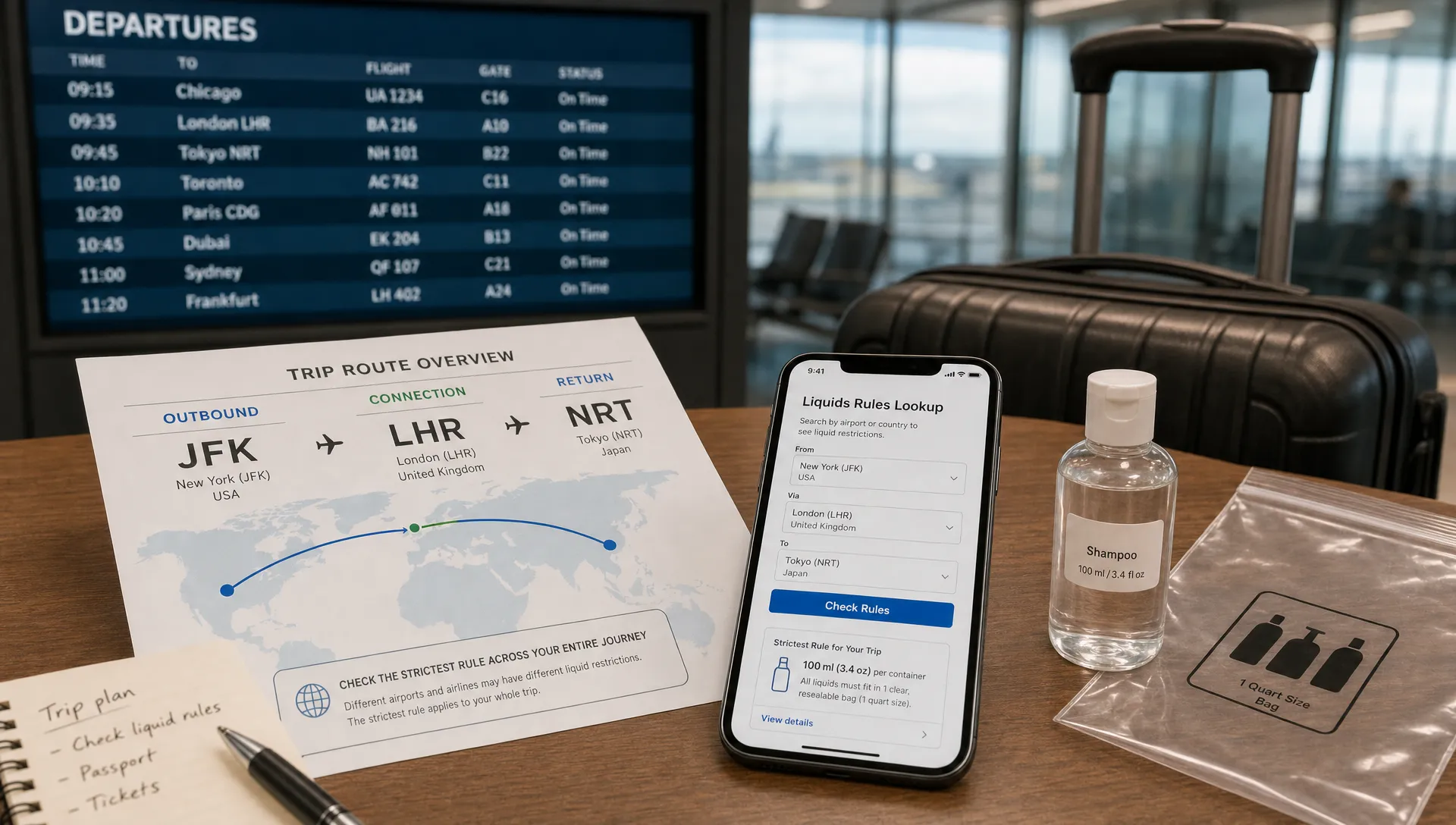
EU liquid regulations for flying in 2026 are simple in principle, but messy in real travel. The baseline rule is still the one most travelers know: liquids, aerosols, and gels in cabin baggage generally need to be in containers of 100ml or less, packed in a transparent resealable bag of about 1 liter.
The confusion starts because some airports have newer screening equipment, some routes involve multiple security checkpoints, and some return flights leave from airports with different rules than the one you departed from. In practice, the smartest approach is to check every airport where you may pass security and pack to the strictest checkpoint on your route.
The short version: what EU travelers should assume in 2026
If you want the lowest-risk packing rule for an EU flight, assume this:
| Rule area | Safest 2026 assumption for EU airport security |
|---|---|
| Container size | 100ml maximum per liquid, aerosol, or gel container |
| Bag size | One transparent resealable plastic bag of about 1 liter |
| Container rule | A 150ml bottle with only 50ml left can still be rejected |
| Exceptions | Medicines, baby food, special dietary liquids, and sealed duty-free liquids may be allowed with screening |
| Airport scanner changes | Only rely on larger allowances if your exact airport and checkpoint confirm them |
| Return flights | Check the return airport separately, not just your departure airport |
The European Commission’s passenger security guidance explains the common EU approach to liquids in cabin baggage and the main exceptions for essential liquids. You can review the official overview on Your Europe’s airport and airline security page.
What counts as a liquid under EU flying rules?
EU liquid regulations are broader than many travelers expect. Security does not only mean water bottles and perfume. The category usually includes liquids, aerosols, gels, pastes, creams, lotions, foams, and similar substances.
Common examples include:
- Drinks, soups, syrups, sauces, and oils
- Shampoo, conditioner, shower gel, sunscreen, and body lotion
- Toothpaste, hair gel, shaving foam, and spray deodorant
- Perfume, aftershave, liquid makeup, mascara, and lip gloss
- Jams, honey, soft cheese, spreads, and other spreadable foods
The practical test is simple: if it can be poured, squeezed, sprayed, smeared, spread, or behaves like a gel or paste, treat it as a liquid for cabin security. This is especially important for food gifts, skincare products, and cosmetics, because many of them look harmless until they are screened.
For a broader item-by-item overview, Liquid Limits also has a guide to which liquids you can bring on a plane, including common toiletries and food items.
The 100ml rule is about the container, not the amount left
One of the most common mistakes is packing a larger bottle that is nearly empty. Under the strict version of the EU liquid rule, the container itself must be 100ml or smaller. A 200ml shampoo bottle with a small amount left inside can still be refused because security staff judge the container capacity, not just the visible contents.
This matters for products such as sunscreen, foundation, contact lens solution, hair products, and expensive skincare. If you want to take them in cabin baggage, decant them into travel-size containers marked 100ml or less. If the original label is important, such as for medication or specialized skincare, consider carrying supporting documentation or packing it in checked baggage when appropriate.
The resealable liquids bag also matters. Your containers should fit comfortably inside the bag so it can close. Overfilled bags can cause delays or lead to items being removed, even if every individual container is under 100ml.
Why some EU airports mention 2-liter liquid limits
In recent years, some European airports introduced advanced cabin baggage scanners that can screen liquids more effectively. These systems are often associated with relaxed rules, sometimes allowing passengers to keep liquids inside bags or carry larger containers.
That does not mean the EU has one universal 2-liter liquid rule. In 2026, the key point is that scanner-based allowances are airport-specific, and sometimes terminal-specific or lane-specific. An airport may have newer scanners in one area and older screening rules in another. A transfer checkpoint may also apply a different procedure from the main departure checkpoint.
For travelers, this creates a simple rule: do not pack based on a general news headline about airport scanners. Pack based on the strictest actual security checkpoint on your itinerary.
If your route includes several airports, use an airport-specific tool such as Liquid Limits to compare the strictest cabin liquid rule for the whole trip, including your return flight. The site is designed to show 100ml and larger airport-specific allowances side by side, with source links and last-checked dates.
EU rules apply at security checkpoints, not only at boarding
Liquid restrictions are enforced when you pass airport security. That may happen more than once on a journey. A direct flight is usually straightforward, but connecting itineraries can create surprises.
You may need to pass security again if you change terminals, travel on separate tickets, connect from a non-EU flight, leave the secure transit area, or collect and recheck baggage. In those cases, liquids that were acceptable at your first airport may be screened again under a stricter rule.
This is especially important for duty-free liquids, water bottles bought after security, and full-size toiletries purchased during a trip. If you have another security checkpoint ahead, do not assume post-security purchases are automatically safe to carry through the rest of the journey.
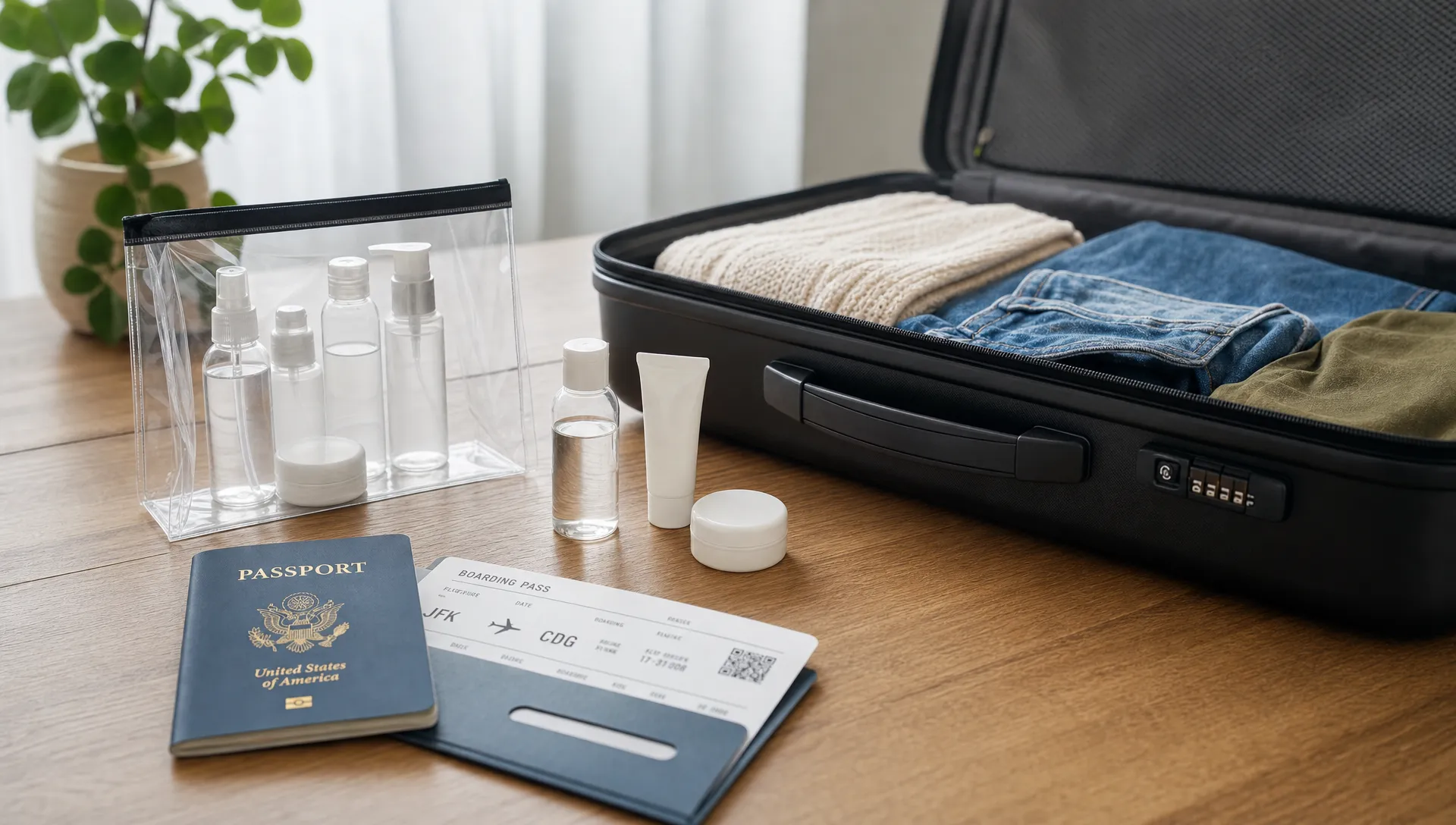
Exceptions: medicines, baby food, dietary liquids, and duty-free purchases
The EU liquid rules include important exceptions, but exceptions are not the same as unlimited permission. Security staff may need to inspect, test, or verify the item.
| Exception type | What travelers should know |
|---|---|
| Liquid medicine | Usually allowed when needed for the journey, but carry it separately and bring a prescription or medical note when possible |
| Baby milk and baby food | Usually allowed in reasonable quantities for the trip, but may be subject to additional screening |
| Special dietary liquids | Can be allowed when needed for medical or dietary reasons, with supporting evidence recommended |
| Duty-free liquids | Must usually stay sealed in a security tamper-evident bag with proof of purchase, especially when connecting |
If you rely on liquid medication, do not hide it inside your regular toiletries bag. Present it separately at screening and keep the label visible if possible. For medicines that need refrigeration, needles, pumps, or medical devices, check both airport security rules and airline guidance before traveling.
For babies and young children, quantities should be reasonable for the journey. That does not always mean only the flight time. Delays, connections, and time at the airport can matter, but security may still ask questions if the amount seems excessive.
Duty-free liquids are another frequent source of confusion. Liquids bought after security or on board may be allowed through a later transfer checkpoint if they are sealed in an approved tamper-evident bag with the receipt inside. Opening the bag before your final destination can create problems at the next screening point.
Checked baggage is different from cabin baggage
EU cabin liquid regulations apply to what you bring through security in your carry-on. Checked baggage is different. You can usually pack larger toiletries, drinks, and other non-prohibited liquids in checked luggage, provided they are not restricted as dangerous goods and comply with airline rules.
However, checked baggage is not a free-for-all. Some liquids are limited or prohibited because they are flammable, corrosive, pressurized, or otherwise hazardous. Examples can include certain aerosols, fuels, solvents, strong chemicals, and high-strength alcohol. Airlines may also set their own limits for leakage risk, packaging, and fragile items.
For ordinary toiletries, checked baggage is often the easiest solution if you need full-size products. Use leakproof caps, seal items in plastic bags, and avoid packing anything you cannot afford to lose or spill. For essential medicines, keep them in cabin baggage whenever possible, because checked luggage can be delayed.
Intra-EU, Schengen, UK, and long-haul flights: what changes?
EU liquid regulations are linked to the airport where you pass security, not simply to the nationality of your airline or the destination printed on your boarding pass.
If you fly from Paris to Rome, the EU airport security framework applies at departure. If you fly from New York to Amsterdam and remain airside without passing transfer security, your next liquid check may be different from a passenger who leaves the secure area and re-enters. If you fly from Madrid to London, EU rules apply at Madrid, but UK rules apply when you fly back from London.
The UK is a major source of confusion because it is no longer in the EU and has had its own airport scanner rollout and liquid rule changes. If your journey includes a UK airport, check the UK airport separately rather than assuming the EU rule applies both ways. Liquid Limits has a separate guide on flying with liquids in the UK if that is part of your trip.
For long-haul flights, also check the rules at your non-EU departure or transfer airport. The United States uses the familiar 3.4 oz limit, which is effectively close to 100ml, but other countries may have different screening practices, transfer rules, or duty-free procedures.
How to pack for EU liquid regulations in 2026
The easiest packing strategy is to decide whether you want maximum convenience or maximum flexibility. If you want the lowest chance of delays, pack all cabin liquids under the 100ml rule even when your departure airport may allow more. If you want to take advantage of a larger airport-specific allowance, verify every airport where you will pass security, including the return journey.
A practical packing plan looks like this:
- Put all non-essential full-size liquids in checked baggage.
- Keep essential liquids, medication, and baby supplies in cabin baggage.
- Use clearly labeled containers of 100ml or less for toiletries.
- Place cabin liquids in a transparent resealable bag unless your exact airport says otherwise.
- Check transfer and return airports before buying duty-free liquids.
- Recheck rules close to departure, since scanner policies can change.
This is also where round trips catch people out. You might depart from an airport with a more relaxed process, then return from an airport that still applies the 100ml rule strictly. If you buy full-size products while away, they may need to go in checked baggage on the way home. For more route-focused advice, see Liquid Limits’ guide to rules for liquids on flights and return trips.
A simple decision table for common EU travel scenarios
| Travel scenario | Best packing choice |
|---|---|
| Direct EU flight with cabin bag only | Use 100ml containers in a 1-liter resealable bag unless the departure airport confirms a larger allowance |
| EU trip with a connection | Check both departure and transfer security rules, then pack to the stricter one |
| Round trip from two different airports | Check outbound and return airports separately before packing full-size liquids |
| Traveling with liquid medicine | Carry it in cabin baggage, separate it for screening, and bring supporting documentation |
| Buying duty-free before a connection | Keep it sealed in the tamper-evident bag with receipt and confirm transfer rules |
| Flying EU to UK or UK to EU | Check each direction separately because UK rules are not EU rules |
What to check before you leave for the airport
Before an EU flight in 2026, the most useful question is not “What is the EU rule?” It is “What is the strictest security checkpoint I will pass through on this trip?”
Check your departure airport, transfer airport, return airport, and any airport where you may need to re-enter security. Then check specific items that often sit in gray areas, such as spreads, creams, aerosols, medical liquids, and duty-free purchases.
Liquid Limits is built for that exact problem. It provides airport rule lookup, item-specific checks, route checks, verified source links, last-checked dates, and a stricter 100ml fallback when a rule is unclear. That conservative fallback is useful because the cost of being wrong is usually losing the item at security.
Frequently Asked Questions
What is the EU liquid limit for flying in 2026? The safest baseline is 100ml per liquid, aerosol, or gel container in a transparent resealable bag of about 1 liter. Some airport-specific scanner rules may differ, but you should only rely on them when your exact airport confirms them.
Can I take a 150ml bottle if it is almost empty? Under the strict 100ml rule, no. Security usually looks at the container capacity, not the amount left inside. Use a container marked 100ml or less.
Do EU liquid rules apply to checked baggage? The 100ml cabin liquid rule applies at security for carry-on baggage. Checked baggage can usually contain larger non-prohibited liquids, but dangerous goods rules, airline policies, and leakage risk still matter.
Are medicines exempt from EU liquid regulations? Liquid medicines needed for the journey are generally allowed in reasonable quantities, but they may be screened separately. Carry labels, prescriptions, or medical documentation when possible.
Can I bring baby milk or baby food over 100ml? Baby milk, baby food, and similar essentials are usually allowed in reasonable quantities for the journey, subject to screening. Keep them accessible and separate from regular toiletries.
Do EU liquid rules apply on the return flight? Only if your return flight departs from an EU airport. If you return from a non-EU airport, local rules apply. Either way, check the return airport because it may be stricter than your outbound airport.
Check your EU liquid rules before you pack
EU liquid regulations for flying in 2026 are easiest to manage when you plan by route, not by rumor. If every liquid in your cabin bag is 100ml or less, you are prepared for the strict baseline. If you want to carry more, verify the exact airport, checkpoint, and return flight before you leave.
Use Liquid Limits to check airport liquid rules before you pack, compare route restrictions, and avoid surprises at security.