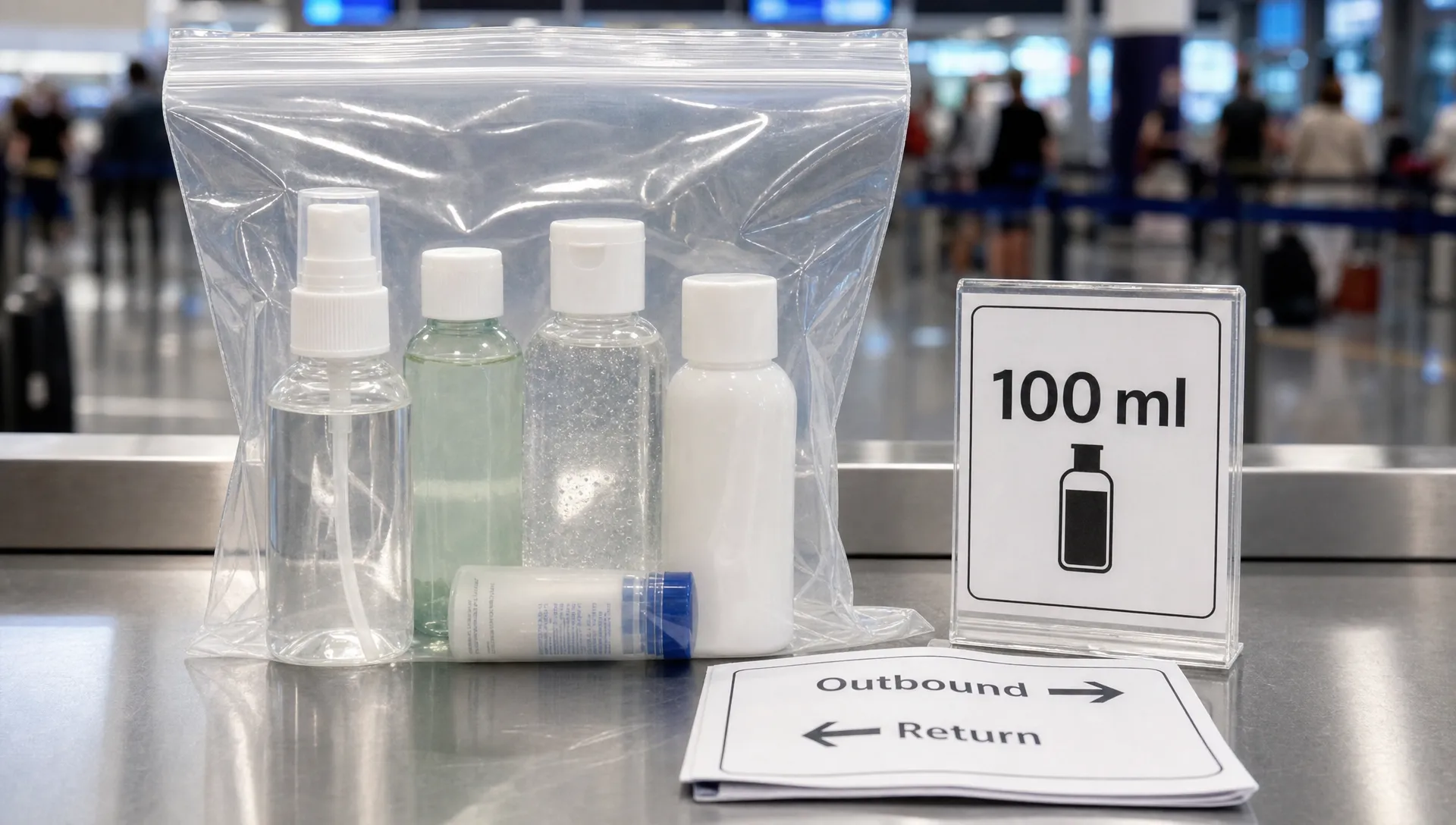
EU liquids on flights are simple in theory but less predictable at the airport than many travelers expect. In 2026, the safest assumption is still this: if a cabin liquid is in a container over 100 ml, it may be refused at security unless your exact departure airport, terminal and lane allows larger liquids.
That uncertainty is not because every airport is making up its own policy. The EU has common aviation security standards, but airports implement those standards with different screening equipment, layouts and local procedures. Some checkpoints have newer scanners that can screen liquids inside your bag. Others still use the familiar tray-and-clear-bag process. Even at airports with newer technology, the rules can change by terminal or date.
This guide focuses on what you should expect at security, not just what the rule says on paper, so you can pack in a way that survives the real checkpoint.
The short version for EU airport security
For most travelers, the low-risk approach is to pack cabin liquids as if the 100 ml rule applies unless you have checked your exact airport shortly before travel. That means each liquid container should be 100 ml or smaller and fit into a transparent, resealable plastic bag, often described as a 1 liter bag.
The container size matters, not the amount left inside. A 200 ml shampoo bottle that is half empty can still be rejected because the printed capacity is over 100 ml.
At some EU airports, approved newer scanners may allow larger liquid containers, sometimes with liquids left inside your cabin bag. But do not assume that one airport’s more generous setup applies across Europe, across your whole route or even across every security lane in the same terminal.
If you want a fuller policy background, our guide to EU liquid regulations for flying in 2026 explains how the rules fit together. This article stays closer to the checkpoint experience: what you will be asked to remove, what gets flagged and how to avoid a last-minute bin at security.
Why EU liquid rules can feel inconsistent
The EU sets a shared aviation security framework, and the European Commission’s aviation security guidance covers the broad policy environment. In practice, your experience depends on how the airport screens cabin baggage that day.
Older screening setups normally require passengers to separate liquids from cabin bags, keep containers at or below 100 ml and place them in a clear resealable bag. Newer computed tomography scanners can produce a more detailed image of a bag’s contents, which is why some airports have trialed or introduced more relaxed liquid handling.
The confusing part is that technology rollout is uneven. A route that starts at a major airport with newer scanners may return from an airport still enforcing the traditional process. A connection may add another security checkpoint. A temporary equipment or policy change can also bring back stricter limits with little notice.
That is why airline emails alone are not always enough. Airlines often summarize general cabin baggage rules, but airport security is run at the departure airport. If you are carrying anything expensive, medically important or hard to replace, verify the airport rule rather than relying on what happened the last time you flew.
What counts as a liquid in EU security screening
At security, “liquid” is broader than water, perfume or shampoo. The practical category includes liquids, aerosols, gels, creams, pastes and many spreadable foods. If it can be poured, sprayed, squeezed, smeared or spread, security may treat it as a liquid.
| Item type | How security often treats it | Packing advice |
|---|---|---|
| Shampoo, conditioner, shower gel | Liquid or gel | Use 100 ml containers unless your airport confirms larger limits |
| Toothpaste, hair gel, face cream | Paste, gel or cream | Put in the liquids bag under the standard rule |
| Perfume, aftershave, liquid makeup | Liquid | Check bottle capacity, especially gift sets and full-size products |
| Aerosol deodorant, shaving foam, dry shampoo | Aerosol | Keep travel-size for cabin baggage and check airline dangerous goods limits |
| Mascara, lip gloss, liquid eyeliner | Liquid-like cosmetic | Pack with toiletries in the clear bag |
| Jam, honey, hummus, yogurt, soft cheese | Spreadable food | Treat as a liquid for cabin screening |
| Solid soap, powder makeup, solid deodorant stick | Usually not a liquid | Keep accessible if the texture could be questioned |
Borderline items cause many of the delays. Peanut butter, chocolate spread and hummus may feel like food rather than liquids, but at the X-ray they behave more like pastes. If the item is in a jar or tub and can spread, assume it belongs under the liquid rule.
For a deeper look at troublesome products, see our guide to liquids at airport security and what gets flagged. It is especially useful if you are packing cosmetics, food gifts or toiletries that do not look obviously liquid.
What happens when you reach the security lane
Before you get to the trays, look for the airport’s signs. Many EU airports post lane-specific instructions before the screening area. These signs matter more than what you read months earlier, because they tell you what that checkpoint is enforcing now.
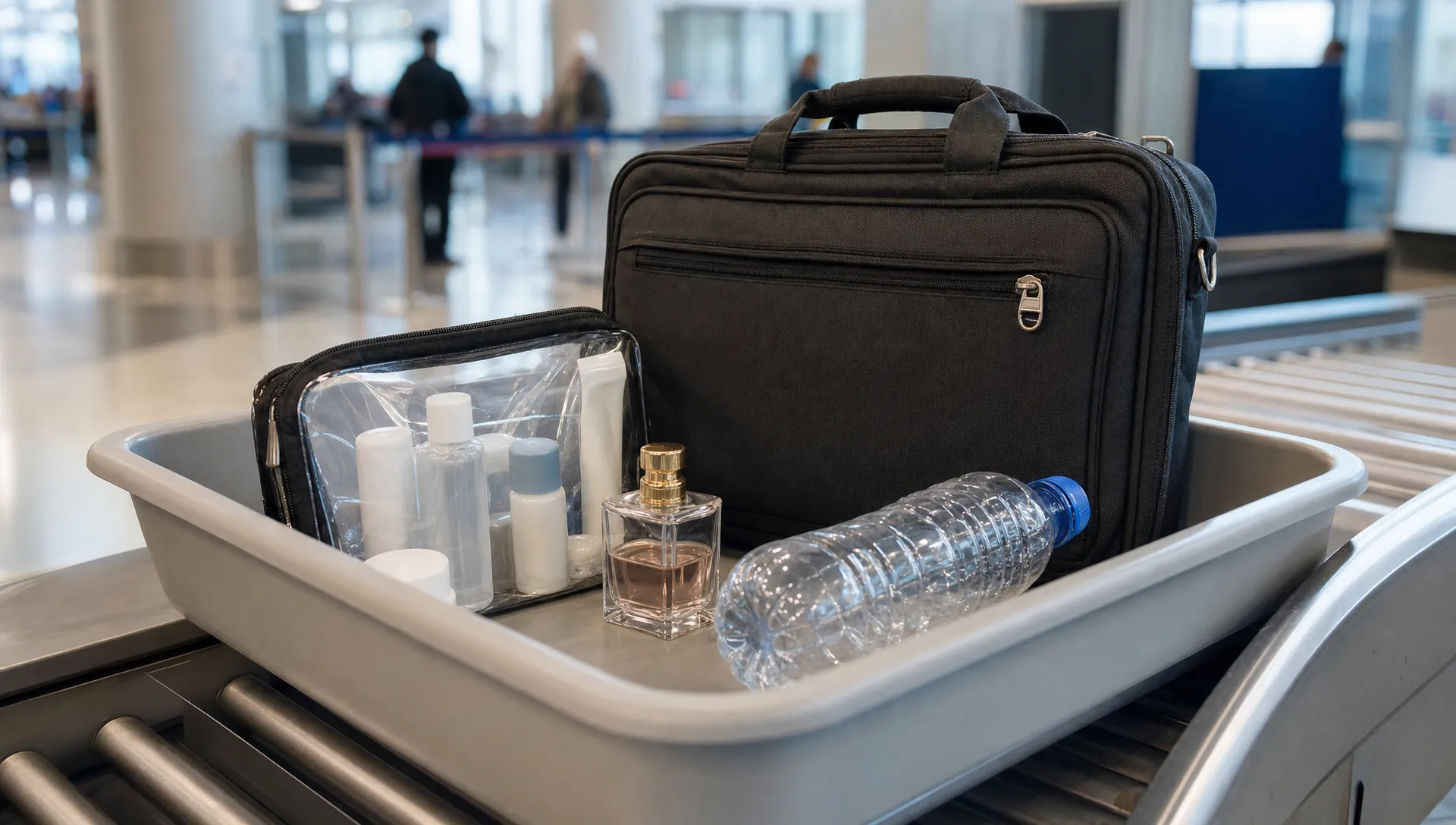
At a traditional lane, staff may ask you to remove your liquids bag from your cabin baggage and place it in a tray. Laptops and large electronics may also need to come out, depending on the equipment. Jackets, belts and pocket items may go into separate trays.
At a newer scanner lane, staff may tell you to leave liquids and electronics inside your bag. If larger liquids are permitted, there may still be limits on container size, item type or how the item is screened. Staff can still pull your bag for a manual inspection if the image is unclear.
Secondary screening is normal and does not mean you did anything wrong. A security officer may open your bag, swab an item, test a liquid or ask what a product is. If an item is not allowed, you usually have limited options at that point: surrender it, return to landside if time and airport layout allow, or check the bag if your airline still accepts late baggage.
The standard 100 ml process, step by step
When the standard rule applies, each liquid container in your cabin bag must be 100 ml or smaller. The containers usually need to fit into one transparent resealable bag of about 1 liter capacity. The bag should close without forcing it.
Security officers are looking at the labeled capacity on the container. A nearly empty 150 ml bottle is still a 150 ml bottle. Unlabeled travel pots can also cause problems if they look too large, so use small containers with clear sizing where possible.
The clear bag is meant to make inspection quick. Do not bury it under shoes, chargers and jackets if you know you will need to remove it. Put it near the top of your cabin bag before you join the queue. This small habit can save time and reduce the chance of forgetting a stray product in a side pocket.
Also check your personal item, not just your roller bag. Lip gloss in a handbag, hand sanitizer in a laptop sleeve and a forgotten water bottle in a backpack pocket can all trigger a bag search.
When larger liquids may be allowed
Some EU airport checkpoints may allow larger liquids when approved screening technology and local procedures support it. This is where travelers often hear “2 liters” mentioned. The key word is “may.” Larger allowances are not universal across the EU and should not be treated as a default rule.
If your departure airport allows larger liquids, check the exact conditions. The allowance may apply only in certain terminals, only after security upgrades are complete or only to specific categories of cabin liquids. Airports can also reintroduce stricter handling if equipment approval, software requirements or operational instructions change.
This matters most on round trips. You might depart through a relaxed checkpoint and return through a strict one. If you buy a large bottle of cosmetics or specialty food during your trip, your return airport could still require it to be checked, discarded or carried only if it qualifies for an exception.
A practical rule is to use larger allowances only for items you can afford to lose or place in checked baggage on the way back. For anything important, pack to the stricter 100 ml standard or verify every security checkpoint on the itinerary.
Exceptions for medicines, baby items and special diets
EU security rules commonly allow reasonable quantities of essential medicines, baby food, baby milk and special dietary liquids in cabin baggage, even when they exceed 100 ml. These items may need to be presented separately and may be subject to additional screening.
For medicines, keep the product in its original packaging when possible. A prescription, doctor’s note or pharmacy label can help, especially for liquid medication, cooling gel packs, syringes or medical nutrition products. You may not always be asked for documentation, but having it reduces the chance of a long conversation at security.
For babies and young children, pack only what you reasonably need for the journey. Security staff may screen bottles, pouches or jars separately. Rules can be more flexible for family travel, but flexible does not mean unchecked.
Special dietary items can include liquid nutrition or medically required food. If the item is not clearly medical, be ready to explain why it is needed during the trip rather than packed in checked baggage.
Duty-free liquids and connections
Duty-free liquids are a separate source of confusion. If you buy perfume, alcohol or another liquid after security at an EU airport, it is often packed in a sealed security tamper-evident bag with the receipt inside. Keep it sealed until you reach your final destination.
The sealed bag helps at connecting security checkpoints, but it is not a magic pass for every itinerary. If the bag has been opened, the receipt is missing or the next airport does not accept the packaging, the liquid may be refused. Connections outside the EU can add more uncertainty because transfer security rules may differ.
Before buying duty-free liquids on a connecting itinerary, ask the shop whether your route is suitable for sealed-bag transfer. If you are not sure, wait until the final airport or buy a smaller container that fits the standard 100 ml rule.
How connections and return flights change the answer
Many travelers search for EU liquids on flights and only think about the first airport. Security rules matter at every airport where your cabin bag is screened. That can include your origin airport, a transfer airport and the airport you fly home from.
A direct outbound flight is usually straightforward because you clear security once. A connecting itinerary is less predictable. If you remain airside and do not pass transfer security, your liquids may not be checked again. If you change terminals, enter a different security zone or connect through an airport that rescreens transfer passengers, the next checkpoint gets a say.
Return flights are the most overlooked case. A traveler may leave from an airport that permits larger liquids, then come home from a smaller airport using the standard 100 ml process. Souvenirs, toiletries bought abroad and duty-free items can all become a problem on the return leg.
The simplest planning method is to pack for the strictest checkpoint on your route. That is also the approach we recommend in our guide to avoiding security confiscation when traveling with liquids. It is less exciting than hoping for the most generous rule, but it is much better than surrendering an expensive item at 6 a.m.
A low-stress packing strategy for EU flights
If you want the fewest surprises, start with the 100 ml setup and upgrade only when your exact route confirms a more generous rule. Put daily toiletries into small labeled bottles. Move full-size products to checked baggage. Choose solid alternatives where they work, such as bar soap, solid shampoo or stick deodorant.
An empty reusable water bottle is fine through security, then you can fill it airside. For food, pack solid snacks rather than dips, spreads or yogurt unless they meet the liquid limit. For gifts, think about texture before you buy. Olive oil, honey, sauces, creams and snow globes are classic airport-security disappointments when carried in the cabin.
Use this quick decision table before you pack:
| Travel situation | Safest cabin baggage choice |
|---|---|
| You have not checked the airport rule | Pack all non-exempt liquids in 100 ml containers |
| Your outbound airport allows larger liquids | Check the return and connection airports before relying on that allowance |
| You are carrying essential medicine | Keep documentation handy and present it separately if asked |
| You plan to buy duty-free liquids | Keep the sealed bag closed and confirm connection rules before buying |
| You are packing food gifts | Treat spreadable, creamy or saucy items as liquids |
For route-specific planning, you can check your airports, items and return trip with Liquid Limits before you pack. The tool is built for exactly this problem: one route may involve both a stricter 100 ml checkpoint and a more generous airport on a different leg.
Frequently Asked Questions
Do EU airports still enforce the 100 ml liquid rule in 2026? Yes, many EU airport checkpoints still enforce the 100 ml rule for cabin liquids. Some airports or lanes may allow larger liquids with approved screening technology, but you should verify your exact departure airport before relying on that.
Can I take a 200 ml bottle if it is half empty? Usually no under the standard rule. Security checks the container capacity, not how much liquid remains inside. A half-empty 200 ml bottle can still be rejected.
Do liquids always need to go in a clear plastic bag? At traditional checkpoints, yes, liquids are typically expected to fit in a transparent resealable bag. At some newer scanner lanes, staff may tell you to leave liquids inside your cabin bag. Follow the signs and officer instructions at the lane.
Are medicines limited to 100 ml on EU flights? Essential medicines may be allowed above 100 ml, but they can be screened separately. Keep them in original packaging when possible and carry supporting documentation for prescriptions or medically necessary liquids.
Can I bring baby milk or baby food above 100 ml? Baby milk, baby food and similar child-care liquids are commonly allowed in reasonable quantities for the journey. Expect separate screening and pack only what you need for travel.
What happens if my airport allows 2 liters but my return airport does not? Your return airport’s security rule applies to the return flight. If it enforces 100 ml limits, larger liquids bought during the trip may need to go in checked baggage or be surrendered unless they qualify for an exception.
Are duty-free liquids safe on connecting EU flights? They can be, if they are packed in a sealed tamper-evident bag with the receipt inside and your connection airport accepts them. Do not open the sealed bag before your final destination.
Check before you zip your cabin bag
The safest answer for EU liquids on flights is not “100 ml everywhere” or “2 liters everywhere.” It is to check the airport where your cabin bag will actually be screened, including your return flight and any transfer security.
If the rule is unclear, pack to the stricter 100 ml standard. If a larger allowance is clearly confirmed for every relevant checkpoint, you can use it with more confidence. A two-minute check before packing is far easier than repacking at the security belt while the queue waits behind you.