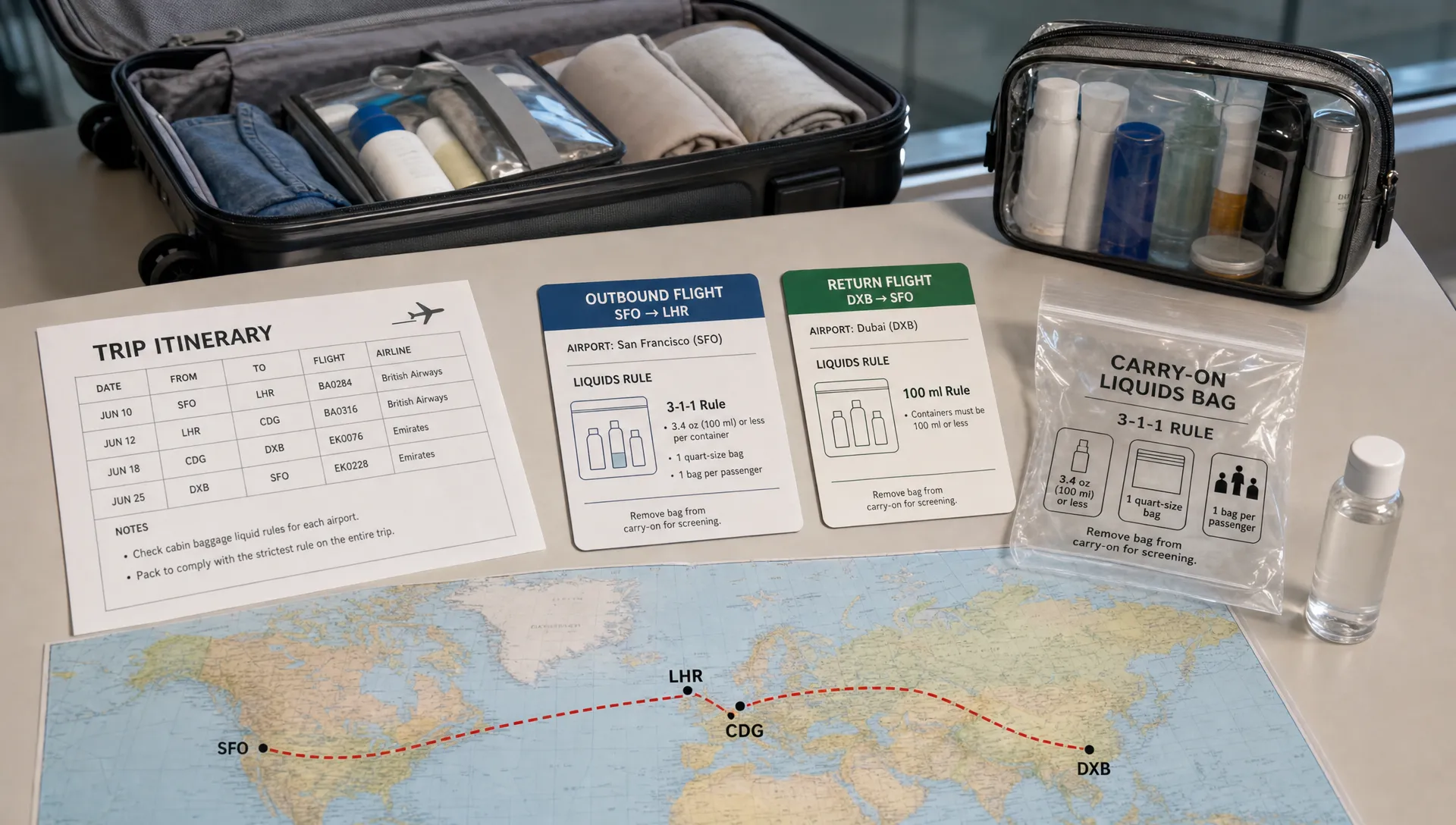
Airport liquid rules look simple when you read them once: small bottles, clear bag, security checkpoint. In real travel, they get confusing fast. Your departure airport may use one screening system, your connection may use another, and your return airport may apply stricter limits than the one you left from.
That is why smarter packing starts with one principle: pack for the strictest liquid rule you will meet on the entire trip, not the most generous rule you have seen online.
This guide explains flight liquid rules in practical terms, so you can decide what goes in your carry-on, what belongs in checked baggage, and what is better bought after security.
The short version: assume 100ml unless your whole route says otherwise
For most travelers, the safest cabin rule is still the familiar 100ml / 3.4oz per container limit for liquids, aerosols, gels, creams, and pastes. Those containers usually need to fit inside a clear, resealable liquids bag. In the U.S., the TSA describes this as the 3-1-1 liquids rule. In the U.K., official hand luggage restrictions also explain the 100ml container approach.
Some airports with approved newer scanners may allow larger liquid containers, sometimes up to 2 liters. The problem is that your trip is not controlled by only one airport. You may pass through security again during a connection, or fly home from an airport that still applies the 100ml rule.
If one security checkpoint on your route uses the stricter rule, pack as if the stricter rule applies. For round trips, this matters even more, which is why it is worth checking liquid rules for return trips before you leave home.
What counts as a liquid on flights?
The liquid regulation on flights covers more than water, shampoo, and perfume. Security teams usually treat anything that can be poured, spread, sprayed, squeezed, smeared, or gelled as a liquid-type item.
That means many items travelers think of as solids can still trigger liquid rules. A stick deodorant is usually different from a gel deodorant. A bar of soap is usually different from shower gel. Powder makeup is usually different from liquid foundation.
| Item type | Usually treated as a liquid? | Smart packing move |
|---|---|---|
| Shampoo, conditioner, shower gel | Yes | Use 100ml travel bottles or pack full sizes in checked luggage |
| Toothpaste | Yes | Choose a travel-size tube for cabin bags |
| Mascara, lip gloss, liquid eyeliner | Yes | Put them in the clear liquids bag |
| Creams, lotions, sunscreen | Yes | Decant or check larger containers |
| Aerosol deodorant, hairspray | Yes | Check size limits and keep caps on |
| Solid deodorant, bar soap | Usually no | Use solids to save liquid-bag space |
| Peanut butter, jam, soft cheese | Often yes | Pack in checked baggage or buy after security |
| Empty reusable bottle | No, if empty | Fill it after security |
A good test is simple: if the item would slowly move, spread, or spill if the container broke, treat it as a liquid unless the airport clearly says otherwise.
The carry-on rule that causes the most problems
The most common mistake is packing a large container that is only partly full. Under the 100ml rule, the container size matters, not the amount left inside it. A 200ml bottle with only 50ml of lotion remaining can still be rejected because the bottle itself is larger than allowed.
The second common mistake is forgetting that all small liquid containers must fit in the allowed bag. If your bottles are each under 100ml but the bag cannot close, you may still be asked to remove items.
For a deeper carry-on-specific breakdown, this guide to flying liquid requirements for carry-on bags explains the standard cabin setup and where airport scanner rules can change the answer.
Why airport liquid rules can differ
Liquid rules vary because security technology, national rules, airport policies, and temporary restrictions do not change everywhere at the same speed. One airport may have upgraded screening lanes, while another terminal at the same airport or a different airport on your itinerary may not.
This is where travelers get caught out. They read that an airport has relaxed liquid limits, pack a 500ml product in a cabin bag, then return through a different airport that still requires 100ml containers. Or they connect through a security checkpoint that does not honor the more relaxed rule from the first airport.
Think of liquid rules as checkpoint-specific rather than airline-specific. Your airline decides baggage allowance, but airport security decides what liquids can pass through screening.
A smarter liquid packing system
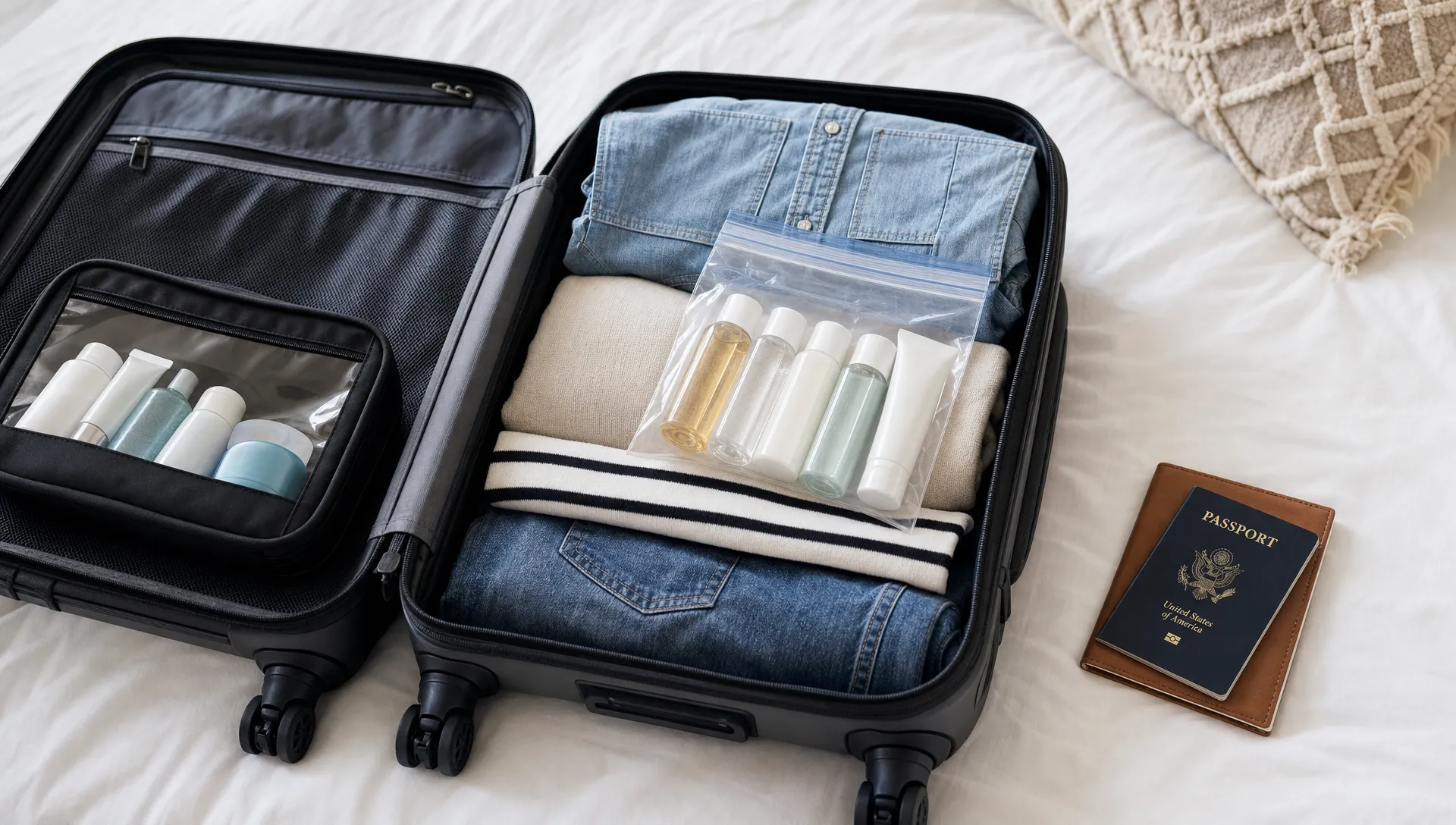
Instead of asking, “Can I bring this?” ask, “Where should this travel?” That changes packing from guesswork into a quick sorting exercise.
Use these four groups:
- Cabin essentials: Medicine, contact lens solution, baby items, a small toothpaste, lip balm, and toiletries you truly need before arrival.
- Checked-bag liquids: Full-size shampoo, sunscreen, perfume, hair products, and anything bulky that is not needed during the flight.
- Buy-after-security items: Water, drinks, some snacks, and destination toiletries that are easy to replace.
- Swap-for-solid items: Solid shampoo, bar soap, stick deodorant, toothpaste tablets, balm-style products, and powdered cosmetics.
This approach keeps your carry-on light and reduces the chance of losing expensive products at security.
How to pack medicines, baby items, and special diet liquids
Many countries allow reasonable exceptions for essential medicines, baby milk, formula, breast milk, and liquids required for medical or dietary needs. These items may be screened separately, and you may need to show them to security staff.
Do not hide exempt liquids deep inside your bag. Keep them accessible and separate from regular toiletries. If you are carrying prescription medicine, it is usually wise to keep it in original packaging and bring supporting documentation when possible, especially for international trips.
For babies and young children, rules can be more flexible than the standard liquids bag, but security officers still decide how items are screened. Pack only what you reasonably need for the journey, and check the airports on your route before assuming a large quantity will pass without extra inspection.
What about duty-free liquids?
Duty-free liquids can be allowed in cabin baggage, but they come with conditions. They are usually sealed in a tamper-evident security bag, with proof of purchase. The catch is transfers. If you have to pass through another security checkpoint after buying duty-free liquids, that airport’s rules still matter.
Do not open the sealed duty-free bag before your final security checkpoint. Keep the receipt inside or attached as instructed. If your route includes a connection, check whether the transfer airport accepts duty-free liquids in sealed security bags.
If the item is expensive, fragile, or easy to replace at your destination, consider whether buying it on arrival is less risky.
Checked baggage gives you more room, but not unlimited freedom
Checked luggage is usually the better place for full-size toiletries and larger liquid containers. Still, “checked” does not mean “anything goes.” Airlines and aviation safety rules can restrict hazardous liquids, strong alcohol, aerosols, fuels, solvents, and other dangerous goods.
For ordinary toiletries, the practical concern is leakage. Cabin pressure changes, rough handling, and loose caps can turn one shampoo bottle into a suitcase-wide mess.
Use a simple leak-control routine:
- Tighten each cap, then place tape or plastic wrap under screw tops if needed.
- Put liquids in a sealed toiletry bag or reusable zip bag.
- Keep fragile glass bottles cushioned inside clothing.
- Avoid packing liquids beside electronics, paper documents, or clothes that stain easily.
If you are traveling with aerosols, make sure caps are fitted and check your airline’s rules. If you are packing alcohol, especially high-strength spirits, check both airline and destination rules before placing it in checked luggage.
Packing examples for common trips
Different trips need different liquid strategies. The smartest setup is not always the smallest setup. It is the one that matches your route and risk.
| Trip type | Best liquid strategy | Why it works |
|---|---|---|
| Weekend with carry-on only | Use 100ml bottles and solid toiletries | Fastest through security and enough for a short stay |
| Beach vacation with checked bag | Put sunscreen and hair products in checked luggage | Saves limited liquids-bag space for cabin essentials |
| Business trip with a connection | Pack to 100ml unless every checkpoint confirms otherwise | Avoids problems during transfer screening |
| Family trip with baby items | Separate baby liquids and keep them easy to inspect | Helps security screen exempt items quickly |
| Return from an airport with stricter rules | Leave space to repack liquids before flying home | Prevents losing items bought during the trip |
Smarter packing also means thinking about what you do not want to worry about while away. For example, if you are leaving a property empty for an extended trip and need a leak or heating issue fixed before departure, U.K. homeowners and landlords can compare vetted local tradespeople ahead of time rather than dealing with a home problem from the airport.
The return flight is where many travelers get caught
Outbound packing is usually neat. Return packing is often messy. You may have bought sunscreen, perfume, cosmetics, sauces, gifts, or local products during the trip. If you return from an airport with stricter cabin rules, those items may not be allowed in carry-on baggage.
Before your final night, sort liquids again. Anything over 100ml should go in checked luggage if you have it. If you are traveling carry-on only, avoid buying large liquids unless you know your return airport permits them and any connection airport will also accept them.
This is especially important for routes involving different countries or airports with different scanner policies. A relaxed departure rule does not guarantee a relaxed return rule.
How Liquid Limits helps you avoid last-minute surprises
Because liquid rules can depend on airport, item, and route, checking a generic rule is not always enough. Liquid Limits is built for the practical question travelers actually have: “What is the strictest cabin liquid rule for my whole trip?”
You can use Liquid Limits to check airport liquid rules before you pack, compare outbound and return restrictions, and look up item-specific guidance. The tool uses verified source links, daily updates, and last-checked dates. When a rule is unclear, it defaults to the safer 100ml assumption so you are less likely to be surprised at security.
That conservative approach is useful because security decisions happen in real time. If the rule is uncertain, packing to the stricter standard is usually cheaper and less stressful than losing an item at the checkpoint.
A final pre-security checklist
Before you zip your bag, run through these questions:
- Are all carry-on liquid containers 100ml / 3.4oz or smaller if any checkpoint may require it?
- Do the containers fit in the required clear liquids bag?
- Are medicines, baby liquids, and special diet items separate and easy to show?
- Are full-size toiletries packed in checked luggage or left at home?
- Have you checked the return airport, not just the outbound airport?
- Are duty-free liquids sealed, with receipts kept available?
If you can answer yes, you are packing for the real trip, not just the first airport.
Frequently Asked Questions
Can I bring a 150ml bottle if it only has a little liquid left? Usually no. Under the standard 100ml rule, the container capacity matters. A larger bottle can be rejected even if it is almost empty.
Do airport liquid rules apply to checked luggage? The 100ml cabin liquids rule is mainly for carry-on bags at security. Checked luggage can usually hold larger ordinary toiletries, but hazardous liquids, aerosols, and alcohol may still be restricted by airline or safety rules.
Are makeup and skincare products counted as liquids? Many are. Mascara, liquid foundation, lip gloss, creams, gels, lotions, and serums should usually go in your liquids bag if carried in the cabin.
Can I rely on a 2L liquid allowance if my departure airport allows it? Only if every security checkpoint on your route allows it, including connections and your return airport. If any checkpoint may apply 100ml, pack to 100ml for carry-on liquids.
What is the safest way to pack liquids for an international trip? Use 100ml containers for cabin essentials, put full-size toiletries in checked luggage, keep exempt items accessible, and check the strictest rule for your outbound and return airports before packing.
Pack once, pass security with less stress
Flight liquid rules are not just about bottle size. They are about your route, your return airport, your items, and the security checkpoint in front of you. When in doubt, pack to the strictest rule, keep essentials accessible, and check your trip before you leave for the airport.
A few minutes of planning can save you from repacking at the checkpoint, throwing away expensive products, or starting your trip with avoidable stress.