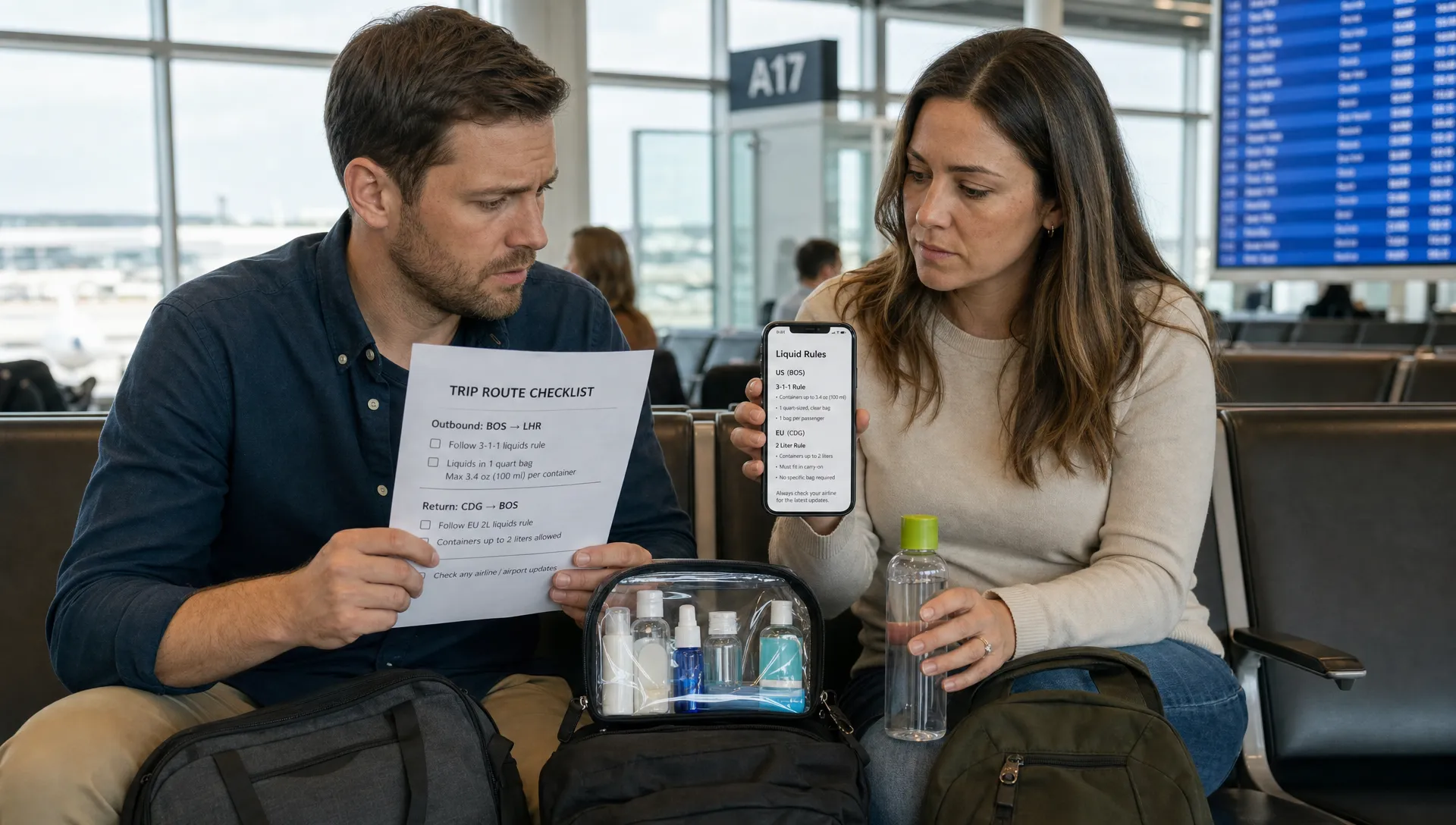
A round trip feels like one journey, but airport security treats it as a series of separate checkpoints. That is why flights and liquids can be simple on the way out and suddenly frustrating on the way home.
Your outbound airport might allow larger liquids because of newer screening equipment, a local policy change or a specific terminal setup. Your return airport may still enforce the classic 100ml cabin liquid rule. If you pack only for the first airport, the return leg is where full-size sunscreen, perfume, cosmetics or food spreads often get confiscated.
The practical rule is straightforward: your carry-on liquids must survive every security checkpoint on your trip, including the one at your return airport. For round trips, that makes the return airport just as important as the departure airport.
Your Return Flight Starts With a Different Security Rulebook
Many travelers think of a return flight as the reverse of the outbound flight. For baggage screening, it is not. The security checkpoint you pass through on the way home belongs to a different airport and sometimes a different country, regulator, terminal or scanner type.
The airline may be the same. Your seat may be on the same aircraft type. Your cabin bag may be identical. None of that guarantees the same liquid allowance.
Airport liquid rules are enforced at the security checkpoint before you enter the secure area. If the return airport applies a 100ml container limit, a 250ml shampoo bottle in your cabin bag is a problem even if your first airport allowed larger containers. If your route includes a connection where you must clear security again, that connecting airport also matters.
For a deeper explanation of how screening staff apply these rules at the checkpoint, Liquid Limits has a separate guide to how the liquid rule at the airport really works.
Why Liquid Rules Still Vary Between Airports
Liquid restrictions are not changing everywhere at the same speed. Some airports have introduced advanced cabin baggage scanners that can support larger liquid allowances. Others still use older screening processes or have kept the 100ml rule in place for operational, regulatory or safety reasons.
That creates a patchwork. One airport may advertise a higher limit, while another airport on the same trip still requires small containers in a clear bag. Official guidance from the TSA Liquids Rule continues to use the familiar 3.4 ounces or 100 milliliters limit for carry-on liquids in the United States. The UK government hand luggage restrictions also show why travelers should check current airport guidance rather than assume every airport has moved to the same system.
This is especially relevant in 2026 because travelers are hearing more about 2L allowances, modern scanners and relaxed rules. Those changes can be real in some places, but they are not universal. The mistake is assuming that one airport's relaxed policy follows you for the rest of the trip.
The Round-Trip Trap: Buying Liquids After You Arrive
The return airport matters most when you buy liquids at your destination. You may leave home with compliant travel-size toiletries, then buy full-size products during the trip because the outbound leg went smoothly.
Common examples include:
- A 200ml sunscreen bottle bought at a beach destination
- Local wine, olive oil, honey or sauces packed in a cabin bag
- Full-size skincare or hair products purchased because they were cheaper abroad
- Perfume, cologne or cosmetics bought as gifts
- Drinks, jams or spreads picked up at a market before heading to the airport
If your return airport enforces 100ml, those items usually need to go in checked baggage unless they qualify for a specific exemption or were bought duty-free and remain in a compliant sealed security bag. Even then, onward connections can create problems.
The risk is not limited to vacation souvenirs. Business travelers often get caught by items they use every day, such as shaving gel, contact lens solution, toothpaste, hand cream or liquid medication that has not been packed with documentation where required.
Return Airport Scenarios That Change What You Should Pack
The safest packing choice depends on where you will pass security, not just where your aircraft takes off. This table shows how the return airport can change your plan.
| Trip situation | Why the return airport matters | Safer packing choice |
|---|---|---|
| Outbound airport allows larger liquids, return airport uses 100ml | Your larger bottles may pass on the way out but fail on the way home | Pack cabin liquids in 100ml containers or place larger items in checked baggage |
| Direct outbound flight, return flight has a connection | You may clear security again during the return journey | Check every airport where you may be screened, not just the first departure airport |
| Same country, different return airport | Airports in the same country can use different equipment or local procedures | Look up the exact return airport and terminal when possible |
| Duty-free purchase before a connection | Sealed airport purchases can still be questioned at later screening points | Keep the receipt and sealed bag intact, and verify transfer rules before buying |
| Rules are unclear or recently changed | Staff will enforce the rule in place at the checkpoint, not a travel article you read earlier | Default to 100ml for cabin bags unless official airport guidance clearly says otherwise |
How to Pack When Outbound and Return Rules Differ
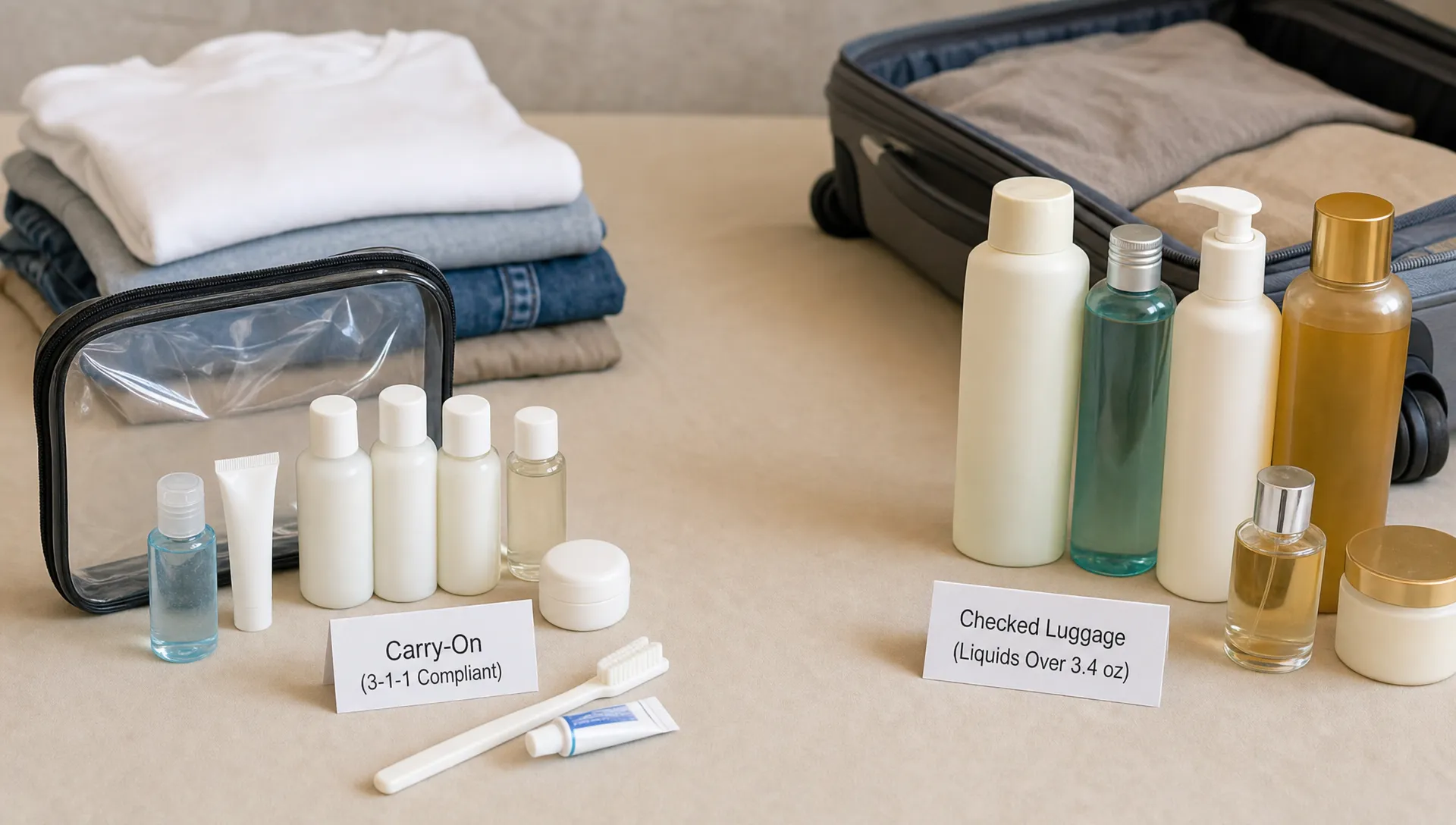
When your outbound and return airports have different liquid rules, pack for the strictest checkpoint if the item needs to stay in your cabin bag. This is the simplest way to avoid losing products at security.
Start by identifying every place where your cabin bag may be screened. For a basic round trip, that usually means the outbound departure airport and the return departure airport. For more complex trips, add any connection where you need to leave the secure area, change terminals, recheck baggage or pass through transfer security.
Then separate liquids into three groups: items you need during the flight, items you only need at the destination and items you can safely check. Keep essential cabin items in containers that meet the strictest rule on the route. Put larger toiletries, food liquids and gifts in checked baggage if you have it.
If you want a more route-focused packing walkthrough, see Liquid Limits' guide to packing cabin bag liquids for every airport on your route.
A practical round-trip packing plan looks like this:
- Use 100ml containers for liquids you want in your cabin bag for the entire journey.
- Pack larger liquids in checked baggage before the return flight, especially souvenirs and destination purchases.
- Leave space in checked baggage if you expect to buy sunscreen, cosmetics, alcohol or local food products.
- Check duty-free rules before buying liquids if your journey includes a transfer.
- Recheck airport guidance close to travel day because liquid rules can change quickly.
The last step matters more than many travelers expect. A blog post, social media tip or past airport experience can be out of date. Security staff enforce the current rule at that airport on that day.
Duty-Free Liquids Are Not a Free Pass
Duty-free liquids are a special case, and they cause plenty of confusion on return flights. If you buy a liquid after security, the store may place it in a sealed tamper-evident bag with a receipt. That can help when you are flying direct, but it does not guarantee a smooth trip through every later checkpoint.
The problem appears when your return journey includes a connection. If you have to pass through another security checkpoint, the officers there may inspect the sealed bag, the receipt, the route and the local rules. If the bag has been opened or the purchase cannot be verified, the item may be treated like any other oversized liquid.
This is why expensive perfume, spirits and cosmetics are sometimes confiscated even though they were bought inside an airport. The purchase was legal at the first airport, but the next screening point still had its own rules.
For direct flights, duty-free liquids are usually simpler. For connecting flights, especially international connections, check the rule for the transfer airport before you buy. If you are unsure, checked baggage is usually the lower-risk option for larger liquids.
Airport-Level Checks Beat Country-Level Assumptions
Country-level rules are useful, but they can be too broad for liquid planning. Airport-level checks are better because screening equipment, terminal procedures and local implementation can vary.
Two airports in the same country may not treat liquids the same way. Even two terminals at a major airport can be at different stages of rollout or use different lanes for certain passengers. A traveler who says "I flew from that country last month with a full-size bottle" may be describing a different airport, terminal, route or date.
This is where route-based checking helps. Instead of asking, "What are the liquid rules for this country?" ask, "What is the strictest liquid rule at every airport where I will be screened?"
Liquid Limits is built around that exact travel problem. You can check airport liquid rules before you pack by airport, item or route, including round trips where the return airport may be stricter than the outbound airport. The tool shows guidance side by side, includes source links and last-checked dates, and defaults to the stricter 100ml rule when a rule is unclear.
What Counts as a Liquid on the Return Trip?
The return airport matters for more than obvious liquids like water or shampoo. Security rules usually apply to liquids, aerosols, gels, creams and pastes. That means a surprising number of travel items can be affected.
Toiletries are the most common category: toothpaste, deodorant gel, moisturizer, hair gel, shaving foam, mascara and sunscreen. Food can also count, especially spreads, syrups, sauces, jams, soft cheese, dips and honey. Souvenirs are another frequent issue because travelers may not think of local products as security-restricted liquids until they reach the checkpoint.
Medicines, baby food, breast milk and special dietary items may be treated differently, but they are not a reason to ignore the return airport. Requirements can include reasonable quantities, separate screening or supporting documentation. Always check the specific rules for your departure airport and destination before relying on an exemption.
A Simple Rule for Flights and Liquids
If your trip has more than one security checkpoint, the strictest one controls what is safe to keep in your cabin bag. That is the simplest way to think about flights and liquids.
A relaxed outbound airport does not protect you on the return. A duty-free receipt does not remove every transfer risk. A country-level rule does not always describe your exact terminal. The return airport matters because it is not a formality, it is a new screening decision.
Before you pack, check both directions of the trip. Before you buy liquids at your destination, check the return airport. Before you rely on a larger allowance, confirm that every checkpoint on the route accepts it.
Frequently Asked Questions
Can I bring larger liquids if my outbound airport allows them? Yes, but only for checkpoints that allow them. If your return airport or transfer airport enforces 100ml, larger containers may need to go in checked baggage for that part of the journey.
Do liquid rules come from the airline or the airport? Cabin liquid rules are mainly enforced by airport security under national or local regulations. Airlines may have baggage policies, but the liquid decision usually happens at the security checkpoint.
Does the return airport matter if I am flying direct? Yes. A direct return flight still begins with security at the return airport. If that airport uses a stricter liquid rule than your outbound airport, your cabin bag must meet the return airport's rule.
Are duty-free liquids safe on a return flight with a connection? They can be, but only if they meet the rules for later screening points. Keep the sealed security bag and receipt intact, and check transfer airport rules before buying expensive liquids.
What should I do if I cannot confirm the return airport's liquid rule? Use the stricter 100ml cabin rule or pack larger liquids in checked baggage. When rules are unclear, conservative packing is usually cheaper than losing items at security.
Check the Return Airport Before You Close Your Bag
A few minutes of checking can save you from repacking at the airport or throwing away products you planned to bring home. Use Liquid Limits to compare liquid rules for your outbound and return airports, verify item-specific guidance and see the strictest rule for your route before you pack.
If your return airport is stricter, you will know before you buy that full-size bottle, not when it is already sitting in a security bin.