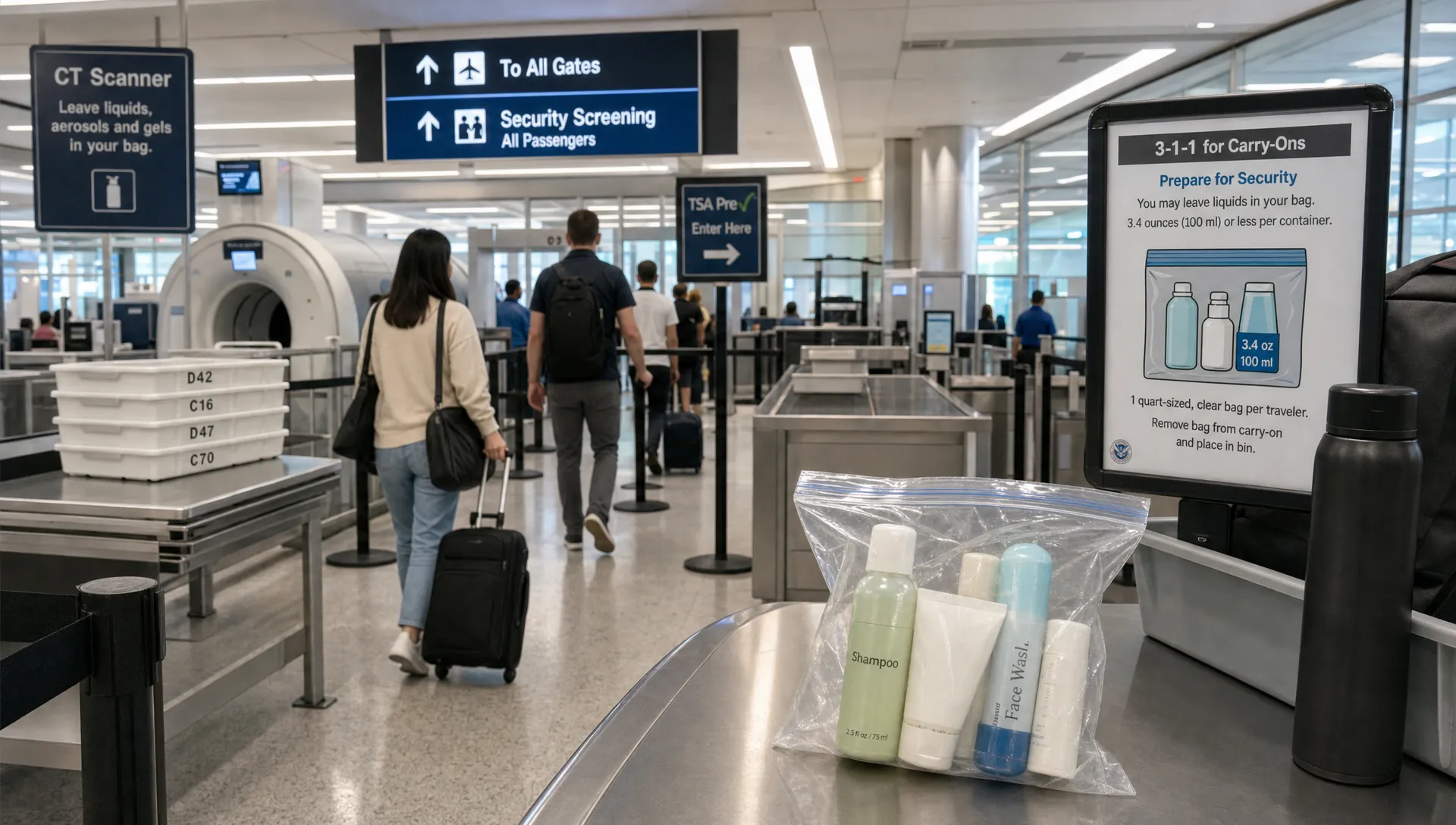
New cabin baggage scanners have made airport liquid rules look simpler than they really are. At some airports, newer CT screening equipment can support larger liquid allowances or reduce the need to unpack liquids. At many others, the familiar 100ml limit still applies exactly as before.
For travelers, the practical takeaway is clear: flights with a 100ml limit are not disappearing just because new scanners exist. The rule you face depends on the airport, terminal, checkpoint, route, transfer and return journey. A scanner is only one part of that chain.
What new scanners actually change at security
Newer cabin baggage scanners, often described as CT scanners, give security officers a more detailed view of the contents of a bag than older X-ray machines. According to TSA's overview of computed tomography screening, CT units create a 3D image that officers can rotate and inspect. That extra visibility can support different procedures, such as leaving some items inside the bag or permitting larger liquid containers where the regulator has approved it.
That does not mean the passenger rule changes the day a machine appears in the terminal. Airports need approved equipment, published procedures, trained staff, working lanes and fallback plans when a lane is closed or a bag needs secondary screening. National authorities may also decide to keep a 100ml cap while they test, validate or standardize new processes.
If you want the broader policy background, Liquid Limits has a separate explainer on why airports still use the 100ml rule. This article focuses on the traveler side: what does not change when you see signs about new scanners.
What new scanners do not change
The biggest mistake is treating new scanner news as a universal permission slip. It is not. Even where technology improves, several parts of the liquid rule stay the same for passengers.
The rule belongs to the checkpoint, not the aircraft
People often say a flight has a 100ml limit, but the cabin bag limit is applied when you pass through security. The airline may remind you of it, and a destination may have customs or import restrictions, but the carry-on liquid screening rule usually depends on the airport and terminal where your bag is screened.
This matters because one booking can involve more than one security checkpoint. A direct outbound flight may be easy, but a return flight, transfer or terminal change can put you under a different liquid policy.
Container size still matters where the 100ml rule applies
Where the 100ml rule is in force, the size printed on the container is usually the key test. A 150ml bottle containing only a small amount of shampoo can still be refused because the container itself is larger than 100ml. Decanting into a 100ml travel bottle is safer than trying to explain how much liquid remains.
For a closer look at this detail, see the guide to what 100ml liquid at the airport actually means. It is one of the most common points travelers miss, especially when they are packing half-empty products from home.
Your return flight can be stricter than your outbound flight
A trip is not governed by the most generous airport on the itinerary. You may depart from an airport with newer scanners, land somewhere with stricter rules and return through a checkpoint that still enforces 100ml containers. If you buy a full-size toiletry at your destination, it may be fine in your hotel bathroom but not fine in your carry-on for the return.
That is why the Liquid Limits trip liquid checker treats outbound and return travel as separate checks. For round trips, the safest answer is usually the strictest rule you will meet anywhere before you get home.
Transfers can reset the liquid rules
A connection does not always mean your bag stays behind the security boundary. Some transfers keep passengers airside. Others require you to clear immigration, collect baggage, change terminals or go through security again. If your carry-on is screened again, the liquid rule at that second checkpoint applies.
This is especially important for long-haul trips with duty-free shopping, separate tickets or self-transfers. A bottle that was allowed at your first airport can become a problem if your connection airport applies the 100ml rule and does not accept the way it is packed.
The liquid category is still broad
New scanners do not change what counts as a liquid for security purposes. The category typically includes liquids, gels, aerosols, creams, pastes and similar products. Toothpaste, mascara, peanut butter, sunscreen, hair gel, perfume, deodorant spray and some food items can all fall into the liquids category.
TSA's 3-1-1 liquids rule and the UK government's hand luggage restrictions both show how wide the category can be. If an item can be poured, spread, sprayed or smeared, check it before assuming it is treated like a solid.
Medical and baby exceptions remain exceptions
Most security systems make allowances for essential medicines, baby milk, baby food and special dietary needs. Those allowances do not mean all other liquids can ignore the standard limit. You may need to present exempt items separately, show they are needed for the trip or allow additional screening.
If you travel with medication or baby supplies, keep them accessible and do not bury them under clothing. New scanners may reduce some unpacking steps, but officers can still ask to inspect exempt liquids.
Duty-free purchases are not a universal workaround
Duty-free liquids can sometimes travel through connections when they are sealed in approved tamper-evident bags with proof of purchase. The word sometimes matters. If the bag is opened, the receipt is missing, the purchase is outside the permitted window or the connection airport does not accept the format, the item can still be questioned or refused.
A large bottle bought after security at one airport should not be treated as automatically safe for every later checkpoint. If your itinerary includes a transfer, check the transfer airport rules before you rely on duty-free packaging.
| What new scanners can improve | What travelers often assume | What does not change |
|---|---|---|
| More detailed bag images | All airports with new machines allow large liquids | Liquid rules still depend on regulator approval and airport procedure |
| Less unpacking at some checkpoints | Liquids never need to be separated | Some lanes or airports may still ask for liquids to be removed |
| Better detection capability | Rules are identical across countries | Local authorities can keep, pause or change liquid allowances |
| Larger liquid trials or approvals | Outbound permission covers the whole trip | Each security checkpoint, including return and transfer, is separate |
How to pack for flights with a possible 100ml limit
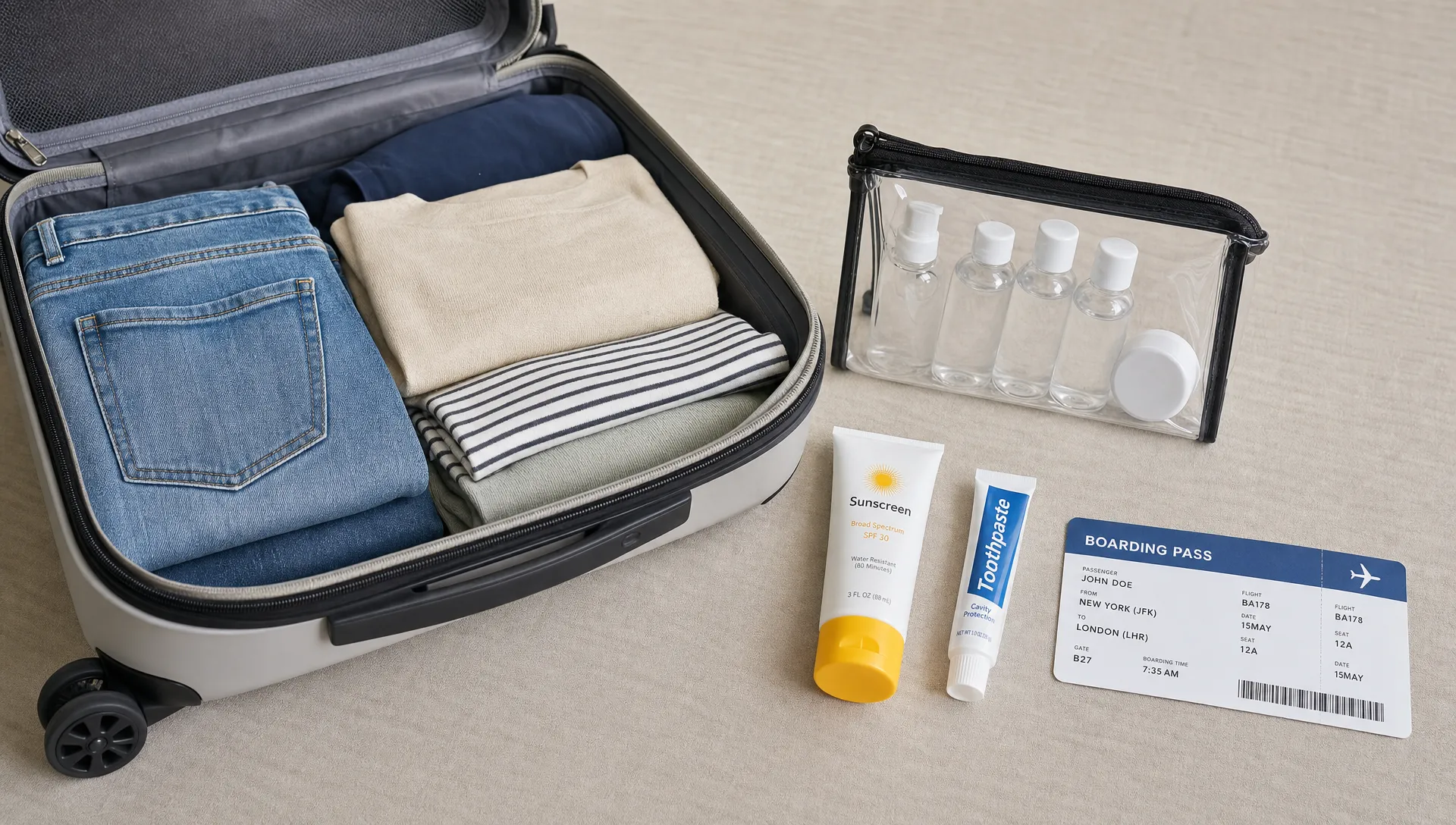
If your route includes any airport where the rule is unclear, pack as if the 100ml limit applies. This is not the most exciting advice, but it is the least likely to cost you a bottle of perfume, skincare product or specialty food at the checkpoint.
A practical packing plan looks like this:
- Use containers marked 100ml or less for non-exempt liquids in your cabin bag.
- Keep travel-size liquids together so they are easy to remove if asked.
- Put larger toiletries in checked baggage when you have checked baggage available.
- Keep medicines, baby supplies and special dietary liquids separate and easy to present.
- Check the return airport before buying full-size liquids during your trip.
If an airport clearly allows larger cabin liquids, you can still choose to pack under 100ml for simplicity. This is often the better choice for multi-city trips, separate tickets and routes with a connection. The lighter your assumptions, the smoother your security experience tends to be.
Common scenarios where new scanners do not save you
Some trips look scanner-friendly on the surface but still end up governed by a 100ml checkpoint. These scenarios are where travelers are most likely to get caught out.
| Travel scenario | Why the 100ml limit may still apply | Safer move |
|---|---|---|
| Your outbound airport advertises new scanners | Your return airport may still enforce 100ml | Pack return liquids in 100ml containers or check a bag |
| You connect through another country | You may be screened again at the transfer airport | Check the transfer rules, not just the departure airport |
| One terminal has upgraded lanes | Your airline may use a different terminal or older lane | Check the exact airport and terminal when possible |
| You buy duty-free before a connection | The next checkpoint may require sealed packaging and proof | Keep the bag sealed and keep the receipt visible |
| Your item is a cream, paste or gel | New scanners do not make it a solid | Treat it as a liquid unless official guidance says otherwise |
The route context is the part many passengers underestimate. If you are checking several flights, 100ml packing is still the least risky default when your trip crosses different airports or countries.
When you can rely on a larger liquid allowance
You can be more confident using a larger allowance only when the current official guidance supports it for the exact checkpoint you will use. A general news article, a friend's recent experience or a sign seen at another terminal is not enough for a trip with expensive or essential liquids.
Before packing larger containers in hand luggage, make sure these points are true:
- The airport currently allows larger liquids at the checkpoint you will use.
- Your terminal, lane or passenger type is included in that policy.
- Your route does not require another security screening with a stricter rule.
- Your return airport also allows the item if you plan to bring it back.
- The item itself is allowed in cabin baggage and is not restricted for another reason.
If one of those answers is unknown, the 100ml limit is the safer fallback. This is especially true in 2026 because scanner rollouts and liquid policies are still not uniform across airports.
A simple decision rule for travelers
Before you close your cabin bag, ask three questions. Which airport and terminal will screen my bag? What is the current rule for this item at that checkpoint? Will my bag be screened again before I reach my destination or return home?
If you can answer all three with current source-backed information, pack according to that rule. If you cannot, pack non-exempt liquids in 100ml containers. New scanners may make some journeys easier, but the strictest checkpoint on your itinerary is the one that matters.
Frequently Asked Questions
Do new airport scanners mean the 100ml limit is gone? No. New scanners can support different liquid procedures at some airports, but the 100ml limit still applies where the airport or regulator keeps it in force.
Is the 100ml limit based on the airline or the airport? It is usually enforced at airport security, not by the aircraft itself. Airlines may publish reminders, but the checkpoint rule is what determines what can pass in your cabin bag.
Can I bring a 150ml bottle if it is almost empty? Where the 100ml rule applies, no. Security usually looks at the container size, so a 150ml bottle can be refused even if it contains less than 100ml.
Do I still need a liquids bag with CT scanners? Some airports with newer scanners may not require the same unpacking process, but others still do. Check the exact airport guidance and keep liquids easy to access in case staff ask to inspect them.
What about medicine, baby milk or special dietary liquids? These items often have exceptions, but they may need separate screening. Carry only what is reasonable for the trip and keep it accessible at security.
How do I know if my flight has a 100ml liquid limit? Check every airport where your cabin bag will be screened, including transfers and the return flight. If any checkpoint is unclear or stricter, plan for 100ml containers.
Check the strictest rule for your whole trip
Before you pack, check your route, airport and item in Liquid Limits. It shows outbound and return liquid rules side by side, with last-checked dates and source links. When a rule is unclear, it uses 100ml as the safer fallback, so you do not plan around a scanner policy that may not apply to your checkpoint.