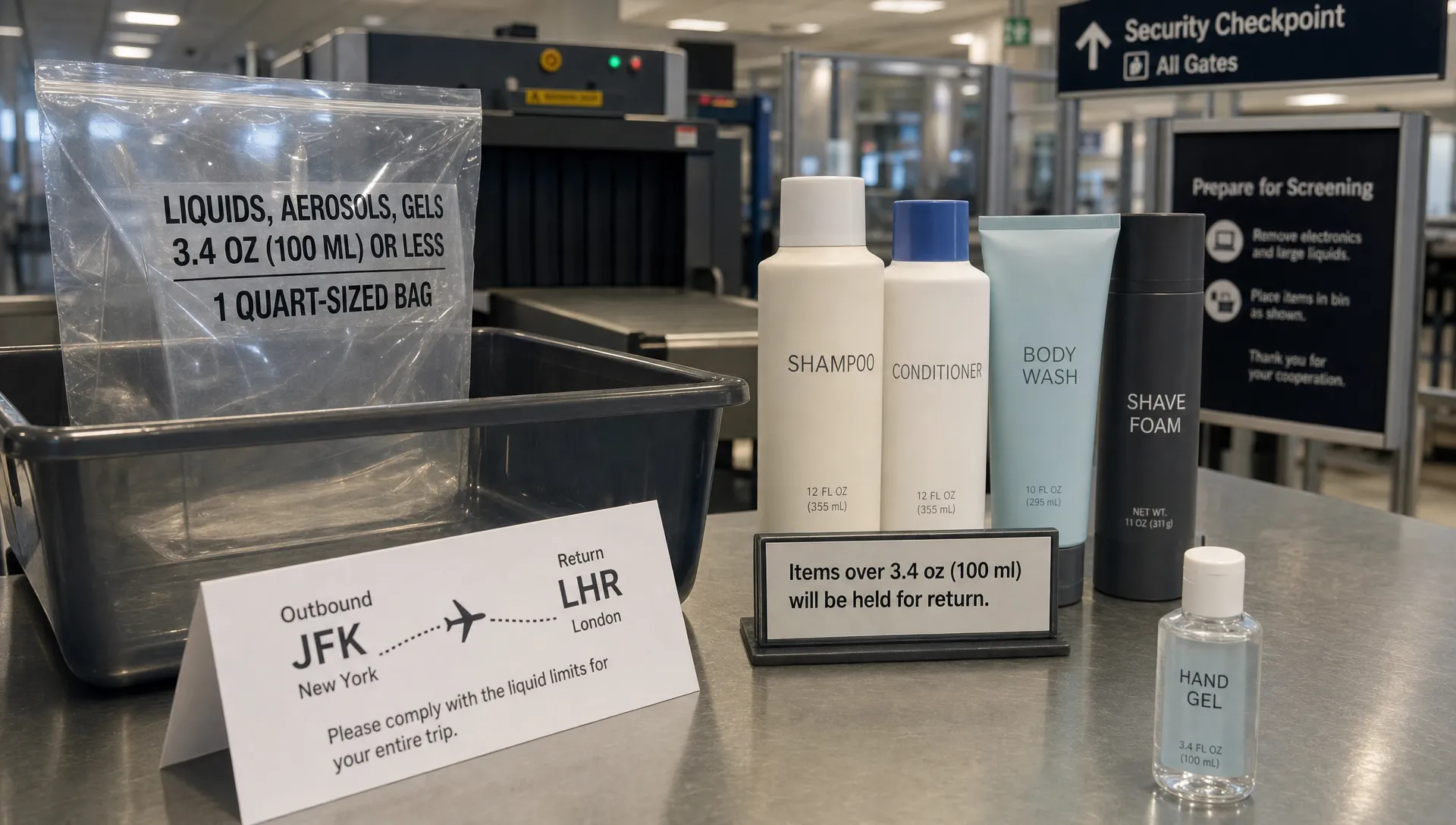
Flying with liquids in the UK is no longer something you should handle from memory. For years, the safe answer was simple: pack liquids in containers of 100ml or less, place them in a small clear bag, and expect security to check them separately. That rule still matters, but airport scanner upgrades mean some UK journeys may involve different limits depending on the airport, terminal, route, and date you fly.
The practical answer is this: before you pack, check the strictest liquid rule that applies to your whole trip, not just your outbound UK airport. A 2L allowance at one checkpoint does not help if your return airport, connecting airport, or next security screening still applies the 100ml rule.
This guide focuses on what to check first when flying with liquids in the UK, so you can make a quick, low-risk packing decision before you leave for the airport.
The first thing to check: your strictest security checkpoint
The most common mistake is checking only the airport you depart from. That is not enough if your trip includes a return flight, a connection, a separate ticket, or a transfer where you must pass security again.
For a low-stress trip, ask one question first: where is the strictest cabin liquid checkpoint on my itinerary?
That checkpoint determines how you should pack your cabin liquids. If one airport on your route still limits liquids to 100ml containers, packing a 500ml shampoo in your hand luggage is risky even if another airport would allow it.
A quick pre-flight check should cover these points:
| What to check | Why it matters | Lower-risk choice |
|---|---|---|
| UK departure airport and terminal | UK airports may not all apply the same liquid allowance at the same time | Confirm the exact airport rule before packing larger containers |
| Return airport | Your return security checkpoint may be stricter than your UK departure airport | Pack for the stricter direction of travel |
| Connections and transfers | You may be screened again after buying or carrying liquids | Keep liquids compliant for every checkpoint |
| Item type | Gels, pastes, creams, aerosols, and some foods may count as liquids | Treat borderline items as liquids unless confirmed otherwise |
| Exemptions | Medicines, baby supplies, and special dietary items can be treated differently | Carry only what you need and keep evidence accessible |
| Checked baggage option | Cabin liquid limits are not the same as hold luggage rules | Put non-essential large liquids in checked baggage when possible |
If you only remember one rule, make it this one: pack for the strictest checkpoint unless every airport on your route clearly confirms a higher allowance.
The baseline UK liquid rule you should still be ready for
The traditional UK cabin liquid rule is still the safest default when rules are unclear. Under the familiar 100ml system, liquids in hand luggage must usually be in containers of 100ml or less, placed in a single transparent, resealable plastic bag. The UK government’s hand luggage restrictions guidance remains a useful baseline for understanding how liquids, gels, creams, pastes, sprays, and aerosols are treated at security.
The important detail is container size, not how much liquid is left inside. A half-empty 200ml bottle is still a 200ml container, so it can be refused at a 100ml checkpoint.
This baseline matters because scanner upgrades have not made liquid rules equally simple everywhere. Some airports may allow larger liquids only after specific equipment and processes are approved. Others may continue to apply the 100ml rule. Rules can also change during operational updates, so last year’s experience is not enough.
If you want a broader airport-focused background before packing, the Liquid Limits guide to UK airports liquids rules for carry-on bags explains the standard UK approach and common exemptions in more detail.
Check the exact airport, not just the country
Flying from the UK does not automatically mean every UK airport applies the same cabin liquid limit. Even when national policy sets the framework, the passenger experience can depend on the airport’s screening equipment, terminal setup, and current security instructions.
That means you should check the exact departure airport, and where relevant, the exact terminal. Do not rely on a general statement such as UK airports allow 2L liquids or UK airports only allow 100ml liquids. Both can be misleading if they do not match your airport and travel date.
This is especially important for travelers who regularly use different airports. For example, you might fly out from one UK airport on a business trip, return through another, then take a family trip from a regional airport a few weeks later. The liquid rule you experienced on the first trip may not apply to the next one.
The same caution applies if you are comparing airports in London, Scotland, Northern Ireland, Wales, or regional England. Airport rules can change at different speeds, and a route-based check is more reliable than memory.
Check your return flight before your outbound flight
Return flights are where many travelers get caught out. You may leave the UK under one rule, then come home through an overseas airport with a stricter 100ml policy. Or you may buy toiletries, perfume, alcohol, cosmetics, sauces, or gifts during your trip and assume they can come back in your cabin bag.
Before packing, look at the return journey as carefully as the outbound journey. If your return airport applies the 100ml rule, you should avoid relying on large cabin liquids unless they qualify for an exemption or are packed in checked baggage.
This is particularly relevant for:
- City breaks where you travel with hand luggage only
- Beach holidays where sunscreen, after-sun, and toiletries are common
- Business trips where grooming products and cosmetics stay in cabin bags
- Trips with duty-free purchases before a connection
- Open-jaw itineraries where you fly home from a different airport
A route check is often faster than checking each airport manually. Liquid Limits lets you check airport liquid rules before you pack, including outbound and return flights, and shows source links and last-checked dates so you can see what the rule is based on.
Check whether your item actually counts as a liquid
Many security problems happen because passengers think only water, shampoo, and perfume count as liquids. In airport screening, the category is much broader.
As a practical rule, treat anything that can be poured, spread, squeezed, sprayed, smeared, or scooped as a possible liquid. That includes obvious toiletries, but also many items people forget about.
Common liquid or liquid-like items include:
- Shampoo, conditioner, shower gel, body wash, and liquid soap
- Toothpaste, mouthwash, deodorant gels, and roll-on deodorant
- Perfume, aftershave, sprays, and aerosols
- Foundation, mascara, lip gloss, creams, balms, and lotions
- Hair gel, styling cream, sunscreen, and after-sun
- Sauces, jams, honey, yogurt, soft cheese, and spreads
- Contact lens solution and saline
- Vape liquids and some refill products
This is where item-specific checking matters. A solid deodorant stick may be treated differently from an aerosol deodorant. A powder foundation is not the same as liquid foundation. A solid shampoo bar is not the same as bottled shampoo.
For a deeper practical overview of borderline items, the guide to liquid restrictions when flying covers what usually counts as a liquid and how checked baggage differs.
Check exemptions before you rely on them
Some liquids are allowed in cabin baggage outside the normal 100ml limit, but you should not treat exemptions as a free pass for anything oversized.
The most common exemptions are for essential medicines, baby food, baby milk, expressed breast milk, and special dietary requirements. These items may be allowed in quantities larger than 100ml when they are needed for the journey. However, airport staff may screen them separately, ask questions, or request supporting evidence.
If you are carrying exempt liquids, keep them easy to reach. Do not bury medication at the bottom of your cabin bag. If you have a prescription, medical letter, product label, or other supporting document, keep it with the item. For baby supplies, pack only what you reasonably need for the journey and allow extra time at security.
Medical cooling packs can also need attention. If a gel pack or ice pack is used to keep medicine at the right temperature, check whether it is covered by the airport’s medical exemption guidance. When in doubt, get confirmation from the airport or airline before travel, and arrive early enough for additional screening.
Check duty-free and airport purchases carefully
Duty-free liquids can be confusing because they are usually bought after security. Perfume, alcohol, cosmetics, and other liquids purchased airside may be sealed in tamper-evident bags with receipts, which can help during onward travel. But this does not guarantee trouble-free passage through every later checkpoint.
The key question is whether you will pass security again. If you have a direct flight home, the risk is lower. If you have a connection, a terminal change, a self-transfer, or separate tickets, your duty-free liquid may be screened again and local rules may apply.
Before buying large liquids at the airport, check your next checkpoint. If you cannot confirm that your sealed duty-free purchase will be accepted, consider buying at your final airport, packing liquids in checked baggage where allowed, or choosing smaller items that comply with 100ml rules.
Also keep receipts inside the sealed bag and do not open the bag before your final destination. Opening it can remove the evidence that the item was purchased in a controlled airport environment.
Check whether checked baggage is the better option
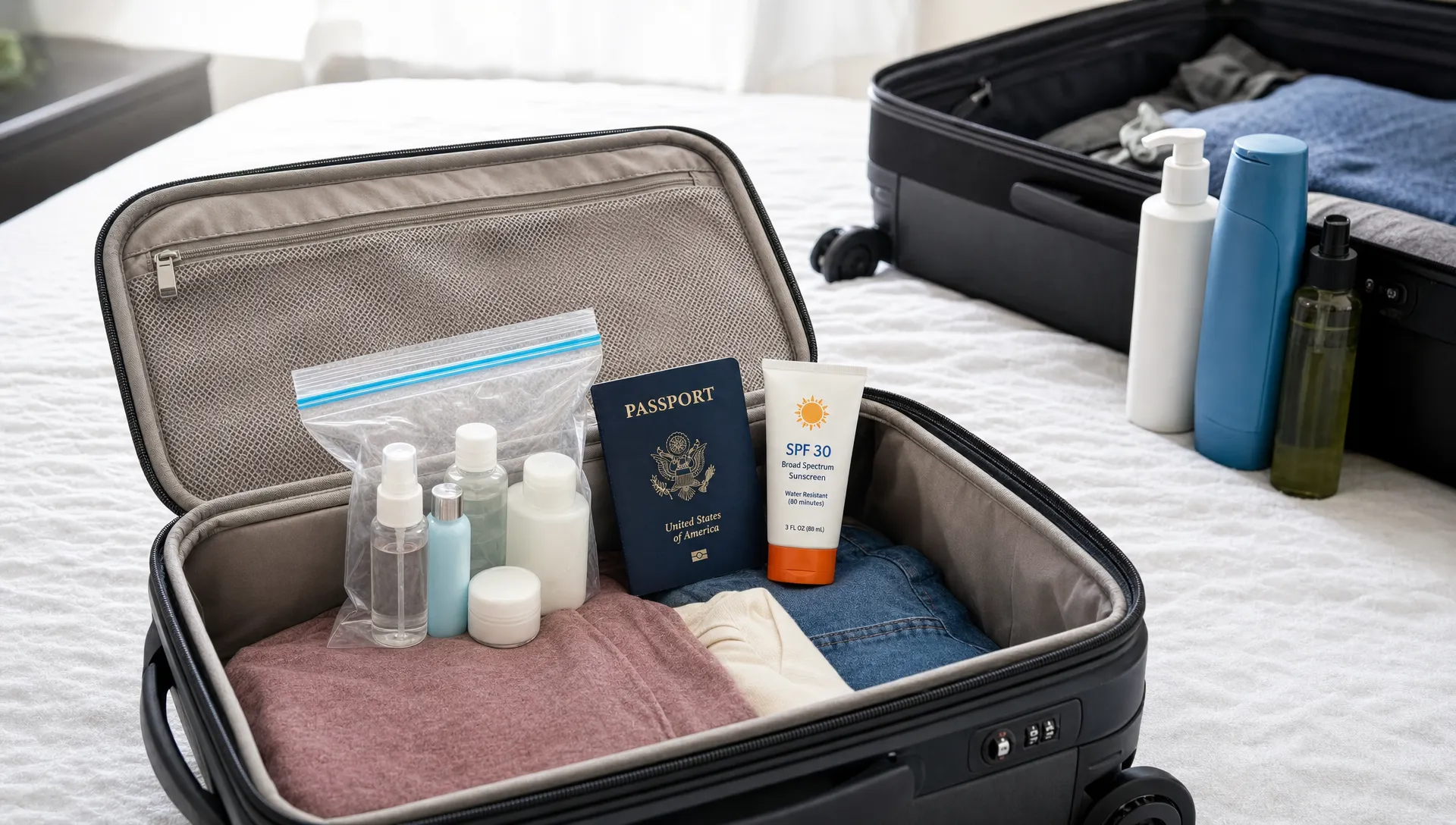
Cabin liquid rules apply to hand luggage screening. They are not the same as checked baggage rules. If you need full-size toiletries, large sunscreen, specialist hair products, perfume, sauces, or gifts, checked baggage may be the simplest choice.
That does not mean everything liquid is automatically allowed in the hold. Some products are restricted because they are flammable, pressurized, corrosive, or otherwise regulated. Aerosols, alcohol, fuel-like products, and chemical items can have airline or safety limits. Always check airline dangerous goods rules if you are packing anything beyond normal toiletries.
For ordinary toiletries in checked baggage, leak prevention matters. Tighten caps, use sealable bags, and cushion bottles inside clothing. Changes in pressure and baggage handling can turn a poorly sealed bottle into a messy arrival.
If you are traveling hand luggage only, reduce risk by switching to solid alternatives where possible. Shampoo bars, solid deodorant, powder makeup, soap bars, toothpaste tablets, and laundry sheets can all reduce your dependence on cabin liquid allowances.
A 2-minute packing decision for UK liquid rules
If you are short on time, use this decision table before packing your cabin bag.
| Situation | What to do |
|---|---|
| Any airport or connection on your route is unclear | Pack cabin liquids in 100ml containers or put larger liquids in checked baggage |
| Every security checkpoint clearly allows larger liquids | Follow the confirmed airport guidance, but keep items easy to screen |
| You are traveling hand luggage only | Prefer 100ml containers and solid alternatives unless your full route confirms otherwise |
| You are carrying medicine or baby supplies | Keep them separate, carry only what you need, and bring supporting information if relevant |
| You plan to buy duty-free liquids | Check whether you will pass another security checkpoint before your final destination |
| Your item is borderline | Treat it as a liquid unless an official source says otherwise |
This approach is deliberately conservative. It is usually cheaper and easier to pack smaller containers than to lose expensive products at security.
If you want a simple rule for mixed or uncertain trips, follow the advice in Liquid Limits’ guide to packing to the strictest checkpoint. That mindset is especially useful when scanner rules differ between airports.
Common UK trip scenarios and what to check
For a UK domestic flight, check the departure airport and the return airport. Even if both airports are in the UK, do not assume they apply the same liquid process. Domestic passengers still pass airport security.
For a UK to Europe trip, check the UK departure airport, the European return airport, and any connecting airports. European airports may have their own scanner rollout status and temporary rules, so a larger allowance in one place may not carry across the whole trip.
For a long-haul trip from the UK, pay close attention to transfers. If you connect through another country, you may need to comply with that airport’s liquid rules even if your first UK airport allowed larger containers.
For a hand luggage only holiday, check sunscreen, toiletries, cosmetics, and food items before you pack. These are among the most common reasons travelers end up repacking at security.
For an open-jaw trip, where you fly out to one city and home from another, check both overseas airports. A rule at your arrival airport may be irrelevant if you do not depart from that airport on the way home.
What not to assume when flying with liquids in the UK
Do not assume your airline sets the airport liquid limit. Airlines set baggage size, weight, and some dangerous goods rules, but airport security controls cabin liquid screening.
Do not assume a previous trip proves today’s rule. Scanner upgrades, temporary restrictions, terminal changes, and local procedures can change what happens at the checkpoint.
Do not assume 2L means every liquid is allowed. Even where larger liquid containers are permitted, dangerous goods rules, alcohol limits, aerosol restrictions, and item-specific screening can still apply.
Do not assume a nearly empty bottle is acceptable. At 100ml checkpoints, the container capacity is what counts.
Do not assume the outbound rule is enough. Your return flight, connection, or transfer can be the strictest point of the trip.
Frequently Asked Questions
Can I take liquids over 100ml through UK airport security? Sometimes, but only if the airport and checkpoint you are using clearly allow larger liquids or the item qualifies for an exemption such as essential medicine or baby supplies. If the rule is unclear, pack to the 100ml limit.
Are UK airport liquid rules the same everywhere? No. UK airport liquid rules can vary because scanner upgrades and security procedures are not always identical across airports and terminals. Check your exact airport, route, and travel date.
Does the 100ml rule apply to checked baggage? No, the 100ml cabin liquid rule is for hand luggage security screening. Checked baggage can usually carry larger everyday toiletries, but dangerous goods, aerosols, alcohol, and airline baggage limits may still apply.
What counts as a liquid when flying from the UK? Liquids can include gels, creams, pastes, aerosols, sprays, lotions, cosmetics, sauces, spreads, and some soft foods. If an item can be poured, squeezed, spread, sprayed, or smeared, treat it as a liquid unless confirmed otherwise.
Do I need to check the return airport if I am flying from the UK? Yes. Your return airport may apply a stricter rule than your UK departure airport. This is especially important if you buy toiletries, cosmetics, alcohol, or gifts during your trip.
Can I take medicine over 100ml in hand luggage? Essential medicines may be allowed in larger quantities when needed for the journey, but they can require separate screening. Keep them accessible and carry supporting evidence where possible.
Check before you pack
Flying with liquids in the UK is easiest when you stop thinking in terms of one universal rule and start checking the actual trip in front of you. The safest packing choice is the one that works at every security checkpoint on your itinerary, including the return flight.
Before you close your suitcase, use Liquid Limits to check airport, item, and route liquid rules side by side. The tool provides verified guidance with source links, last-checked dates, and a stricter fallback when rules are unclear, so you can pack with fewer surprises at security.