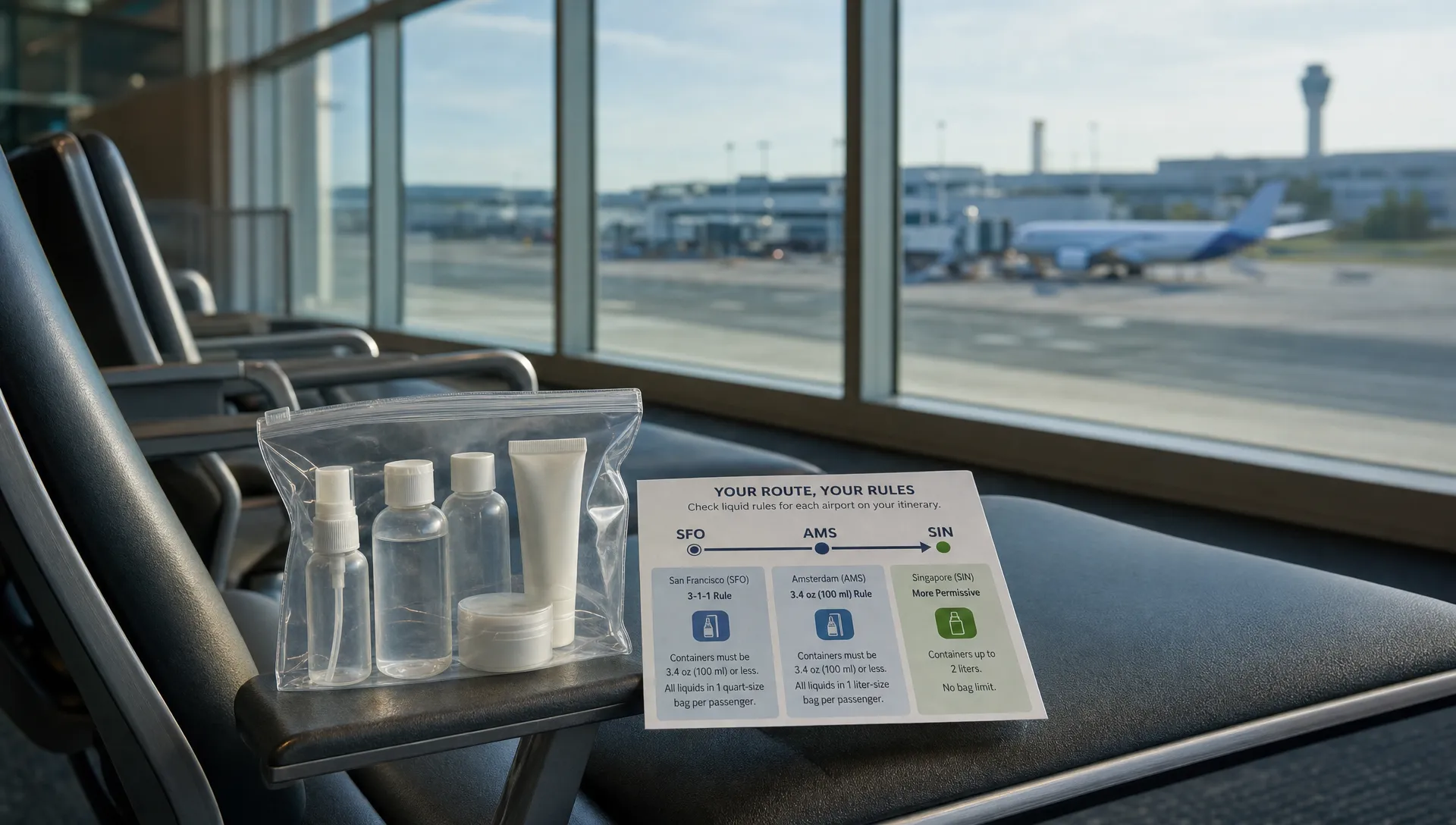
If you only remember one thing about hand carry liquids, make it this: pack for the strictest security checkpoint on your trip, not the most generous one.
That simple habit solves most liquid-rule confusion. One airport may still enforce the familiar 100ml rule. Another may use newer screening equipment and allow larger containers. Your return airport, transfer airport, or final pre-boarding security check may apply a different rule again. When your bag has to pass through more than one checkpoint, the most restrictive rule is the one that matters.
This guide keeps the rules practical, so you can pack toiletries, drinks, medicine, makeup, baby supplies, and duty-free liquids without guessing at the airport.
The simple hand carry liquids rule
For most travelers, the safest cabin-bag rule is:
Each liquid container should be 100ml, or 3.4oz, or smaller, and your small liquids should fit inside a clear resealable liquids bag.
That is the rule many airports still apply. In the United States, the TSA explains this as the 3-1-1 liquids rule: containers of 3.4oz or less, placed in one quart-sized bag, with one bag per passenger. Other countries often use similar language, although the exact bag size, screening process, and exceptions may vary.
The important detail is that the limit normally applies to the container size, not how much product is left inside. A 200ml shampoo bottle that is half empty is still a 200ml container. If security is enforcing a 100ml limit, that bottle can be refused even if it contains less than 100ml.
Some airports with newer scanners may allow larger liquid containers in hand carry bags, sometimes up to 2L. But this is not universal, and rules can change due to airport policy, equipment availability, or temporary security instructions. That is why checking the airport and route before you pack is safer than relying on what happened on your last trip.
What counts as a liquid in hand carry luggage?
Airport security uses “liquids” more broadly than many travelers expect. It usually includes liquids, aerosols, gels, creams, pastes, and spreadable items. If it can be poured, squeezed, sprayed, smeared, or spread, treat it as a liquid unless you have confirmed otherwise.
Common hand carry liquids include toiletries, cosmetics, food products, and everyday travel items. If you want a deeper item-by-item explanation, Liquid Limits also has a guide to liquids in carry-on luggage and what is allowed.
| Item | Does it usually count as a liquid? | Safest hand carry approach |
|---|---|---|
| Water, juice, coffee, soft drinks | Yes | Empty or finish before security, then refill or buy after screening |
| Shampoo, conditioner, shower gel | Yes | Use containers of 100ml or less, unless your airport clearly allows more |
| Toothpaste | Yes | Pack a travel-size tube in your liquids bag |
| Lotion, sunscreen, moisturizer | Yes | Use small containers and check sunscreen size carefully |
| Mascara, liquid foundation, lip gloss | Yes | Pack with other liquids, gels, and creams |
| Aerosol deodorant or hairspray | Yes | Use a small personal-care aerosol and keep the cap on |
| Solid deodorant or bar soap | Usually not treated like a liquid | Still check local rules if the item is soft, gel-like, or unusual |
| Peanut butter, honey, jam, sauces | Yes | Pack small containers or put larger jars in checked baggage |
| Contact lens solution | Yes, with possible medical handling | Carry only what you need and check whether your route allows a medical exception |
| Liquid medicine | Often exempt when medically necessary | Keep it accessible, declare it if required, and bring supporting documentation when possible |
The mistakes that cause most confiscations
Most airport liquid problems are not caused by unusual items. They happen because a traveler applies the right rule in the wrong way.
One common mistake is packing one full-size product because it is “almost empty.” Security normally looks at the label or container capacity. A large bottle with a small amount inside can still fail.
Another mistake is assuming airside purchases are always safe through connections. A sealed duty-free bottle may be allowed on one leg, but if you pass through transfer security later, the rules of that airport apply. Many airports recognize sealed security tamper-evident bags with receipts, but you should keep the bag sealed and confirm transfer rules before opening or repacking anything.
A third mistake is trusting one airport’s relaxed rule for an entire round trip. Your outbound airport may allow larger containers, but your return airport may still require 100ml containers. If you fly out with a 500ml face wash in your hand carry, you might not be able to bring it back in the same bag.
Finally, travelers often forget that airline baggage rules and airport security rules are separate. Your airline decides cabin bag size and weight. Airport security decides what liquids can pass through screening. You need to satisfy both.
Why the rules feel different from airport to airport
Liquid rules are not confusing because travelers are careless. They are confusing because airport screening systems are not identical worldwide.
Many airports still use the standard 100ml approach. Some airports have introduced newer computed tomography screening equipment, often called CT scanners, which can change how liquids are screened. Other airports may have the equipment in some lanes but not all lanes. In some places, larger-liquid permissions have been paused or adjusted after rollout.
Government guidance can also differ. For example, the UK government maintains public guidance on hand luggage restrictions at airports, while the TSA publishes U.S. screening guidance. These sources are useful, but your real trip may involve multiple airports across different jurisdictions.
That is why Liquid Limits focuses on the trip, not just one airport. You can check airport liquid rules before you pack and compare the strictest requirement for your whole journey, including a return flight.
The safest rule for round trips and connections
If you are taking a simple one-way flight with no connection, you only need to pass the departure airport’s security checkpoint. Still, you should check the destination country for customs or import restrictions if you are carrying food, alcohol, or specialty products.
For round trips, check both directions. The liquid rule on the way home may be stricter than the rule on the way out. This matters if you plan to buy toiletries, perfume, skincare, drinks, or local food products while traveling.
For connecting flights, the key question is whether you will pass through security again. If your connection involves transfer screening, your hand carry liquids may be checked again under that airport’s rules. This is especially important for duty-free liquids, large toiletries, and beverages bought after the first security checkpoint.
When in doubt, use this practical hierarchy:
- If every checkpoint clearly allows larger liquids, follow the published airport rules and keep items easy to inspect.
- If one checkpoint uses the 100ml rule, pack all non-exempt cabin liquids in 100ml containers.
- If the rule is unclear, assume the 100ml limit for hand carry liquids and put larger items in checked baggage.
Liquid Limits uses the same conservative idea when guidance is unclear: default to the stricter 100ml rule rather than telling travelers to gamble at security.
Exceptions: medicine, baby items, and special needs
Some liquids may be allowed in quantities above 100ml, but exemptions are not a free pass to pack anything without screening.
Liquid medicines are commonly treated differently when they are medically necessary for the trip. That can include prescription medicine, certain over-the-counter products, nutritional liquids for medical needs, and supplies connected to medical equipment. Keep these items easy to remove from your bag, carry them in original packaging when possible, and bring a prescription, doctor’s note, or proof of need if you have it.
Baby milk, formula, expressed breast milk, sterilized water, and baby food may also be allowed in larger quantities when traveling with a baby or young child. These items may need separate screening, and the amount should be reasonable for the journey.
Special dietary liquids can be more complicated. If an item is medically necessary, it may be treated under a medical exception. If it is simply preferred food or drink, it may need to follow the standard liquids rule. The safest approach is to check your specific airport and item before travel.
How to pack hand carry liquids without stress
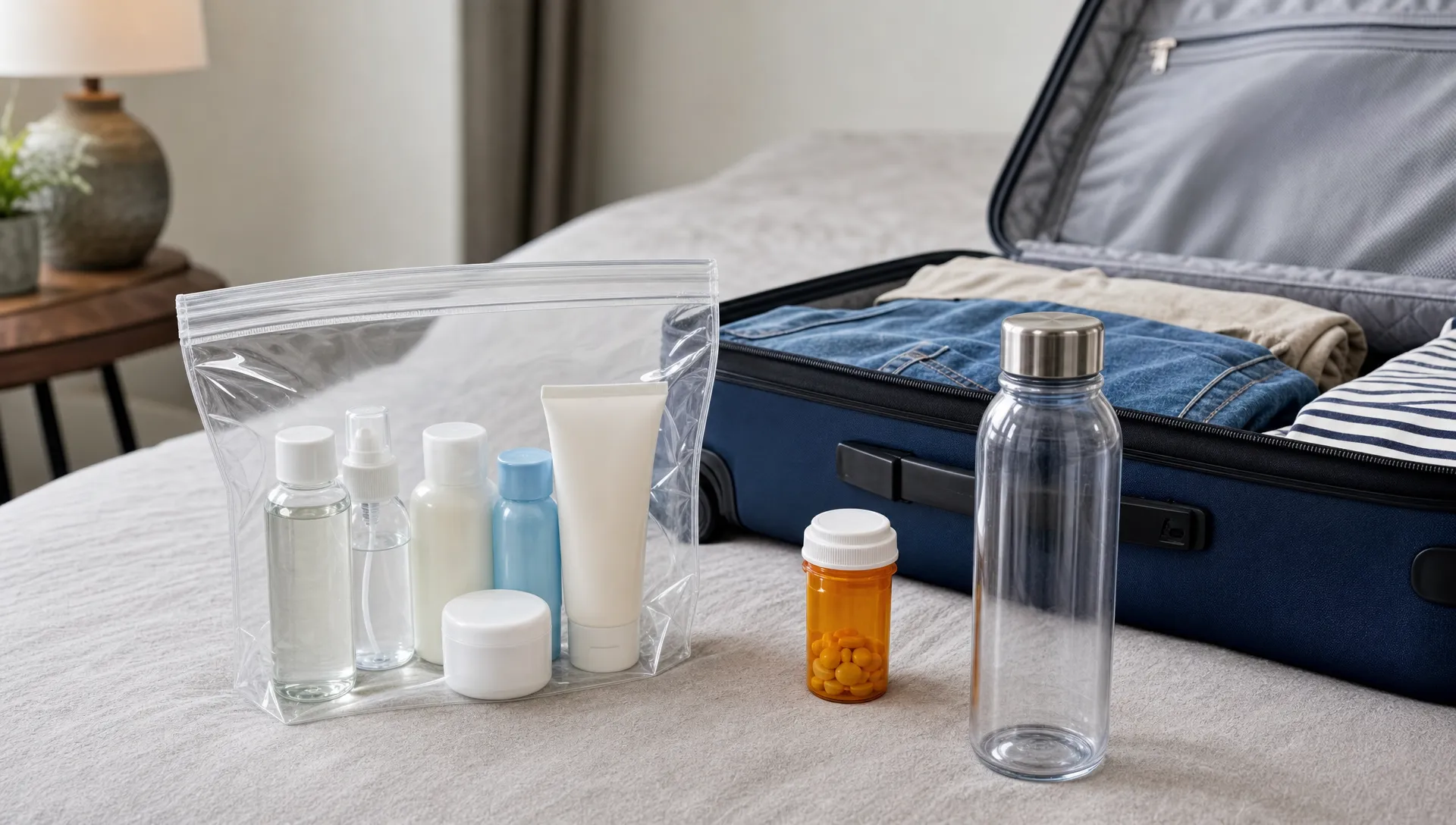
Start with the route, not the toiletry bag. Before choosing what to bring, check the departure airport, any transfer airport, and the airport for your return flight. If any part of the route is stricter, pack to that standard.
Then separate liquids into three groups. First, put everyday toiletries and cosmetics into 100ml containers. Second, place larger non-essential liquids in checked baggage if you are checking a bag. Third, keep exempt items such as necessary medicine or baby supplies separate and easy to show at security.
Use original labels where you can. Unlabeled travel bottles are common, but they can create questions if the item looks unusual. If you decant products into smaller bottles, make sure the bottle itself is 100ml or less and closes securely.
For leak prevention, tighten caps, use tape or plastic wrap under screw lids, and place liquids in a resealable bag. Pressure changes can cause bottles to leak, even when they pass security. Keep especially important items, such as medicine, upright and accessible.
If you are traveling with only hand luggage, avoid buying large liquid products early in your trip unless you know you can bring them home. A full-size perfume, sauce, shampoo, or sunscreen may be fine in checked baggage, but it can become a problem if your return journey is cabin-bag only.
A simple pre-airport checklist
Use this quick check before leaving for the airport:
- Are all normal hand carry liquids in containers of 100ml or less?
- Does the liquids bag close without forcing it?
- Are medicines and baby supplies packed separately for screening?
- Is your water bottle empty before security?
- Have you checked connection and return-airport rules?
- Are duty-free liquids sealed with the receipt kept inside the security bag?
- Are larger toiletries packed in checked baggage, if you have one?
If you can answer yes to those questions, you have covered the issues that cause most liquid-related delays.
Frequently Asked Questions
Can I bring a 200ml bottle if it only has 50ml left? Usually no. At airports enforcing the 100ml rule, security normally looks at the container capacity, not the remaining amount inside.
Do makeup products count as hand carry liquids? Many do. Mascara, liquid foundation, concealer, cream blush, lip gloss, and gel products should usually be packed with your liquids.
Can I take an empty water bottle through security? In most cases, yes. The simplest approach is to empty it before screening and refill it after security, where refill stations are available.
Are liquid medicines allowed over 100ml? Often, medically necessary liquids can exceed the standard limit, but they may require separate screening. Keep them accessible and bring supporting documentation when possible.
What if one airport allows 2L but another airport on my route allows only 100ml? Pack to the 100ml rule unless you can avoid taking those larger liquids through the stricter checkpoint. The strictest checkpoint on your trip is the one that matters.
Can I bring duty-free perfume or alcohol through a connection? Sometimes, but it depends on transfer screening rules. Keep duty-free liquids sealed in the official tamper-evident bag with the receipt, and check the rules for your connecting airport.
Check once, pack with confidence
Hand carry liquids rules are simple when you plan for the strictest airport on your route. Use 100ml containers for ordinary cabin liquids, keep exceptions separate, and remember that your return flight can have different rules from your outbound flight.
Before you zip your bag, use Liquid Limits to check airport, item, and route liquid rules side by side. The tool shows verified source links, last-checked dates, and the stricter rule when guidance is unclear, so you can pack with fewer surprises at security.