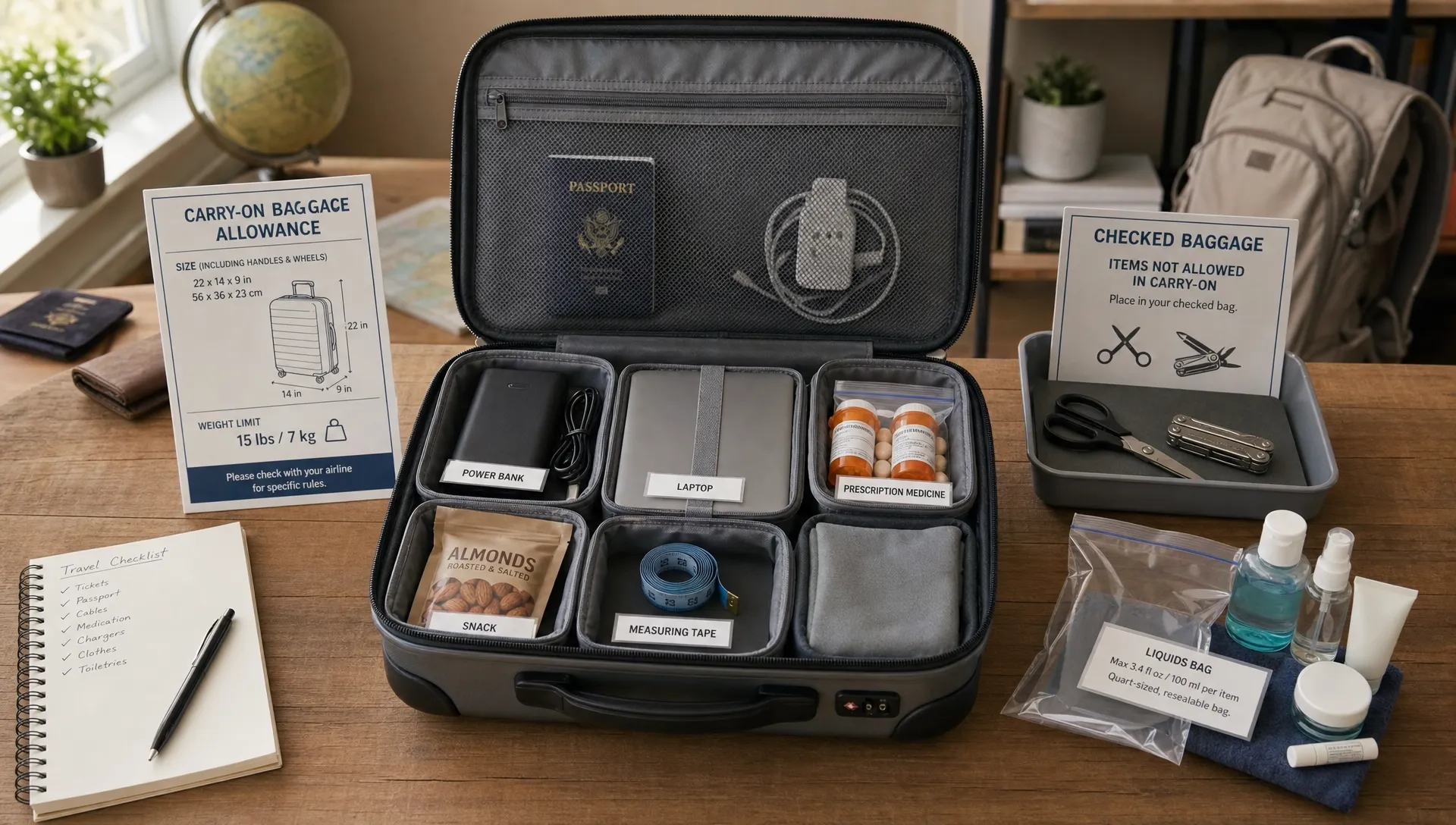
Most travelers know to think about liquids before airport security. Fewer realize that the rules on hand luggage also cover batteries, blades, food, powders, medical items, duty-free purchases, bag size, and even what happens if your carry-on is gate-checked.
That is why a bag can look perfectly compliant at home and still cause trouble at the airport. Your shampoo might be in the right container, but your power bank may be too large. Your snacks may pass security, but not customs. Your airline may accept the contents of your bag, then reject the bag itself because it is too heavy for your fare.
This guide focuses on the hand luggage rules that affect more than liquids, so you can pack with fewer surprises and fewer last-minute bin losses.
Why hand luggage is governed by several rulebooks
There is no single global hand luggage rule. What you can bring depends on several overlapping rule layers. Some are set by aviation security authorities. Some are set by airlines. Others come from dangerous goods regulations, customs rules, or the airport where you connect.
That is why “allowed in hand luggage” is not always a simple yes or no. An item may be allowed through security but not by your airline, allowed on your first flight but not through a transfer screening point, or allowed in the cabin but restricted at your destination.
| Rule layer | Who usually controls it | What it can affect |
|---|---|---|
| Airport security | National authorities and airport screening teams | Liquids, electronics, sharp objects, powders, food screening |
| Airline cabin policy | Your airline and fare type | Bag size, bag weight, personal item allowance, gate checks |
| Dangerous goods rules | Aviation safety authorities and airlines | Lithium batteries, power banks, aerosols, fuel, camping gear |
| Customs and biosecurity | Destination country | Food, plants, medicines, animal products, high-value goods |
| Transit procedures | Connection airport or country | Re-screening, duty-free items, local security requirements |
If you want a broader view of how these layers interact, Liquid Limits also has a guide to airport rules that affect what you can pack. The key point is simple: your hand luggage has to satisfy the strictest relevant rule on your actual journey, not just the rule you remember from your last flight.
Bag size and weight can matter before security does
Many travelers focus on airport security first, but the airline’s cabin baggage policy can be the first real obstacle. Airlines set their own hand luggage size and weight limits, and these can vary by fare, route, aircraft type, loyalty status, and whether you booked a basic economy or low-cost ticket.
A bag that passes security may still be refused at the gate. If that happens, the airline may require you to check it into the hold. That creates an immediate problem if your hand luggage contains items that should stay in the cabin, such as spare lithium batteries, power banks, certain medical devices, or fragile valuables.
Before you pack, check the exact allowance for your ticket, not just the airline’s general baggage page. Measure your bag including wheels, handles, and external pockets. If your fare includes only a personal item, do not assume a small roller bag will be accepted.
Electronics and batteries have their own safety rules
Laptops, tablets, cameras, e-readers, drones, and portable chargers are common in hand luggage, but they are not treated like ordinary objects. At many checkpoints, large electronics may need to be removed from your bag for screening. Some airports with newer scanners may handle this differently, but you should still pack electronics so they are easy to access.
Lithium batteries deserve special attention. The FAA’s PackSafe guidance on lithium batteries explains that spare lithium batteries and power banks generally belong in carry-on baggage, with terminals protected against short circuit. Most consumer lithium-ion batteries are limited to 100 watt-hours, with limited airline-approved exceptions for some larger batteries up to 160 watt-hours.
That watt-hour rating is usually printed on the battery or device. If it is not visible, airport or airline staff may not be able to confirm that it is compliant. For power banks, remember that capacity listed in mAh is not always enough on its own. Some airlines ask for the Wh rating.
If your carry-on is unexpectedly gate-checked, remove spare batteries and power banks before the bag leaves your hands. This is one of the most common moments when travelers accidentally put a cabin-only item into the hold.
Sharp items, tools, and souvenirs are not judged by size alone
Small does not always mean safe. Pocket knives, multitools, corkscrews with blades, craft knives, box cutters, and sharp souvenirs can be confiscated even if they fit easily in a toiletry pouch.
Rules vary by country, but the security logic is consistent: if an item can cut, stab, strike, restrain, or be used as a weapon, it may be restricted. The TSA’s “What Can I Bring?” database is a useful reference for U.S. travel, but it should not be treated as a universal global rule. A pair of scissors, for example, may be treated differently depending on blade length and local rules.
Tools can also be tricky. Screwdrivers, pliers, wrenches, drills, drill bits, and work equipment may be restricted because of size, sharp edges, or possible use as impact objects. If you are traveling with tools for a job, conference booth, hobby, or repair task, check both security rules and airline rules before assuming they belong in hand luggage.
Food and powders can pass one checkpoint and fail another
Food is one of the most misunderstood hand luggage categories. Many solid snacks are fine for the flight itself, but spreadable, gel-like, creamy, or saucy foods may be treated as liquids. Peanut butter, jam, hummus, yogurt, soft cheese, and sauces often cause problems because they do not behave like solid food under liquid rules.
Powders can also attract extra screening. In the United States, TSA notes that powder-like substances over 12 oz / 350 ml in carry-on bags may require additional screening and may be prohibited if they cannot be resolved. Other countries may apply different procedures, especially for dense powders, supplements, protein powder, spices, and cosmetics.
Then customs adds another layer. Meat, fruit, seeds, plants, dairy products, and some homemade foods may be restricted when you enter another country, even if airport security allowed them through. This is especially important when flying to countries with strict biosecurity rules.
Medicines and medical items need more than a packing pouch
Medicines, medical liquids, mobility aids, CPAP machines, insulin supplies, syringes, cooling packs, and medical batteries may be allowed under exceptions, but they still need to be screened. The safest approach is to keep medicine in original packaging when possible, carry prescriptions or supporting documents for controlled substances, and check destination rules before traveling internationally.
Medical liquids can have different treatment from ordinary toiletries, but you should never assume the exemption will be handled identically at every airport. If your medical item is essential, pack it in a way that makes it easy to declare and inspect.
For the liquid-specific side of medicines, baby supplies, and toiletries, this plain-English guide to hand luggage liquids rules made easy explains what usually counts as a liquid and where common exceptions apply.
Duty-free purchases can become a connection problem
Duty-free does not automatically mean checkpoint-proof. Liquids, gels, aerosols, perfumes, cosmetics, and alcohol bought after security may still be inspected if you connect through another airport. Many airports use sealed security tamper-evident bags with receipts for duty-free liquids, but acceptance can vary by route and screening point.
Non-liquid duty-free purchases can also affect your hand luggage. A bottle opener with a blade, a kitchen souvenir, a large toy, a spare battery gift, or a fragile purchase may conflict with security rules, airline cabin limits, or your available personal item space.
If you are connecting internationally, think twice before buying anything you cannot afford to lose or check in later.
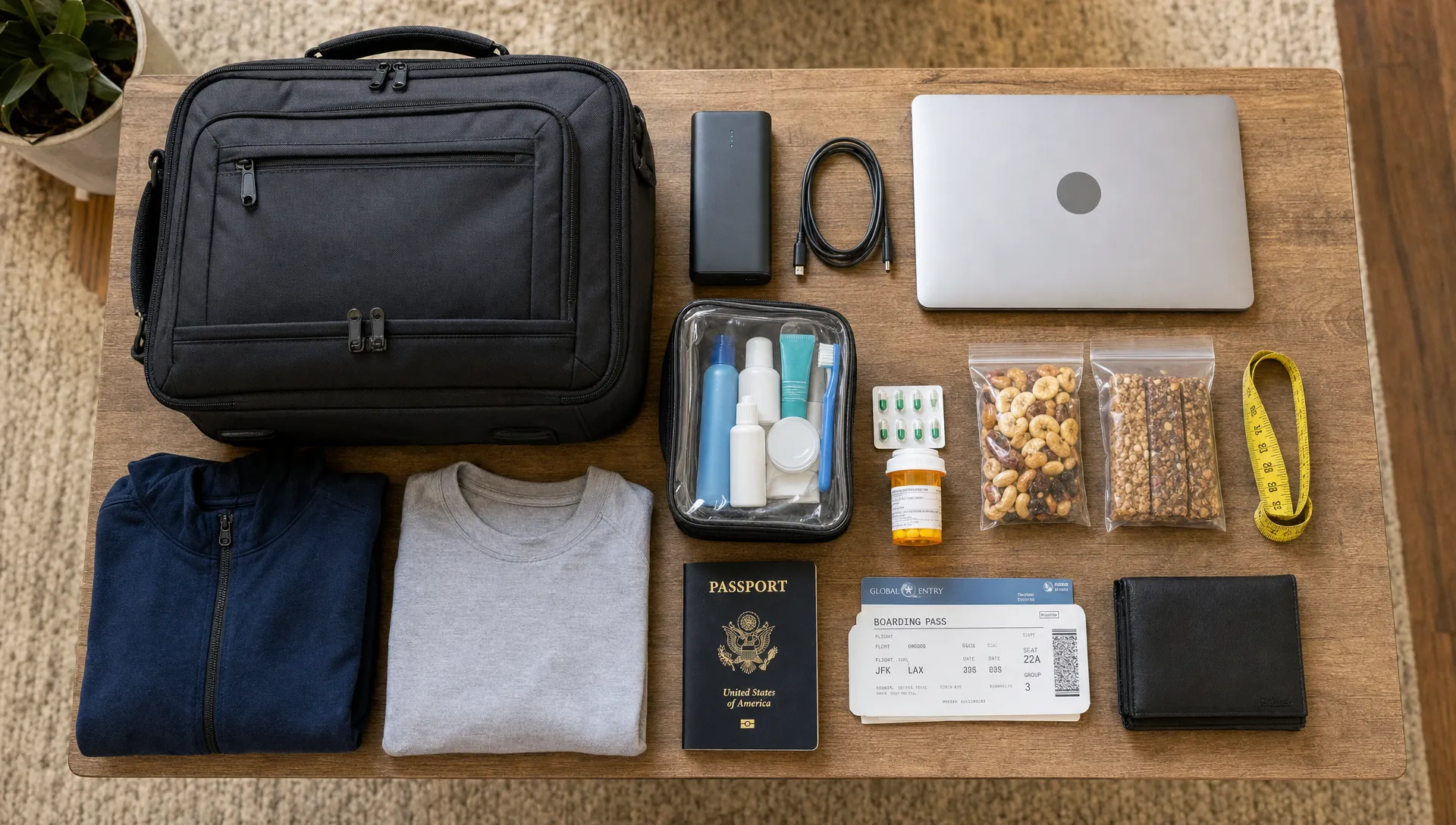
Quick reference: hand luggage rules beyond liquids
Use this table as a practical packing filter. It does not replace official rules, but it shows which rule layer to check before you travel.
| Item type | Main rule to check | Typical hand luggage issue | Safer packing move |
|---|---|---|---|
| Carry-on bag | Airline cabin policy | Too large or too heavy for your fare | Check your exact ticket allowance |
| Power banks | Dangerous goods and airline policy | Watt-hour rating too high or not visible | Keep in cabin, protect terminals, confirm Wh rating |
| Spare lithium batteries | Dangerous goods and airline policy | Accidentally left in a gate-checked bag | Keep accessible and remove before gate check |
| Pocket knives and multitools | Airport security | Blade or tool function is restricted | Pack in checked baggage or leave at home |
| Work tools | Airport security and airline policy | Size, sharpness, or impact risk | Check local rules before packing |
| Dry foods | Security and customs | Allowed for flight but restricted at destination | Check destination food rules |
| Powders | Airport security | Extra screening or unresolved contents | Keep original packaging and pack smaller amounts |
| Prescription medicine | Security and customs | Documentation or destination legality issues | Carry prescription proof and original labels |
| Duty-free purchases | Transit security and airline policy | Re-screening, sealed bag issues, extra cabin volume | Keep receipts and check connection rules |
| Smart bags | Airline and battery rules | Battery may need to be removable | Confirm airline smart bag policy |
Connections and return flights change the answer
The safest way to think about hand luggage is route-first, not airport-first. Your outbound airport, connection airport, return airport, and airline can all affect the final answer.
A few common examples show why:
- You depart from an airport with newer scanners, but return through an airport still using the stricter 100 ml liquid rule.
- Your first airline allows a larger cabin bag, but your connecting airline has a smaller or lighter allowance.
- You buy duty-free before a connection, then face another security screening point.
- You carry food that is fine on board, but restricted when you arrive.
- Your bag is gate-checked, so batteries that were safe in the cabin suddenly need to be removed.
This is where a route-based check helps. For liquids specifically, Liquid Limits lets you check airport liquid rules before you pack, including round trips where return airports may differ. It provides airport, item, and route checks with verified source links and last-checked dates, and it defaults to the stricter 100 ml rule when a rule is unclear.
Even when the item is not a liquid, the same mindset applies: check the whole journey, not just the first airport.
How to pack when rules differ
If different rule layers seem to conflict, pack for the most restrictive realistic scenario. That may feel conservative, but it is usually cheaper than surrendering an item at security or paying for an unexpected checked bag.
A simple packing process works well:
- Check your airline’s hand luggage size and weight limits before choosing the bag.
- Put electronics, power banks, medicine, food, and liquids where they can be inspected quickly.
- Keep spare lithium batteries and power banks in the cabin, never buried in a bag that might be checked.
- Move sharp tools, pocket knives, and questionable souvenirs to checked baggage if you are bringing checked luggage.
- Keep prescriptions, receipts, battery ratings, and product labels visible for items that may need explanation.
- Recheck rules before the return flight, especially if you bought items during the trip.
The goal is not to memorize every airport rule. The goal is to reduce the number of items that require judgment calls when you are under time pressure.
The “allowed last time” mistake
One of the riskiest phrases in travel is “I brought this last time.” That may be true, but it does not guarantee the same result today.
Rules can change. Airports can use different scanners. Security officers may interpret an item differently. Airlines can enforce cabin baggage limits more strictly on full flights. A connection can introduce a new screening point. A return airport can apply a stricter liquid rule than your departure airport.
That does not mean packing has to be stressful. It means the best packing habits are repeatable: check the route, check the airline, separate sensitive items, and avoid bringing borderline objects in hand luggage unless you truly need them.
Frequently Asked Questions
Do hand luggage rules depend on the airline or the airport? Both. Airports and security authorities usually control what can pass the checkpoint, while airlines control cabin bag size, weight, personal item limits, smart bag rules, and whether a bag may be gate-checked.
Can I bring a power bank in hand luggage? Usually yes, and power banks generally belong in carry-on baggage rather than checked baggage. You still need to check the watt-hour rating, protect the terminals, and confirm your airline’s battery rules.
Are food items allowed in hand luggage? Many solid foods are allowed for the flight, but creamy, spreadable, saucy, or gel-like foods may fall under liquid rules. Customs and biosecurity rules at your destination can also restrict foods that passed security.
Do connecting flights follow the rules from my first airport? Not always. If you go through security again during a connection, the transit airport’s rules may apply. Duty-free liquids, food, and cabin bag limits can also be affected by your connection and onward airline.
What should I do if different airports have different liquid rules? Follow the strictest rule that applies to your trip, especially for the return flight or connections. When rules are unclear, treating the item as subject to the 100 ml limit is the safest approach.
Check the liquid part before you pack
Hand luggage rules cover far more than liquids, but liquids are still one of the most route-sensitive parts of packing. A rule that looks simple on your outbound flight can change on the return, at a connection, or at an airport using different screening procedures.
Before you zip your bag, use Liquid Limits to check the strictest cabin liquid rule for your whole trip. You can compare airport, item, and route guidance side by side, then pack with a clearer idea of what belongs in your hand luggage and what should stay out.