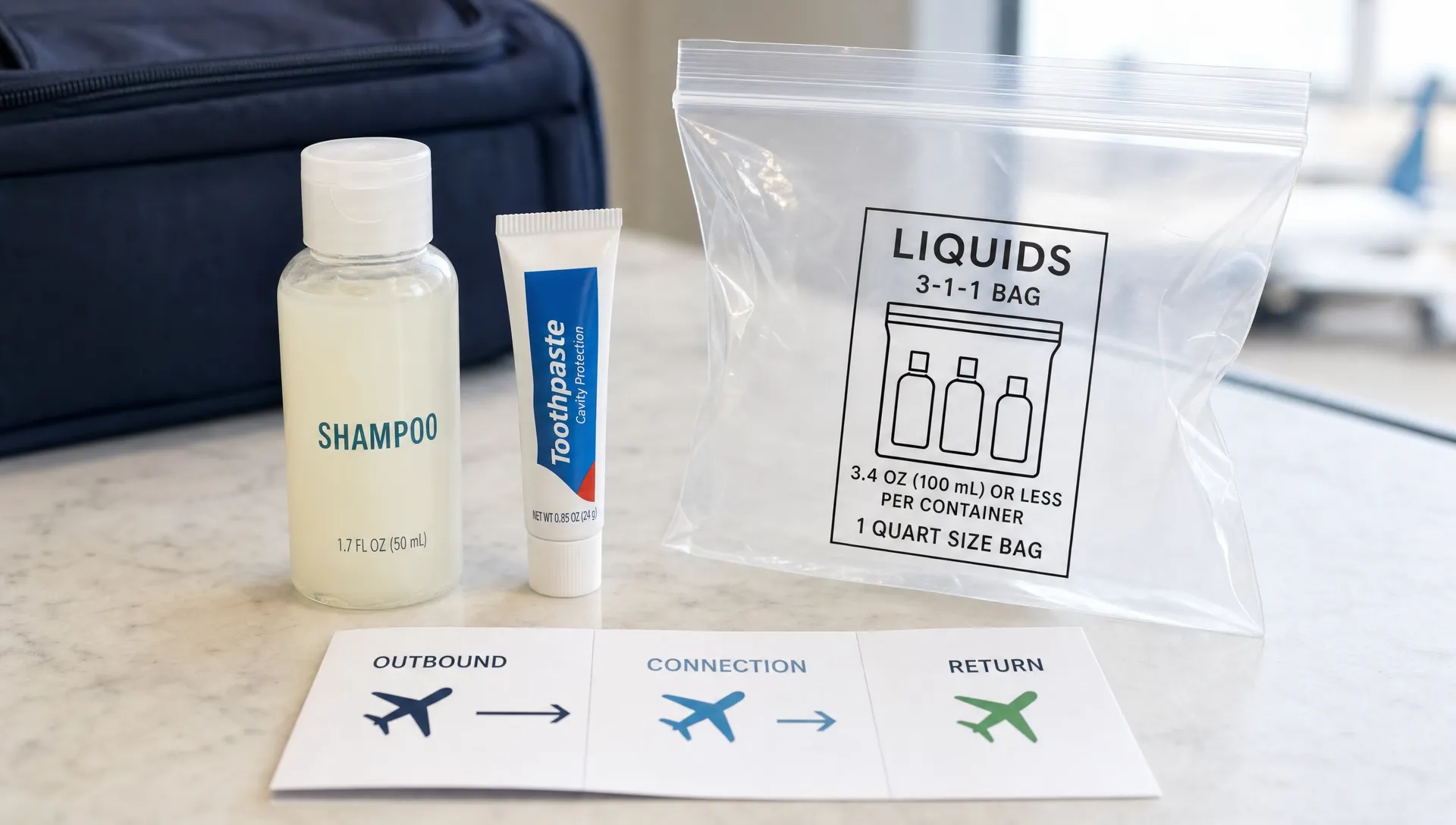
Toiletries are the small items that cause surprisingly big problems at airport security. Shampoo looks harmless, toothpaste feels essential and a travel-size perfume bottle seems easy to forget, but airport screeners group many of these products under liquid, gel, paste, cream or aerosol rules.
The safest way to understand hand luggage toiletries rules is to think less about the product category and more about the texture. If it can be poured, squeezed, sprayed, spread or smeared, it may need to follow the liquid rules for your airport and route.
That matters even more in 2026 because rules are not perfectly uniform. Some airports have newer scanners and different local allowances, while many still apply the familiar 100 ml rule. Your return flight or connection can also be stricter than your outbound airport, so a toiletry kit that passes one checkpoint may fail at another.
The basic toiletries rule most travelers should pack for
At many airports, cabin toiletries still follow the small-container rule: liquids, aerosols, gels, creams and pastes must be in containers of 100 ml or 3.4 oz or less, and those containers usually need to fit inside one clear resealable plastic bag. The TSA's 3-1-1 liquids rule uses 3.4 oz containers in one quart-sized bag. The UK Government hand luggage restrictions describe a similar 100 ml container rule with a transparent resealable bag.
The exact bag size and screening process can vary by country, airport and scanner type, but the practical packing habit is the same: keep regulated toiletries small, visible and easy to remove if asked.
Container size matters more than the amount left inside. A 200 ml shampoo bottle that is almost empty can still be rejected because the printed capacity is above the limit. Decanting into a clearly marked 100 ml travel bottle is safer than hoping a half-used full-size container will pass.
Some airports advertise larger allowances for liquids at certain terminals or security lanes, sometimes because of upgraded scanning equipment. Do not treat those allowances as global rules. If your connection or return airport still uses 100 ml limits, pack for the stricter checkpoint unless you plan to check the item or discard it before that part of the trip.
What counts as a liquid toiletry?
Airport security uses a broad definition. A toiletry does not need to be watery to count as a liquid. Creamy, pasty, gel-like and spray products are often treated the same way as shampoo.
Use this table as a practical guide, but always check your exact airport if the item is expensive, medically necessary or larger than 100 ml.
| Toiletry item | How security usually treats it | Packing tip |
|---|---|---|
| Shampoo, conditioner and body wash | Liquid or gel | Use 100 ml travel bottles and keep them in the clear bag |
| Toothpaste and whitening gel | Paste or gel | Treat as a liquid and keep it under 100 ml |
| Face cream, moisturizer and sunscreen | Cream or lotion | Choose travel-size tubes or decant into marked containers |
| Spray deodorant, hairspray and perfume | Aerosol or liquid | Keep each container at 100 ml or less and replace caps securely |
| Roll-on deodorant | Liquid or gel | Put it in the clear liquids bag |
| Stick deodorant, bar soap and solid shampoo | Solid | Usually can stay outside the liquids bag |
| Mascara, liquid eyeliner and cream foundation | Liquid, gel or cream makeup | Pack with other liquids if not clearly solid |
| Powder makeup and dry shampoo powder | Powder | Usually not part of the liquid bag, though extra screening is possible |
| Lip gloss and liquid lip color | Gel or liquid cosmetic | Keep small tubes in the liquids bag |
| Lip balm sticks | Usually solid | Often allowed outside the liquids bag, but soft pots can be treated as creams |
Toothpaste is one of the most common surprises because it feels like a basic hygiene item rather than a liquid. Security usually treats it as a paste, so the container limit still applies. If you want the detailed item-specific answer, Liquid Limits has a separate guide on toothpaste in hand luggage.
Toiletry items that most often slow travelers down
Toothpaste, mouthwash and dental products
Standard toothpaste, gel toothpaste and whitening gels should be packed with your liquid toiletries. Mouthwash is a liquid, so a large bottle from home belongs in checked baggage unless your airport route clearly allows more than 100 ml. Dental floss, manual toothbrushes and most electric toothbrush handles are not liquid toiletries, although battery rules can apply to certain powered devices.
If you use prescription dental gels or medically necessary rinses, check the medical liquid exception for your departure airport and any transit airport. Keep the label or prescription details accessible because screeners may need to inspect it separately.
Sunscreen, moisturizer and skincare
Sunscreen catches travelers out because a normal beach bottle is often 150 ml, 200 ml or larger. In hand luggage, that is usually too big under the 100 ml rule. The same goes for facial cleanser, toner, moisturizer, serum, aftershave balm, shaving cream and body lotion.
A useful approach is to divide skincare into essentials and nice-to-have products. If you will need it during the flight or immediately on arrival, buy or fill a small container. If it is a full-size product you can live without until your bag arrives, put it in checked baggage or buy it after security.
Deodorant, hairspray and fragrance
Stick deodorant is usually the easiest option for hand luggage because it is solid. Roll-on deodorant and gel deodorant usually count as liquids. Aerosol deodorant, hairspray and body spray count as aerosols and must meet the container limit at many airports.
Perfume and cologne also count as liquids. Small fragrance bottles under 100 ml are usually fine in the liquids bag, but remember that the bottle's printed capacity is what matters. A 120 ml bottle with only a little perfume left can still be a problem.
Makeup that is not clearly solid
Powder eyeshadow, pressed powder, blush and pencil eyeliner are usually not liquid toiletries. Mascara, liquid eyeliner, cream blush, cream bronzer, liquid foundation, concealer and lip gloss are more likely to fall under liquid rules.
If you are packing makeup for an event, do not place all high-value liquids loose in the bottom of your bag. Put them together in the clear bag and keep a few solid alternatives where possible. A pressed powder foundation or pencil eyeliner can reduce pressure on limited liquid-bag space.
Your return airport can change the answer
Many travelers check the rule at their outbound airport and stop there. That is risky for toiletries because the same items may need to pass through security more than once, especially on round trips or connecting itineraries.
For example, your first airport might allow certain larger liquid containers because it uses newer scanners. If your return airport still applies the 100 ml rule, the full-size face wash you carried out may not be allowed back in your cabin bag. The same problem can happen on a connection if you have to clear security again before boarding the next flight.
Duty-free purchases can also get complicated. Toiletries bought after security are usually fine for that immediate airport area, but if you connect through another airport and pass security again, the item may need to be in an approved sealed tamper-evident bag with proof of purchase. Even then, procedures can vary. If the item is easy to replace, waiting until your final destination is often less stressful.
For a round trip, check every airport where you may face a security checkpoint: outbound departure, outbound connection, return departure and return connection. If you are carrying the same toiletry kit throughout the journey, the strictest rule on that route is the one that should guide your packing.
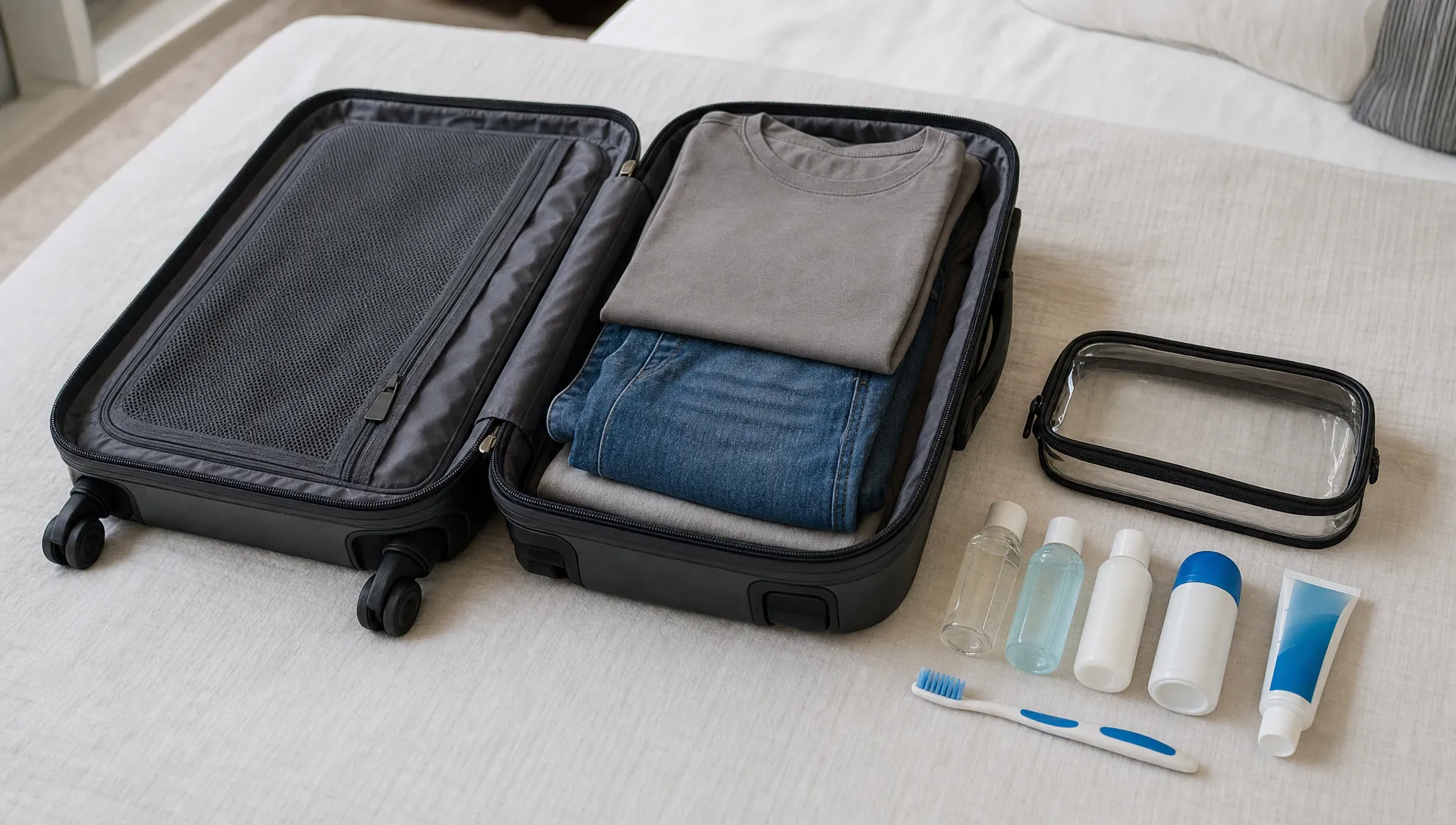
How to pack toiletries in hand luggage without overthinking it
A good toiletry setup is not about carrying the fewest possible items. It is about making every regulated item easy for security to understand. The clearer your packing looks, the less likely you are to need a long repack at the checkpoint.
Start by putting every liquid, gel, paste, cream and aerosol toiletry in one place before you pack your suitcase. Then remove anything over 100 ml unless your exact route allows larger containers. If you are not sure, assume 100 ml.
A simple packing routine works well for most trips:
- Choose containers with the capacity printed clearly on the bottle or tube.
- Use leakproof travel bottles for shampoo, conditioner and cleanser.
- Keep all liquid toiletries together in one clear resealable bag.
- Pack solid swaps where possible, such as bar soap, solid shampoo and stick deodorant.
- Put medically necessary liquids in a separate, easy-to-reach place if they exceed the standard limit.
- Leave spare room in the liquids bag for airport purchases or last-minute items.
The most avoidable problems are oversized containers, forgotten gels and products hidden across several pockets. If you want a focused checklist of those errors, read Liquid Limits' guide to common 100 ml liquids mistakes.
2026 regional snapshot for toiletry packing
This table is a practical starting point, not a legal guarantee. Airport-specific pages, route rules and security notices should always take priority.
| Region or system | Toiletry rule to expect | Practical packing move |
|---|---|---|
| United States | TSA 3-1-1 rule for liquids, aerosols, gels, creams and pastes | Use 3.4 oz or 100 ml containers in one quart-sized bag |
| United Kingdom | 100 ml containers in a transparent resealable bag unless specific airport guidance says otherwise | Check the airport before travel, especially during scanner changes |
| European Union | 100 ml liquid, aerosol and gel controls remain common, with airport variations possible | Do not assume one airport's larger allowance applies across your route |
| Other international routes | Many airports use similar 100 ml rules, but wording and enforcement vary | Pack to the strictest airport if you cannot confirm every checkpoint |
The main lesson is that toiletries are not only an airline issue. Airlines set cabin bag size and weight policies, but liquid screening rules are enforced at airport security. Your airline can approve your carry-on bag and an airport can still reject an oversized toiletry.
Exceptions for medicines, baby items and medical liquids
Some toiletry-like products may qualify for exceptions when they are medically necessary. Examples can include liquid medicine, prescribed creams, antiseptic solutions, contact lens solution, dietary liquids for a medical condition and certain baby care items.
These exceptions are not a free pass to pack full-size toiletries for convenience. Security may inspect the item separately, ask why it is needed and require supporting documentation depending on the airport and country. If the product has a prescription label, keep it on the original container. If you have a doctor's note for a larger medical liquid, carry it where you can reach it quickly.
Contact lens solution deserves special care. Small travel-size bottles usually fit under the standard liquid rule. Larger bottles may be treated as medically necessary in some systems, but you should not assume that every airport will handle them the same way. If your eyes depend on it, carry enough for the trip in compliant containers and place extra solution in checked baggage when possible.
Baby milk, baby food and sterilized water may also be allowed in quantities above the standard liquid limit in many countries, but rules can depend on whether the child is traveling and how the item is presented. Pack these items separately from regular toiletries so they can be screened without your entire liquids bag being unpacked.
When checked baggage is the better toiletry plan
Checked baggage is often the easiest place for full-size shampoo, conditioner, lotion, sunscreen and nonessential sprays. It gives you more room and avoids the 100 ml cabin container problem. Still, checked baggage is not ideal for everything.
Keep essential medication, medically needed creams, contact lens basics and a minimal hygiene kit in your hand luggage in case your checked bag is delayed. For aerosols, make sure caps are fitted and the product is suitable for baggage transport. Some hazardous or highly flammable products may be restricted regardless of bag type, so do not assume every spray can travel simply because it is a toiletry.
If you are traveling hand luggage only, solid products are your best friend. Solid shampoo, conditioner bars, bar soap, toothpaste tablets and stick deodorant can free up space in your liquids bag. Just remember that very soft balms, gels and creams in pots may still be treated as liquid-style items.
Quick pre-security toiletries checklist
Before you leave for the airport, run through a short check. It takes less than a minute and can save an expensive bin-side decision at security.
| Question | If the answer is no |
|---|---|
| Are all liquids, gels, creams, pastes and aerosols in compliant containers? | Move oversized items to checked baggage or replace them with travel sizes |
| Can the regulated toiletries fit in the required clear bag? | Reduce duplicates or swap some products for solids |
| Have you checked your return airport and connections? | Pack for the strictest rule on the whole route |
| Are medical or baby exceptions separate and easy to explain? | Put them where you can present them for screening |
| Are expensive items replaceable if rejected? | Consider checked baggage, smaller containers or buying after arrival |
This last point is easy to overlook. A premium skincare serum or fragrance may be allowed if it is under 100 ml, but it can still be lost if you misunderstand a transfer rule. For high-value toiletries, checking the route is worth the extra minute.
Frequently Asked Questions
Do hand luggage toiletries have to be in a clear bag? At many airports, liquid, gel, paste, cream and aerosol toiletries must fit in a clear resealable bag for cabin screening. Some airports with upgraded scanners may handle bags differently, but you should not assume that applies to your route.
Can I bring a 150 ml bottle if it is half empty? Usually no. Under the standard 100 ml rule, the container's printed capacity matters. A 150 ml bottle can be rejected even if it contains less than 100 ml of product.
Does deodorant count as a liquid toiletry? It depends on the type. Roll-on, gel and aerosol deodorants usually count under liquid or aerosol rules. Stick deodorant is usually treated as a solid and can often stay outside the liquids bag.
Are solid shampoo bars and bar soap included in liquid rules? Usually no. Solid shampoo bars and bar soap are normally treated as solids, which makes them useful for hand luggage only trips. Very soft or creamy products in pots can be treated differently.
Can I take full-size sunscreen in hand luggage? Only if your airport route specifically allows that container size. For most travelers, sunscreen in hand luggage should be in a 100 ml or 3.4 oz container or smaller.
Do return flights use the same toiletry rules as outbound flights? Not always. Your return airport, connection airport or terminal may apply different liquid screening rules. Check the full route before packing full-size or expensive toiletries.
Check your exact toiletry rules before you pack
The simplest safe rule is to pack toiletries for 100 ml containers unless you have confirmed that every security checkpoint on your route allows more. That includes your return flight and any airport where you may need to clear security again.
Before you zip up your carry-on, use Liquid Limits to check airport liquid rules for your trip, item and route. It shows verified guidance with source links and last-checked dates, and when a rule is unclear, it defaults to the stricter 100 ml approach so you can pack with fewer surprises.