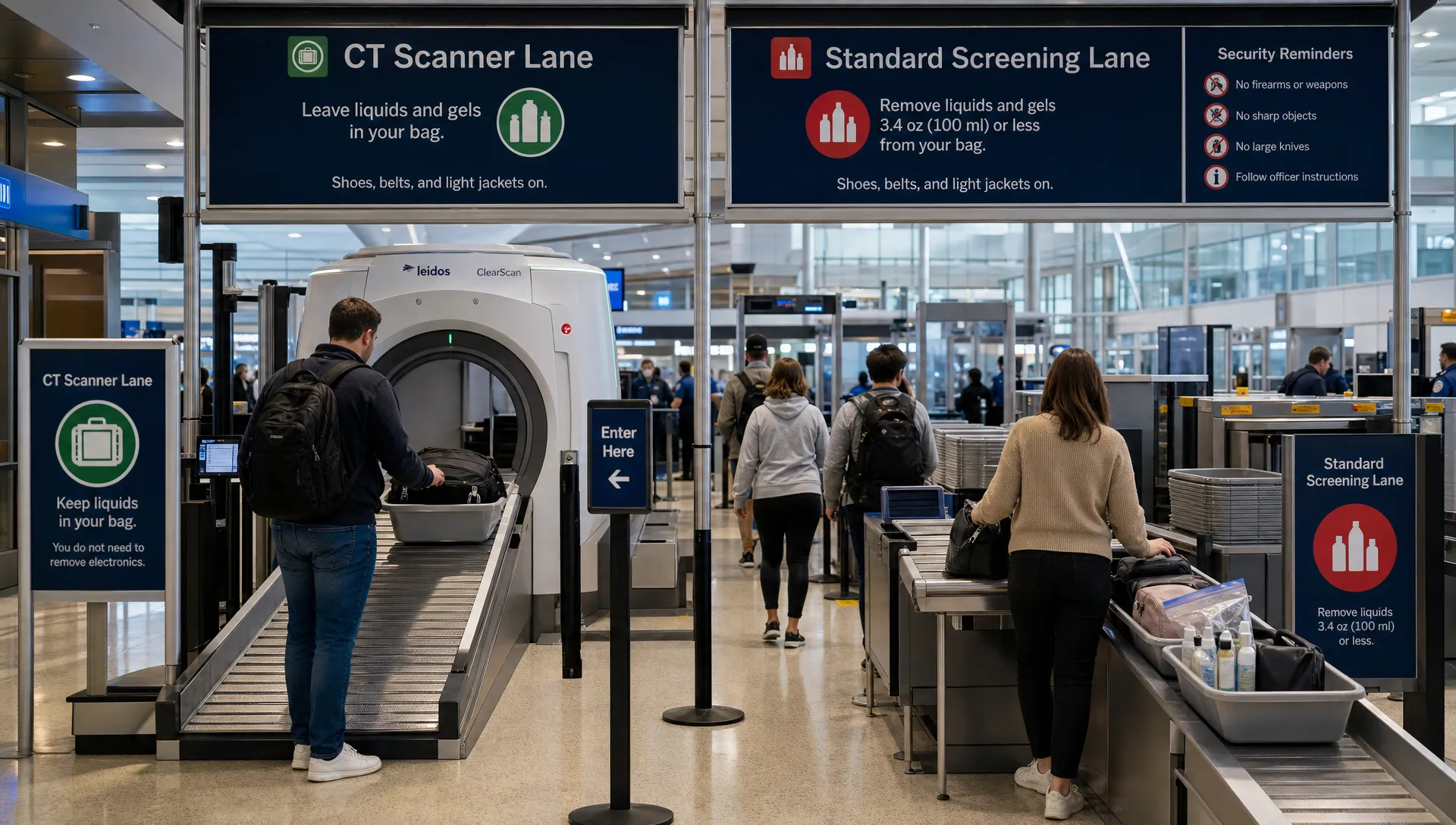
New scanners have changed the conversation around carry-on liquids, but they have not created one simple global rule. That is the part travelers often miss. A modern airport checkpoint may let you keep toiletries inside your bag, yet still enforce 100ml containers. Another airport may permit larger liquids in certain lanes, then apply the old rule again if a scanner is unavailable or a regulator changes guidance.
Airport liquids policy is no longer only about what technology can detect. It is about whether that technology is installed, certified, staffed, accepted by the national regulator and used consistently across every security point you will pass through. For travelers, the practical question is not “does this airport have new scanners?” It is “what rule will apply to my bag on the day I fly, including my return and any transfer?”
What the new airport scanners actually do
Most changes to airport liquids policy are linked to computed tomography security scanners, often called CT scanners. Unlike older 2D X-ray machines, CT scanners create a 3D image of cabin baggage. Security officers can rotate and inspect the image digitally, and the system can support more advanced threat detection.
This matters for liquids because the original 100ml rule was introduced to reduce the risk of passengers carrying larger volumes of liquid explosives through security. Better imaging and detection can help screen liquids without requiring the same manual separation process used at older checkpoints.
That does not mean a scanner automatically changes the legal allowance. A checkpoint can have newer equipment and still follow the standard liquids policy. The US Transportation Security Administration, for example, still lists the familiar 3.4 ounces or 100ml container limit for carry-on liquids in its public guidance. Many other countries also continue to apply 100ml rules at most airports.
The scanner is the technical enabler. The policy change comes later, and only when the regulator and airport decide the system can support it safely.
How a scanner upgrade becomes a liquid policy change
From the passenger side, a rule change can look sudden: one month you remove your liquids bag, the next month you do not. Behind the scenes, it usually moves through several steps.
First, the airport installs new screening equipment. This can happen terminal by terminal or even lane by lane, which means an airport may be partly upgraded for months or years. A passenger departing from Terminal 1 might see a different process from a passenger departing from Terminal 4.
Next comes certification and regulatory approval. Security equipment has to meet standards set by national or regional aviation authorities. The airport does not decide alone that larger liquids are allowed simply because the machine is newer.
Then the airport has to train staff and adjust checkpoint procedures. A more capable scanner still depends on officers who know how to interpret alarms, apply exemptions, manage rejected items and handle busy periods without creating confusion.
Finally, the airport communicates the change to passengers. This step is often where confusion begins, because airlines, airport websites, government pages and checkpoint signs may not update at the same speed. A traveler who saw an announcement six months earlier may arrive to find a temporary 100ml restriction back in place.
If you want the broader regulatory background, Liquid Limits has a separate guide on why the 100ml rule still exists even as scanner technology improves.
Why new scanners do not create the same rule everywhere
Airport liquid rules vary because security systems are not upgraded as one global network. Every country has its own regulator, every airport has its own infrastructure schedule and every checkpoint has its own operational constraints.
The same airport can also have different rules in different places. Departures, transfers, domestic connections, international connections and staff screening areas may not all use identical equipment. If one part of the airport cannot screen larger liquids, the airport may keep the stricter rule everywhere to avoid sending passengers into the wrong lane with non-compliant items.
Government policy can also override airport capability. The UK is a useful example of how scanner rollout and liquids policy can move at different speeds. The UK government hand luggage rules have continued to emphasize checking restrictions before travel, because requirements can vary by airport and can change during the transition to newer screening technology.
| Situation | What may happen at security | Safer traveler assumption |
|---|---|---|
| Airport has some new scanners | Only certain lanes or terminals may use them | Pack for the strictest lane unless the airport confirms otherwise |
| Airport says liquids can stay in bags | Container size may still be limited to 100ml | Do not assume “in the bag” means “any size” |
| Outbound airport allows larger liquids | Return airport may still enforce 100ml | Check both directions before packing full-size items |
| Transfer airport screens passengers again | Your duty-free or toiletries may be checked under local rules | Keep receipts and sealed security bags where required |
| Scanner lane is closed or under maintenance | Staff may redirect passengers to a standard lane | Be ready to comply with the older rule |
The important distinction is between screening convenience and liquid allowance. Keeping bottles inside your bag is a process change. Carrying a 500ml shampoo through security is an allowance change. They often arrive together, but not always.
What changes first for passengers
The first visible change at many upgraded checkpoints is that passengers no longer have to remove liquids and electronics from their cabin bags. This can make the security process faster and less stressful, especially for travelers carrying laptops, toiletries, baby supplies or medical items.
The next possible change is a higher liquid volume limit. In some places, newer scanners have supported policies that allow larger containers, sometimes up to 2 liters. This is the change that gets the most attention, but it is also the one most likely to vary.
A traveler should treat these as separate questions:
- Can my liquids stay inside my bag at this checkpoint?
- Are containers above 100ml allowed at this checkpoint?
- Does the rule apply to every passenger, every terminal and every flight type?
- Will the same rule apply when I come home?
For a general packing baseline, the Liquid Limits guide to airport liquid limits for carry-ons in 2026 explains how the standard 100ml rule still fits into current airport screening.
The route problem: your strictest airport usually decides how you should pack
Most travelers do not pass through only one security checkpoint. A round trip can include a departure airport, a return airport and sometimes a transfer airport where passengers must clear security again. Each airport may apply a different liquids policy.
That is why a single airport announcement can be misleading. If your home airport permits larger liquids but your return airport does not, packing a full-size bottle may still create a problem on the way back. You could end up checking a bag, throwing the item away or trying to mail it home.
The same applies to one-way trips with connections. If you buy or pack liquids based on the first airport only, you may run into a stricter policy at the connecting airport. This is especially relevant for self-transfer itineraries, separate tickets and international connections where you leave the secure area and re-enter.
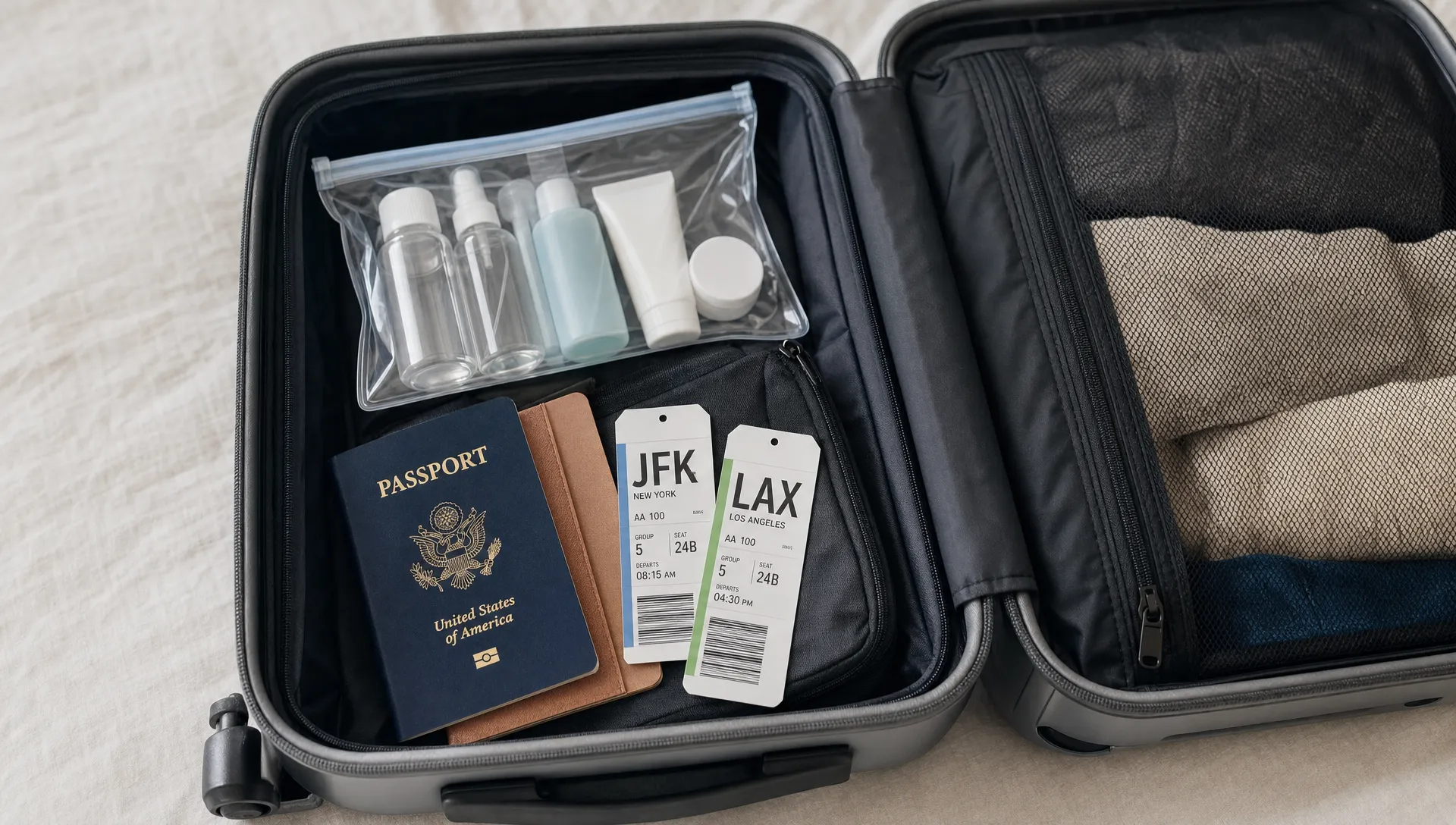
A practical way to think about it is simple: the strictest airport on your route should guide your packing. If one airport still requires 100ml containers in a clear bag, that rule can determine what makes sense for the whole trip.
How to pack during the scanner transition period
Until scanner upgrades and policies are consistent, the safest packing strategy is conservative. You do not need to ignore newer rules, but you should avoid betting your trip on an assumption.
For most travelers, these habits prevent the common problems:
- Pack essential toiletries in containers of 100ml or less unless every relevant airport clearly permits more.
- Check the departure, return and transfer airports rather than relying only on your airline.
- Keep medicines, baby food and special dietary liquids easy to explain at security.
- Keep duty-free liquids sealed in the official security bag with the receipt when required.
- Recheck the rule close to departure, especially if you are flying through an airport mid-upgrade.
A full-size liquid may be fine at one airport and confiscated at another. The inconvenience is rarely worth it for everyday toiletries. If the item is easy to buy after arrival, 100ml containers or checked baggage remain the lower-risk choices.
Medical and baby-related liquids are different. Many airport liquid policies include exceptions, but officers may need to inspect them separately. The details vary, so these items should be packed where they can be reached quickly.
Why airport liquids policy can appear to go backward
Travelers sometimes ask why an airport would install advanced scanners and then return to stricter liquid limits. It feels like a downgrade, but there are several practical reasons it can happen.
A regulator may require additional testing or software updates. A scanner model may be approved for one process but not another. An airport may decide that mixed lanes create too much confusion. A temporary security instruction may apply nationally, even to airports with newer equipment.
There is also a communication problem. A policy can change faster than travel blogs, airline emails or old social posts can be corrected. A passenger might find an article saying that a specific airport allows 2L liquids, then arrive after the airport has reverted to 100ml rules.
This is why source dates matter. A current airport liquids policy should be tied to an official airport page, a government page or a recently checked travel rule source. If you cannot find a current source, assume the stricter 100ml rule.
That stricter fallback is also how Liquid Limits is designed to help: it checks airport, item and route details, shows the stricter rule for a trip and defaults to 100ml when a rule is unclear.
What airports need before larger liquid limits become normal
For larger liquid limits to become routine, airports need more than scanners. They need enough approved machines to cover all passenger flows, including peak periods and backup lanes. They need trained staff, clear passenger instructions and reliable procedures for exceptions.
Regulators also need confidence that the technology performs consistently. Aviation security is built around repeatability. If a rule works only when the newest lane is open and staffed by a certain team, it is not ready to become the airport-wide default.
That is why the transition feels uneven. Some airports move quickly. Others keep the 100ml limit while upgrading infrastructure. Many will sit in the middle, with faster screening but no meaningful change to container size.
For travelers, the likely future is gradual rather than instant. You may see fewer requirements to unpack liquids before you see broad permission to carry large bottles. Even when larger allowances expand, they may remain airport-specific for some time.
How to read an airport liquids policy before you fly
When checking a rule, look for three details. First, confirm the container size limit. The phrase “liquids can remain in your bag” does not answer whether 250ml or 1L containers are allowed.
Second, check the scope. Does the rule apply to all terminals, all airlines and all destinations? If the page only mentions one terminal or a trial area, treat it as limited.
Third, check the date. Airport security pages can lag behind operational changes, but an undated social media post or old news article is even riskier. Recent official guidance is the most useful source.
If you are traveling with expensive cosmetics, specialty food, sports nutrition, perfumes or medical liquids, take the extra minute to verify the rule for every screened airport on the route. A small check before packing can prevent a frustrating choice at security.
Frequently Asked Questions
Do new scanners mean the 100ml rule is gone? No. New scanners can support different screening procedures, but the 100ml rule remains in many airports and countries. The legal allowance depends on the airport and regulator, not just the machine.
Can I leave liquids in my bag if the airport has CT scanners? Often, yes, but not always. Some upgraded checkpoints allow liquids to remain inside cabin bags, while others still ask passengers to remove them. Follow the signs and officer instructions at the airport.
Can I bring a full-size shampoo through an airport with new scanners? Only if that airport currently permits containers above 100ml for your terminal and flight type. If you are unsure, pack it in checked baggage or use a 100ml travel container.
What happens if my return airport has stricter rules? The return airport can require you to follow its own liquids policy, even if your outbound airport was more relaxed. For round trips, check both directions before packing larger liquids.
Why would an airport change back to 100ml after allowing larger liquids? Temporary restrictions can happen because of regulator instructions, scanner approvals, software updates, lane availability or operational consistency. Airport liquids policy can change even after new equipment is installed.
Are medicines and baby liquids treated the same way as toiletries? Usually no. Many airports allow necessary medicines, baby milk and baby food in larger quantities, but they may need separate screening. Check the airport rule and carry supporting documentation for prescriptions when appropriate.
Check the rule before you pack
New scanners are making airport security smarter, but they have not made liquid rules universal. Before you pack a full-size bottle, check the strictest rule across your whole trip, including the return flight.
Liquid Limits helps you compare airport liquid rules by route, airport and item, with daily updates, source links and last-checked dates. If a rule is unclear, it falls back to the safer 100ml assumption so you are not caught out at security.