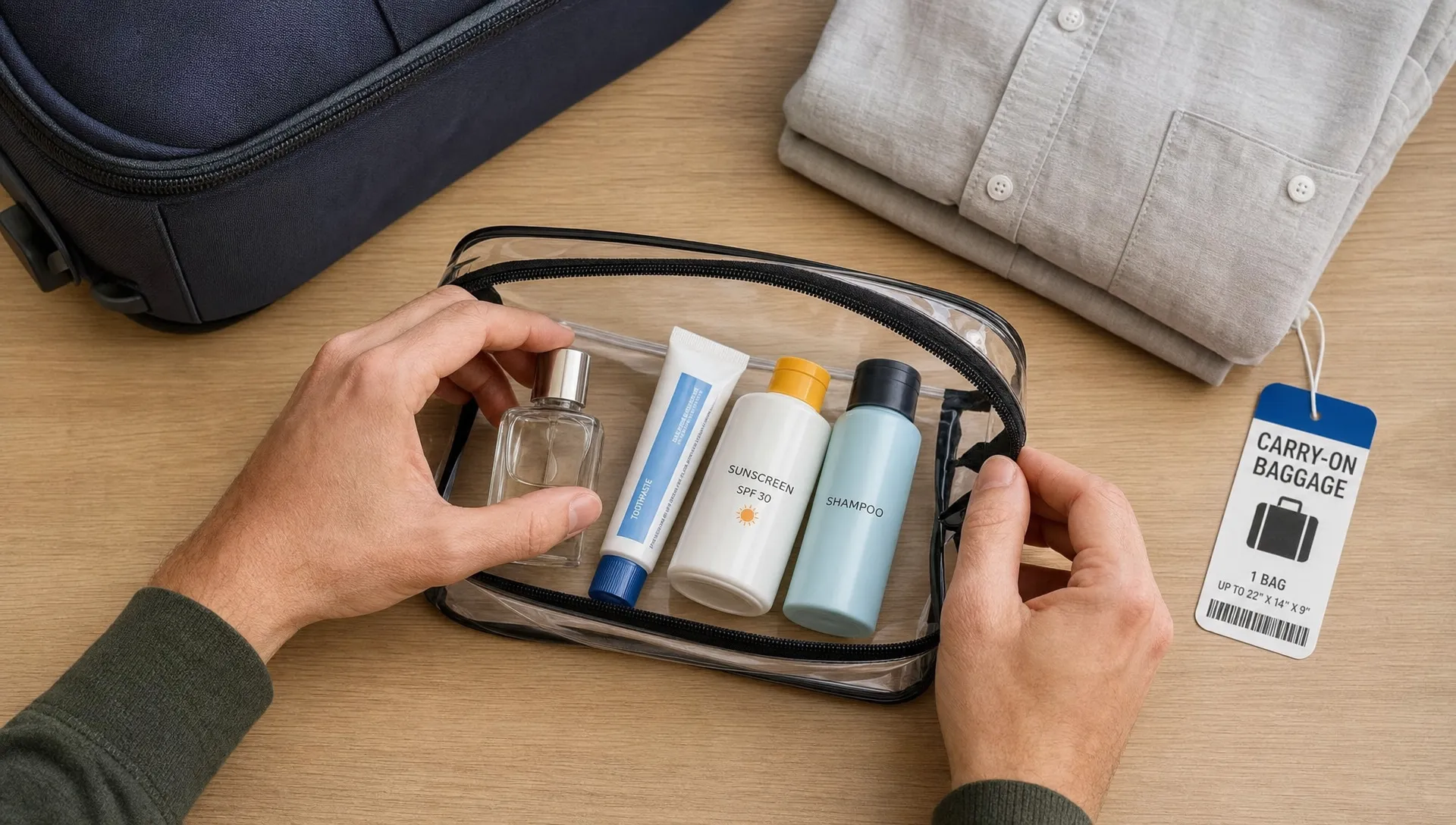
If you are asking carry on luggage how much liquid fits, the quick answer is: usually as much as you can place in 100ml (3.4 oz) containers inside one clear resealable liquids bag. In many airports, that works out to roughly 600ml to 1 liter of total container capacity in practice, not one giant bottle. The exact answer depends on your airport, route, bag size and the shapes of your bottles.
The short answer: legal limit and physical space are different
For most standard airport security checkpoints, the familiar rule is 100ml per container, with those containers placed in one clear resealable bag. In the United States, TSA's 3-1-1 liquids rule limits liquids, gels, creams, pastes and aerosols to containers of 3.4 oz or 100ml, all fitting in one quart-sized bag.
In many European and international airports, the same idea appears as 100ml containers in a transparent resealable bag, often with a maximum bag capacity around 1 liter. The European Commission guidance on liquids, aerosols and gels uses the same 100ml container framework for standard screening.
The physical capacity of a quart bag is close to 946ml, but that does not mean you can always carry exactly 946ml of products. Bottles waste space, caps add bulk and security staff may reject a bag that cannot close properly.
What counts as liquid in carry-on luggage?
Airport liquid rules cover more than water, shampoo and perfume. Gels, sprays, creams, pastes, lotions and semi-liquid foods usually count too. Toothpaste, mascara, lip gloss, peanut butter, sunscreen, deodorant spray and hair gel are common surprises.
If you want a broader item-by-item overview, Liquid Limits has a guide to what is allowed as liquids in carry-on luggage. For this packing calculation, assume that anything spreadable, pourable, squeezable or sprayable may need to fit inside your liquids bag.
The size printed on the container matters. A half-empty 200ml bottle is still a 200ml container, so it will usually fail the 100ml rule even if only a small amount remains inside.
Carry on luggage how much liquid fits in the bag?
The realistic answer is that a standard liquids bag usually holds 6 to 10 travel-size containers if they are close to 100ml each. With smaller bottles, you may fit more items, but the total liquid volume may be lower.
The table below gives practical estimates for a 1-quart or 1-liter style liquids bag. These are packing estimates, not legal guarantees, because bottle shape and local screening rules matter.
| Packing setup | What usually fits | Approximate total container capacity | Best for |
|---|---|---|---|
| Round 100ml bottles | 6 to 8 bottles | 600ml to 800ml | Simple toiletry kits |
| Slim 100ml bottles | 8 to 10 bottles | 800ml to 1000ml | Maximizing volume |
| 50ml mini bottles | 10 to 15 bottles | 500ml to 750ml | Short trips and variety |
| Mixed minis and samples | 7 to 12 items | 500ml to 900ml | Skincare, makeup and fragrance |
The bag must normally close, and you should be able to remove it for screening if asked. Overstuffing it with bulging bottles can cause more problems than packing one fewer item.
The packing math: why 1 liter rarely means 1 liter of product
A more realistic carry on luggage how much liquid calculation starts with container volume, not product volume. Ten perfect 100ml containers would equal 1 liter, but real bottles are not perfect cubes. Caps, shoulders, labels and air gaps take up room.
A tall cylindrical 100ml shampoo bottle often wastes more bag space than a flat rectangular bottle with the same capacity. Soft pouches can save space, but they must still show a compliant capacity and seal well enough not to leak.
For most travelers, 700ml to 900ml of labeled capacity is the sweet spot. That might mean shampoo, conditioner, face wash, sunscreen, moisturizer, toothpaste, perfume, deodorant and a small styling product. If your trip is longer, decant products into smaller bottles and move backups to checked luggage when possible.
How to pack more without breaking the rules
The easiest way to fit more is to reduce container size before you reduce product variety. Many people bring 100ml of items they use only once or twice, then run out of the one product they use daily.
Start with your daily essentials, then choose sizes based on real usage. For example, you may need 100ml of sunscreen for a beach trip, but only 30ml of face wash for a weekend. A mini toothpaste, solid deodorant and bar cleanser can free space for products that must stay liquid.
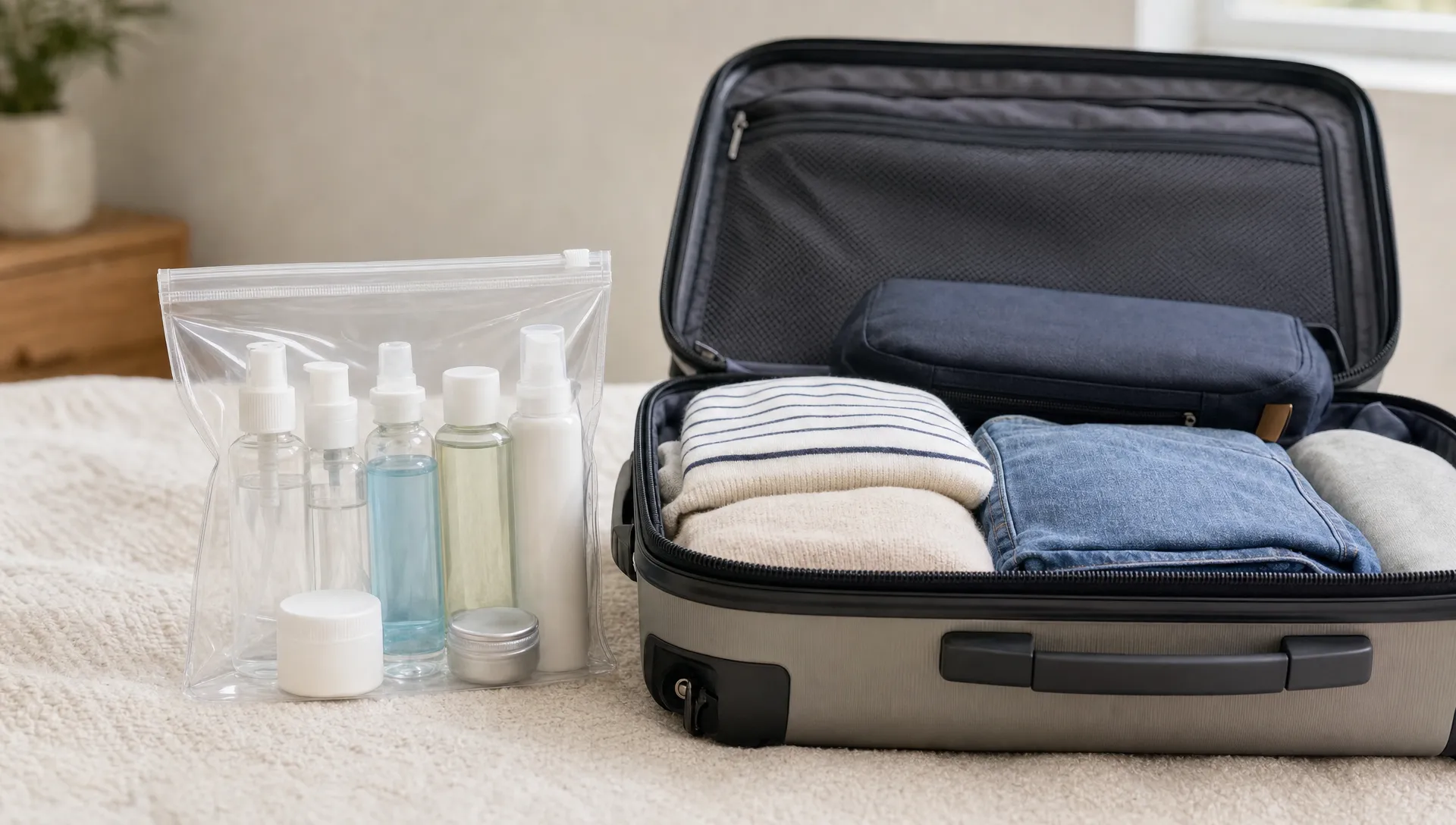
Solid swaps are useful because they usually do not need to go in the liquids bag. Bar shampoo, solid conditioner, powder cleanser, stick balm and solid perfume can reduce pressure on the clear bag, though final decisions are still made at security.
When airport rules allow more than 100ml
Some airports use advanced security scanners that can allow larger liquid containers, sometimes up to 2 liters. That does not make 2 liters the global rule. Airport policies vary by country, terminal, scanner availability and date.
For international carry on luggage how much liquid you can keep with you may be determined by the strictest checkpoint on your whole route, not only your departure airport. A relaxed rule at the first airport may not help if you connect through, return from or get rescreened at an airport using the 100ml limit.
The United Kingdom's official hand luggage restrictions page is a good example of why travelers should check current local rules rather than rely on memory. Scanner policies have changed in recent years, and airports do not always move at the same pace.
This is also where a route-based check helps. Liquid Limits lets you check the strictest liquid rule for your trip, including return flights, source links and last-checked dates.
Exemptions that do not follow the normal bag limit
Some liquid items can be allowed outside the standard liquids bag, but they still need screening. Common examples include medically necessary liquids, prescription medicines, baby formula, breast milk and baby food.
Do not hide exempt liquids deep in your suitcase. Keep them easy to remove, bring supporting documentation where appropriate and allow extra time at security. The container may be larger than 100ml, but security officers can still inspect it.
Duty-free liquids are another special case. Liquids purchased after security are usually allowed on that flight, but international connections can complicate things. Many airports require duty-free liquids to stay sealed in a tamper-evident bag with the receipt visible. If that bag is opened before a rescreening point, the liquid may be treated like any other oversized container.
Carry-on vs checked luggage liquid capacity
In carry-on bags, security screening is the main constraint. In checked bags, you can usually pack larger toiletries, but hazardous material rules still apply. Aerosols, alcohol, fuel-like products and strong chemicals may have separate limits or be banned.
If the carry on luggage how much liquid answer leaves you short, put bulky nonessential liquids in checked baggage. Wrap lids with tape, place bottles in sealed plastic bags and protect them with clothing. Shampoo spills are inconvenient, but leaking perfume or sunscreen can ruin electronics and documents.
For a fuller comparison between cabin bags and hold baggage, see Liquid Limits' guide to luggage liquid rules for checked bags and carry-ons.
Sample liquid kits by trip length
A one-night business trip can often fit inside 250ml to 400ml total liquid capacity if your hotel provides basics. A practical kit might include toothpaste, deodorant, face wash, moisturizer, hair product and a small fragrance.
A weeklong leisure trip is different. You may need closer to 700ml to 900ml if you bring sunscreen, skincare and haircare. Even then, it is better to refill small bottles or buy some items after arrival than to overpack the liquids bag.
For a family trip, each ticketed traveler can often use their own permitted liquids bag, depending on the airport's rules. That can help spread sunscreen, toothpaste and other shared items across several bags. Children may also have baby or medical exemptions where relevant.
A simple pre-flight checklist
Before you zip your bag, use this quick check so the carry on luggage how much liquid question does not become a security line problem:
- Every standard liquid container is 100ml or 3.4 oz or smaller, unless a verified airport rule allows more.
- The printed container size is compliant, not just the amount left inside.
- All standard liquids fit in one clear resealable bag where required.
- Medicines, baby items and duty-free liquids are packed for easy inspection.
- Your return airport and connection airports follow the same rule, or you have packed for the strictest one.
If any answer is uncertain, plan for the 100ml rule. It is usually safer to assume the stricter limit than to lose an expensive product at screening.
Frequently Asked Questions
How many 100ml bottles fit in a carry-on liquids bag? Most travelers can fit 6 to 10 bottles of 100ml each in a quart-sized or 1-liter liquids bag. Slim bottles fit better than round bottles, and the bag must usually close properly.
Can I bring a 200ml bottle if it is half full? Usually no. Security rules normally use the container's labeled capacity, not the remaining liquid inside. A half-full 200ml bottle is still treated as a 200ml container.
For carry on luggage how much liquid can be medicine or baby supplies? Medically necessary liquids, baby formula, breast milk and baby food may be allowed in larger amounts, but they must be screened separately and should be easy to show at security.
Do newer airport scanners mean I can always bring 2 liters? No. Some airports allow larger liquids where advanced scanners and local rules permit it, but many routes still use the 100ml limit. Check every airport on your trip, including your return.
Check the rule before you finish packing
The safest packing plan is not just what fits in your clear bag, but what will pass the strictest checkpoint on your route. Liquid Limits helps you check airport, item and route liquid rules with daily updates, source links and last-checked dates.
Before you choose which bottles make the cut, check your trip on Liquid Limits and pack for the rule that actually applies to your journey.