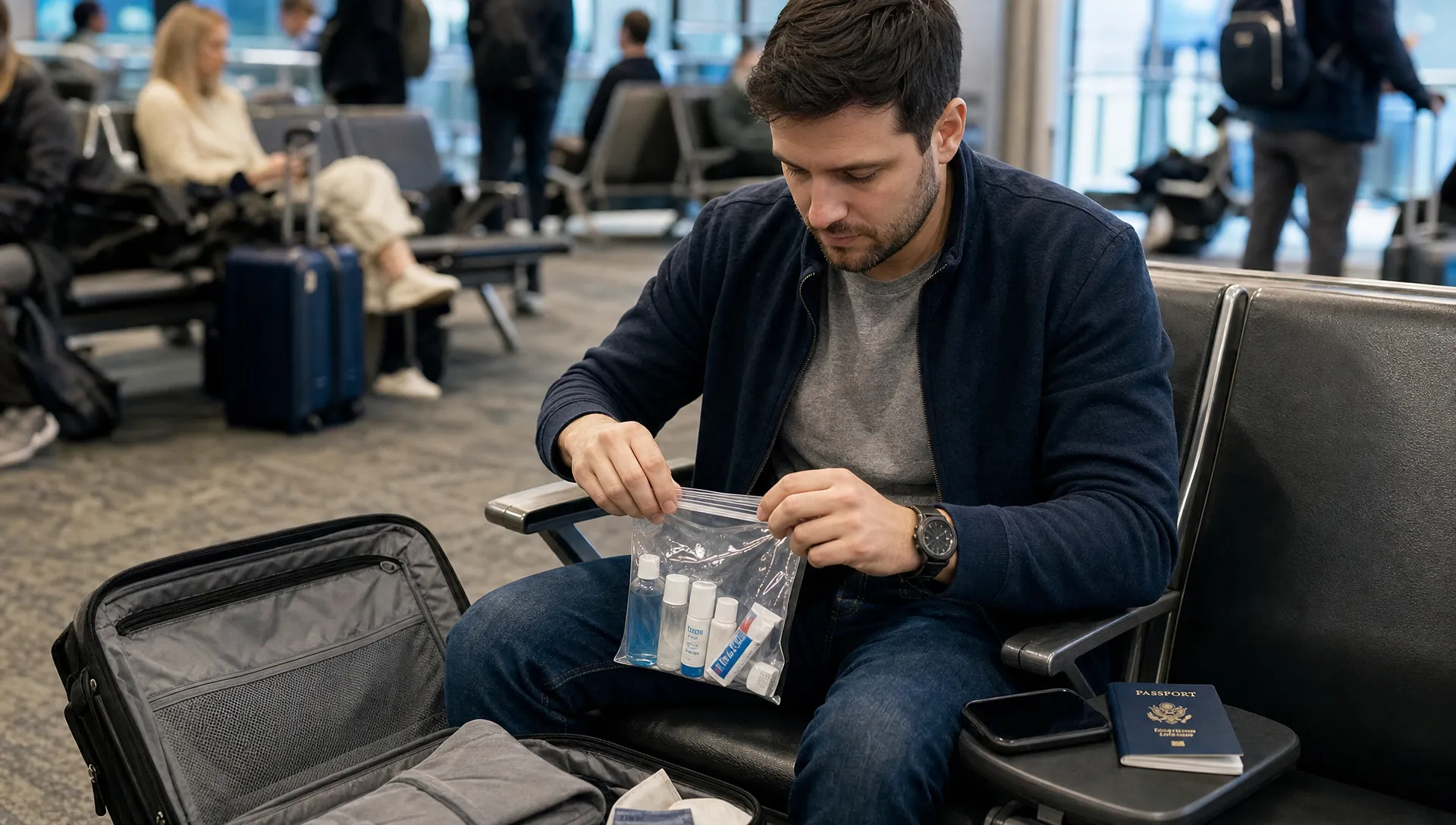
Choosing a security liquids bag seems simple until you are repacking at the checkpoint with a line behind you. The right bag is clear, correctly sized, easy to open, hard to overfill and suitable for every airport on your route, not just the one where your trip begins.
A good bag will not make an oversized shampoo legal, but it can prevent common problems: containers hidden under makeup, a pouch that will not close, a toiletry case that is too opaque or a bag that looks larger than airport staff expect. Use this guide to choose one that works in real travel conditions, from short business trips to long-haul routes with transfers.
What a security liquids bag actually needs to do
Airport liquid rules are written around containers and visibility, not fashion. At many checkpoints, small liquid containers must fit inside a single transparent, resealable bag. The bag lets screening officers see your items quickly and confirms that you have not packed more cabin liquids than the rule allows.
In the United States, the TSA liquids rule refers to containers of 3.4 oz or 100 ml or less, packed in one quart-sized bag. In the United Kingdom, GOV.UK hand luggage guidance describes a single transparent, resealable plastic bag that holds no more than 1 liter and measures about 20 cm by 20 cm.
These rules sound similar, but they are not always applied in exactly the same way. Some airports have newer screening equipment and may allow liquids to stay inside your cabin bag, while others still ask travelers to remove a separate liquids bag. If you want fewer surprises, choose a bag that satisfies the stricter, more traditional version of the rule.
How to choose the right security liquids bag
The best security liquids bag is not necessarily the biggest clear pouch you can buy. It is the one that fits the limit, closes fully with your liquids inside and can be inspected without staff needing to handle each item.
Choose the right capacity, not just the right label
Look for a bag around 1 liter or 1 quart. That is the practical sweet spot for most airports that still enforce the classic cabin liquids rule. Travel brands often label clear toiletry pouches as “TSA approved,” but that phrase is not a guarantee for every airport or every journey.
A bag that is noticeably larger than 1 liter can attract attention even if your containers are small. A bag that is too small can force you to stack bottles tightly, making them hard to inspect. The safest choice is a compact, transparent pouch close to the standard 20 cm by 20 cm format or a quart-sized equivalent.
Prioritize transparency over style
Frosted plastic, tinted vinyl and patterned panels may look better in your luggage, but they reduce visibility. Choose a bag that is fully clear on both sides, especially if you carry small cosmetics, sample tubes or medication-related liquids that can be hard to identify at a glance.
The security team should be able to see the contents without opening the pouch. If the bag has a large logo, opaque base or fabric side panels, keep those details minimal. A plain clear bag is usually less interesting, but it works better at the checkpoint.
Pick a closure that stays shut
A resealable top is one of the most important features. Zip-top plastic bags are lightweight and widely accepted, but they can split if reused too often. Clear zipper pouches are sturdier, though some bulky versions take up too much of the allowed space.
Whatever style you choose, test it when the bag is full. If the zip bends open, the slider catches or the top cannot close without squeezing, it is the wrong bag for airport security. A security liquids bag should close normally, not only when you press the air out and hope it holds.
Compare common liquids bag types
Different travelers need different levels of durability. A disposable zip-top bag may be enough for a weekend, while frequent flyers may prefer a reusable pouch that survives repeated packing.
| Bag type | Best for | Strengths | Watch out for |
|---|---|---|---|
| Disposable clear zip-top bag | Occasional trips and backup packing | Cheap, lightweight and close to standard sizes | Can tear, leak or lose its seal after reuse |
| Reusable clear PVC or TPU pouch | Frequent flyers | Durable, easy to clean and more structured | Some models are too large or too rigid |
| Clear cosmetic pouch | Travelers who want organization | Often has stronger seams and a smooth zipper | May include opaque panels or exceed 1 liter |
| Silicone travel pouch | Leak control inside luggage | Flexible and protective | Often not transparent enough for screening |
For most carry-on travelers, a simple clear reusable pouch is the best balance. It should be flexible enough to fit in an outer pocket, but not so flimsy that it collapses every time you remove it.
Match the bag to the strictest airport on your route
A bag that passes at your home airport may not pass on the way back. That is especially relevant when your trip includes a connection, a return from another country or an airport that has not adopted the same screening process.
Before packing, check the rules for every airport you will use. Liquid Limits can help you compare route restrictions through its trip liquid checker, including return flights where the rule may be different. If one airport on the route still uses the 100 ml container limit and a clear bag requirement, pack for that standard.
This matters even more when airports are in transition. New scanners have changed the process in some places, but travelers can still encounter temporary restrictions, local policy differences and staff instructions that override what they expected. A conservative security liquids bag keeps you prepared when the airport with the strictest rule is not the airport where you started.
If you are planning a multi-airport itinerary, this broader guide on packing cabin bag liquids for every airport on your route explains how to think beyond the outbound checkpoint.
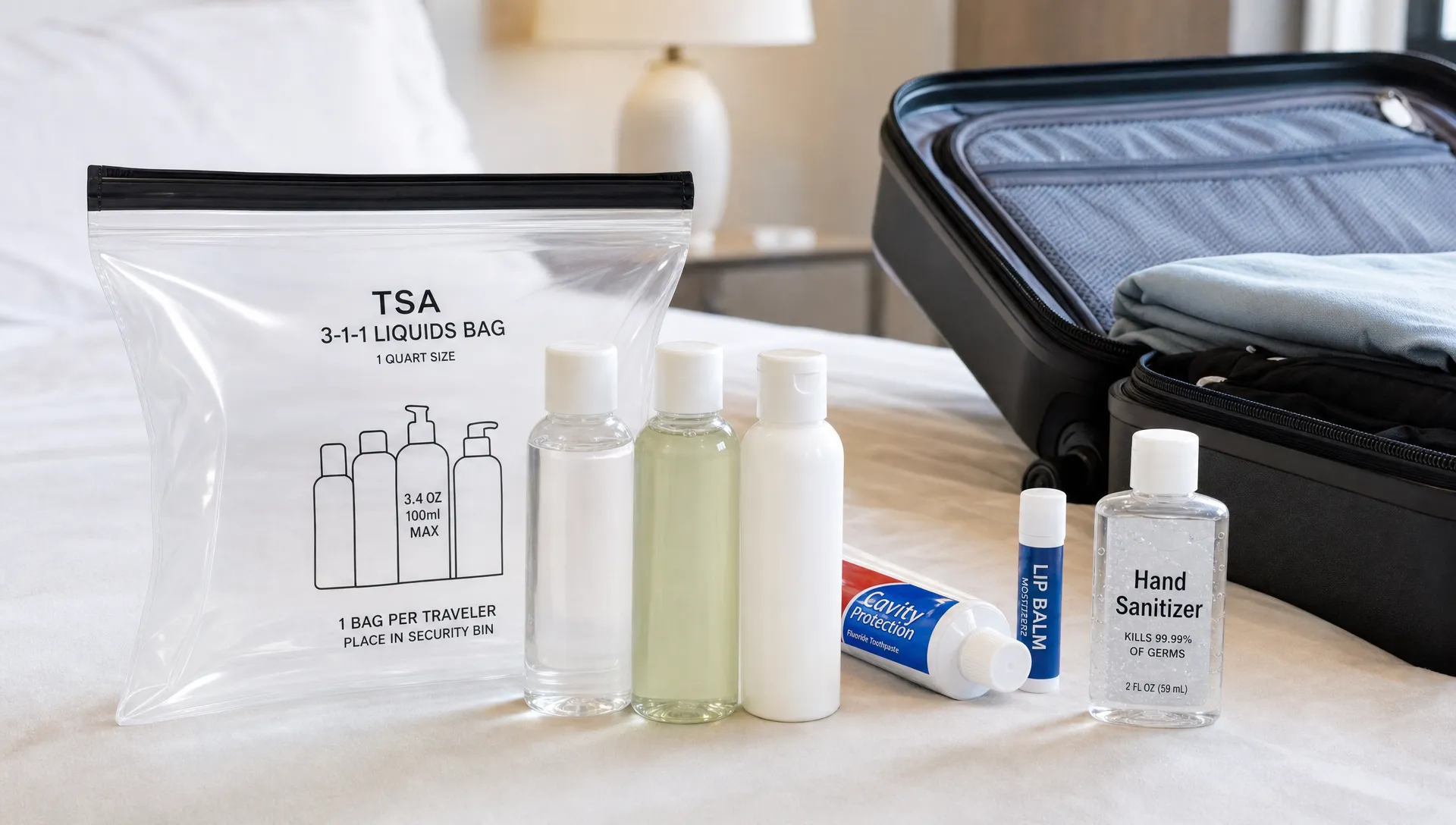
Choose based on what you actually carry
The right bag depends on your packing style. A minimalist with toothpaste, deodorant and sunscreen needs a different setup from a traveler carrying skincare, makeup, hair products and contact lens solution.
For toiletries and cosmetics
Choose a flat, wide pouch rather than a deep cube. Flat bags make it easier to see bottle labels and prevent small items from disappearing under larger ones. If you use foundation, mascara, lip gloss, setting spray or gel-based products, remember that airport security often treats them as liquids, gels, creams or pastes.
A good approach is to lay out everything you want to bring, then remove anything you can buy at your destination or replace with a solid alternative. Solid shampoo bars, stick deodorants and powder cosmetics can reduce pressure on your liquids space. For category-specific examples, the Liquid Limits guide to security liquid rules for creams, gels and sprays is useful before you decide what belongs in the pouch.
For medicines, baby items and special needs
Medicines, baby milk and certain dietary liquids may be treated differently from standard toiletries, but they should still be packed clearly. Do not bury them under cosmetics. Keep prescription labels, supporting documents or product packaging where relevant, especially for international travel.
Even if an item is exempt from the standard liquids bag limit, a transparent pouch can help you organize it separately. The goal is not to hide special items inside the main security liquids bag, but to make your packing easier to explain if screening staff ask.
For duty-free and connecting flights
Duty-free liquids can create problems after a connection if they are not sealed correctly or if the next airport applies different rules. Keep receipts and use the tamper-evident bag supplied by the retailer when required. Your regular liquids bag is not a substitute for approved duty-free packaging.
If your route includes a transfer, check whether you will pass through security again. A perfume bought after one checkpoint may still be inspected at the next one.
The five-minute packing test before you leave
Once you choose a bag, test it before travel day. Pack the exact bottles you plan to bring, close the pouch and place it in the same part of your carry-on where it will sit during the journey.
Use this simple check:
- Every container is 100 ml or smaller when the strict rule applies.
- The bag closes fully without bulging open.
- All items are visible through the clear material.
- The pouch can be removed from your cabin bag in a few seconds.
- Anything exempt or unusual is packed separately and easy to explain.
This test catches most avoidable problems. It also helps you decide whether to decant products into smaller bottles, switch to solids or move nonessential liquids into checked baggage. If you are unsure which products may be treated as liquids, review this list of common items covered by airport security liquid limits before finalizing your bag.
A well-packed security liquids bag should feel boring. Nothing spills, nothing strains the zip and nothing requires an argument at screening.
Common mistakes when buying a liquids bag
The most common mistake is buying a travel toiletry bag instead of an airport liquids bag. Many toiletry organizers are designed for hotel bathrooms, not security checkpoints. They may be clear on top, but opaque on the sides. They may also be too large, especially if they are marketed for checked luggage or full-size products.
Another mistake is choosing a rigid box-style pouch. It may protect bottles from leaks, but it can waste space and make the contents harder to rearrange. A little flexibility helps, especially when you need the bag to fit into a crowded cabin bag pocket.
Travelers also overfill the bag because it technically zips shut. If the seams are under pressure or the bottles are stacked in multiple layers, screening staff may ask you to remove items. The container limit still matters, and the bag should look like it fits the spirit of the rule.
Finally, do not rely on an old plastic bag indefinitely. Cloudy plastic, broken seals and tiny splits increase the chance of leaks or extra inspection. Replace the security liquids bag when it becomes hard to see through or no longer closes smoothly.
What to buy if you want one bag for most trips
If you want a reliable all-purpose choice, look for a clear, resealable, 1 liter or quart-sized pouch with minimal branding, flexible sides and a smooth zipper. It should hold several small bottles in one visible layer rather than forcing you to pack a deep stack.
A practical size is more valuable than extra compartments. Dividers can make sense for organization inside checked luggage, but they reduce usable space in a liquids pouch and may make inspection harder. For airport security, simple is usually better.
Keep a spare disposable clear bag in your suitcase as a backup. It weighs almost nothing and can save time if your main pouch breaks, a product leaks or an airport staff member asks for a more standard-looking bag.
Frequently Asked Questions
Does my security liquids bag have to be exactly 20 cm by 20 cm? Not always. Requirements vary by airport and country, but a clear resealable bag around 1 liter, or about 20 cm by 20 cm, is a safe standard for many trips.
Can I use a reusable clear toiletry pouch? Yes, if it is transparent, resealable, close to the accepted capacity and not too bulky. Avoid opaque panels, oversized cosmetic cases and rigid pouches that exceed the expected limit.
Do all liquids need to fit in the same bag? Standard cabin liquids usually need to fit in one bag where the classic 100 ml rule applies. Medicines, baby items and some special dietary liquids may be handled separately, but you should still keep them easy to inspect.
What if my airport has scanners that allow larger liquids? Pack for the strictest airport on your full route unless you are certain every checkpoint allows larger quantities. Rules can differ on return flights and connections.
Should I buy a bag labeled TSA approved? Treat that label as a clue, not a guarantee. Check the actual size, transparency and closure. A TSA-style bag may be fine in the United States but still too large or poorly suited for another airport.
Pack the bag that matches your route
The safest choice is a clear, simple pouch that meets the stricter version of the rule before you leave home. Before your next flight, use Liquid Limits to check the liquid rules for your airports, route and items so your bag choice matches the trip you are actually taking.