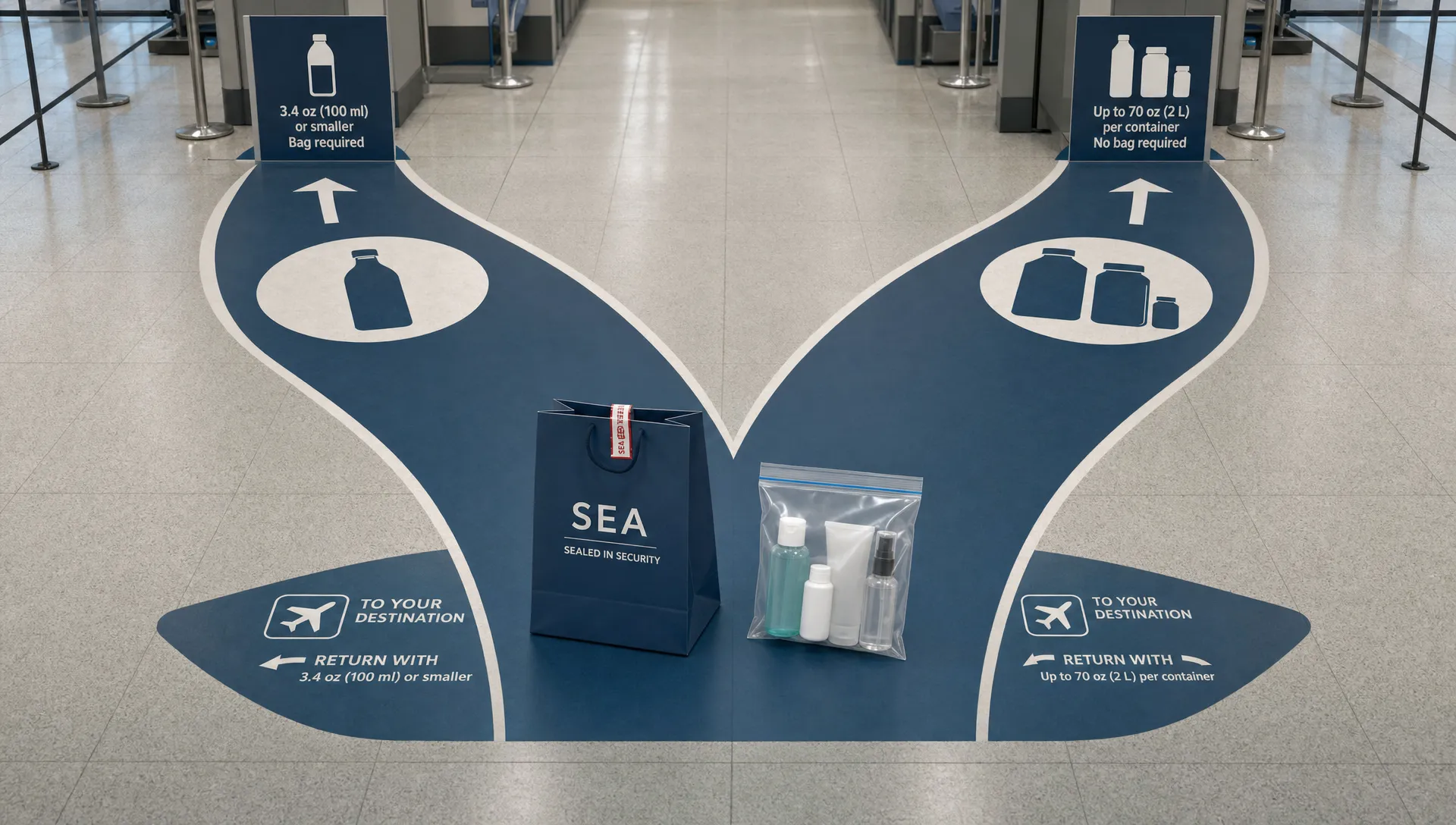
Airport liquid rules are simple until they are not. One airport may ask you to remove a clear bag of 100 ml bottles. Another may let liquids stay inside your cabin bag because it uses newer scanners. A return airport may apply a stricter rule than the airport you left from. The delay usually happens when travelers pack for the easiest checkpoint instead of the strictest one on their route.
If you want to take liquids through airport security without losing time, the goal is not just to obey the rule. It is to make your liquids easy to inspect, easy to separate and impossible to question at the tray stage.
Start with the strictest airport on your trip
The fastest packing strategy is to assume your liquids will be checked under the most restrictive rule on your full itinerary, including your return flight and any connection where you must pass security again.
For many routes, that still means the familiar 100 ml or 3.4 oz container limit for liquids, aerosols, gels, creams and pastes in cabin baggage. In the United States, the TSA liquids rule limits carry-on liquids to containers of 3.4 oz or 100 ml that fit in one quart-sized clear bag, with exceptions for medically necessary liquids and some infant or child items. Other countries use similar limits, but the exact bag size, screening process and exemptions can vary.
New scanner rollouts have made this more confusing. Some airports have trialed or introduced technology that changes how liquids are screened, but rules can differ by terminal, checkpoint, destination or temporary security notice. If one airport on your trip allows larger containers but the next one does not, the stricter airport decides what survives.
Before packing, check the airport and route rules rather than relying on memory. Liquid Limits lets you compare the liquid restrictions for your trip and is especially useful when your outbound and return airports may not use the same policy. You can also use a travel liquids checklist for stress-free security if you want a quick packing pass before you zip your bag.
Know what counts as a liquid before it gets flagged
Security teams do not only look for water bottles and shampoo. Many delays happen because a traveler packed something that felt solid at home but screens like a liquid, gel, paste or spread.
Common examples include mascara, lip gloss, toothpaste, sunscreen, hair gel, deodorant gels, peanut butter, jam, honey, hummus, soft cheese, snow globes and some skincare products. Aerosols also fall under liquid-style screening, even when the product comes out as mist or foam.
The practical test is simple: if it can be poured, pumped, squeezed, smeared, sprayed or spread, treat it as a liquid unless your airport authority says otherwise.
| Item type | Why it delays screening | Faster packing choice |
|---|---|---|
| Half-empty large shampoo bottle | The container size matters, not the remaining liquid | Decant into a 100 ml bottle or pack it in checked baggage |
| Makeup and skincare | Small items get scattered in pockets and pouches | Put all liquid-like cosmetics in the clear liquids bag |
| Food spreads | Many travelers think food rules are separate from liquid rules | Pack spreadable foods in checked baggage or keep them within the liquid limit |
| Aerosols | They may need liquid screening plus pressure-container checks | Use travel-size aerosols and keep caps fitted |
| Medication liquids | They may be exempt, but still need screening | Keep them separate, labeled and easy to declare |
| Duty-free bottles | Connections can trigger a second screening | Keep them sealed in the security bag with the receipt |
If you are unsure whether an item is likely to slow you down, compare it with examples in this guide to liquids at airport security that get flagged.
Pack liquids so officers can screen them once
A good liquids setup saves time because it removes decision-making at the checkpoint. You should not be digging through your bag while people behind you wait, or trying to decide which bottle to surrender while your tray is already moving.
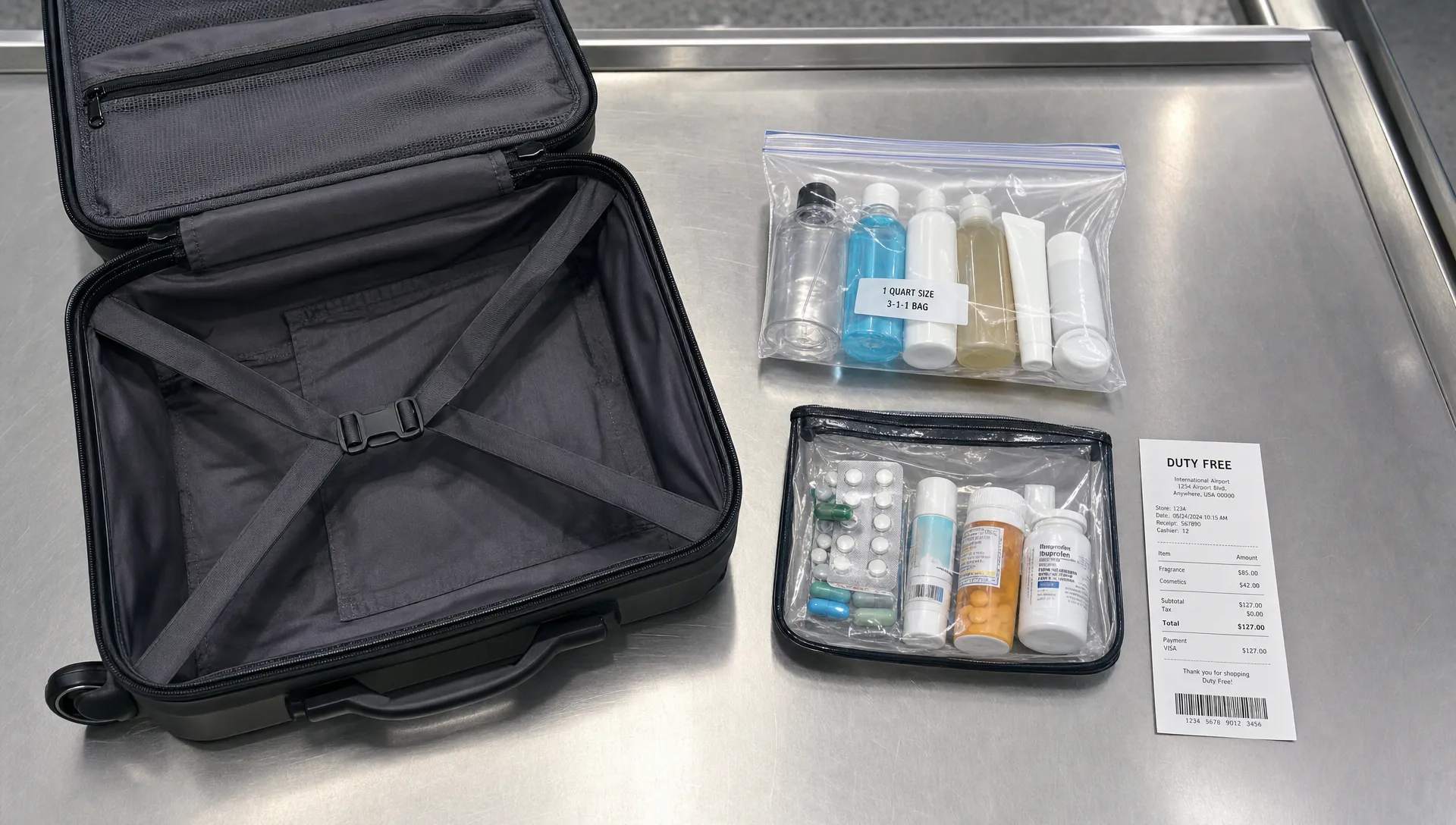
Put your cabin liquids in one clear, resealable bag if your airport requires it. The bag should close fully without bulging. If you need to force the zipper, security may treat it as overpacked even if each individual container is 100 ml or less.
Keep that liquids bag near the top of your personal item or carry-on. A front pocket is ideal if it is large enough and does not crush the bottles. Avoid burying liquids under clothing, chargers or shoes. If the checkpoint asks travelers to remove liquids, you can lift the bag out in seconds. If the checkpoint allows liquids to stay inside, you have still packed in a way that is easy to inspect if your bag gets pulled aside.
For toiletries, choose travel-size containers with clear volume markings. Unlabeled mini bottles are not automatically banned, but a bottle that clearly says 100 ml or less creates less doubt. If you refill containers at home, avoid using oversized bottles even when partly empty. A 200 ml bottle with 50 ml left can still be rejected because the container capacity is too large.
Solid alternatives can also remove friction. Bar soap, solid shampoo, stick deodorant and some powder makeup do not usually need to go in the liquids bag. They are not always the right substitute, but they can help if your liquids bag is crowded.
Separate exceptions before you reach the trays
Exempt liquids are allowed in many security systems, but they are not invisible. They still need to be screened, and they can delay you if packed like ordinary toiletries.
Medically necessary liquids, prescription liquid medication, contact lens solution, baby formula, breast milk, toddler drinks and certain special dietary liquids often receive different treatment from standard toiletries. For example, TSA says medically necessary liquids may be brought in larger quantities than 3.4 oz, but travelers should inform officers at the checkpoint and present them for screening.
The fastest approach is to separate exceptions from your regular liquids bag. Keep them in an accessible pouch, ideally with original labels or supporting documentation when available. You do not need to over-explain, but you should be ready to say clearly what the item is: liquid medication, baby formula, breast milk, medically necessary nutrition or contact lens solution.
Do not place exempt liquids at the bottom of a packed carry-on. If an officer needs to inspect them, the entire bag may be opened and repacked, which costs more time than simply handing over the item at the start.
Avoid the five most common liquid delay triggers
Most checkpoint delays involving liquids come from a small group of packing mistakes. Fix these before you travel and you reduce the chance of a secondary bag check.
Oversized containers in the cabin bag
This is the classic problem. A traveler packs a 150 ml moisturizer or 200 ml sunscreen, thinking it is acceptable because there is not much left. Security usually judges the printed container capacity, not the remaining contents.
If the container is over the allowed limit, put it in checked baggage, decant it into a compliant container or leave it at home. Do not plan to talk your way through. The checkpoint is the worst place to negotiate container size.
Liquids hidden in multiple places
A clear liquids bag is only helpful if all relevant items are in it. Lip gloss in a purse, hand sanitizer in a jacket, toothpaste in a wash pouch and sunscreen in a side pocket can turn one screening task into several searches.
Before leaving for the airport, do one final sweep of every pocket and pouch. Gather all liquid-like items into the liquids bag unless they are exempt and packed separately for declaration.
Crowded bags that cannot close
Even when every bottle is small enough, an overstuffed liquids bag can slow you down. Security officers need to see what is inside, and a bag that cannot close may fail local requirements.
Bring fewer products, switch some items to solids or move nonessential liquids to checked baggage. If you are traveling with family, do not assume one person can carry every liquid for the group in one bag. Rules may be applied per passenger, but each traveler should be able to present their own liquids clearly.
Duty-free bottles before a connection
Duty-free liquids can be allowed in cabin baggage when packed correctly, often in a sealed tamper-evident security bag with proof of purchase. The risk appears when you have a connecting flight and must pass through security again.
Do not open the sealed duty-free bag before your final destination. Keep the receipt visible and check whether your connection airport accepts duty-free liquids from your origin. If you are not sure, avoid buying large liquid items until the last airport before your destination.
Return-trip surprises
Travelers often pack carefully for the outbound flight and forget the return. Then they buy full-size toiletries, perfume, sauces, oils or gifts that cannot pass the return airport's cabin liquid rule.
If you plan to shop abroad, check your return airport before buying liquids. This matters even more when your outbound airport has relaxed screening but your return airport does not.
At the checkpoint, follow the local process
Once you reach security, speed comes from doing what that checkpoint asks, not what another airport did last week.
Watch the signs and listen to staff before loading trays. Some airports still ask for liquids to be removed and placed separately. Others want everything left inside the bag because their scanners are configured for that process. If you remove liquids when officers told passengers not to, you can slow down the line just as much as someone who leaves liquids inside when removal is required.
Keep your liquids bag and exceptions reachable until you are fully through screening. Do not repack too early while your carry-on is still in the scanner queue. If your bag is selected, you will need access to the same items again.
If you have an exempt liquid, declare it calmly and early. A simple sentence is enough in most cases: "I have liquid medication in this pouch" or "This is baby formula." Officers may need to test it, open a container or inspect the outside, depending on the local procedure.
If an item is refused, stay practical. You may be offered options such as checking the bag, returning the item to someone outside security or surrendering it. Arguing about a different airport's rule rarely helps because the current checkpoint has the authority to apply its own security procedure.
Build extra time for special liquid cases
Some travelers should allow a little more screening time even when everything is packed correctly. This does not mean you will have a problem. It means your liquids may require a separate inspection.
Build in extra time if you are carrying:
- Liquid medication or medical nutrition above the standard container limit
- Baby formula, breast milk, toddler drinks or baby food
- Several cosmetic or skincare liquids for work or an event
- Duty-free alcohol, perfume or cosmetics during an international connection
- Food gifts such as sauces, oils, jams or honey
For simple domestic trips with only a small toiletries bag, the liquid process may take seconds. For medical, infant or duty-free items, a few extra minutes can prevent stress.
Do not rely on scanner upgrades alone
New CT-style scanners can change how liquids are screened, but they do not create one global rule. A route can include airports using different scanners, older scanners in some terminals or temporary restrictions because of equipment, staffing or security direction.
This is why "I heard the 100 ml rule is gone" is risky advice. In some places, liquids may be allowed in larger containers or left inside bags. In others, the standard small-container rule still applies. Even within the same country, implementation can be uneven.
If you are traveling through airports that advertise newer screening technology, check the current rule close to departure. For more context, Liquid Limits explains how airport liquid policies change with new scanners and why route-specific checks are safer than general assumptions.
A 10-minute liquids check before you leave home
The easiest way to avoid delays is to do a short liquids audit before you close your suitcase. This is especially useful if you packed over several days or added last-minute toiletries in the morning.
Use this sequence before heading to the airport:
- Check the liquid rule for every airport where you may pass security, including the return airport.
- Pull out every liquid, gel, cream, paste, aerosol and spreadable item from your cabin bag and personal item.
- Confirm each standard liquid container is within the allowed size for your strictest checkpoint.
- Put standard liquids in the required clear bag and make sure it closes.
- Separate medical, baby and special dietary liquids so they are easy to declare.
- Move oversized nonessential liquids to checked baggage or leave them behind.
- Keep duty-free receipts and sealed security bags intact if you are connecting.
This short check catches the items most likely to trigger a bag search: the hand sanitizer in a backpack pocket, the full-size toothpaste in a toiletry kit, the sauce bought as a gift or the perfume you forgot was in your purse.
Frequently Asked Questions
Can I take liquids through airport security in containers larger than 100 ml? Usually not for standard cabin liquids at airports using the 100 ml or 3.4 oz rule. Some exemptions apply for medical, baby and special dietary items, and some airports with newer scanners may have different limits. Always check the rule for your actual airport and route.
Does a half-empty bottle count as 100 ml if there is only a little liquid left? No. Security usually looks at the container capacity printed on the bottle. A 200 ml bottle can be refused even if it contains less than 100 ml.
Do makeup and deodorant count as liquids? Some do. Mascara, liquid foundation, lip gloss, gel deodorant and cream products are generally treated as liquid-like items. Solid stick deodorant and powder makeup are less likely to need liquid screening, but local rules can vary.
Can I keep my liquids in my bag at security? It depends on the airport and checkpoint. Some scanners allow liquids to stay inside cabin bags, while other checkpoints still require you to remove the liquids bag. Follow the signs and staff instructions at the checkpoint.
What is the best way to pack liquids for a return flight? Pack for the strictest airport on the full trip, not just the airport you depart from first. If you buy liquids during your trip, check whether they can pass through the return airport in cabin baggage or whether they need to go in checked luggage.
Check your liquids before you pack
Airport liquid rules can change by country, airport, terminal and route. The simplest way to avoid delays is to verify your strictest checkpoint before you leave home.
Use Liquid Limits to check airport liquid rules for your trip, including return flights, item-specific restrictions and source-backed updates. If a rule is unclear, pack for the stricter 100 ml limit so your liquids are less likely to slow you down at security.