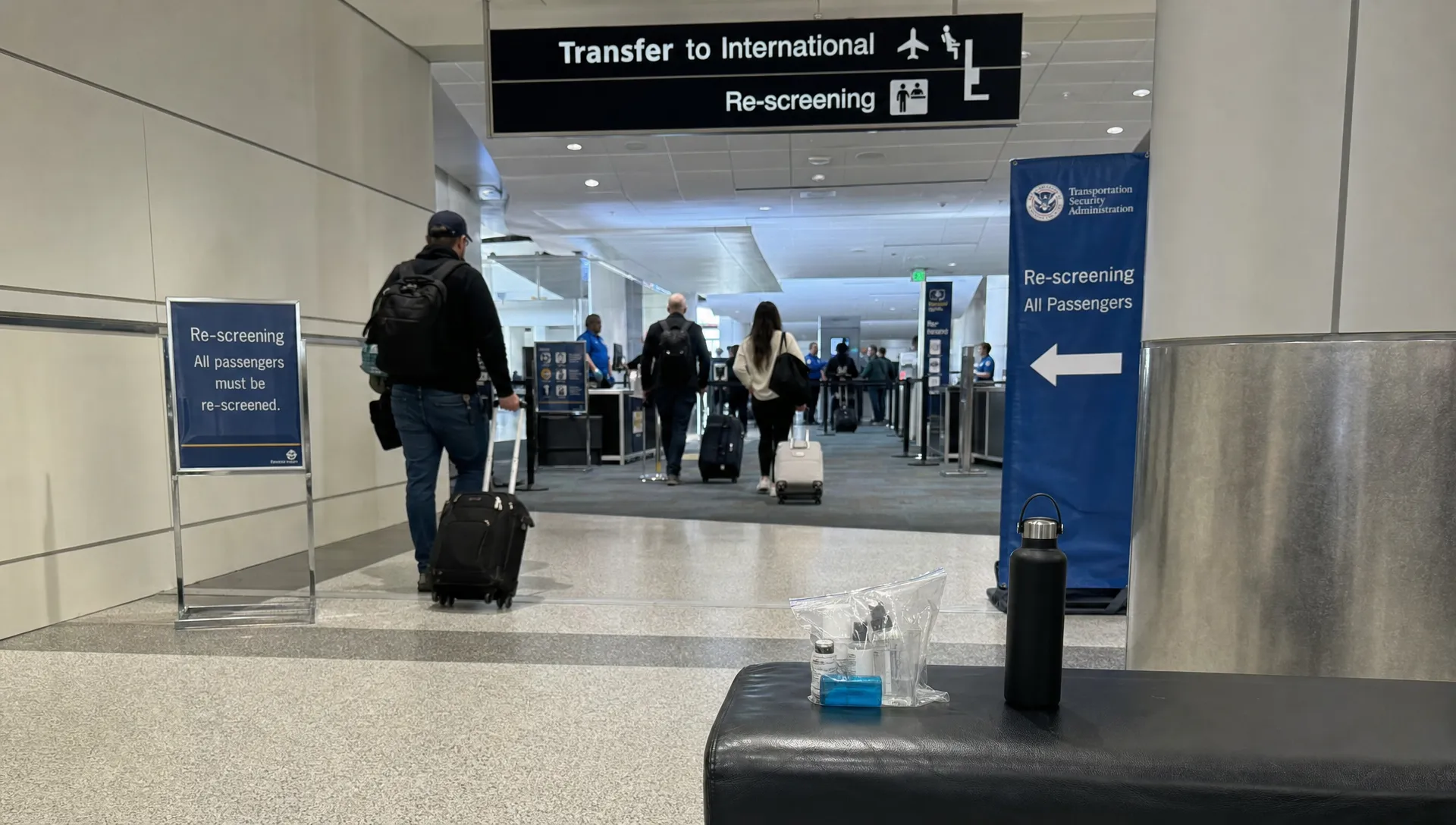
International connections turn a simple packing question into a route-planning problem. A bottle that is fine at your first airport may still be screened again at a transfer checkpoint, after customs, during a terminal change or on the return leg. The safest way to treat liquid limits for international travel is to map every place your cabin bag might go through security, then pack for the strictest one.
That matters more in 2026 because airports do not all use the same screening equipment or apply the same cabin liquid policy at the same time. Some airports may allow larger liquid containers in certain lanes or terminals. Others still apply the familiar 100ml limit. If your itinerary crosses both systems, the more relaxed rule only helps if your liquids are not screened again later.
Why connections change the liquid rules
Most travelers check the departure airport and stop there. For a nonstop flight, that is often enough. For an international connection, it can leave you exposed to confiscation at the point in your trip where you have the least time to repack.
Think of each security checkpoint as its own decision point. Your first airport does not give your bottle a permanent approval for the rest of the journey. If you pass through another checkpoint, that airport’s rule applies to what is in your cabin bag at that moment.
The key question is not simply whether your first airport allows 100ml or larger containers. The more useful question is whether that container will be screened again before your final destination. If the answer is yes or unclear, plan for the stricter cabin liquid rule.
For the baseline rules, the TSA liquids rule still describes the common 3-1-1 approach for U.S. checkpoints: liquids, aerosols, gels, creams and pastes in containers of 3.4 ounces, or 100ml, packed in a quart-size bag. Other countries use similar concepts, but details and exceptions vary by airport, route and date.
Where your liquids may be screened on an international itinerary
Connections are not all the same. A same-ticket airside transfer can be very different from a self-transfer where you leave security, collect a bag and check in again. The risk is highest when your cabin bag must enter a new public security screening area.
| Itinerary moment | Why it matters for liquids | Safer packing choice |
|---|---|---|
| First departure airport | This is the first rule your cabin bag must pass | Check the local cabin liquid rule before packing |
| Airside international transfer | Some airports rescreen transfer passengers even if they stay airside | Keep cabin liquids at 100ml if transfer screening is possible |
| Terminal change | Moving between terminals can sometimes require a new checkpoint | Do not rely on the first airport’s relaxed rule |
| International to domestic connection | Immigration, customs, baggage reclaim or recheck may create a new screening step | Move large liquids to checked baggage only if you legally have access before recheck |
| Separate-ticket connection | You are often treated like a new departing passenger | Pack as if starting a new trip at the connection airport |
| Return flight | The return airport may have different rules from the outbound airport | Check the return route separately |
If you are comparing a nonstop flight with a cheaper connecting itinerary, liquids are one of the hidden tradeoffs. A connection can add a second checkpoint, which can matter if you carry expensive skincare, specialty food, perfume, contact lens solution or liquid medication.
The strictest checkpoint should set your cabin packing rule
For cabin bags, the practical rule is simple: if any airport on the route may enforce 100ml, pack your cabin liquids in 100ml containers. This avoids the common mistake of packing for the most generous airport instead of the most restrictive one.
This does not mean every liquid must be left at home. It means you decide where each item belongs. Essential liquids that you need during the flight should be packed in compliant cabin sizes or carried under a valid exception. Larger items that you only need after arrival usually belong in checked baggage.
If you need a refresher on current carry-on size rules before planning a multi-airport route, Liquid Limits has a broader guide to airport liquid limits for carry-ons in 2026. For connections, though, the extra step is route order. A large container that passes at airport one may still fail at airport two.
How to pack when your airports disagree
Start by dividing liquids into three groups: items you must use in the cabin, items you only need at the destination and items you may buy during the trip. This makes the connection problem much easier to solve.
For must-have cabin items, use 100ml containers unless you have verified every transfer checkpoint on the route and any exception that applies. This includes toothpaste, deodorant gels, face creams, sunscreen, mascara, liquid makeup, hand sanitizer, hair gel, perfume and other items that security may treat as liquids or gels.
For destination-only items, checked baggage is usually the simplest option. If you are checking a bag through to your final destination, remember that you may not be able to access it during the connection. If you are self-transferring and collecting checked baggage, you might be able to move duty-free or oversized liquids into the checked bag before rechecking it, but only where customs, airline and airport procedures allow it.
For items you plan to buy later, timing matters. Buying a full-size liquid before your last security checkpoint creates risk. Buying after your final checkpoint is usually safer, provided the item is allowed on board and is not restricted by airline, customs or destination rules.
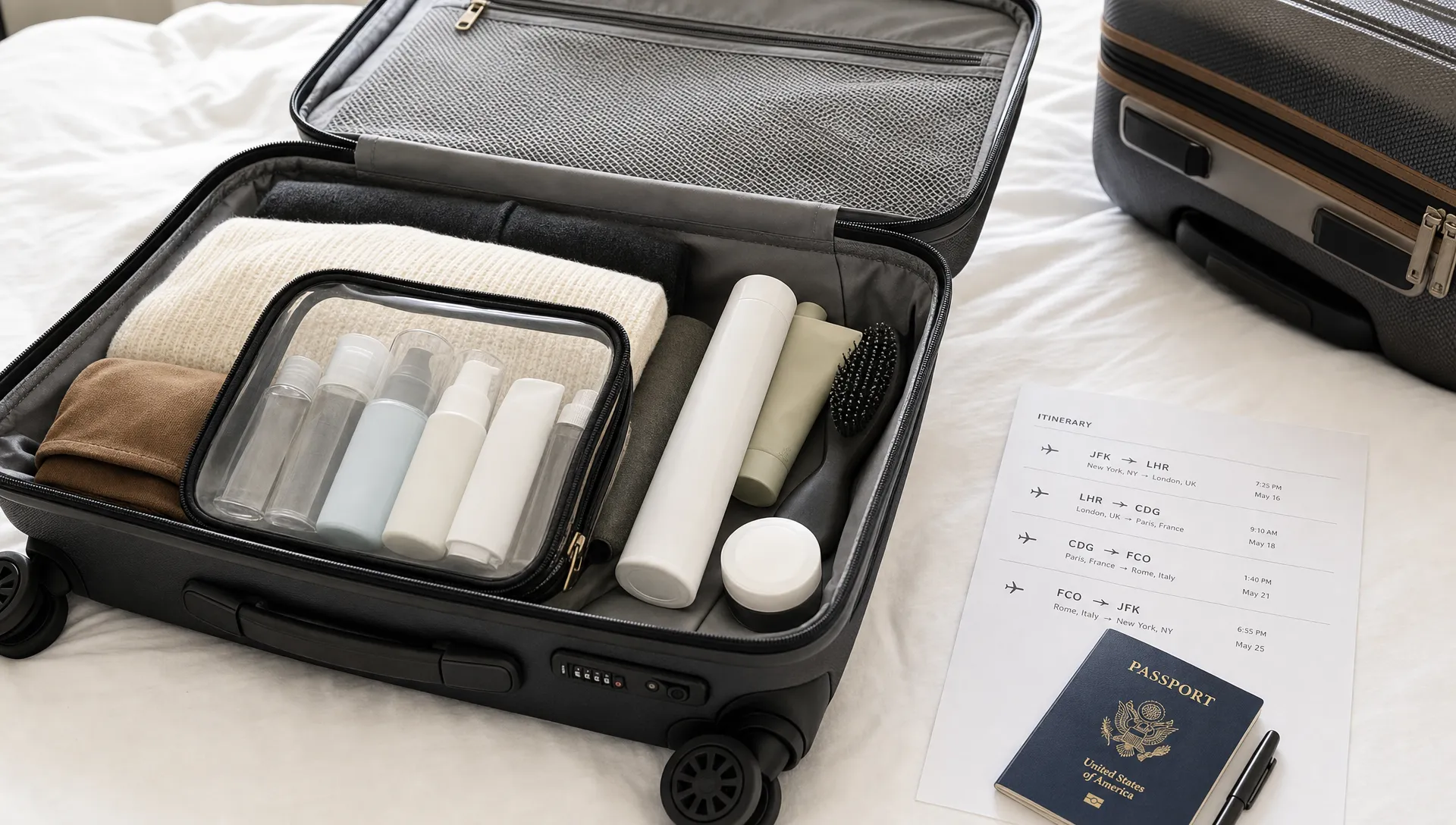
A half-empty 200ml shampoo bottle is still a 200ml container when the 100ml rule applies. Security rules usually focus on the container capacity, not the amount left inside. If a product matters, decant it into a properly sized travel container before leaving home.
Duty-free liquids can still be a connection problem
Duty-free purchases are one of the most common traps on international connections. Travelers often assume that anything bought after security can be carried through the rest of the trip. That is not always true.
Many airports and security regimes allow duty-free liquids above 100ml only when they are packed in an official sealed tamper-evident bag, often called a STEB, with proof of purchase visible. The bag should remain sealed until you reach your final destination. If it is opened, damaged or missing the receipt, a transfer checkpoint may treat the bottle like any other oversized liquid.
Even with a sealed bag, you should verify the route. Some transfer points may inspect the contents. Some may apply local restrictions. Some airport layouts force you through security again unexpectedly. If you have a tight connection, do not assume you will have time to argue, repack or return an item.
A practical approach is to buy duty-free liquids after your final transfer security checkpoint whenever possible. If your route includes a connection, ask the store whether the purchase is packed for transfer screening and whether your specific destination and connecting airport are covered. Then still treat that answer as one input, not a guarantee.
Medicines, baby items and special liquids
Medicines, baby formula, breast milk and some special dietary liquids are usually handled differently from ordinary toiletries, but an exception is not the same as a free pass. You may need to present items separately, allow additional screening or carry supporting documentation.
For medication, keep it in original packaging where possible and carry a prescription, doctor’s note or translated summary if the trip crosses language barriers. This is especially useful for liquid medicines, cooling gels, injectable treatments and medically necessary nutrition. Check both aviation security rules and destination import rules, since being allowed through screening does not automatically mean a product is legal to bring into the country.
For baby or toddler items, pack only what is reasonable for the journey and expect separate inspection. The GOV.UK hand luggage restrictions page is a good example of how official rules often define liquids broadly, including gels, pastes, lotions, sprays and food items with liquid content. Other countries may use similar categories but apply different screening procedures.
If a liquid is essential for health, do not rely on a last-minute airport decision. Check your route before travel, carry documentation and allow extra time at transfer security.
Build your liquid plan around the route, not the country
Country-level advice is useful, but connections are airport-level events. A traveler flying from New York to Madrid through London does not have one liquid rule. They have the New York departure checkpoint, any London transfer screening, the Madrid arrival context and the return journey to consider.
This is where a route-based check helps. You can check the whole route on Liquid Limits instead of searching each airport separately, then compare the strictest rule for the trip with item-specific guidance. Liquid Limits includes source links, last-checked dates and daily updates. When a rule is unclear, it defaults to the stricter 100ml fallback, which is usually the safer way to pack a cabin bag.
For round trips, repeat the process in reverse. Your outbound journey may be simple, while the return has a different connection airport, a separate terminal change or a stricter departure airport. If return flights are where you usually bring back perfume, sauces, cosmetics, olive oil or gifts, the return route deserves its own check. Liquid Limits also has a guide on rules for liquids on flights and return trips if that is the part of your itinerary most likely to catch you out.
A simple connection checklist before you pack
Use this checklist before an international itinerary with one or more stops:
- List every airport in order, including the return route.
- Mark any self-transfer, terminal change or separate-ticket connection.
- Check whether transfer security may apply at each connection airport.
- Pack cabin liquids to the strictest rule on the route if any step is unclear.
- Keep essential liquids in 100ml containers unless a verified exception applies.
- Buy duty-free liquids after the final transfer checkpoint when possible.
- Keep medicine, baby items and special liquids easy to remove for inspection.
This takes only a few minutes, but it prevents the most expensive liquid mistakes. It is especially useful for travelers with premium toiletries, special diets, medical liquids or long-haul routes with multiple airlines.
Common mistakes to avoid on connecting flights
The first mistake is assuming that staying airside means you will not be screened again. Some airports still route transfer passengers through security, even when they never enter the public arrivals hall. Airport design, terminal layout and origin country can all affect this.
The second mistake is treating a relaxed liquid rule as route-wide permission. If Airport A allows larger containers but Airport B screens your cabin bag under a 100ml rule, Airport B decides what gets through.
The third mistake is packing liquids for the destination rather than for the journey. A full-size sunscreen may be perfect for a beach trip, but if you do not need it during the flight, checked baggage is usually less risky.
The fourth mistake is forgetting the return trip. Many travelers leave home with compliant travel sizes, then come back with gifts, cosmetics or food items bought abroad. If those items are over the cabin limit and your return route includes transfer screening, they may not make it home in your hand luggage.
Frequently Asked Questions
Do liquid limits reset after an international connection? No. Each security checkpoint applies its own rules to your cabin bag. If your liquids are screened again during a connection, the transfer airport’s rule matters even if the items passed your first airport.
Can I bring a 2L liquid if my first airport allows larger containers? Only if every later checkpoint where your cabin bag is screened also allows that container. If any connection airport may apply the 100ml rule, pack that liquid in checked baggage or use compliant travel sizes.
Are duty-free liquids allowed through connecting airports? Sometimes. Duty-free liquids over 100ml are often accepted only in a sealed tamper-evident bag with proof of purchase. Do not open the bag before your final destination and check your specific route before buying.
What if I never leave the secure area during my connection? You may avoid additional screening, but it is not guaranteed. Some airports rescreen transfer passengers inside the secure area, especially on international routes or terminal changes.
Should I follow the departure airport rule or the destination airport rule? For carry-on liquids, follow every airport where your bag may be screened. In practice, pack for the strictest checkpoint on your outbound and return routes.
Plan your connection before you zip the bag
International liquid rules are manageable when you plan by checkpoint instead of by trip headline. Before you pack, enter your origin, connection airports, destination and return route into Liquid Limits. You will see the relevant airport rules, item guidance, source links and the stricter fallback when rules are unclear.
That is the easiest way to avoid losing a full-size bottle at transfer security, especially on international routes where the first airport is not the final decision-maker.