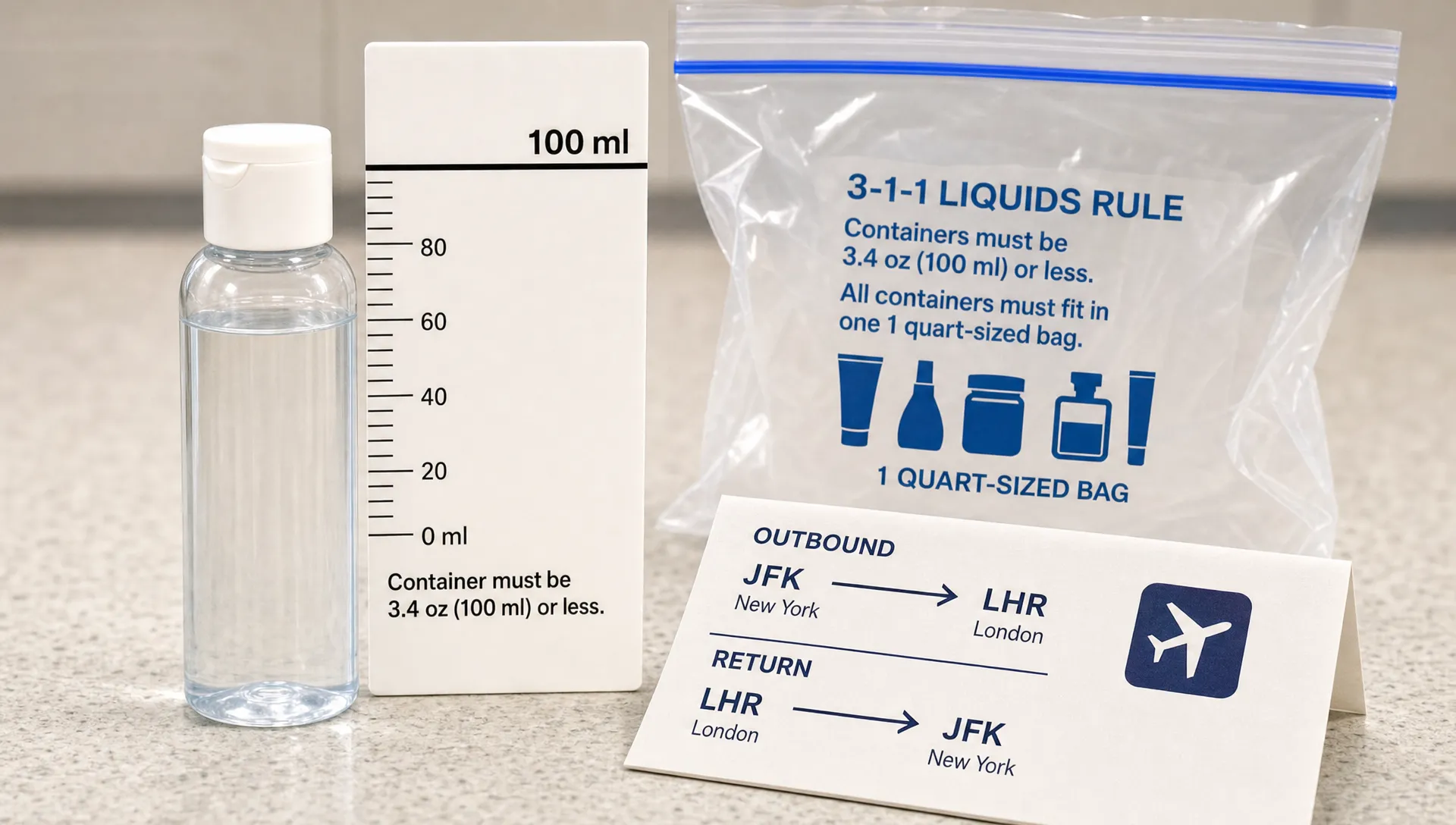
Liquids and flying are easiest to understand when you separate three things: the security checkpoint, the bag you are carrying and the size printed on the container. Most problems happen when travelers focus only on the airline or the destination. In practice, the rule that matters most is the checkpoint you pass through with your cabin bag.
That checkpoint might be your home airport, a transfer airport where you are screened again or the airport you fly home from. A bottle accepted on the outbound trip can still be refused on the return if the return airport follows a stricter cabin liquid rule.
Use this guide as a practical packing framework. It explains how checkpoints apply liquid rules, what belongs in cabin bags versus checked bags and how to read container sizes before you get to security.
Start with the checkpoint, not the plane
Airport security rules apply before you board the aircraft. Airlines can set cabin baggage dimensions, weight limits and boarding policies, but security staff decide whether a liquid can pass through the checkpoint.
That distinction matters because liquid rules are not identical everywhere. Many airports still use the familiar 100 ml / 3.4 oz cabin limit. Some airports with newer screening equipment may allow larger containers, sometimes up to 2 L, but those allowances are airport-specific and can change. Not every terminal, lane or connecting airport will necessarily follow the relaxed rule.
For round trips, treat the outbound and return as separate checks. If you depart from an airport with a larger allowance but return from one using the 100 ml rule, your cabin bag needs to work for the stricter point in the journey. You can check your whole route on Liquid Limits before packing, including the return flight.
A simple rule of thumb works well: if any checkpoint on your route is unclear or stricter, pack cabin liquids to the 100 ml standard.
What counts as a liquid when flying?
Security rules usually cover more than drinks. The U.S. Transportation Security Administration describes the cabin rule as applying to liquids, aerosols, gels, creams and pastes in its liquids rule. The UK government gives similar practical guidance in its hand luggage restrictions.
If an item pours, sprays, spreads, smears, squeezes or pumps, assume it may be treated as a liquid at the checkpoint. That includes plenty of items travelers do not think of as liquids.
| Item type | Common examples | Safer cabin packing approach |
|---|---|---|
| Toiletries | Shampoo, conditioner, shower gel, lotion | Use containers of 100 ml / 3.4 oz or less unless your checkpoint clearly allows more |
| Cosmetics | Mascara, lip gloss, liquid foundation, cream blush | Put them in the liquids bag when using the standard rule |
| Pastes and gels | Toothpaste, hair gel, shaving gel, balm | Treat them like liquids for cabin screening |
| Spreadable foods | Peanut butter, hummus, jam, yogurt | Pack small containers in cabin bags or place full sizes in checked baggage |
| Medical and care items | Contact lens solution, saline, liquid medicine | Check exception rules and keep them easy to present |
Solid items are usually different. A solid stick deodorant, bar soap or powder makeup is less likely to fall under the liquid rule, though powders and unusual items can still receive extra screening. When an item is borderline, pack it like a liquid if you want the least friction at security.
For a more detailed cabin-focused explanation, the guide to flying liquid requirements for carry-on bags is a useful companion.
Cabin bag sizes: the 100 ml rule in plain English
Under the standard rule, each liquid container in your cabin bag must be 100 ml / 3.4 oz or smaller. The key word is container. A half-empty 200 ml bottle is still a 200 ml container, so it can be refused even if only a small amount remains inside.
In many places, those containers must fit inside one clear, resealable plastic bag. In the United States, TSA calls this the 3-1-1 liquids rule: 3.4 oz containers, one quart-size bag, one bag per passenger. In many other countries, the bag is commonly described as about 1 liter.
| Rule element | What it means | Common mistake |
|---|---|---|
| Container size | Each bottle, tube or pot must be 100 ml / 3.4 oz or less under the standard rule | Bringing a 150 ml tube that is almost empty |
| Liquids bag | Containers usually need to fit in one clear resealable bag | Spreading toiletries across multiple pouches |
| Passenger allowance | The allowance normally applies per traveler | Packing one person’s toiletries in another person’s full liquids bag |
| Screening access | Liquids may need to be removed from the bag at older checkpoints | Burying the liquids bag deep in a suitcase |
Some airports with newer scanners may let you keep liquids inside your bag or carry larger containers. Do not rely on that unless you have checked the exact airport and route. If your trip involves a connection, a return airport or a different terminal, the stricter checkpoint still decides what is safe to pack in the cabin.
Cabin bag or checked bag: where should liquids go?
Checked baggage is usually the better place for full-size toiletries, large sunscreen bottles, wine, sauces and gifts that are not needed during the flight. Standard cabin liquid limits are mainly about what passes through passenger security screening in your hand luggage.
That does not mean checked bags are unlimited. Airlines and aviation safety rules can restrict hazardous materials, flammable products, certain aerosols, high-strength alcohol and pressurized containers. Caps should be secure, containers should be protected from leaks and anything fragile should be wrapped carefully.
| Liquid item | Cabin bag | Checked bag |
|---|---|---|
| Full-size shampoo or lotion | Usually not allowed under the 100 ml rule | Usually the better option if permitted by airline and safety rules |
| Prescription liquid medicine | Often allowed above 100 ml with screening, depending on local rules | Pack a backup if practical, but keep needed doses with you |
| Baby milk, formula or food | Often treated as an exception when traveling with a child | Possible, but not ideal for items needed during the journey |
| Perfume | Cabin only if within the checkpoint limit or allowed by local rules | Protect from leaks and breakage |
| Aerosol deodorant or hairspray | Must follow cabin liquid and aerosol rules | Check airline limits and make sure caps are secure |
| Sauces, oils or jars of food | Cabin only in small containers under the standard rule | Usually better in checked baggage if allowed |
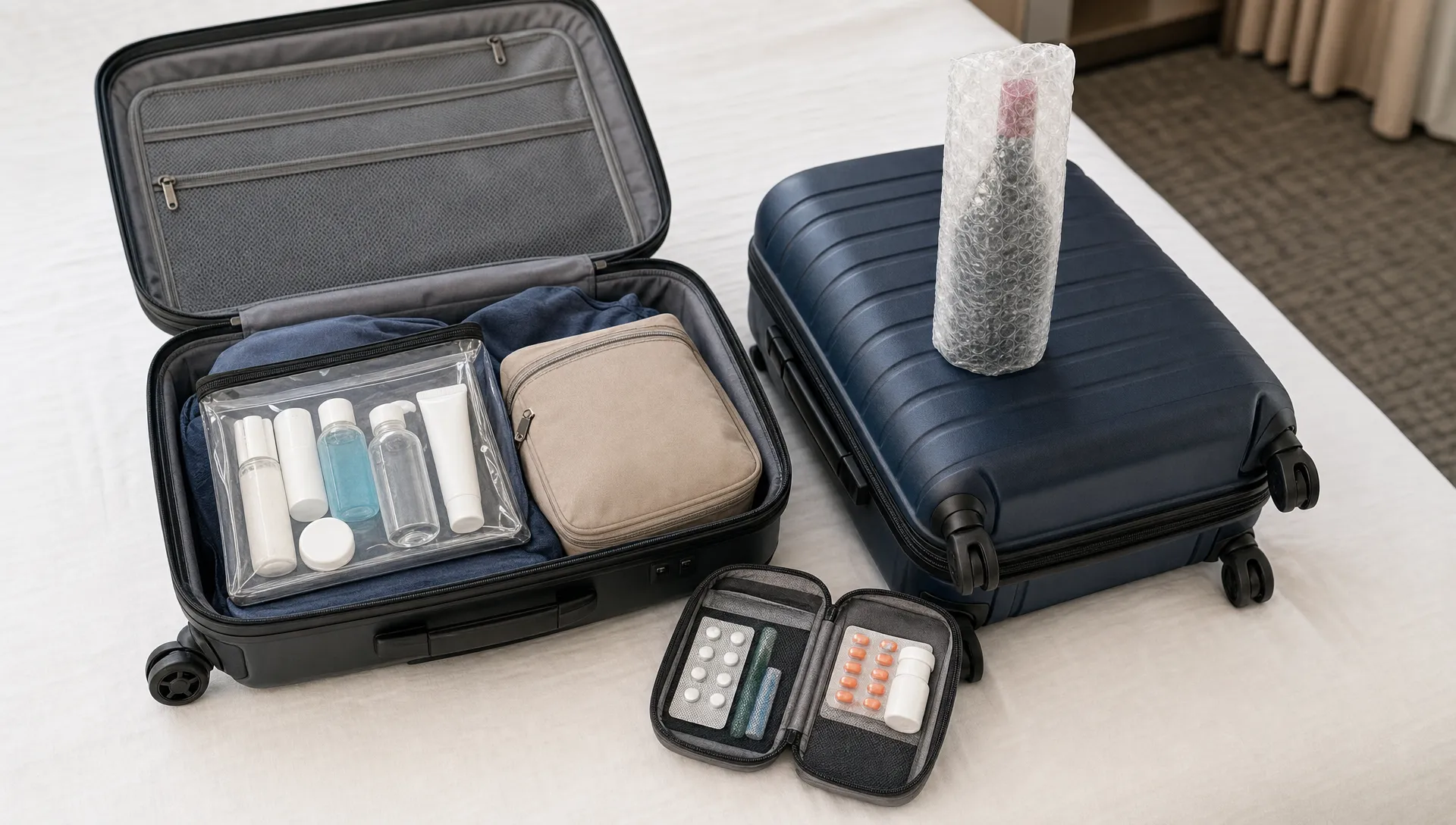
If losing the item would ruin your trip, do not gamble. Put nonessential full-size liquids in checked baggage or buy them after arrival. Keep essential medicines and care items accessible, separated from regular toiletries and ready for inspection.
Size labels: milliliters, ounces and misleading bottles
The standard cabin size is often written as 100 ml or 3.4 fl oz. Those are treated as equivalent for travel purposes, even though 100 ml is slightly less than 3.4 U.S. fluid ounces.
Problems usually come from bottles labeled 4 oz, 125 ml or 150 ml. Those are too large for the standard 100 ml rule. Security officers look at the container capacity printed on the packaging, not the amount left inside.
| Label on container | Safer assumption at a 100 ml checkpoint |
|---|---|
| 30 ml / 1 fl oz | Usually fine if it fits in the liquids bag |
| 50 ml | Usually fine if it fits in the liquids bag |
| 100 ml / 3.4 fl oz | Standard travel-size limit |
| 118 ml / 4 fl oz | Too large for the standard rule |
| 150 ml | Too large for the standard rule |
| No visible size label | Risky, especially if the container looks larger than 100 ml |
Refillable travel bottles are useful, but choose ones with clearly printed capacities. A plain silicone bottle with no marking may create unnecessary debate at screening. If you use your own bottles, label them clearly and keep them genuinely within the stated size.
The same logic applies to jars and cosmetic pots. A 120 ml face cream jar is not made acceptable by being half empty. A small 15 ml or 30 ml pot is much safer for cabin packing.
Bigger liquid allowances: when 2 L does not mean everywhere
Some travelers now see airport rules mentioning larger cabin liquid allowances, including 2 L limits at certain locations. These rules usually depend on security equipment and local policy. They are not a universal replacement for the 100 ml rule.
The most common mistake is assuming a relaxed rule applies to the whole trip. It may apply only to one airport, one terminal or one direction of travel. If a later checkpoint uses the standard 100 ml rule, your larger bottle can still be confiscated during a transfer or on the return journey.
This is why route-based checking is more reliable than memory. If you are flying through multiple airports, use a tool or official airport guidance to compare each checkpoint. Liquid Limits explains this route-first approach in its guide to packing cabin bag liquids for every airport on your route.
When you are not sure which rule applies, the safer decision is to pack cabin liquids in 100 ml containers and put larger items in checked baggage.
Duty-free liquids and connections
Duty-free purchases can be an exception, but they are not a free pass on every route. Many airports allow larger duty-free liquids if they are sealed in an official tamper-evident bag with the receipt visible. You should not open that bag before your final security checkpoint.
Connections are the risk point. If you must pass through security again, the next airport’s rules apply. Some transfer checkpoints accept sealed duty-free bags from approved sources. Others may inspect them or refuse them if the seal is broken, the receipt is missing or the route does not meet local requirements.
If you are buying perfume, spirits, cosmetics or specialty foods in the airport, ask whether your connection airport accepts sealed duty-free liquids. For expensive items, it is better to verify before purchase than to argue at a transfer checkpoint.
Customs rules are separate. Even if security allows the bottle on board, your destination may have limits on alcohol, food products or other imports.
A quick preflight routine for liquids and flying
Before you zip the suitcase, run through the journey in the order you will experience it. This prevents most liquid problems without making packing complicated.
- Map every checkpoint where your cabin bag may be screened, including departure, transfers and the return airport.
- Check each airport’s current liquid rule, not just the airline’s baggage page.
- Pack cabin liquids to the strictest checkpoint on the route.
- Move full-size toiletries, sauces and gifts to checked baggage when they are not needed in flight.
- Keep medicines, baby items and special dietary liquids separate and easy to show.
- Leave space in the liquids bag instead of forcing extra tubes into an overfilled pouch.
- Bring an empty water bottle and fill it after security if permitted.
This routine is especially helpful for families, long-haul trips, cruises, multi-city itineraries and travelers bringing cosmetics or specialty food gifts. The more checkpoints in the trip, the more valuable it is to plan for the strictest one.
Frequently Asked Questions
Can I bring a half-empty 200 ml bottle through airport security? Not under the standard 100 ml rule. Security usually judges the printed capacity of the container, not the amount of liquid left inside.
Do all liquids need to fit in one plastic bag? At many standard checkpoints, yes. Rules vary by airport, especially where newer scanners are used, but one clear resealable bag is still the safest default when you are unsure.
Are medicines limited to 100 ml when flying? Many airports allow medically necessary liquids above the normal limit, but they may need separate screening. Keep them accessible and bring documentation when the airport or airline recommends it.
Can I take baby formula or breast milk over 100 ml? Many security systems allow reasonable quantities for babies and young children, subject to screening. Check the airport rule before travel and keep these items separate from regular toiletries.
Can I bring a drink bought after security onto the plane? Usually yes for that flight, but connections can complicate things. If you will be screened again, the next checkpoint may apply its own liquid rule.
Should I follow the departure airport or return airport liquid rule? Follow the strictest checkpoint you will pass through with your cabin bag. For round trips, check both directions before packing.
Check liquids before flying, not at the checkpoint
Liquid rules are manageable when you know which checkpoint, bag and size apply to your trip. The safest approach is to verify the route, pack cabin liquids to the strictest rule and keep exceptions easy to inspect.
Liquid Limits helps travelers check airport liquid rules before they pack, including route checks, item-specific guidance, daily updates, source links and last-checked dates. When a rule is unclear, it defaults to the stricter 100 ml cabin standard so you can avoid preventable surprises at security.