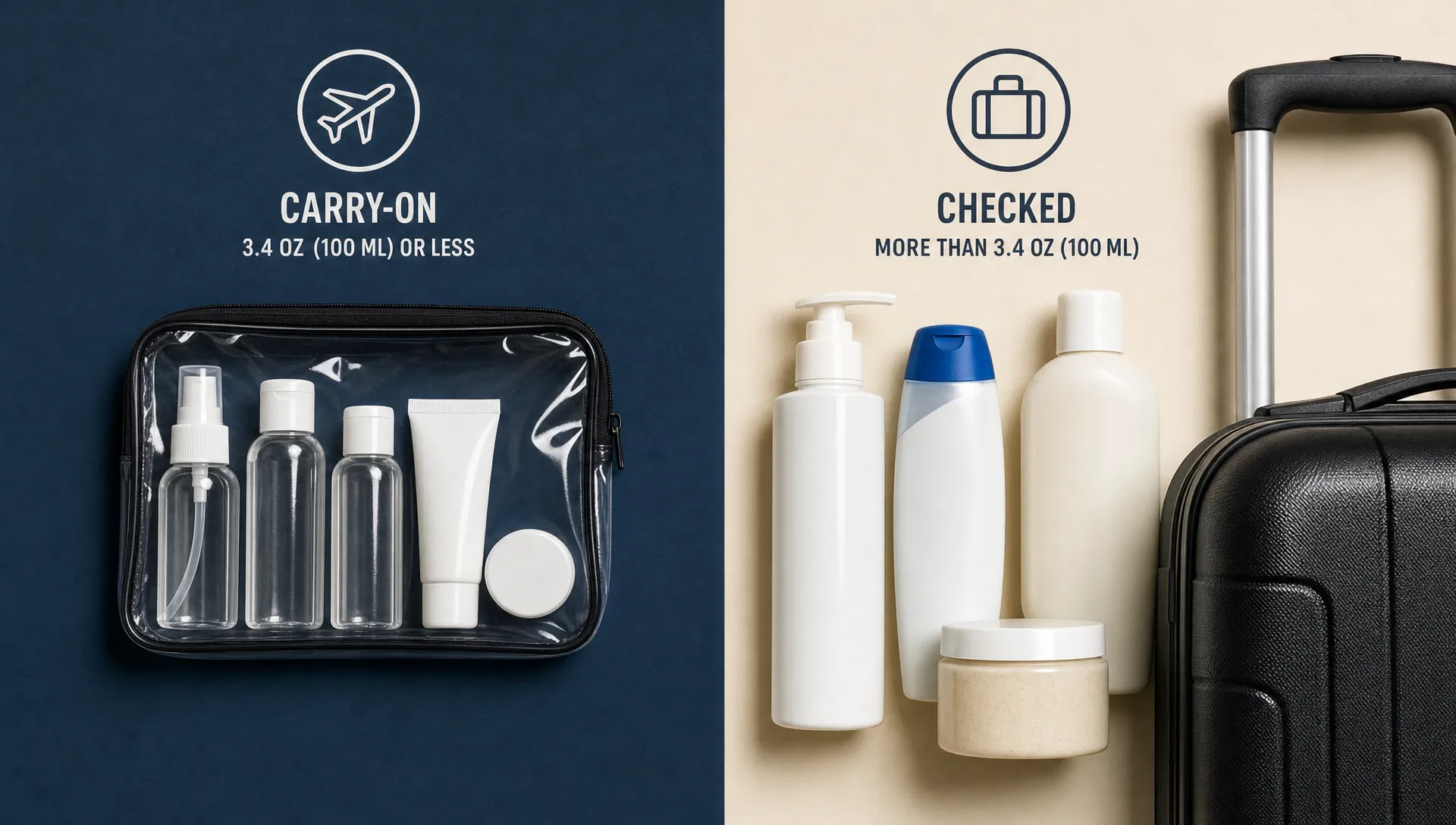
Packing liquids for a UK flight can feel simple until you realise there are two different rulebooks: one for cabin luggage and one for checked luggage. The familiar 100ml rule is a security screening rule for liquids you take through the airport checkpoint in your hand luggage. It does not apply in the same way to liquids packed in your checked bag, although checked luggage still has important safety and airline restrictions.
The easiest way to think about it is this: small, essential liquids belong in your cabin bag, larger everyday toiletries usually belong in checked luggage, and anything flammable, pressurised, alcoholic, or unusual needs a closer check before you pack.
Quick answer: cabin vs checked liquids in the UK
For most UK departures, liquids in cabin bags must follow the standard 100ml container rule unless the airport has clearly published a different current rule. Checked bags are not screened under the same 100ml cabin liquid limit, but dangerous goods rules still apply.
| Luggage type | Main UK liquid rule | Best for | Main caution |
|---|---|---|---|
| Cabin luggage | Containers must usually be 100ml or less and fit in one clear resealable liquid bag | Medicines, baby supplies, small toiletries, essentials during the flight | Larger containers are usually not allowed through security, even if partly empty |
| Checked luggage | The 100ml cabin security rule does not normally apply | Full-size shampoo, conditioner, body wash, sunscreen, non-restricted cosmetics | Aerosols, alcohol, flammable liquids, and some chemicals may be limited or banned |
| Duty-free liquids | Usually allowed if sealed in a security tamper-evident bag with proof of purchase | Perfume, alcohol, cosmetics bought after security | Connections and return airports may apply different checks |
| Route with a return flight | Rules may differ at the airport you fly back from | Round trips and multi-airport itineraries | Follow the strictest airport security rule on the route when unsure |
The UK government’s official hand luggage restrictions on liquids remain the best primary reference for cabin bag screening rules. For route-specific planning, it is also sensible to check your departure airport, return airport, and airline close to travel.
What counts as a liquid in UK luggage?
Airport security uses a broad definition of liquids. It is not limited to water, drinks, or shampoo. Many items that feel solid, creamy, spreadable, squeezable, or gel-like may be treated as liquids at the cabin baggage checkpoint.
Common examples include:
- Drinks, including water, juice, and soft drinks
- Shampoo, conditioner, shower gel, and body lotion
- Perfume, aftershave, and liquid deodorant
- Toothpaste, gels, creams, pastes, and balms
- Mascara, lip gloss, foundation, and liquid makeup
- Hair gel, styling cream, and shaving foam
- Aerosols, including deodorant sprays and hairspray
- Soups, sauces, jams, honey, and other spreadable foods
This broad definition matters most for cabin luggage. A jar of honey, a tube of toothpaste, and a bottle of moisturiser may all be treated the same way at security. If it is in your hand luggage and behaves like a liquid, cream, gel, paste, foam, or aerosol, assume the cabin liquids rule applies.
UK cabin luggage liquids rules
When flying from a UK airport, the standard cabin rule is that liquids must be in containers of 100ml or less. These containers must usually fit inside a single transparent, resealable plastic bag with a capacity of about one litre. The bag must close properly, and each passenger normally gets one bag.
The container size is what counts, not the amount left inside. A 200ml bottle with only 50ml of shampoo remaining can still be refused because the container itself is over 100ml.
For cabin bags, remember these core rules:
- Use containers of 100ml or less.
- Put liquid containers inside one clear resealable plastic bag.
- Make sure the bag can close without forcing it.
- Remove the liquids bag at security if asked.
- Keep essential medicines and baby supplies accessible for inspection.
Some airports in the UK and abroad have been introducing newer screening equipment, but rules can change and may not be consistent across your full journey. If you want a deeper cabin-only breakdown, Liquid Limits has a dedicated guide to UK flight liquids rules for cabin bags.
Exemptions for medicines, baby food, and special dietary needs
There are important exemptions for essential medical and care items. You can usually carry liquids over 100ml in cabin luggage if they are needed for medical reasons, special dietary requirements, or baby care during the journey. These items may need to be screened separately, and airport staff may ask for supporting evidence for medicines.
Examples may include liquid medicines, prescribed creams, insulin-related supplies, baby milk, sterilised water, baby food, and specialist dietary liquids. You should only carry what is reasonably needed for the trip, and you should keep these items easy to remove at security.
If you are travelling with prescription liquids, keep them in their original packaging where possible. Carry a prescription, doctor’s letter, or pharmacy label if the item could raise questions at security, especially if it is over 100ml.
UK checked luggage liquids rules
Checked luggage, also called hold luggage, is different. The airport cabin liquid bag rule does not normally apply to liquids packed in a suitcase that you check in before security. That means full-size toiletries such as shampoo, conditioner, body wash, sunscreen, and moisturiser are usually better placed in checked luggage if you do not need them during the flight.
However, checked luggage is not a free-for-all. Airlines and aviation safety rules restrict dangerous goods. Some liquids are banned because they are flammable, corrosive, toxic, explosive, or otherwise unsafe on an aircraft. Others are allowed only in limited quantities.
| Item type | Cabin luggage | Checked luggage | Notes |
|---|---|---|---|
| Shampoo, conditioner, shower gel | Usually 100ml or less in the liquids bag | Usually allowed in larger containers | Pack tightly to prevent leaks |
| Toothpaste and creams | Usually 100ml or less in the liquids bag | Usually allowed in larger containers | Counts as a liquid or paste for cabin screening |
| Perfume and aftershave | Usually 100ml or less in the liquids bag | Usually allowed, subject to airline and dangerous goods limits | Often flammable, so avoid large quantities |
| Aerosol deodorant or hairspray | Usually 100ml or less in the liquids bag | Often allowed in limited personal-use quantities | Caps should be fitted to prevent accidental release |
| Alcohol under 24 percent ABV | Subject to cabin liquid rules unless bought after security | Usually allowed, subject to airline baggage rules | Weight and customs rules may still matter |
| Alcohol 24 to 70 percent ABV | Subject to cabin liquid rules unless bought after security | Commonly limited to 5 litres per person in retail packaging | Airline rules may be stricter |
| Alcohol over 70 percent ABV | Generally not allowed | Generally not allowed | Treated as too flammable for air travel |
| Paint, fuel, solvents, lighter fluid | Generally not allowed | Generally not allowed | Do not pack unless your airline explicitly confirms it is permitted |
For personal care aerosols and similar regulated items, aviation rules often limit the total quantity a passenger can carry. A common limit is 2kg or 2L total for certain toiletry and medicinal articles, with each individual item no more than 0.5kg or 0.5L. Airlines can be stricter, so check before packing large quantities of sprays, perfumes, or medicinal liquids.
Should you put liquids in cabin or checked luggage?
The best choice depends on whether you need the liquid during the journey, whether it is allowed through security, and how much you are carrying.
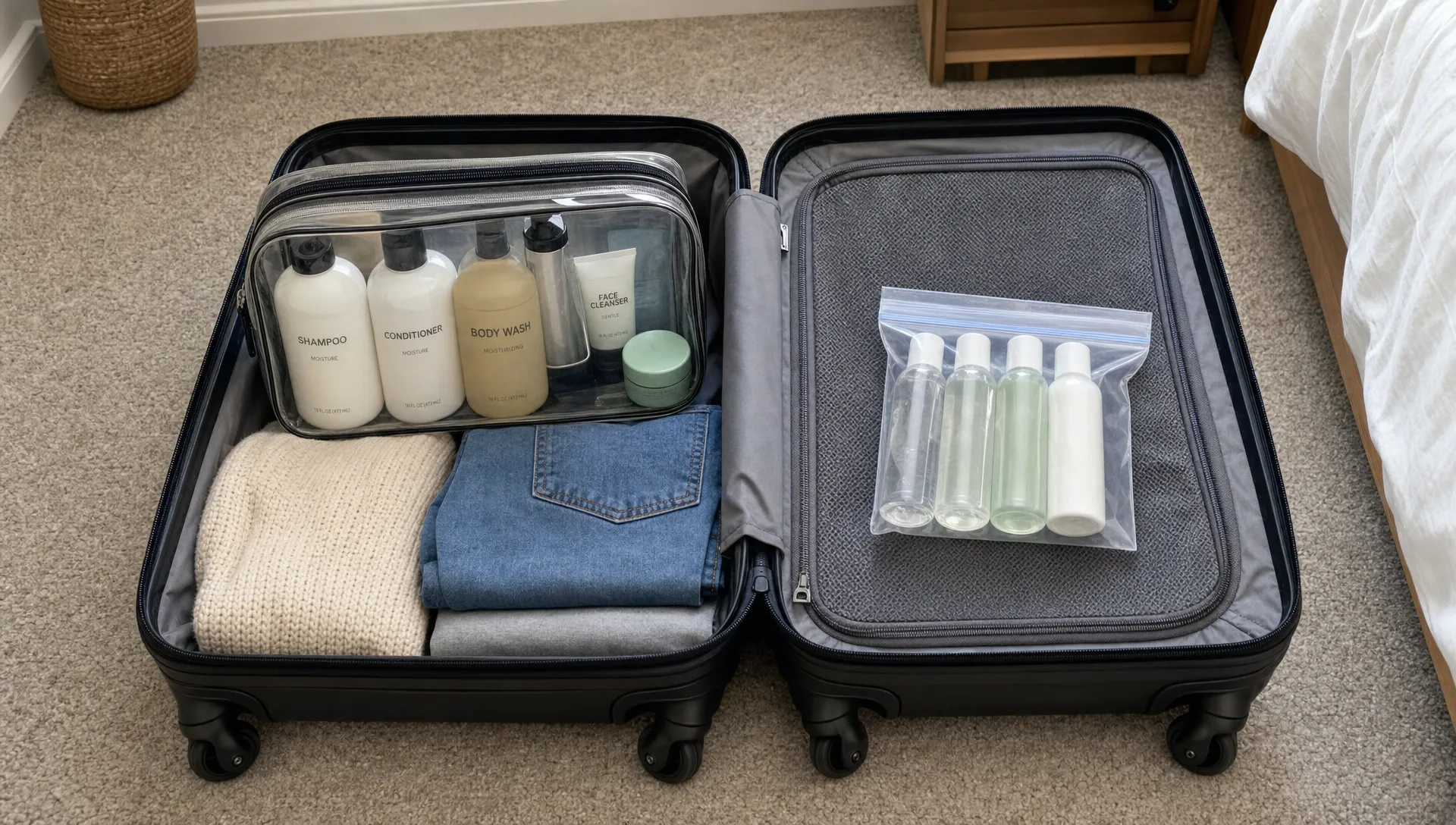
Put liquids in cabin luggage when the item is essential during travel. This includes medication, contact lens solution, baby supplies, hand sanitiser in a compliant container, a small toothpaste, or a small moisturiser. Keep the items within the 100ml cabin rule unless they qualify for an exemption.
Put liquids in checked luggage when the container is larger than 100ml and the item is an ordinary travel product. Full-size toiletries, sunscreen for a beach trip, hair products, and non-restricted cosmetics are usually easier to pack in the hold.
Do not pack a liquid in either bag if it is a banned dangerous good. Examples can include fuel, strong solvents, some paints, some chemicals, and very high-strength alcohol. If the label has strong flammable, corrosive, toxic, or explosive warnings, check your airline before packing it.
What about duty-free liquids?
Duty-free liquids bought after airport security are handled differently from liquids you bring from home. Perfume, alcohol, cosmetics, and other liquids purchased in the secure area are usually placed in a sealed security tamper-evident bag, often called a STEB, with a receipt inside.
Keep the bag sealed until you reach your final destination. If you open it before a connection, the liquid may be treated like any other cabin liquid at the next security checkpoint. This is especially important on multi-leg trips where you change airports or pass through security again.
Duty-free rules can also depend on where you bought the item, where you are connecting, and where you are flying next. If your route includes a return journey, do not assume the same duty-free process applies in both directions.
Why return flights matter for liquids in luggage
Many travellers check only the rules at their UK departure airport, then get caught out on the way home. Your return airport may use different screening equipment, follow different local rules, or apply the 100ml limit more strictly.
For example, you might fly out of the UK with neatly packed 100ml toiletries, buy a larger skincare product abroad, then try to bring it back in your cabin bag. If the return airport applies the 100ml rule, that item may need to go in checked luggage or be surrendered at security.
This is why round-trip planning matters. Liquid Limits lets you check rules by airport, item, and route, including return flights. If you want to understand the route issue in more detail, see the guide to rules for liquids on flights and return trips.
Practical packing tips for UK travellers
A little preparation prevents most liquid-related airport problems. The goal is to separate what you need in the cabin from what can safely travel in the hold.
Use a small clear liquids bag for cabin essentials and test it before travel. If it does not close, remove non-essential items and put them in checked luggage. Do not rely on airport staff accepting an overfilled bag.
For checked luggage, prevent leaks by tightening caps, adding tape around lids, and placing bottles in a sealed wash bag or reusable plastic pouch. Pressure changes and baggage handling can cause bottles to leak, especially if they are already partly open.
If you are packing alcohol, check the alcohol percentage and quantity. Bottles between 24 and 70 percent ABV are not the same as ordinary toiletries and are usually subject to stricter limits. Anything over 70 percent ABV should not be packed for air travel.
Before you travel, use a route-specific check rather than relying on memory. Liquid rules can vary by airport, country, scanner setup, item type, and connection. A quick check is especially useful if you are carrying medicines, baby supplies, aerosols, alcohol, duty-free liquids, or expensive toiletries.
Common mistakes to avoid
One of the most common mistakes is packing a large container in cabin luggage because it is nearly empty. Security checks the labelled container capacity, so a 150ml tube is still too large even if there is only a small amount left.
Another mistake is assuming checked luggage has no limits. While the 100ml cabin rule does not apply to checked luggage, dangerous goods restrictions still matter. This is especially true for aerosols, strong alcohol, fuel-based products, solvents, and specialist chemicals.
Travellers also forget about connections. If you collect bags and go through security again, or if your duty-free liquids are inspected at a transfer point, the rules at that airport matter too. The safest approach is to keep cabin liquids compliant for every security checkpoint on the route.
Finally, many people check rules too early. Airport liquid rules have changed several times as screening technology has developed. Always recheck close to your travel date, especially if you are flying from or through an airport that has recently changed its security process.
Frequently Asked Questions
Can I put full-size shampoo in checked luggage on a UK flight? Yes, ordinary full-size shampoo is usually allowed in checked luggage because the 100ml cabin liquid rule does not normally apply to hold bags. Pack it in a sealed bag to prevent leaks.
Can I take a 200ml bottle in cabin luggage if it is half empty? No, not under the standard UK cabin rule. The container must usually be 100ml or less, regardless of how much liquid is left inside.
Are aerosols allowed in checked luggage? Many personal care aerosols, such as deodorant or hairspray, are often allowed in limited quantities, but caps must be fitted and airline rules may apply. Large quantities or non-toiletry aerosols can be restricted or banned.
Do UK liquid rules apply to domestic flights? Yes, cabin liquid security rules generally apply at the airport security checkpoint whether your flight is domestic or international. Checked baggage allowances may still depend on the airline.
Can I carry liquid medicine over 100ml in my cabin bag? Usually yes, if it is essential for your journey and you can provide supporting evidence if asked. Keep it accessible because it may need separate screening.
Do checked liquids count toward my baggage weight allowance? Yes. Even when a liquid is allowed in checked luggage, it still counts toward your airline’s weight and size allowance for checked bags.
Check your UK liquid rules before you pack
If you are unsure whether an item belongs in cabin or checked luggage, check before you leave for the airport. Liquid Limits helps travellers compare airport, item, and route rules, including return flights where restrictions may differ.
Use it to check the strictest liquid rule for your trip, see source links and last-checked dates, and avoid relying on outdated assumptions. When a rule is unclear, Liquid Limits defaults to the stricter 100ml guidance so you can pack with fewer surprises at security.