
Packing cabin bags is easy until you reach the bathroom shelf. Is toothpaste a liquid? Can mascara stay in your purse? What about a half-empty 200ml shampoo bottle, airport-bought perfume, or baby milk?
Here is the short version: for most flights, liquids on a plane must be in containers of 100ml / 3.4oz or less and fit inside your clear liquids bag. Some airports with newer scanners may allow larger containers, but the safest rule for a whole trip, especially with connections or a return flight, is still the strictest airport rule on your route.
This guide focuses on what you can pack in cabin bags, what usually needs to go in checked baggage, and how to avoid having items taken at security.
The quick rule for liquids on a plane
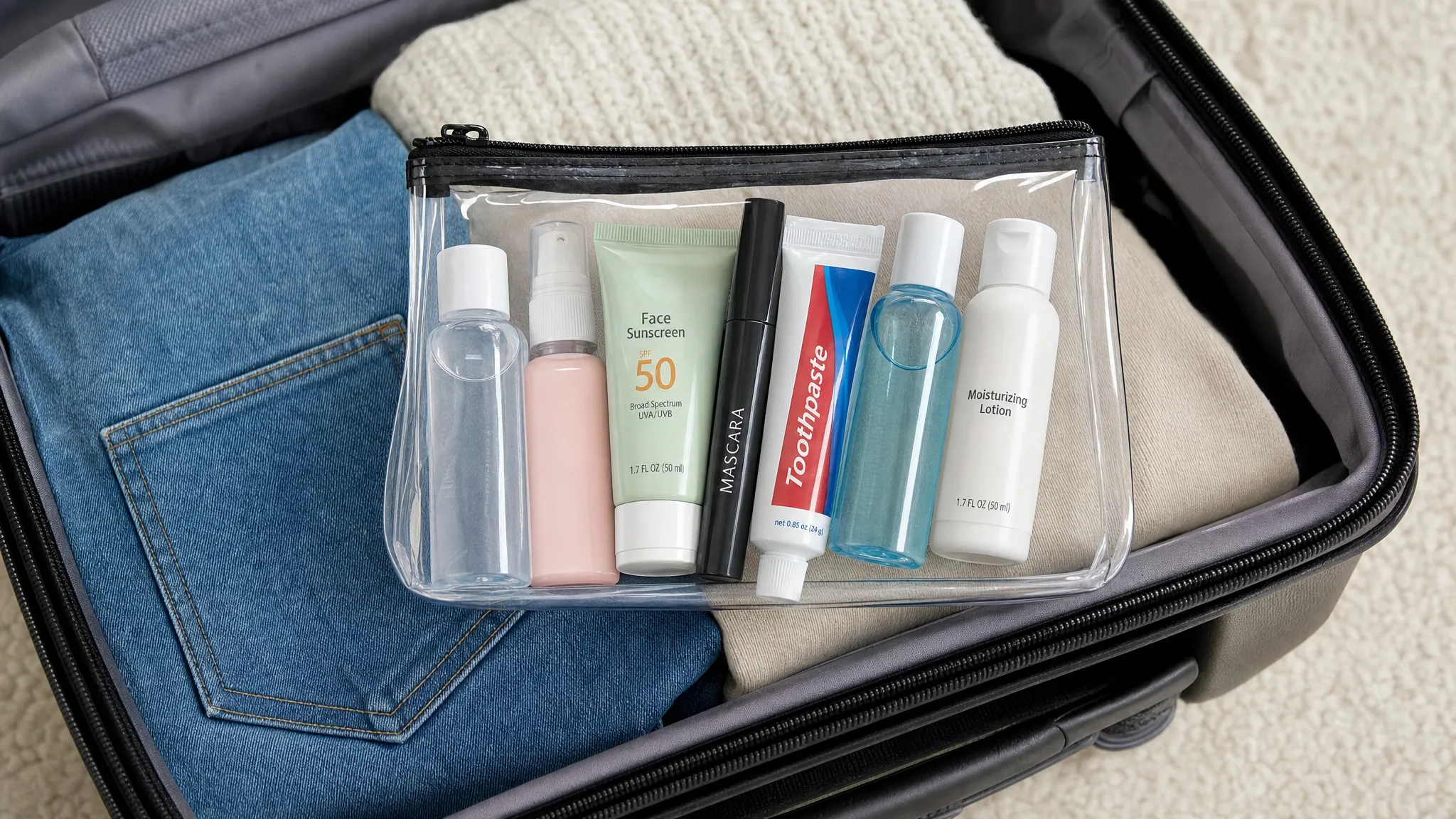
In many airports, cabin liquids follow the familiar 100ml rule. In the United States, the TSA calls this the 3-1-1 liquids rule: each liquid, aerosol, gel, cream, or paste must be in a container of 3.4oz / 100ml or less, and all containers must fit in one quart-sized clear bag.
Rules outside the U.S. are similar in many places. For example, the UK government’s hand luggage restrictions also treat liquids, gels, pastes, creams, and aerosols as restricted items in cabin bags.
The most important details are:
- The limit applies to the container size, not how much product is left inside.
- A 200ml bottle that is half full is still treated as a 200ml bottle.
- “Liquid” includes more than water, shampoo, and drinks.
- Checked baggage usually allows larger toiletries and liquids, except dangerous or prohibited substances.
- Exceptions may apply for medicine, baby food, baby milk, and special dietary needs.
If you want the simplest packing decision, use this default: if it can be poured, sprayed, spread, squeezed, smeared, or scooped, assume it belongs in your liquids bag unless you have confirmed otherwise.
What counts as a liquid in cabin baggage?
Airport security uses “liquid” as a broad category. Many items that feel solid at home still count as liquids, gels, creams, pastes, or aerosols at screening.
| Item type | Common examples | Cabin bag rule in most airports |
|---|---|---|
| Liquids | Water, perfume, mouthwash, toner | 100ml / 3.4oz container limit |
| Gels | Hair gel, aloe gel, gel deodorant | 100ml / 3.4oz container limit |
| Creams | Moisturizer, sunscreen, cream foundation | 100ml / 3.4oz container limit |
| Pastes | Toothpaste, peanut butter, some cosmetics | 100ml / 3.4oz container limit |
| Aerosols | Spray deodorant, hairspray, shaving foam | 100ml / 3.4oz container limit in cabin bags |
| Semi-liquid foods | Soup, salsa, yogurt, dips, sauces | 100ml / 3.4oz container limit |
| Solids | Bar soap, solid deodorant, powder makeup | Usually not part of the liquids bag |
This is why travelers often lose items that seem harmless, such as a large toothpaste tube, a jar of peanut butter, or a full-size bottle of sunscreen. They are not banned because of what they are. They are restricted because of their form and container size.
Toiletries you can pack in cabin bags
Most everyday toiletries are allowed in cabin baggage if they meet the liquid limit. That includes travel-size bottles of shampoo, conditioner, body wash, face wash, moisturizer, sunscreen, perfume, aftershave, mouthwash, and shaving foam.
The easiest way to pack toiletries is to use clearly marked travel containers of 100ml / 3.4oz or less. Do not rely on guessing. If the bottle has no visible size marking, airport staff may reject it.
Solid alternatives can also save space in your liquids bag. Bar soap, solid shampoo, solid conditioner, toothpaste tablets, and solid stick deodorant are usually treated as solids. Deodorant is a common point of confusion: stick deodorant is typically fine outside the liquids bag, while spray, gel, and roll-on versions usually count as liquids. For a more detailed breakdown, see the guide to taking deodorant on a plane.
A practical toiletry setup for a short trip might include travel-size toothpaste, moisturizer, sunscreen, deodorant, contact lens solution, and one small fragrance. For longer trips, consider packing full-size liquids in checked baggage or buying bulky products after arrival.
Makeup and cosmetics: what goes in the liquids bag?
Makeup rules depend on texture. Powder products are usually easier to pack than creams and liquids. Liquid foundation, primer, setting spray, lip gloss, mascara, cream blush, gel eyeliner, and nail polish normally count as liquids, gels, or creams.
Mascara is one of the most common examples. Even though the tube is small, it is still treated as a liquid or gel, so it should go in your liquids bag. The good news is that standard mascara tubes are usually well below 100ml. You can check the item-specific guidance for mascara in cabin bags if you want a clear yes-or-no answer before packing.
Foundation depends on the formula. Liquid and cream foundation generally count toward your liquids allowance, while powder foundation usually does not. If you use both, pack the liquid product in your clear bag and keep the powder compact separately. Liquid Limits also has a specific guide on foundation liquid and powder rules for travelers who want to avoid last-minute repacking at security.
As a rule of thumb, put any cosmetic that squeezes, pumps, rolls on, sprays, or has a wet applicator into your liquids bag.
Food and drinks in cabin bags
Drinks are the easiest category to understand: you usually cannot take a full bottle of water, juice, soda, coffee, or smoothie through security if it is over 100ml / 3.4oz. However, you can usually take an empty refillable bottle through security and fill it afterward.
Food is more nuanced. Solid food is often allowed in cabin bags, but wet, creamy, spreadable, or saucy food may be treated as a liquid. That can include soup, yogurt, honey, jam, salsa, hummus, soft cheese, gravy, and sauces.
This can surprise travelers bringing souvenirs or snacks. A sealed jar of sauce may look like a grocery item, but security may still treat it like a liquid. If it is over 100ml, pack it in checked baggage, buy it after security, or choose a solid alternative.
There are also customs and biosecurity rules to consider when entering another country. Even if a food item passes airport security, it may not be allowed at your destination. This is especially important for meat, dairy, fresh fruit, seeds, and homemade foods.
Medicines, baby supplies, and special dietary needs
Many airports allow exceptions for essential medicines, baby milk, baby food, and special dietary liquids. These items may be permitted in quantities over 100ml, but they often need extra screening.
For medicine, keep the product in its original packaging when possible and carry documentation if you have it, especially for prescription liquids, injectable medication, or medical equipment. The TSA’s guidance on medications and medical screening explains that medically necessary liquids can be allowed in larger amounts, but travelers should declare them for inspection.
For babies and young children, breast milk, formula, baby food, and cooling accessories may be treated differently from ordinary liquids. Rules vary by airport and country, so check your departure airport before flying. It is also wise to allow extra time at security because these items may be tested separately.
Special dietary liquids, such as medically required nutrition drinks, may also qualify for an exception. Do not assume every protein shake or meal replacement will be accepted over the limit, though. The exception is strongest when the item is medically necessary or required during the journey.
Duty-free liquids: when larger bottles are allowed
Duty-free liquids can be allowed in cabin baggage even when they are over 100ml, but only under specific conditions. Typically, they must be sealed in a tamper-evident security bag with proof of purchase, and the bag should remain sealed until you reach your final destination.
The biggest risk is a connecting flight. A bottle of duty-free perfume or liquor bought after security at your first airport may still need to pass screening at your connection. If the airport or country does not accept the sealed duty-free bag, the item may be confiscated.
If you have a connection, especially an international one, check the rule for every airport on your route. Do not assume that buying after security solves the problem for the whole journey.
Why some airports allow 2L liquids and others still use 100ml
Some airports have introduced newer cabin baggage screening technology that can screen liquids without the older 100ml restrictions. At certain airports or lanes, passengers may be allowed to keep liquids and electronics inside their bags, and larger liquid containers may be accepted.
The problem is inconsistency. Scanner rollout is not global, rules can change, and an airport may have different equipment in different terminals or security lanes. Your outbound airport might allow larger liquids, while your return airport, transfer airport, or destination security checkpoint may still enforce the 100ml rule.
That is why the safest packing approach is route-based, not airport-based. Before you pack, check the strictest liquid rule across your whole trip. Liquid Limits is built for exactly this situation: you can check airport liquid rules for your trip and compare the 100ml and larger-liquid possibilities side by side, including the return flight.
Cabin liquids packing checklist
Use this checklist before closing your cabin bag:
- Check the container size printed on each bottle, tube, or aerosol.
- Move anything over 100ml / 3.4oz to checked baggage unless your route clearly allows more.
- Put liquids, gels, creams, pastes, aerosols, and wet cosmetics in a clear resealable bag.
- Keep medicines, baby liquids, and special dietary items separate and easy to declare.
- Pack an empty water bottle, not a full one, before security.
- Leave sealed duty-free liquids sealed if you have a connection.
- Check the return airport and any transfer airport, not just your departure airport.
If you are choosing between two versions of the same item, pick the solid one when possible. Solid sunscreen sticks, bar soap, powder makeup, and stick deodorant can reduce pressure on your liquids bag.
Common mistakes that get liquids taken at security
The most common mistake is packing a full-size container with only a small amount left inside. Security officers look at the container capacity, not the remaining contents. A 250ml shampoo bottle with 50ml left is still too large for the standard cabin liquid rule.
Another common mistake is forgetting that “natural” or “food” items can still count as liquids. Honey, sauces, dips, soup, nut butter, and soft spreads may be restricted in the same way as toiletries.
Travelers also get caught by return flights. You might leave from an airport with newer scanners, buy full-size toiletries abroad, then return through an airport that still requires 100ml containers. If you do not have checked baggage, those items may not make it home.
Finally, do not rely on old screenshots, viral travel tips, or rules from a different country. Liquid rules are changing as airports adopt new technology, but they are not changing everywhere at the same time.
Frequently Asked Questions
Can I bring water on a plane in my cabin bag? You can usually bring an empty water bottle through security and fill it afterward. A full bottle over 100ml / 3.4oz is usually not allowed through security unless a specific exception applies.
Does the 100ml rule apply if the bottle is half empty? Yes. The rule applies to the container size. A half-empty 200ml bottle is still not allowed under the standard 100ml cabin liquid rule.
Can I bring perfume in cabin baggage? Yes, if the perfume bottle is 100ml / 3.4oz or smaller and fits in your liquids bag. Larger perfume bottles should go in checked baggage or be bought duty-free under the applicable sealed-bag rules.
Is toothpaste considered a liquid on a plane? Toothpaste is usually treated as a paste, which falls under the liquids rule for cabin bags. Use a travel-size tube of 100ml / 3.4oz or less.
Can I take medicine over 100ml in my cabin bag? Often, yes, if it is medically necessary, but it may need to be declared and screened separately. Keep medicine accessible and bring supporting documentation when possible.
What if my airport says it allows 2L liquids? Check the whole route before relying on that rule. Your return airport, transfer airport, or another security checkpoint may still enforce 100ml limits.
Before you pack, check the strictest rule for your route
The best cabin liquids plan is not just “100ml or 2L.” It is knowing which rule applies to every airport on your journey.
Before your next flight, use Liquid Limits to check airport, item, and route-specific liquid rules, including your return trip. When rules are unclear, pack to the stricter 100ml standard so your toiletries, cosmetics, food, and souvenirs have the best chance of making it through security.