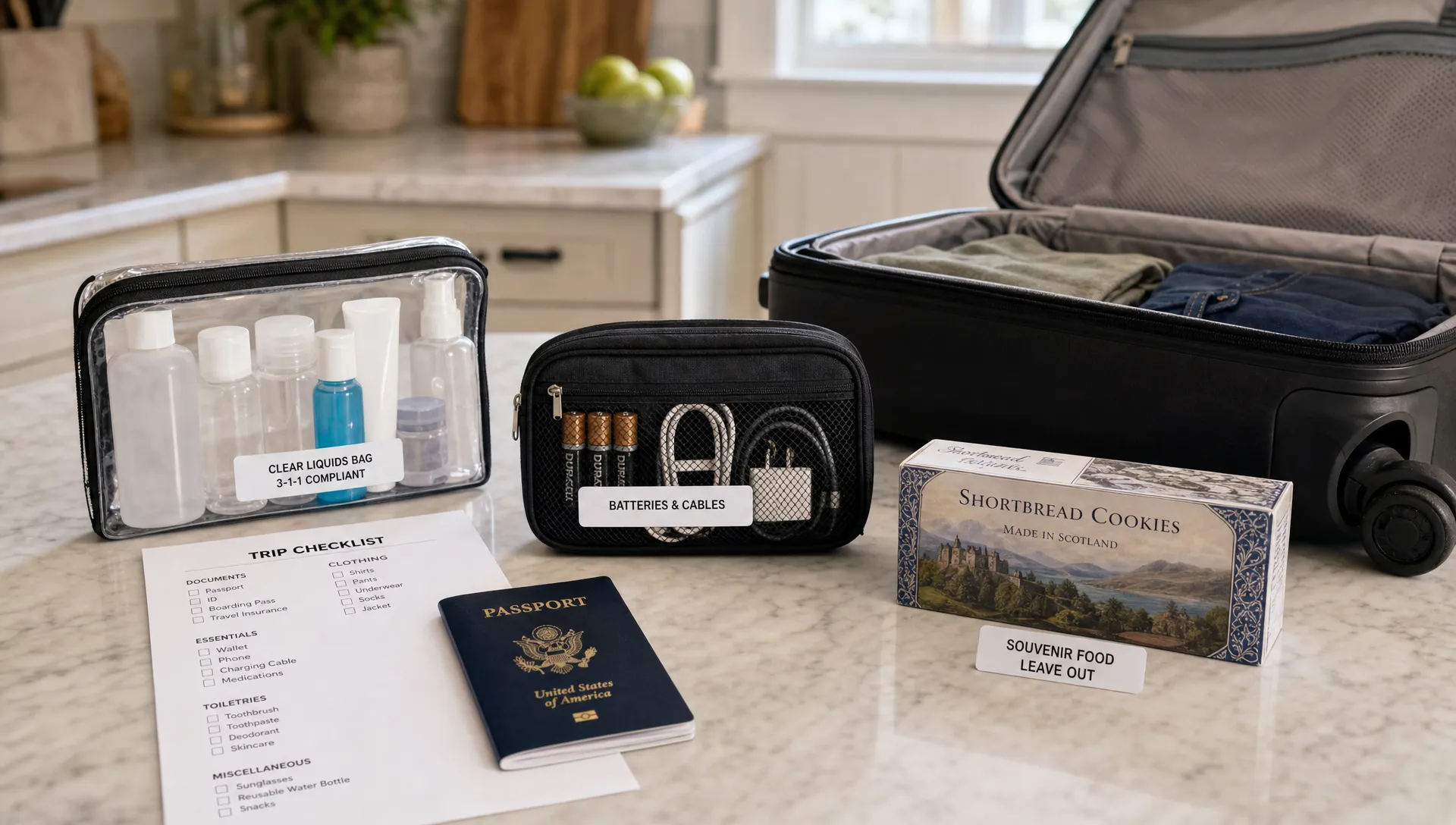
The hardest part of packing for a flight is not fitting everything into the bag. It is knowing which everyday items become a problem once they meet airport security, airline safety rules, customs controls, and the rules at your return airport.
Most travelers remember the obvious basics: no large bottles of shampoo in the cabin, no knives in a backpack, no oversized suitcase at the gate. The mistakes that cause delays are usually less dramatic. A half-used jar of peanut butter. A power bank packed in checked luggage. A souvenir snow globe. A full-size sunscreen bought on vacation, then carried through a stricter return airport.
If you want the practical version of the rules on what you can take on a plane, start with one idea: your item is not judged by one rule. It is judged by several rule layers at once.
The rule that matters most: your bag has to pass every checkpoint
A flight itinerary can involve multiple rulebooks. Airport security decides what can enter the secure area. The airline decides what can fly safely in the cabin or hold. Aviation safety rules restrict batteries, aerosols, fuel, and pressure-sensitive items. Customs and agriculture rules can affect food, plants, alcohol, animal products, and expensive purchases when you cross borders.
That is why a product can be legal to own, legal to buy, and still not be practical to pack in your cabin bag. It is also why the same item can be fine on one trip and inconvenient on another.
For a deeper breakdown of those layers, Liquid Limits has a useful guide to airport rules that affect what you can pack. The key takeaway is simple: pack for the strictest airport and the strictest segment of your route, not just the airport where your trip begins.
This matters even more in 2026 because scanner technology and liquid policies are not consistent everywhere. Some airports have modern screening equipment and may allow more flexibility. Others still enforce the familiar 100ml container rule. If your journey includes a connection or a return flight from a different airport, the more relaxed rule at one airport may not help you later.
Liquids, gels, creams, and pastes: the container matters, not the amount left
The cabin liquid rule trips up travelers because it feels logical to judge what is inside the bottle. Security usually judges the container.
If a 200ml bottle of face wash is almost empty, it can still be refused at a checkpoint that applies the 100ml rule. The problem is not the remaining liquid. The problem is that the container is larger than allowed.
Common items treated as liquids, gels, creams, pastes, or aerosols include shampoo, conditioner, toothpaste, mascara, lip gloss, liquid foundation, moisturizer, sunscreen, shaving foam, perfume, deodorant spray, hair gel, hand sanitizer, honey, jam, and many spreadable foods. Premium skincare and toiletries count too, whether they are pharmacy basics or natural marine cosmetics such as the face and body care products from Passion Marine.
For cabin bags, the safest default is still to pack containers of 100ml or less in a clear, resealable liquids bag unless you have verified that every airport on your route allows something different. If you are carrying larger toiletries, place them in checked baggage when possible.
There are common exceptions for medically necessary liquids, baby milk, baby food, and special dietary items, but exceptions do not mean “pack casually.” Keep them separate, bring supporting documentation when relevant, and allow extra screening time.
If you want to understand how airports apply liquid limits in practice, Liquid Limits explains the basics in its guide to flight liquid rules for smarter packing.
Batteries and power banks: cabin bag, not checked bag
Lithium batteries are one of the most important packing rules because they are a safety issue, not just a security preference. Power banks, spare camera batteries, loose rechargeable batteries, and many e-cigarette batteries usually belong in your carry-on bag, not your checked suitcase.
The reason is fire risk. If a battery overheats in the cabin, crew can respond quickly. If it overheats in the cargo hold, it is harder to detect and manage.
Most travelers should also check the watt-hour rating on larger power banks. Many common portable chargers fall under standard limits, but high-capacity models can require airline approval or may be prohibited. If the rating is missing, security or airline staff may reject it because they cannot verify whether it is safe to fly.
Smart luggage adds another wrinkle. If your suitcase has a removable lithium battery, airlines may require you to remove it before checking the bag. If the battery cannot be removed, the bag may not be accepted.
Aerosols are not all treated the same
Aerosols sit at the intersection of liquid rules and pressure or flammability rules. A travel-size deodorant spray may be fine in a cabin liquids bag. A large aerosol paint can is a different story.
Toiletry aerosols, such as deodorant, shaving foam, dry shampoo, and hair spray, are often allowed in limited quantities, subject to liquid rules in cabin baggage and airline limits in checked baggage. Industrial, flammable, or chemical aerosols can be restricted or banned.
The label matters. If an aerosol is marked flammable, corrosive, toxic, or hazardous, do not assume it can fly. This is especially relevant for camping products, automotive sprays, cleaning products, and hobby materials.
| Item type | Why it causes problems | Safer packing choice |
|---|---|---|
| Travel-size deodorant spray | Counts as both aerosol and liquid | Cabin liquids bag if 100ml or less, or checked bag if allowed |
| Full-size dry shampoo | Often exceeds cabin liquid limits | Checked bag, subject to airline aerosol limits |
| Spray paint | Flammable and not a toiletry | Usually do not pack for air travel |
| Insect repellent aerosol | Can be flammable or chemical-restricted | Check label and airline rules before packing |
| Oxygen canisters or compressed gas | Pressure and safety risk | Only carry if explicitly permitted under applicable rules |
Food and souvenirs: solid is easier than spreadable
Food feels harmless, but airport security often treats texture as the deciding factor. Solid snacks are usually easier to carry than anything spreadable, pourable, squeezable, or semi-liquid.
A sandwich is usually straightforward. A jar of salsa, a tub of hummus, a bottle of maple syrup, a soft cheese, or a jar of jam can be treated like a liquid or gel in cabin baggage. If the container exceeds the cabin liquid limit, it can be refused even if it is sealed and bought as a gift.
Customs and agriculture rules are separate. Even if security allows a food item onto the plane, your destination may restrict meat, dairy, fruit, seeds, plants, or fresh produce. This is why international travelers should be especially careful with local food gifts.
Souvenirs can be just as confusing. Snow globes, perfume bottles, olive oil, sauces, cosmetics, and bath products may all trigger liquid rules. Sharp decorative items, tools, corkscrews with blades, and sports souvenirs can also be refused from cabin bags.
Medicines, medical devices, and baby essentials need extra organization
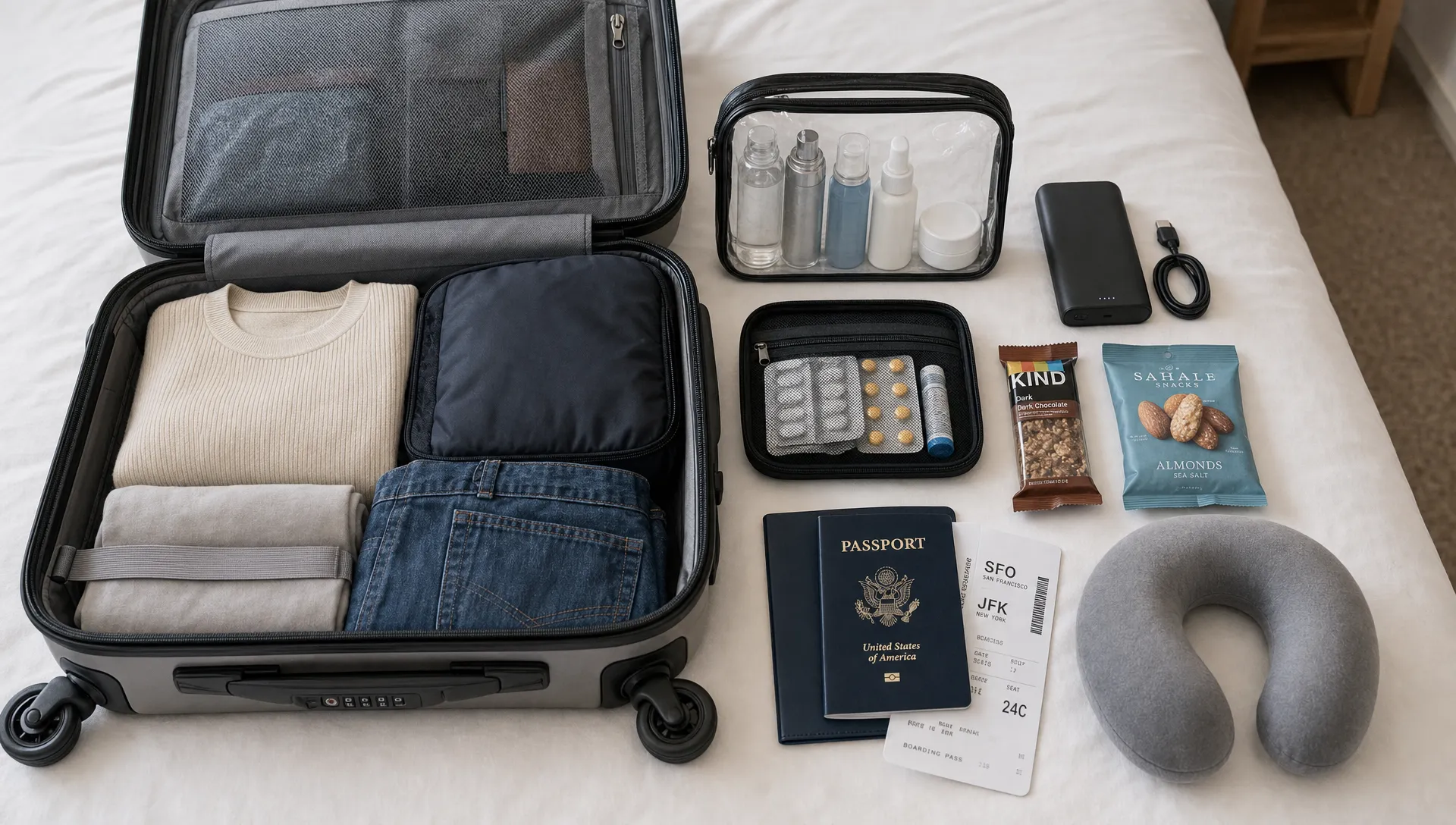
Important medical and baby items are usually treated differently from ordinary toiletries, but organization matters. Security staff need to identify the item quickly and understand why it is being carried.
Keep prescription medicines in original packaging when possible, especially for international travel. Carry a copy of the prescription or a doctor’s note for controlled medications, injectables, liquid medicines, and equipment that may look unusual on an X-ray.
Liquid medicines can often exceed the standard cabin liquid size limit when they are necessary for the trip, but they may need separate screening. The same is true for baby formula, breast milk, baby food, and medically required nutrition.
Do not bury these items at the bottom of your bag. Pack them so you can remove them easily at security. If you use a medical device with batteries, check both the device rules and the battery rules before travel.
Sharp items, tools, and sports equipment: size is not the only issue
Many travelers think only knives are a problem. In practice, the category is broader. Scissors, multitools, corkscrews, screwdrivers, razors, knitting tools, tent pegs, darts, climbing gear, and sports equipment can all raise questions.
Small grooming items may be allowed in some places, but blade type and length matter. A disposable razor may be treated differently from a loose razor blade. Small scissors may be accepted under one rule set and rejected under another. Multitools are especially risky because one hidden blade can make the whole item unsuitable for cabin baggage.
Sports gear is another common surprise. Baseball bats, golf clubs, hockey sticks, ski poles, martial arts equipment, and similar items are generally not cabin-friendly because they can be used as blunt instruments. Even if they fit in the overhead bin, that does not mean they are permitted.
When in doubt, pack sharp items and sports gear in checked baggage, provided the airline accepts them and they are legal at your destination.
Checked baggage is not a “no rules” zone
Checked luggage gives you more freedom for liquids and sharp items, but it has its own restrictions. The biggest mistake is assuming anything rejected from the cabin can simply go in the hold.
Power banks and spare lithium batteries are the classic example. They are often not allowed in checked bags because of fire risk. Fuel, lighter fluid, camping gas, fireworks, many chemicals, and some high-proof alcohol products can also be prohibited.
Alcohol rules deserve attention. Many travelers bring wine, spirits, or local bottles home from a trip. Lower-strength alcohol is generally easier to pack, while strong spirits can be limited by volume and alcohol percentage. Very high-proof alcohol may be banned entirely. Bottles also need to be protected from breakage, and customs limits may apply when you land.
Checked baggage also introduces airline weight and size limits. An item might be allowed by security but still cost extra or be refused if it exceeds the airline’s baggage policy.
The return flight trap: what you buy abroad may not come home in your cabin bag
Outbound packing is only half the story. The return flight is where many travelers get caught.
You may leave home with a compliant toiletry kit, then buy a full-size sunscreen, perfume, hair product, sauce, or skincare item during the trip. If you do not have checked baggage on the return flight, that item may be impossible to bring through a 100ml checkpoint.
Duty-free purchases can help in some cases, especially when they are sealed in a security tamper-evident bag with proof of purchase. But duty-free rules can become complicated when you connect through another airport. A sealed bag accepted at one checkpoint may need to be screened again later.
This is why round trips deserve their own packing plan. If your return airport has stricter liquid screening than your departure airport, pack as if the stricter rule applies from the start. Liquid Limits explains this in more detail in its guide to rules for liquids on flights and return trips.
A simple packing system that prevents most airport problems
You do not need to memorize every rule in every country. You need a repeatable system that catches the problem items before you leave home.
Use this quick pre-flight check before closing your bag:
- Put all cabin liquids, creams, gels, pastes, and aerosols in containers that match the strictest liquid rule on your route.
- Move full-size toiletries, sauces, wines, and other large liquids to checked baggage when allowed.
- Keep power banks, spare lithium batteries, e-cigarettes, and battery packs in your carry-on, with terminals protected.
- Remove sharp tools, multitools, sports gear, and questionable souvenirs from your cabin bag.
- Keep medication, baby items, and medical liquids accessible for separate screening.
- Check food, plant, meat, dairy, and alcohol rules before crossing borders.
- Verify your return airport rules before buying liquids or gifts during the trip.
The best packing decision is often not “Can I bring this?” but “Where should I pack this so it survives every airport, airline, and border check on my itinerary?”
For liquids specifically, the easiest way to reduce guesswork is to check your airport, item, and route before you pack. Liquid Limits helps travelers compare liquid rules for the whole trip, including the return flight, with source links and last-checked dates.
Frequently Asked Questions
What are the most important plane packing rules to know? The most important rules involve cabin liquids, lithium batteries, sharp items, aerosols, medicines, food, and airline baggage limits. You should also check customs rules if you are traveling internationally.
Can I bring full-size toiletries on a plane? Full-size toiletries are usually not allowed in cabin baggage at airports that enforce the 100ml container rule. They may be allowed in checked baggage, subject to airline and hazardous materials restrictions.
Where should I pack my power bank? Power banks and spare lithium batteries should usually be packed in carry-on baggage, not checked luggage. Check the watt-hour rating and your airline’s policy for high-capacity models.
Does the 100ml liquid rule apply on the return flight too? It can. Your return airport may have different screening rules from your departure airport. If one airport on your route applies the 100ml rule, packing to that stricter standard is the safest approach.
Are solid foods allowed in cabin bags? Many solid foods are easier to bring through security than liquids, gels, or spreads. However, customs and agriculture rules may restrict certain foods when you enter another country.
What should I do if I am not sure whether an item is allowed? Check the rule for the specific airport, airline, item, and route. If the answer is unclear, pack conservatively, choose a smaller container, or place the item in checked baggage if it is safe and permitted there.
Pack for the strictest rule, not the easiest one
Plane packing rules are not there to make travel complicated, but they do reward preparation. A few minutes of checking can save you from losing expensive toiletries, surrendering souvenirs, repacking at security, or missing a connection.
Before your next trip, check the items that are most likely to cause friction: liquids, aerosols, batteries, foods, medicines, and return-flight purchases. If a rule is unclear, assume the stricter version applies until you can verify otherwise. That one habit will make your carry-on lighter, your security experience smoother, and your trip much less stressful.