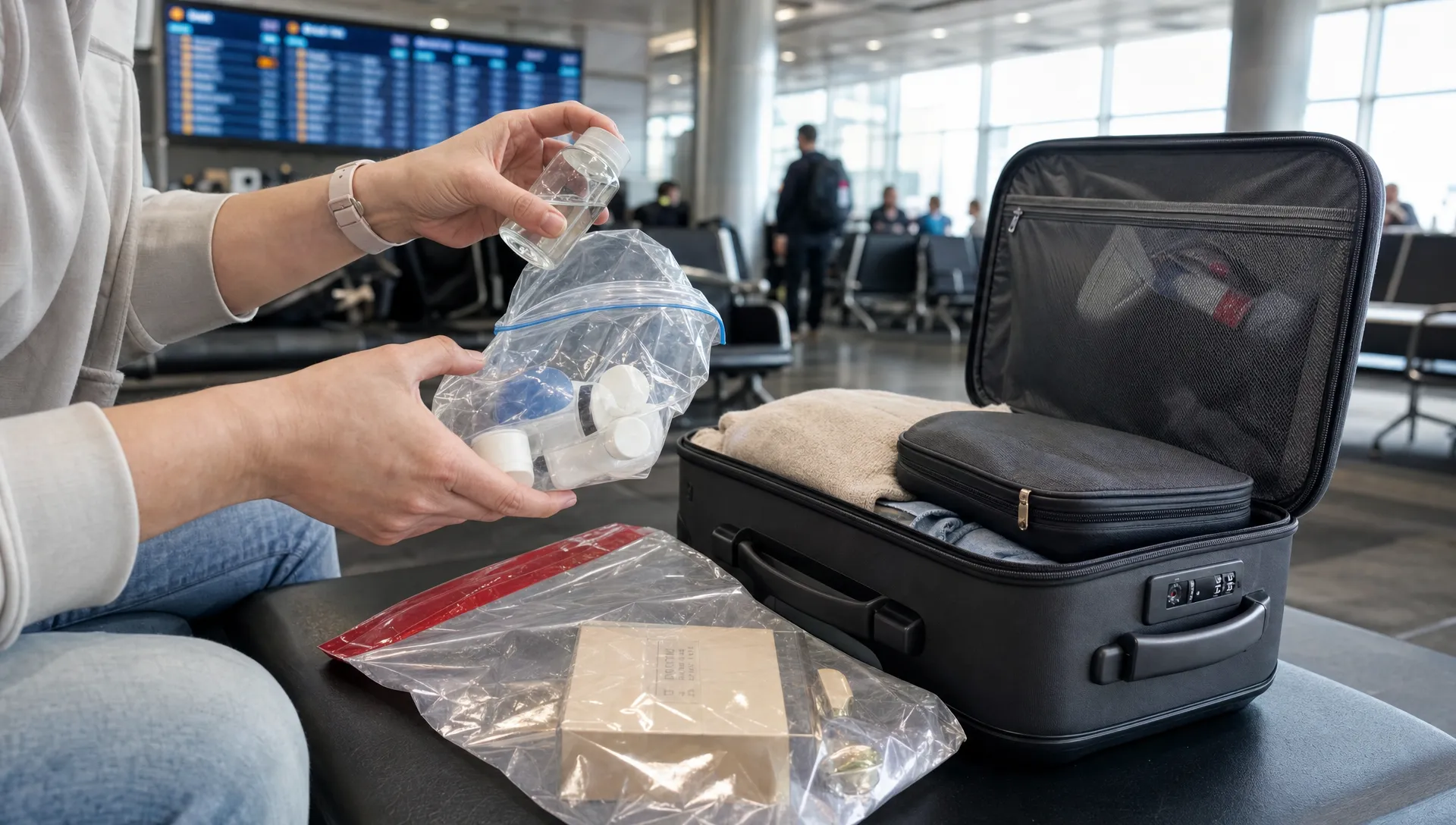
The rules about flying with liquids get more complicated when your trip includes an international connection. A bottle that was allowed at your departure airport can become a problem at a transfer checkpoint, especially if you change terminals, pass through customs or leave the secure transit area before boarding the next flight.
For most travelers, the safest starting point is simple: pack cabin liquids as if every security checkpoint on your route will apply the 100ml rule. That means each liquid, aerosol, gel, cream or paste should be in a container of 100ml or less and packed in the required clear bag where that rule applies. Some airports now allow larger containers in specific lanes or terminals, but you should not rely on that unless the airport currently confirms it for your exact route.
International connections also create a timing problem. You may buy water, perfume or cosmetics after the first security check, then face another screening before your next flight. That second checkpoint does not usually care where the item was purchased unless it qualifies for a recognized duty-free security bag process.
The core rules about flying with liquids at international connections
At an international connection, the key question is not only “What does my airline allow?” It is “Will I pass through security again before boarding the next flight?” Airport security rules are enforced by the departure or transfer airport, not by the country where your journey began.
This is why a route can feel inconsistent. Your first airport may allow a larger bottle because it uses newer screening equipment, then your connecting airport may still require every cabin liquid to be in a 100ml container. If your return trip connects somewhere else, the rule can change again.
| Connection situation | What it usually means for liquids |
|---|---|
| You stay airside and do not pass transfer security | Liquids bought after the first screening may be allowed, subject to gate checks and local rules |
| You pass through transfer security | Cabin liquids are screened again under that airport's rules |
| You collect checked bags and recheck them | You normally go through security again before the next flight |
| You enter the country during the connection | Treat the next flight like a new departure |
| You change airports in the same city | You will almost certainly be screened again |
If you want a route-specific check before packing, use Liquid Limits to compare airport liquid rules for your trip. It is especially useful for round trips because the strictest airport may be on your way home, not on your outbound journey.
Why the strictest checkpoint controls what you should pack
For international travelers, the rules about flying with liquids are practical rather than theoretical. You do not need to predict every possible exception if you pack to the strictest confirmed checkpoint on your itinerary.
The 100ml rule is still the most common baseline for cabin baggage. Under the TSA liquids rule, for example, liquids, gels and aerosols in carry-on bags are limited to containers of 3.4 ounces or 100ml, with those containers placed in a quart-sized bag. Other countries use similar limits, often with a 1-liter resealable bag.
The strictest-checkpoint approach matters because security officers assess the item in front of them at that checkpoint. A half-empty 200ml shampoo bottle can still fail because the container capacity is over 100ml. A sealed drink bought before security can fail at the next screening. A cream, spread or paste may be treated as a liquid even if you think of it as food or makeup.
For a broader overview of the basic carry-on limits, the guide to liquid restrictions when flying explains the standard categories and common exceptions.
What counts as a liquid during a transfer screening
Transfer screening does not only apply to obvious liquids like water, lotion or perfume. Many airport rules include aerosols, gels, creams, pastes and substances with a similar consistency. That can include toothpaste, mascara, sunscreen, deodorant gel, peanut butter, honey, jam, snow globes and some cosmetics.
Food can be especially confusing at international connections. Solid snacks are usually easier to carry, but soft cheese, yogurt, soup, sauces and spreads may be restricted in cabin baggage. If you bought them after the first security check, they can still be refused if you meet another checkpoint.
Medicine, baby milk, infant food and special dietary items often have exemptions, but exemptions do not mean “no screening.” You may need to separate these items, show them to security staff and carry only a reasonable amount for the journey. Rules vary by country, so check the departure and transfer airports rather than relying on a single national rule.
Duty-free liquids are the biggest connection trap
Duty-free is where the rules about flying with liquids catch many international passengers. Buying perfume, liquor or skincare after security does not automatically protect the item through every later checkpoint.
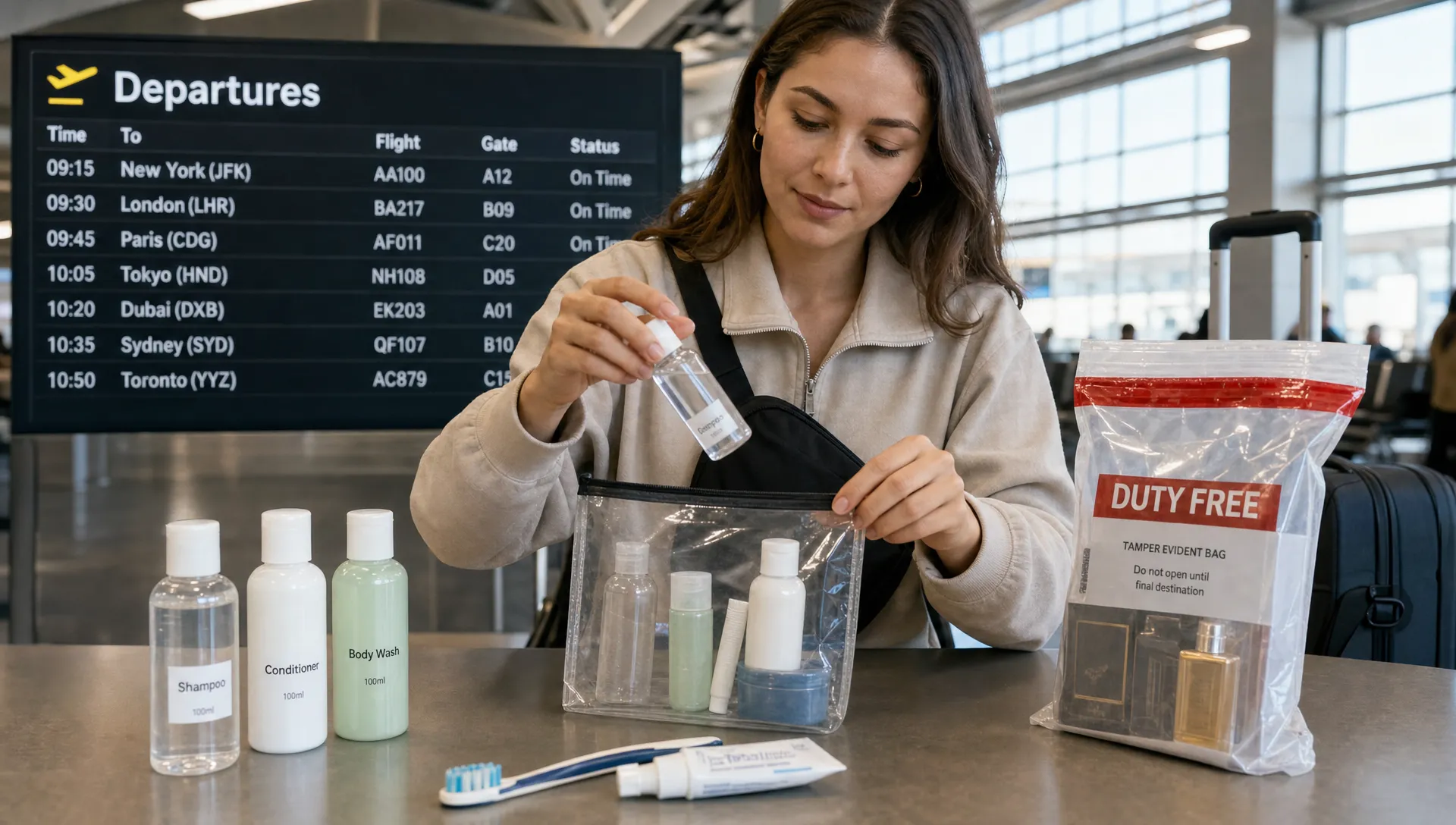
Many airports recognize duty-free liquids if they are packed in a sealed, tamper-evident security bag with proof of purchase. The bag should usually remain sealed until after your final security screening. If you open it during the trip, place other items inside it or lose the receipt, the next checkpoint may treat the bottle like any other oversized liquid.
The TSA guidance on duty-free liquids explains that some duty-free liquids over 100ml may be permitted in carry-on baggage when they are in a secure, tamper-evident bag and can be screened. That does not guarantee acceptance everywhere. Some transfer airports, routes or screening technologies may apply stricter handling.
A good rule is to buy duty-free liquids only when you know your remaining route. If you still have an international connection, ask the shop whether the item will be packed in an approved sealed bag and whether it is suitable for transfer through your connecting airport.
Checked baggage, rechecking and customs can change the answer
A connection that requires you to collect checked baggage can actually make liquid planning easier if you know it is coming. Once you collect your bag, you may be able to move larger liquids from your cabin bag into checked baggage before rechecking it, as long as airline and dangerous goods rules allow the item.
This often comes up when entering a country before a domestic onward flight. For example, many international arrivals involve immigration, baggage claim, customs and then a new security screening for the next flight. At that point, cabin liquids must meet the rules of the airport where you are re-departing.
Be careful with alcohol, aerosols and flammable products. Even in checked baggage, airlines and aviation safety rules can limit quantities or prohibit certain items. Everyday toiletries are usually less problematic than fuel, solvents, strong chemicals or high-proof alcohol, but the exact allowance depends on the item.
If your connection is tight, do not plan on repacking at the last minute. Reclaiming bags, passing customs and rechecking luggage can take longer than expected. Put oversized liquids in checked baggage from the start unless you have a confirmed reason to keep them in the cabin.
Common international connection scenarios
At transfer points, the rules about flying with liquids interact with immigration, customs and airport layout. Two passengers on the same airline can face different liquid checks if one stays airside and the other changes terminals through the public area.
| Scenario | Practical liquid advice |
|---|---|
| International to domestic after entering a country | Expect a new security check and pack cabin liquids to the local limit |
| International to international in the same secure terminal | You may avoid rescreening, but check the transfer airport before relying on it |
| Terminal change requiring landside access | Treat the next flight as a fresh departure |
| Separate tickets with baggage recheck | Expect to pass security again and follow the connecting airport rule |
| Duty-free purchase before another connection | Keep it sealed in the security bag with the receipt visible |
The biggest mistake is assuming “I already cleared security” applies to the entire journey. It only applies until your route, airport process or border formalities put you in front of another checkpoint.
If your itinerary includes several airports, the guide on taking liquids on flights with a connection is a useful companion for understanding when rescreening is likely.
How to pack liquids for an international connection
The best packing strategy is boring, which is exactly why it works. Keep your cabin liquids small, visible and easy to remove. Put anything larger in checked baggage unless you need it during the flight or it qualifies for a specific exemption.
Use this pre-flight checklist before an international itinerary with a connection:
- Pack standard toiletries in containers of 100ml or less.
- Use a clear resealable liquids bag where required by the airport.
- Keep medicine, baby food and special dietary liquids separate for inspection.
- Do not assume a 2L airport rule applies at your transfer airport.
- Leave duty-free liquids sealed in the tamper-evident bag.
- Keep the receipt for duty-free purchases until your final destination.
- Check the outbound route and the return route separately.
When an airport does not publish a clear policy, the safest interpretation of the rules about flying with liquids is the 100ml limit. Liquid Limits follows that conservative approach when rules are unclear because it is better to pack smaller than to lose an item at transfer security.
What to check before you buy liquids on a layover
Before buying a bottle during a layover, look at what still stands between you and your destination. If you have no more security checks, the purchase may be straightforward. If you still need to change terminals, enter a country, recheck baggage or board another international flight through transfer screening, think twice.
Ask three questions at the shop or transfer desk: Will this be sealed in a recognized security bag? Will I receive a dated receipt inside or attached to the bag? Is this accepted for passengers connecting through my next airport? Staff may not know every rule, but their answer can reveal whether the airport regularly handles transfer passengers with that type of purchase.
If the item is expensive or hard to replace, delay the purchase until your final airport or buy it in checked baggage before departure. For gifts like perfume, spirits, oils or cosmetics, the safest plan is often to buy after the last security checkpoint of the trip.
Frequently Asked Questions
What are the rules about flying with liquids if I have an international connection? Plan for every security checkpoint on your route. If you pass through transfer security, your cabin liquids must meet that airport's current rule, even if the items were allowed earlier in the journey.
Can I take a water bottle bought after security onto my connecting flight? Sometimes, but not if you face another security screening that applies the 100ml rule. Empty reusable bottles are easier because you can refill them after your final screening.
Are duty-free liquids always allowed through international connections? No. They are more likely to be accepted if sealed in a tamper-evident security bag with proof of purchase, but acceptance still depends on the transfer airport, screening process and local rules.
Do liquid rules apply to checked baggage? The 100ml cabin liquid rule does not apply to checked baggage, but checked bags still have safety restrictions for items such as aerosols, alcohol, chemicals and flammable products.
Should I check liquid rules for my return flight too? Yes. Return flights often use different airports and different transfer points. The strictest liquid rule on your trip may apply on the way home.
Check your whole route before you pack
International connections are easier when you treat liquid rules as route-specific, not airline-specific. Check the departure airport, every transfer airport and the return journey before deciding what goes in your cabin bag.
With Liquid Limits, you can compare airport rules side by side, review source links and see last-checked guidance for your trip. If a rule is unclear, pack to the stricter 100ml standard so your liquids are less likely to become a connection-day problem.