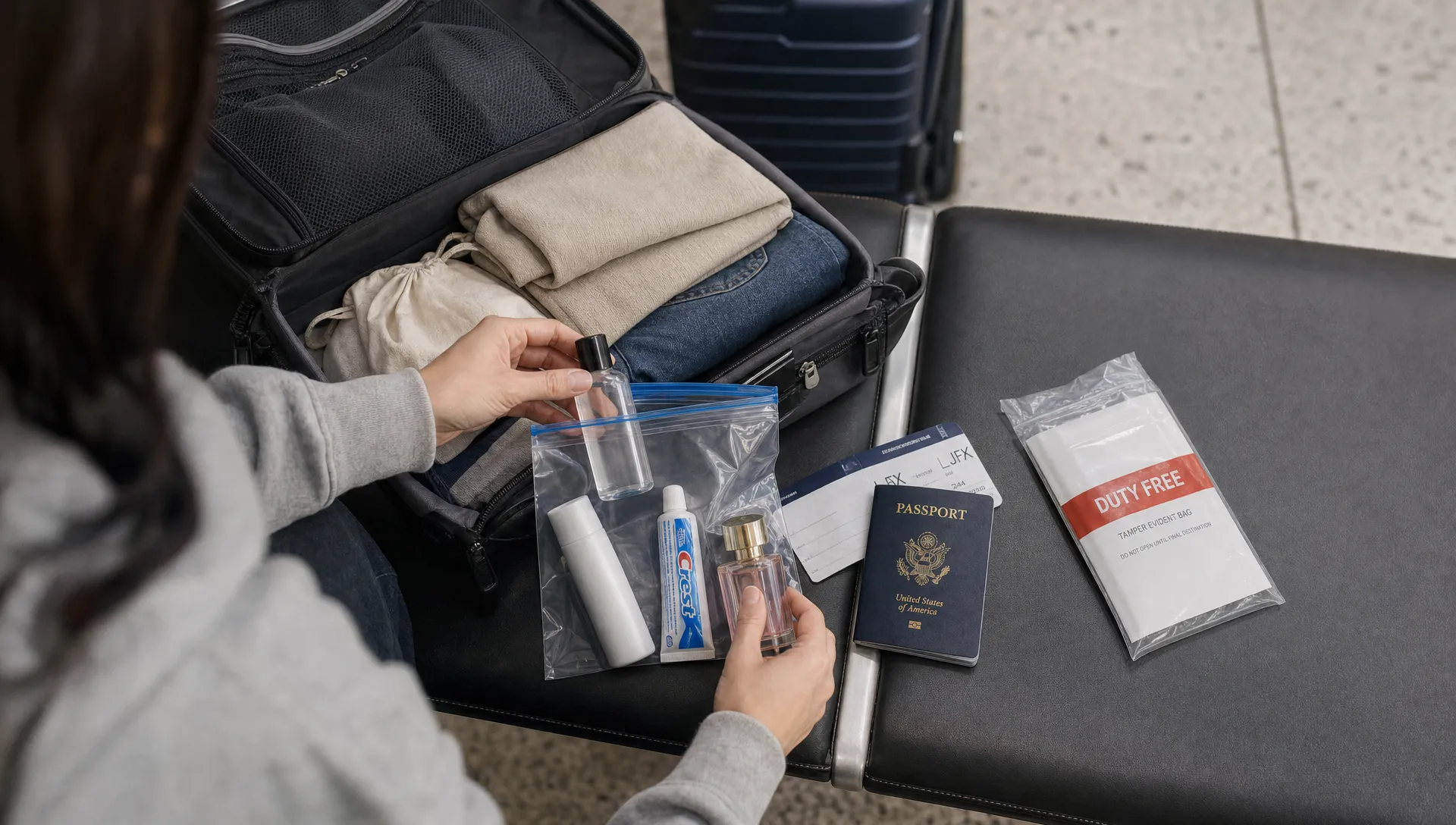
If you are taking liquids on flights with a connection, the rule that matters is not always the rule at your first airport. A layover can add another security checkpoint, a terminal change, immigration, customs or a bag recheck. Any one of those can make your full-size drink, duty-free bottle or oversized toiletry a problem, even if it was allowed earlier in the trip.
Connections are where liquid rules become confusing because passengers often think of a trip as one journey. Airport security does not always work that way. Each checkpoint applies the rules in force at that airport, in that terminal, on that day. If your route includes three airports, you may need to satisfy three different versions of the cabin liquid rule.
Why connections can change the liquid rule
Most travelers know the basic cabin rule: small liquid containers, usually 100 ml or 3.4 oz each, packed in a clear bag. In the United States, the TSA liquids rule still describes the familiar 3-1-1 format for carry-on bags. The UK government also explains hand luggage liquid restrictions through its official hand luggage guidance.
The complication is that some airports have upgraded screening equipment and may publish different allowances. Others still enforce the standard 100 ml rule. Some airports may even have different rules by terminal or security lane. That is why taking liquids on flights with a connection should be planned around the strictest checkpoint, not the most generous one.
A connection also changes what happens to your cabin bag. If you remain airside in a secure transit area, you may not see security again. If you leave the secure area, change terminals, pass immigration or transfer from an international flight to a domestic flight, you may be screened again before boarding.
For a broader baseline on what counts as a liquid, gel, paste or aerosol, Liquid Limits has a separate clear guide to limits on liquids on flights.
The connection rule for taking liquids on flights
The safest connection rule is simple: every liquid in your cabin bag should be acceptable at the next security checkpoint, not just the first one. This matters most when your journey includes an international connection, a self-transfer, a long layover outside the airport or a return flight from a different airport.
For taking liquids on flights through a hub, start by asking one practical question: will I be screened again before my next flight? If the answer is yes or unclear, pack as if the 100 ml rule applies. Liquid Limits uses the stricter 100 ml fallback when a rule is unclear because an uncertain allowance is not useful at the checkpoint.
| Connection situation | What may happen | Liquid risk |
|---|---|---|
| Same terminal, airside transfer | You may stay inside the secure area | Lower risk, but airport-specific rules still matter |
| Terminal change | You may need to pass security again | Oversized liquids can be refused |
| International to domestic connection | Immigration, customs or bag recheck may be required | High risk if liquids are in cabin baggage |
| Self-transfer on separate tickets | You often need to exit and check in again | Treat it like a new departure airport |
| Long layover outside the airport | You leave the secure area | All cabin liquids must pass security again |
Airline staff may help with connection logistics, but security officers decide what passes through screening. If the airport rule and the airline baggage page seem to conflict, follow the airport security rule for cabin liquids.
What to do with toiletries, drinks and duty-free liquids
Toiletries are the easiest category to manage. Shampoo, conditioner, sunscreen, perfume, toothpaste, hair gel, mascara and creams should be in containers that meet the strictest cabin rule on your route. The container size matters, not the amount left inside. A half-empty 200 ml bottle can still be rejected at a 100 ml checkpoint.
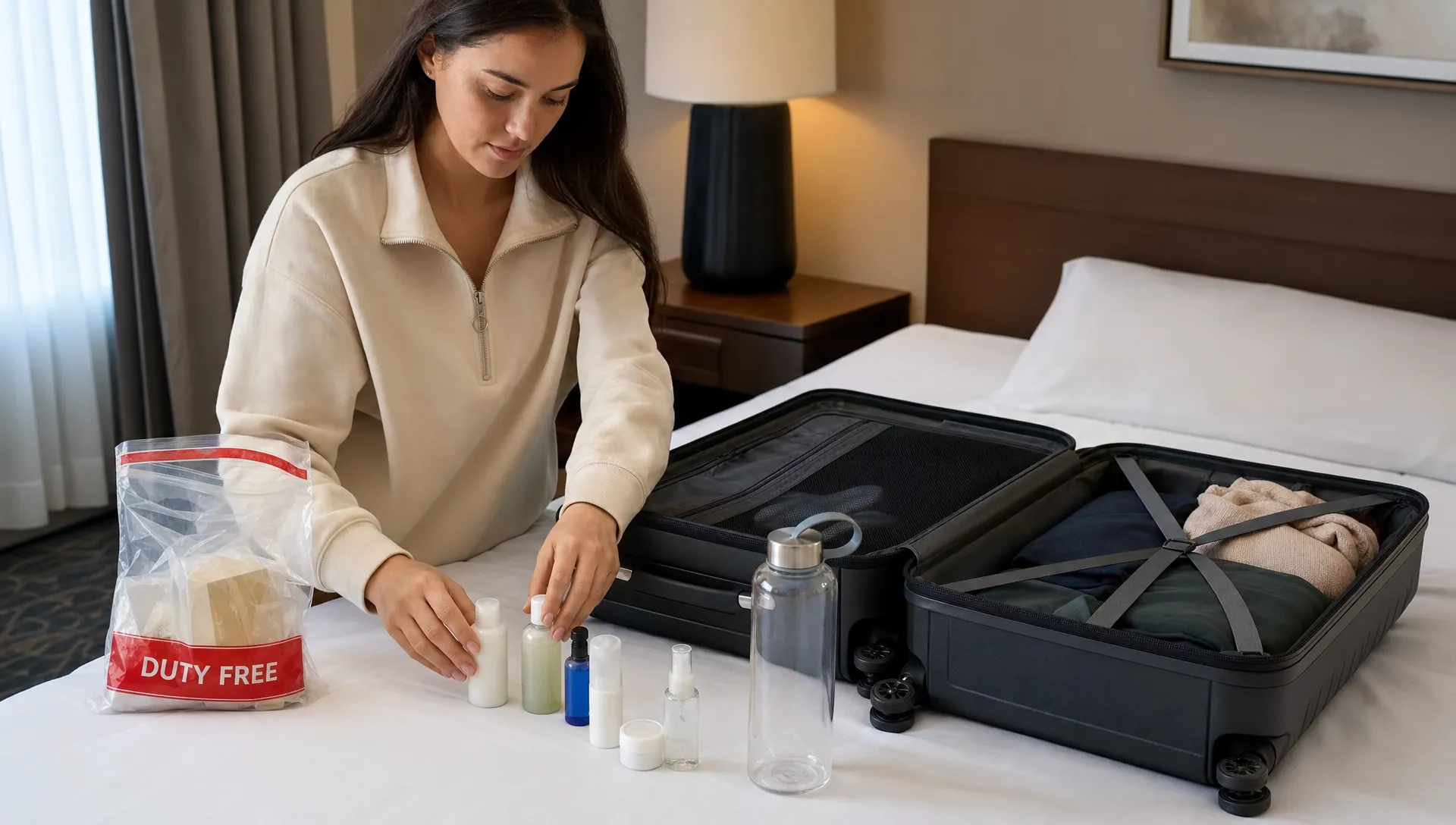
Drinks are different because travelers often buy them after the first security screening. A water bottle bought airside may be fine on the first flight, then become a problem if you must clear security again during the connection. Finish it before re-screening or pack an empty refillable bottle and refill it after the final checkpoint.
Duty-free liquids need special attention. If you are taking liquids on flights after buying duty-free alcohol, perfume or cosmetics, keep the item sealed in its secure tamper-evident bag with the receipt visible. Many international security systems recognize these bags, often called STEBs, but acceptance can depend on the airport, route and whether the bag remains sealed.
The European Commission has shown how quickly liquid screening rules can change when equipment policies change. A duty-free purchase that feels routine on one trip may need extra care on another.
Packing strategy for a connecting trip
When a connection is involved, packing for the strictest airport is usually less stressful than trying to memorize every exception. Use travel-size containers for cabin toiletries, keep them together and separate them from electronics or snacks that may slow down screening. If you need larger bottles, checked baggage is usually the better place for them.
There is one catch with checked bags: you may not always be able to access them during a connection. If your checked bag is tagged to the final destination, your large liquids should stay inside and you will not see them until arrival. If you must collect and recheck luggage, such as on some international arrivals, you may have a chance to move items from cabin bag to checked bag before the next security checkpoint.
Medicines, baby food, breast milk and certain dietary liquids often have exceptions, but they are still screened. Keep them easy to remove and bring supporting documentation where relevant, especially for prescriptions. Do not bury essential medicine in checked baggage unless you can safely travel without access to it.
How different connection types affect liquids
Taking liquids on flights with a long layover is not the same as making a short airside transfer. The more your journey resembles a new airport departure, the more likely you are to face the full liquid screening process again.
Domestic connection on one ticket
A domestic connection on one ticket is often the simplest case. You may stay airside, especially if both flights use the same terminal or concourse. Still, do not rely on this without checking the airport layout. Construction, terminal assignments and security procedures can change.
International connection without entering the country
Some airports allow international transit passengers to remain in a sterile transit area. Others require all passengers to pass transfer security, even if they do not enter the country. In that second case, your cabin liquids must satisfy the transfer airport rule.
International arrival followed by a domestic flight
This is one of the most common problem scenarios. You may need to clear immigration, collect checked luggage, pass customs and recheck bags before boarding a domestic flight. After that, you normally go through security again. Any oversized cabin liquid that survived the first flight can be confiscated at the domestic departure checkpoint.
Separate tickets or low-cost self-transfers
If your connection is on separate tickets, assume you will need to exit, collect baggage if checked, check in again and pass security again. Build in extra time and pack liquids as if you are starting a new trip at the connection airport.
A simple pre-flight checklist
A few minutes of checking before you leave home can prevent losing expensive products or delaying your connection. The goal is not to know every rule in the world. It is to know the strictest rule that applies to your specific route.
Use this checklist before packing:
- Check the liquid rule for your departure airport, connection airport and return airport.
- Treat unknown or unclear rules as 100 ml rules for cabin baggage.
- Keep duty-free liquids sealed with receipts until your final destination.
- Put full-size toiletries in checked baggage when you can.
- Carry an empty bottle instead of a full drink through security.
- Keep medicine and baby liquids separate for inspection.
The easiest habit for taking liquids on flights is to think in checkpoints instead of flights. A direct flight has one main checkpoint before boarding. A connecting itinerary may have two or more, and each one can apply a different limit.
You can use Liquid Limits to check airport rules, item-specific rules and route rules side by side, including return flights. The tool shows verified source links, last-checked dates and daily updates so you are not relying on an old forum post or a rule from a different terminal.
Common mistakes that lead to confiscation
The most common mistake is buying a large liquid after the first security checkpoint and assuming it is safe for the whole journey. That may be true on a direct flight, but it can fail during a transfer screening.
Another mistake is focusing only on the outbound trip. Return airports may apply different rules, and your return route may include a different connection. If you buy full-size products during your trip, check the return route before putting them in your cabin bag.
Travelers also underestimate borderline items. Peanut butter, soft cheese, jam, yogurt, honey, snow globes, liquid makeup, creams and pastes are often treated like liquids or gels. If they exceed the cabin limit, they belong in checked baggage unless a verified exemption applies. For more practical prevention tips, see Liquid Limits’ guide to avoiding liquid confiscation at airport security.
Frequently Asked Questions
Can I bring a drink bought after security onto a connecting flight? Sometimes, but only if you do not need to pass security again. If your connection requires transfer screening, finish the drink before that checkpoint or carry an empty bottle and refill it afterward.
Are duty-free liquids allowed through a connection? They may be allowed if sealed in an approved tamper-evident bag with the receipt, but acceptance depends on the transfer airport and route. Keep the bag sealed until your final destination.
Does the 100 ml rule apply if my first airport allows larger liquids? It can apply later in the trip if your connection or return airport uses the 100 ml rule. Pack cabin liquids for the strictest checkpoint on your itinerary.
Can I move liquids into checked baggage during a connection? Only if you collect your checked bag during the connection. If the bag is checked through to your final destination, you usually cannot access it before arrival.
Do medicines count as liquids on connecting flights? Liquid medicines are screened, but many airports allow medically necessary liquids above the standard cabin limit. Keep them separate, labeled and supported by documentation when possible.
Check the strictest liquid rule before you pack
Connections make liquid rules more route-specific than travelers expect. Before you pack, check each airport on your itinerary, including the return flight, and assume the stricter rule if anything is unclear.
Liquid Limits is built for exactly that kind of trip planning. Search by airport, item or route to see the cabin liquid rule that matters before you leave for the airport.