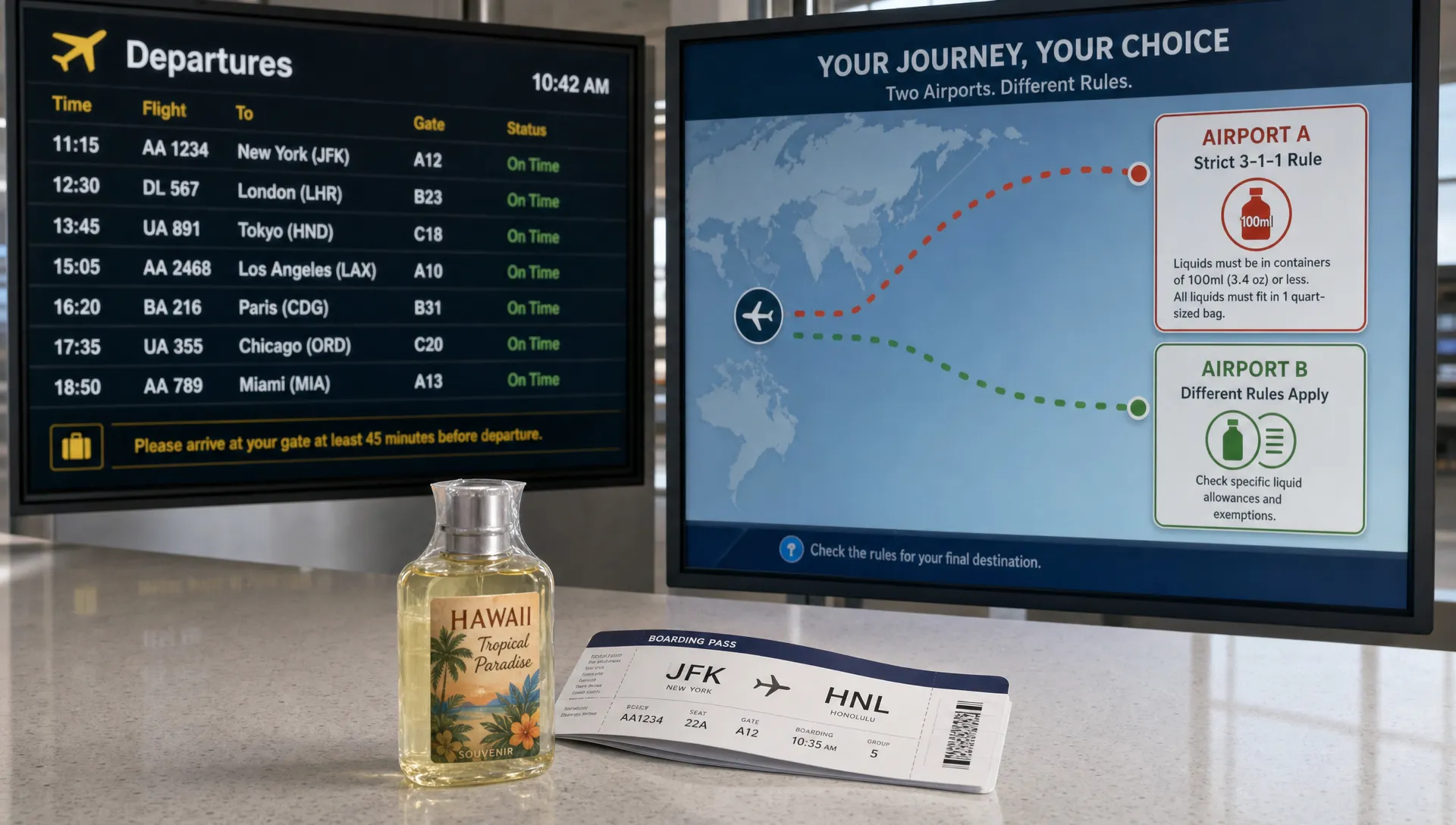
Most travelers remember the small bottle rule. They know cabin liquids usually need to be in containers of 100ml / 3.4oz or less, and they may even remember the clear bag. The requirement they forget is different: your liquids must work for every security checkpoint on your trip, not just the airport where you leave home.
That means the return flight matters. Connections can matter. A second security screening after immigration can matter. Even the terminal or scanner lane can matter when rules are not applied uniformly.
In plain terms, the liquid requirement for carry on luggage is not only a question of bottle size. It is a route question. If one airport on your itinerary enforces the traditional 100ml rule and another allows larger containers under newer screening procedures, the stricter checkpoint is the one that decides what survives in your cabin bag.
The forgotten requirement: pack for the strictest checkpoint
Liquid rules are set and enforced by airport security authorities, not by your suitcase, your airline booking, or the most relaxed airport on your route. The officer screening your bag applies the rule in force at that checkpoint on that day.
That is why a traveler can feel completely prepared and still lose a perfectly normal item. A 250ml sunscreen may be fine in checked luggage. It may even be allowed through a specific airport using newer scanners. But if your return airport, transfer airport, or re-screening point still applies the 100ml container limit, that same sunscreen can be refused at security.
For the basic bottle and bag rules, start with a refresher on flying liquid requirements for carry-on bags. Then apply the extra step many people skip: check the strictest rule across the whole trip.
The safe rule is simple: if any checkpoint on your journey requires 100ml containers, pack your cabin liquids as if the 100ml rule applies everywhere.
Why this catches careful travelers
The mistake is not usually carelessness. Many travelers check the first airport, pack neatly, and follow the guidance they saw while booking. The problem is that liquid restrictions are not always symmetrical.
Return flights turn souvenirs into security problems
Outbound packing is controlled. You decide what goes into your bag at home. Return packing is messier. You may have bought skincare, perfume, hot sauce, olive oil, jam, sunscreen, or local cosmetics during the trip.
Those items may feel like normal purchases, but once they are in your cabin bag and you approach security for the return flight, they are screened like any other liquid, gel, cream, paste, or aerosol. If the container is too large for that airport's rule, the fact that you bought it legally during your trip will not help.
This is especially common with weekend trips and city breaks, where travelers avoid checked luggage and assume a small shopping bag will be fine on the way home.
Connections can create a second liquid check
A connection does not always mean you stay airside. Some itineraries require you to collect luggage, pass immigration, change terminals, or exit and re-enter security. Self-transfer tickets are especially risky because you may be treated as a new departing passenger at the connecting airport.
Duty-free liquids can also cause confusion. In many places, sealed tamper-evident bags with receipts are recognized, but they can still be inspected, and rules vary by country, airport, and transfer setup. If the seal is broken, the receipt is missing, or your connection requires a standard security screening, you may have a problem.
If you are worried about confiscation risk, it helps to think in terms of the strictest checkpoint, a principle also covered in this guide to avoiding security confiscation when traveling with liquids.
Scanner rules are not always airport-wide
Newer CT scanners can allow some airports to screen liquids differently, including larger containers in certain circumstances. But travelers should not assume that one announcement means every airport, terminal, route, or lane now has the same relaxed rule.
In practice, equipment rollouts can be partial, temporary restrictions can be reintroduced, and older lanes can still operate beside newer ones. If guidance is unclear or inconsistent, treating 100ml as the fallback is the least risky choice.
Airlines are not the final authority
Airlines control baggage size, weight, and onboard policies. Airport security controls what you can bring through the checkpoint. Your airline may say your carry-on bag is allowed, but that does not mean every liquid inside it is allowed through screening.
This is why checking only your airline's baggage page is not enough for liquids. You need the airport and route rule.
What actually counts as a liquid
Another reason travelers miss the requirement is that many restricted items do not look like liquids in everyday life. Airport security often uses broader categories such as liquids, aerosols, gels, creams, and pastes.
The TSA liquids rule describes the familiar 3.4oz / 100ml container limit for carry-on liquids, gels, and aerosols in the United States. UK government guidance on hand luggage restrictions also lists items such as creams, pastes, gels, and sprays as liquids for airport security purposes.
A practical test helps: if it can be poured, sprayed, squeezed, spread, smeared, or scooped, check it as a liquid before packing it in carry-on.
| Item type | Common examples | Why travelers forget it |
|---|---|---|
| Liquid toiletries | Shampoo, conditioner, mouthwash, perfume, contact lens solution | The bottle looks travel-friendly but may still be over 100ml |
| Creams and gels | Toothpaste, face cream, hair gel, sunscreen, mascara | These do not always feel like liquids in normal packing |
| Aerosols | Deodorant spray, hairspray, shaving foam | Aerosols can count as liquids and may also have airline safety limits |
| Food and souvenirs | Honey, jam, sauces, olive oil, nut butter | They are often bought after arrival and forgotten until return security |
| Medical and baby items | Liquid medicines, formula, breast milk, special dietary liquids | Exceptions may apply, but screening and declaration can still be required |
The key point is not to memorize every possible item. The key point is to check the item against the strictest airport rule you will face.
The route test: what to check before you pack
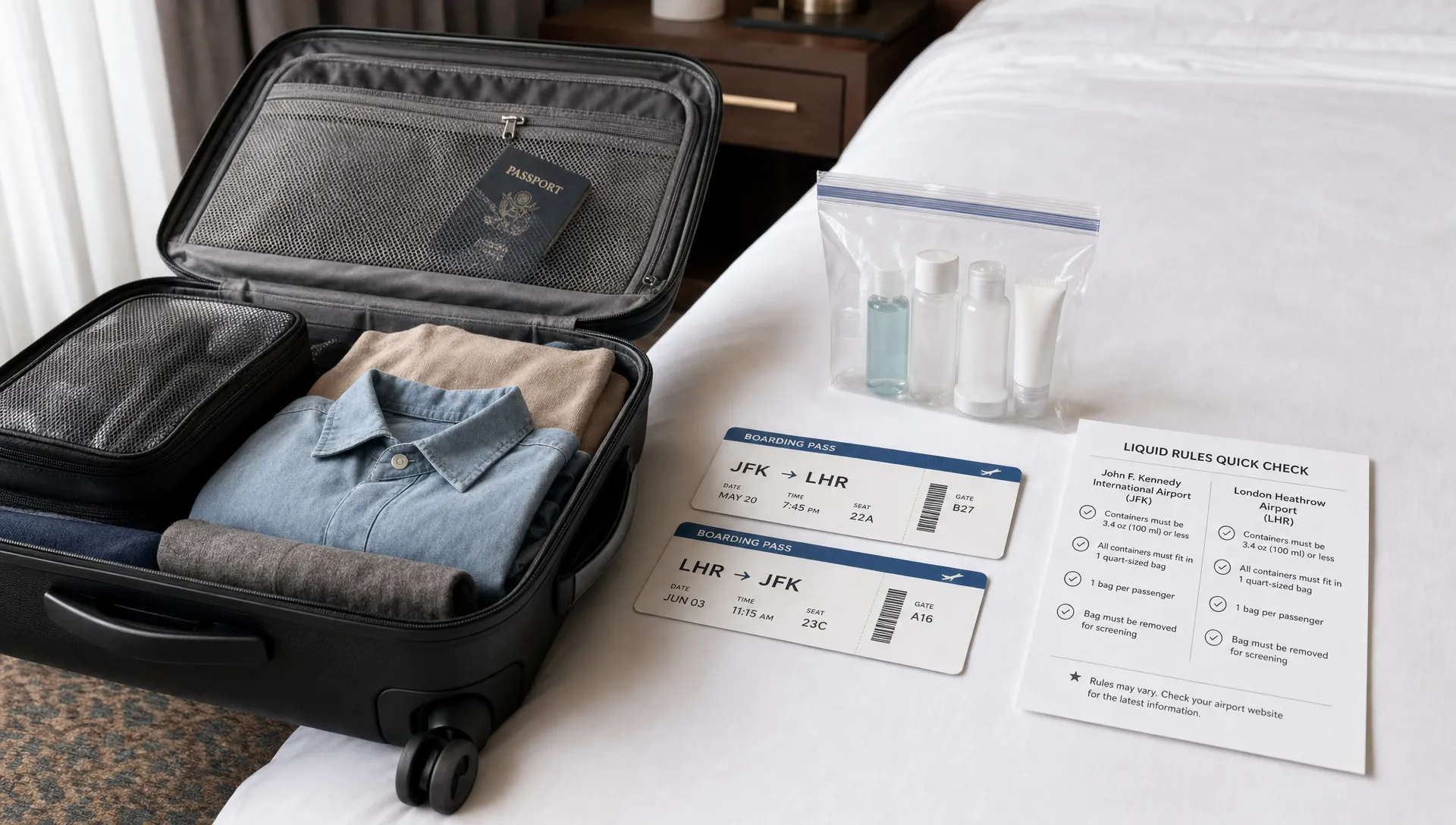
Before you decide whether a liquid belongs in your cabin bag, ask where that bag will be screened. For a simple round trip, that usually means your departure airport and your return airport. For more complex travel, it can also mean a transfer airport, a terminal change, or a re-entry point after immigration.
This is the step most travelers forget because they think of liquids as a packing rule. It is really a security journey rule.
| Trip situation | Check these liquid rules | Safer packing choice |
|---|---|---|
| Direct round trip | Departure airport and return airport | Follow the stricter of the two |
| One-way flight | Departure airport and any transfer screening | Use 100ml containers unless every checkpoint clearly allows more |
| International connection | Origin, transfer airport, and any re-screening after immigration | Avoid large cabin liquids unless you can confirm transfer rules |
| Trip with shopping | Return airport and transfer airport | Put full-size liquid souvenirs in checked luggage when possible |
| Unclear airport guidance | Official airport, security authority, and recent rule status | Default to 100ml to reduce confiscation risk |
For trips where the outbound and return airports differ, use a source that compares the whole itinerary rather than checking one airport in isolation. Liquid Limits lets travelers check airport, item, and route guidance, including return trips, with source links and last-checked dates.
How to pack around the forgotten requirement
The easiest strategy is to pack as if the strictest rule applies, then make exceptions only when you have verified every checkpoint on your route. This may feel conservative, but it prevents the classic return-flight problem: arriving at security with a full-size product you cannot legally carry on.
Use these habits when packing cabin liquids:
- Choose containers of 100ml / 3.4oz or less unless the entire route clearly allows more.
- Keep liquids in a clear resealable bag where the airport requires one.
- Put larger toiletries, food liquids, and souvenir liquids in checked luggage when possible.
- Keep medicines, baby liquids, and special dietary items accessible for screening.
- Leave duty-free liquids sealed in their security bag and keep the receipt with them.
- Recheck the rule shortly before travel, especially if your route uses airports changing scanner policies.
For many travelers, the biggest improvement is simply checking the return airport before buying liquids during the trip. If you know the return airport enforces 100ml, you can buy a small version, pack the item in checked luggage, ship it home, or skip it.
A simple example
Imagine your outbound airport allows larger liquid containers at certain checkpoints because of newer scanning technology. You pack a 300ml sunscreen in your carry-on and pass through without issue.
On the way home, your return airport still applies the 100ml rule. That same 300ml sunscreen is now a problem. It does not matter that it passed once. It does not matter that it is half empty. Security usually looks at the container capacity, not the amount left inside.
Now add a connection. If you need to leave the secure area and go through screening again, the transfer airport's rule matters too. A liquid that was allowed at the first airport can be challenged later in the journey.
This is why the strictest-checkpoint mindset is so useful. It turns a confusing set of airport-specific rules into one practical decision: can this item pass every screening point on my itinerary?
What to do when rules conflict
Conflicting guidance is common because airport liquid policies have been changing. One page may describe newer scanner rules, another may still instruct passengers to prepare 100ml containers, and a traveler forum may report a different experience from last month.
When official guidance is unclear, use the most restrictive rule. That usually means 100ml containers for cabin liquids, placed in a clear bag if required. It may feel inconvenient, but it is better than losing expensive toiletries or gifts at security.
This is also where route-specific checking helps. Instead of relying on memory or old travel habits, compare the airports you will actually pass through. For more detail on the return-flight angle, see these travel liquid guidelines for airports and return trips.
The quick pre-flight checklist
Before you zip your carry-on, run through these questions:
| Question | Why it matters |
|---|---|
| Which airports will screen my cabin bag? | Every screening point can apply a different rule |
| Is my return airport stricter than my departure airport? | Return flights are where many purchases get confiscated |
| Will I leave the secure area during a connection? | Re-entering security can trigger another liquid check |
| Are any containers larger than 100ml / 3.4oz? | Container size often matters even if the item is partly used |
| Are any items creams, gels, pastes, aerosols, or spreadable foods? | Many restricted items are not obvious liquids |
| Do I have medicines, baby liquids, or duty-free items? | Exceptions can apply, but they may require screening or proof |
| Have I checked the latest airport guidance? | Liquid rules can change as scanner policies change |
If you can answer these questions confidently, you are much less likely to be surprised at the tray table.
Frequently Asked Questions
What is the carry-on liquid requirement travelers forget? The forgotten requirement is checking every security checkpoint on your route, including your return airport and any transfer airport where you may be screened again. The strictest checkpoint should guide how you pack.
Do liquid rules depend on the airline or the airport? Airport security rules decide what liquids can pass through screening. Airlines may set cabin bag size and weight rules, but they are not the final authority on liquids at the security checkpoint.
Can I bring larger liquids if my departure airport has new scanners? Only if every relevant checkpoint on your trip allows it and you can confirm the rule. If your return or transfer airport still uses the 100ml limit, larger cabin liquids can still be refused later.
Does the 100ml rule apply to half-empty containers? In many airports, the limit is based on container capacity, not how much liquid is left inside. A 200ml bottle that is half full can still be treated as a 200ml container.
Are medicines and baby liquids included in the same limit? Medicines, baby formula, breast milk, and special dietary liquids often have exceptions, but they may need to be declared or screened separately. Always check the airport rules before travel.
What should I do if I cannot confirm the rule for one airport? Use the stricter 100ml approach for carry-on liquids. When guidance is unclear, conservative packing is the safest way to avoid confiscation.
Check the whole trip before you pack
The liquid rule travelers forget is not hidden in fine print. It is hidden in the route. Your carry-on liquids need to satisfy the airport where you start, the airport where you return, and any place you are screened in between.
Before your next flight, check your airports, route, and specific items with Liquid Limits. It compares cabin liquid guidance side by side, includes source links and last-checked dates, and defaults to the stricter 100ml rule when a rule is unclear, so you can pack with fewer surprises.