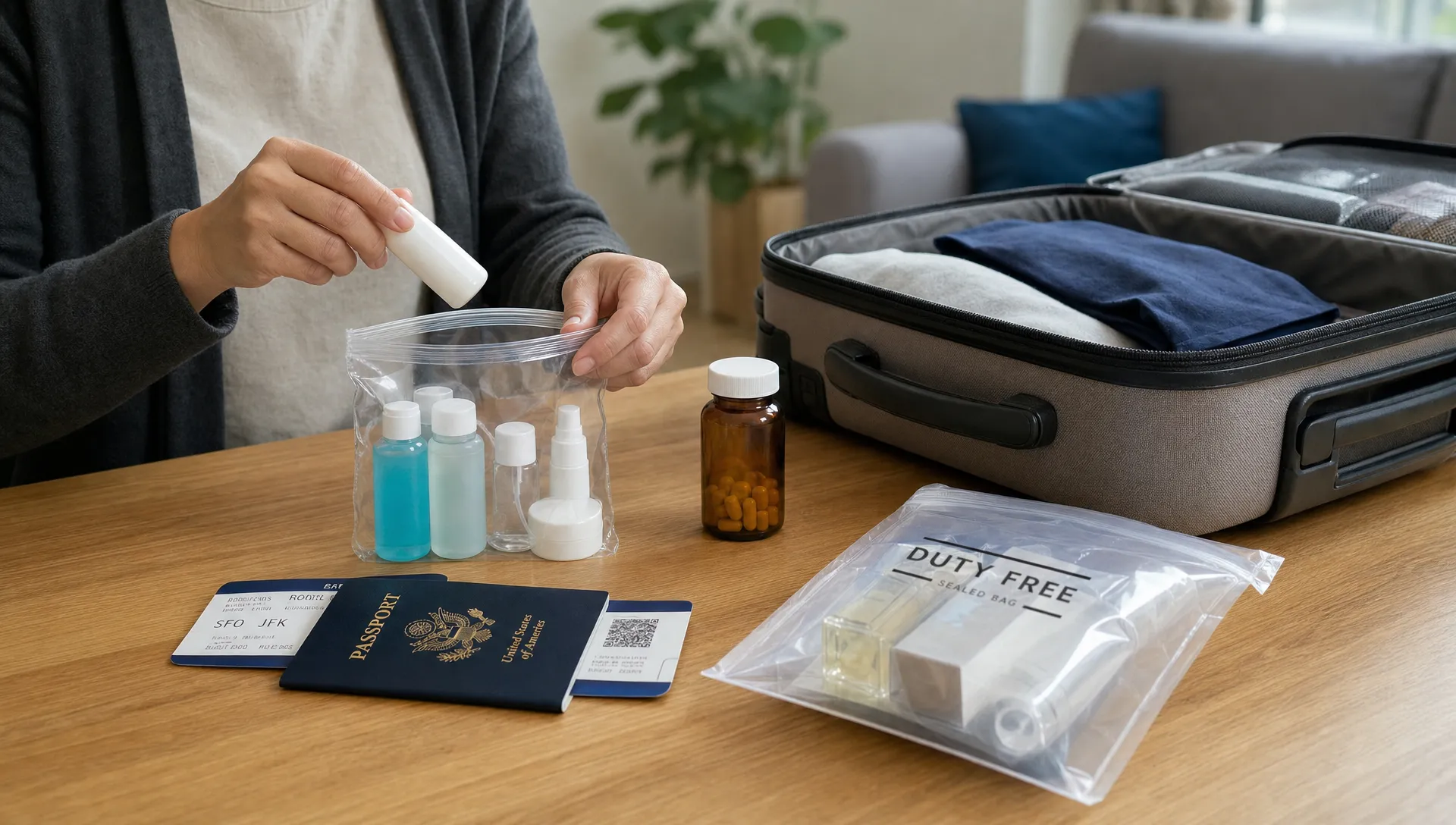
The liquid rule for planes can feel straightforward until your trip includes a connection, a return flight from another country or a duty-free purchase between airports. For most cabin bags, the safe baseline is still small containers of liquids, gels, creams, pastes and aerosols, usually no more than 100 ml or 3.4 oz each, placed in a clear liquids bag where required. The tricky part is that the rule you meet at your first airport may not be the only one that matters.
Direct flights are usually simple because you pass through one main security checkpoint before boarding. Connecting trips can be different. You may stay airside and avoid another liquid screening, or you may be screened again after customs, terminal changes or a self-transfer. That is why smart packing starts with the strictest checkpoint on the whole route, not only the airport where you begin.
What the liquid rule for planes means before you choose a bag
Airport liquid restrictions apply mainly to cabin baggage. Checked bags are not screened under the same cabin liquids limit, although dangerous goods rules still apply to items such as flammable aerosols, high-strength alcohol and certain chemicals. If an item is essential during the flight, it must satisfy the carry-on rules at every security checkpoint where your cabin bag is inspected.
The best-known version is the U.S. TSA 3-1-1 liquids rule: containers must be 3.4 oz or 100 ml or less and fit in a quart-size bag. Many airports outside the U.S. use a similar 100 ml container limit, often with a one-liter clear bag. Some airports with newer scanners may handle liquids differently, but travelers should not assume that every lane, airport or transfer point follows the relaxed version.
A liquid is not limited to drinks and shampoo. Security teams usually treat gels, creams, sprays, lotions, mascara, toothpaste, peanut butter, soft cheese, sauces and similar spreadable items as liquids. When in doubt, assume the item will be judged by how it behaves, not by how the label describes it.
Direct trips: one checkpoint usually decides
On a nonstop itinerary, the liquid rule for planes is usually enforced at the airport where you start the trip. If you pass through security in Boston and fly directly to Los Angeles, you normally do not have another cabin-bag liquid check after landing. The same idea applies to many international nonstop flights: the departure airport’s security checkpoint is the key moment for cabin liquids.
That does not mean you should ignore the destination. If you are returning from a different airport, flying home later from another country or continuing by air on a separate ticket, the next checkpoint may apply a different rule. A direct outbound flight can be easy while the return leg is stricter, especially if one airport has temporary scanner limits or a more conservative liquids policy.
For a simple direct trip, use this practical rule: pack every cabin liquid in a compliant small container unless you have verified that your exact departure airport and airline route allow something larger. If you want a broader refresher on basic cabin liquid sizes, Liquid Limits has a separate guide to flying rules for liquids every traveler should know.
Connecting trips: why the same bottle may be allowed, then refused
Connections are where the liquid rule for planes creates the most confusion. A bottle that was allowed at your first airport can become a problem if you are screened again during the connection. This often happens after arriving internationally, collecting bags, clearing customs and re-entering security for a domestic or onward flight.
The risk is higher on self-transfers. If you booked two separate tickets, you may need to exit the secure area, check in again and pass through security like a new departing passenger. In that case, your cabin liquids must comply with the second airport’s rules, even if the first airport was more permissive.
Some connections are smoother. If you remain in the sterile transit area and do not pass another checkpoint, your cabin liquids may never be rechecked. The problem is that travelers often do not know this until they arrive. Terminal layouts, airline agreements, local rules and missed connections can all change what happens on the day.
| Connection situation | Liquid risk level | Why it matters |
|---|---|---|
| Same airport, same secure area | Lower | You may not face another full security screening |
| Terminal change with security | Medium to high | Liquids can be checked again before the next gate |
| International arrival plus customs | High | You may need to re-enter security for the onward flight |
| Separate tickets or self-transfer | High | You are often treated like a new departing passenger |
| Overnight stop before next flight | High | The next flight starts with a new checkpoint |
Return flights and multi-city trips need a stricter mindset
Round trips and multi-city itineraries deserve extra attention because your departure airport changes. The outbound airport may allow a certain setup, but the return airport could require the traditional 100 ml limit. If you buy full-size toiletries after arrival, they may be fine in your hotel but not in your carry-on when you fly home.
The liquid rule for planes should be checked for the return leg before you pack for the outbound leg. That sounds early, but it prevents the common problem of carrying an oversized product abroad and having to throw it away at the return airport. It also helps if you are traveling with gifts, specialty foods, cosmetics or local products that look harmless but count as liquids at security.
For round trips, Liquid Limits focuses on the strictest rule across the whole journey, including the return airport. You can also compare the specific scenarios in this related guide to rules for liquids on flights and return trips.
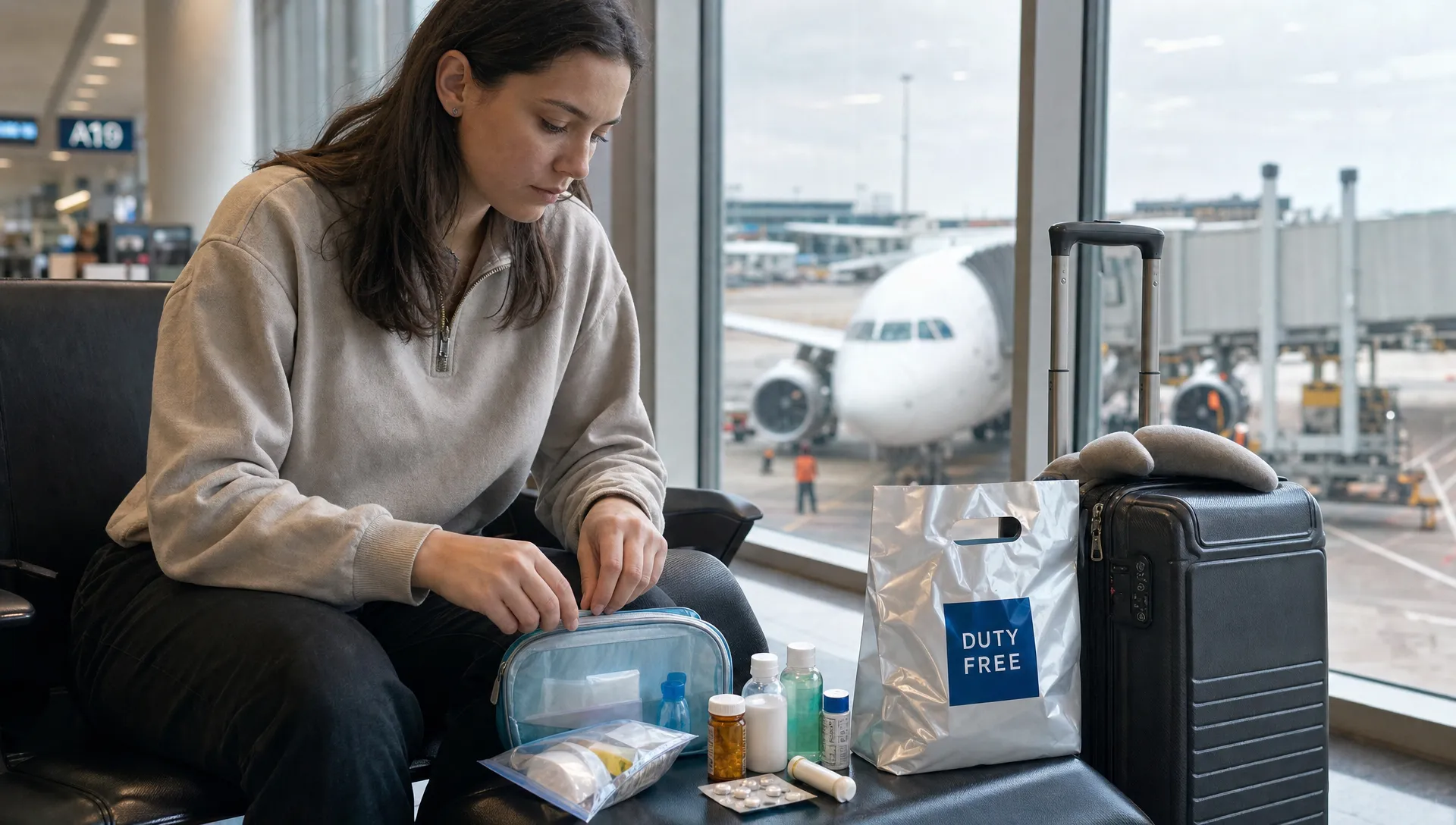
Duty-free liquids on connecting flights
Duty-free purchases are a special case. Many airports allow larger duty-free liquids, such as perfume or alcohol, if they are packed in a sealed, tamper-evident bag with the receipt visible. This is often called a STEB, short for security tamper-evident bag. It is designed to show that the product was purchased after security at an approved airport shop.
The liquid rule for planes can still affect duty-free items at transfer points. If you need to pass through another security checkpoint, officers may check whether the bag is sealed, the receipt is recent and the contents meet local transfer rules. If the bag has been opened or the receipt is missing, the item may be treated like any other oversized cabin liquid.
Duty-free is safest on nonstop flights or when the shop and airport can confirm your connection is eligible. It is riskier on self-transfers, overnight stops and routes where you must collect baggage and re-clear security. If the purchase matters, ask before buying whether it can travel through your exact connection.
Medicines, baby items and special dietary liquids
Most airport liquid rules include exceptions for medically necessary liquids, baby milk, formula, breast milk and certain special dietary items. These items may be allowed in quantities above 100 ml, but they usually need to be presented separately at security. Officers may screen them using additional methods.
Do not hide exempt liquids inside a packed toiletry bag. Keep them accessible, leave extra time and carry supporting documentation when relevant. A prescription label, doctor’s note or clear original packaging can reduce confusion, especially on international routes where languages and procedures differ.
The UK government guidance on hand luggage restrictions also separates essential medical liquids and baby food from standard toiletries, but local screening procedures can vary. The practical takeaway is simple: exemptions exist, but they are not a free pass to pack any large liquid casually in a cabin bag.
How to pack for direct and connecting trips
The liquid rule for planes is easiest to manage when you pack as if the strictest checkpoint will apply. That usually means choosing travel-size containers, keeping them together and moving anything nonessential into checked baggage. If your route later proves more relaxed, you lose nothing. If it is strict, you are ready.
Start with the items you must have during the journey: medication, contact lens solution, baby supplies, moisturizer for a long flight and small hygiene items. Then decide what can go in checked luggage or be bought after arrival. Full-size shampoo, sunscreen, hair products and sauces rarely need to be in the cabin unless your trip is carry-on only.
Before you leave, run through this quick packing check:
- Put standard liquids, gels, creams, pastes and aerosols in containers of 100 ml or 3.4 oz or less.
- Use a clear liquids bag if your departure or transfer airport requires one.
- Keep medicines, baby items and special dietary liquids separate for screening.
- Do not open sealed duty-free bags before your final destination.
- Check the return airport, not only the outbound airport.
If you want a route-specific answer instead of guessing, you can check airport liquid rules on Liquid Limits and compare the strictest cabin rule for your trip side by side.
Common mistakes that cause delays at security
The most common mistake is focusing on the amount left in the bottle instead of the container size. A 200 ml shampoo bottle that is half empty can still be refused because the container itself is larger than the allowed limit. Security officers usually judge the marked capacity, not your estimate of what remains inside.
Another mistake is assuming a connection is not a new screening event. The liquid rule for planes matters every time your cabin bag goes through security, and connections can create extra checkpoints without much warning. This is especially true when flying internationally into a country where domestic connections require you to exit and re-enter security.
Travelers also forget borderline items. Lip gloss, liquid foundation, gel deodorant, snow globes, jams, dips and spreadable foods can all be treated as liquids. If you would pour it, smear it, spray it, squeeze it or spread it, pack it under the liquids rule unless you have verified otherwise.
Frequently Asked Questions
Does the liquid rule for planes apply to checked baggage? The standard cabin liquid limit applies to carry-on bags, not checked bags. Checked baggage can usually hold larger toiletries, but dangerous goods restrictions still apply to items such as certain aerosols, fuels, solvents and high-strength alcohol.
Do I have to follow the rule again on a connecting flight? Yes, if you pass through another security checkpoint. If you stay airside and do not get screened again, your liquids may not be rechecked, but you should not rely on that unless you know the airport transfer process.
Can I bring a 150 ml bottle if it only has a little liquid left? Usually no. Security teams normally look at the container’s stated capacity. A container larger than 100 ml or 3.4 oz can be refused even if it is nearly empty.
Are duty-free liquids always allowed on connecting trips? No. Duty-free liquids are often allowed only when sealed in an approved tamper-evident bag with a receipt and accepted by the transfer airport. If you need to clear security again, the bag may be inspected.
What is the safest way to pack for a multi-airport trip? Pack standard cabin liquids in 100 ml or 3.4 oz containers, keep exemptions separate and check every airport where you may go through security, including the return airport.
Check the strictest rule before you pack
Liquid rules are not just about the first flight on your booking. Direct trips are usually predictable, but connecting, return and multi-city trips can add extra checkpoints where a different airport rule applies. Packing to the strictest point on the route is the safest way to avoid delays, surrendered items and last-minute repacking.
Liquid Limits helps you check verified airport, item and route guidance with source links and last-checked dates. Before you zip your bag, look up your full itinerary so you know whether the safest answer is 100 ml, a larger allowance or the stricter fallback when a rule is unclear.