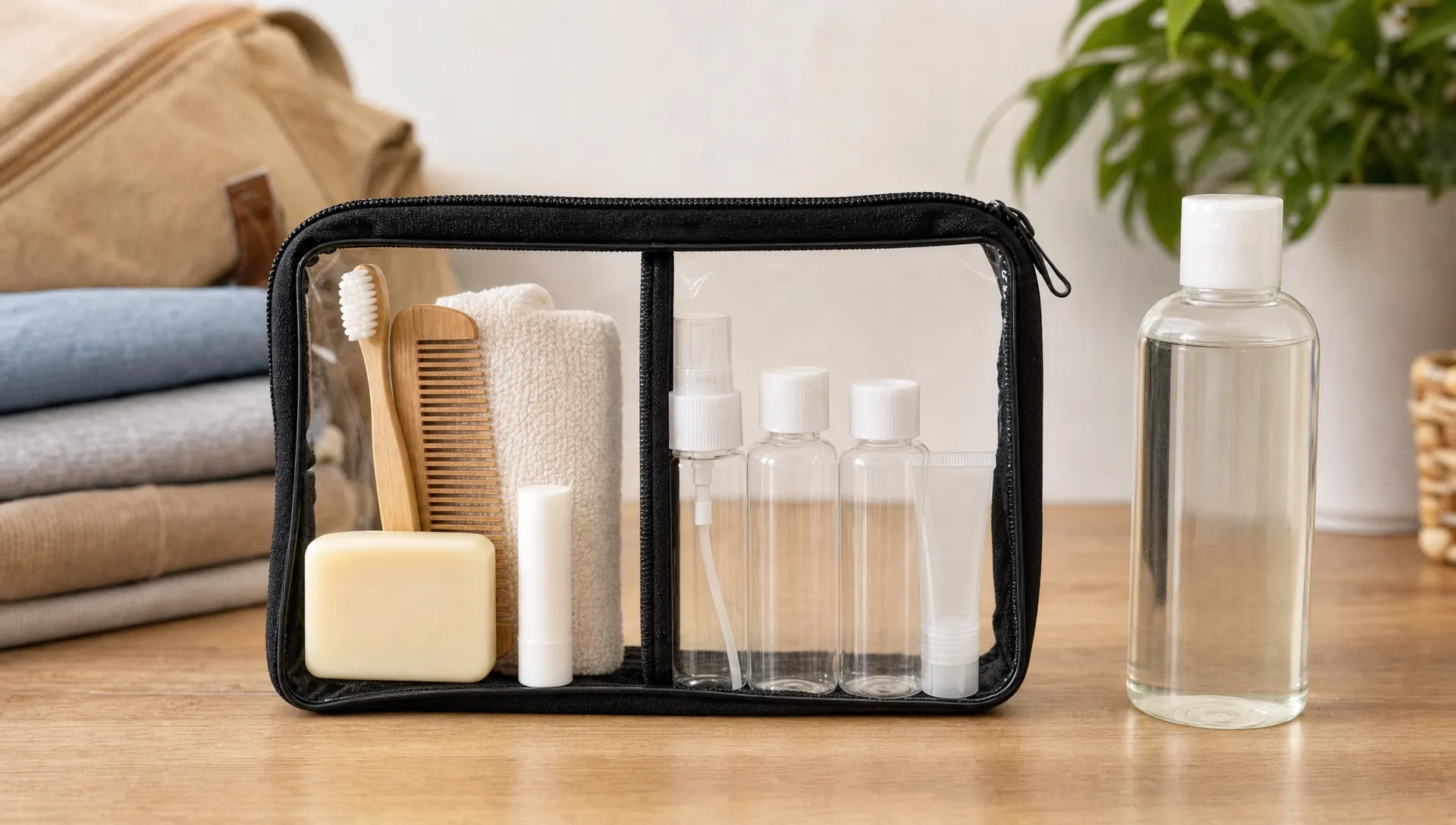
Packing toiletries for a flight should be simple: keep what you need, skip what you do not, and make sure airport security will not throw anything away. The confusing part is that many everyday toiletries are treated as liquids even when they do not look like drinks. Toothpaste, mascara, shaving gel, sunscreen, face cream, lip gloss, and roll-on deodorant can all fall under cabin liquid rules.
The safest short answer is this: you can bring most toiletries on a plane without trouble if solid items go in any cabin bag and liquid, gel, cream, paste, spray, and aerosol items are in containers of 100 ml / 3.4 oz or less, packed in the required clear liquids bag where that rule applies. Larger toiletries usually belong in checked luggage, unless a medical, baby, or accessibility exemption applies.
That rule is not universal everywhere, though. Some airports use newer screening equipment and may allow larger liquid containers in certain lanes, while other airports still enforce the standard 100 ml rule. If your trip includes a transfer or return flight, pack for the strictest airport you will pass through, not just the airport you leave from first.
Quick answer: toiletries that usually travel well
Most common toiletries are allowed on planes. The issue is not whether shampoo or moisturizer is dangerous in normal use. The issue is container size, texture, aerosol pressure, sharp edges, and whether the airport security system treats the item as a liquid.
| Toiletry | Cabin bag approach | Checked bag approach |
|---|---|---|
| Toothbrush, floss, comb, hairbrush | Allowed in cabin bags | Allowed |
| Bar soap, solid shampoo, solid conditioner | Usually allowed outside the liquids bag | Allowed |
| Toothpaste | Must follow liquid, gel, or paste limits, usually 100 ml / 3.4 oz | Larger tubes usually allowed |
| Shampoo, conditioner, body wash | Travel-size containers only under common cabin rules | Full-size bottles usually allowed |
| Face cream, moisturizer, sunscreen | Travel-size containers only under common cabin rules | Full-size containers usually allowed |
| Roll-on, gel, or aerosol deodorant | Counts under liquid or aerosol rules | Usually allowed, with caps and quantity limits |
| Solid stick deodorant | Usually allowed outside the liquids bag | Allowed |
| Perfume, cologne, aftershave | Travel-size bottles only under common cabin rules | Larger bottles usually allowed, but protect from leaks |
| Mascara, liquid eyeliner, foundation, concealer | Usually treated as liquids, gels, or creams | Allowed |
| Powder makeup, pressed powder, solid lipstick | Usually allowed outside the liquids bag | Allowed |
| Contact lens solution | Small bottle is easiest, larger medically necessary amounts may need screening | Allowed |
| Wet wipes, cleansing wipes, makeup wipes | Usually not treated like a bottle of liquid | Allowed |
A good rule of thumb: if you can pour it, spray it, squeeze it, smear it, pump it, or spread it, assume it needs to meet the airport liquid rule unless your airport clearly says otherwise.
What counts as a liquid toiletry at airport security?
Airport liquid rules cover more than watery products. The TSA liquids rule uses the familiar 3.4 oz / 100 ml container limit for liquids, aerosols, gels, creams, and pastes in carry-on bags. The UK government hand luggage guidance also includes items such as creams, lotions, oils, perfumes, sprays, gels, pastes, mascara, and lip gloss under liquid restrictions.
That means many toiletries you use every day count as liquids for screening purposes, including:
- Toothpaste and whitening gel
- Shampoo, conditioner, and leave-in treatments
- Body wash, cleanser, toner, and micellar water
- Sunscreen, after-sun lotion, and body lotion
- Hair gel, pomade, mousse, and spray
- Shaving cream, shaving gel, and aerosol foam
- Liquid foundation, concealer, mascara, and lip gloss
- Perfume, cologne, and aftershave
The container size matters more than how much product is left inside. A half-empty 200 ml bottle is still a 200 ml container, so it can be refused at a 100 ml checkpoint. If the label is missing or the size is hard to read, security may take a closer look. For a smoother experience, use clearly marked travel bottles.
For a broader breakdown beyond toiletries, Liquid Limits has a guide to which liquids you can bring on a plane, including food, drinks, medicines, baby items, and duty-free purchases.
Build a no-trouble toiletry kit for your cabin bag
The easiest cabin toiletry kit uses solids wherever possible and small containers only where liquids are unavoidable. This reduces the number of items that need to fit inside your clear bag and makes security screening faster.
Start with a solid-first setup: toothbrush, floss, solid deodorant, bar soap, shampoo bar, conditioner bar, solid cleanser, lip balm, and powder makeup. These items usually do not need to go into the liquids bag because they are not liquid, gel, cream, paste, or aerosol products.
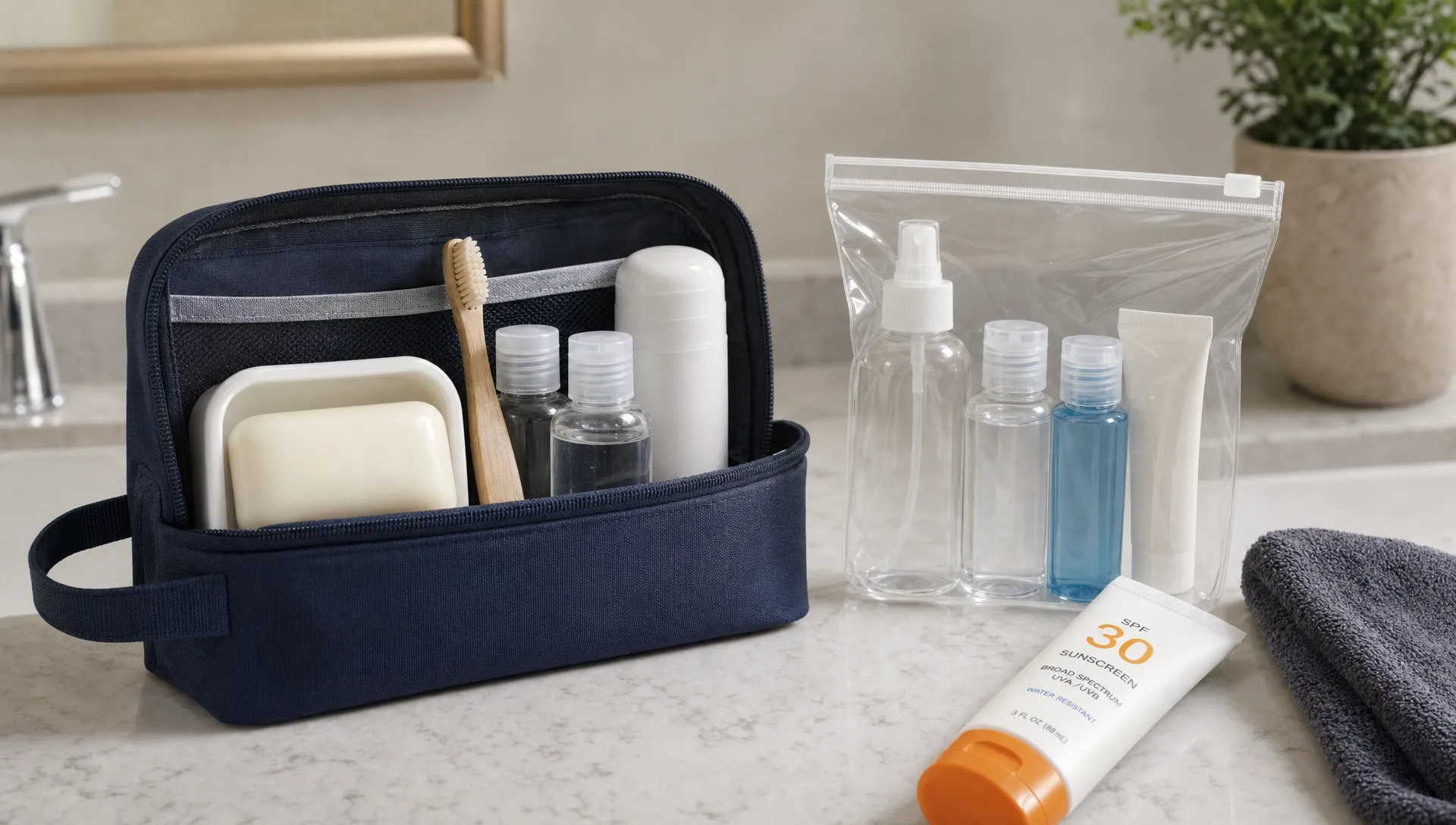
Then add only the liquid toiletries you actually need during the trip. For many travelers, that means toothpaste, moisturizer, sunscreen, and one or two makeup or shaving items. Decanting products into travel-size containers can work well, but only if the container itself is 100 ml / 3.4 oz or less and seals properly.
If you are using refillable bottles, label them. Security usually cares about container size, but labeling helps you avoid mystery bottles, leaks, and accidental mix-ups. It also helps you pack faster on the way home.
Cabin bag vs checked bag: where each toiletry belongs
The best place for a toiletry depends on when you need it and whether it is likely to slow down screening. Keep essentials and small compliant items in your cabin bag. Put full-size products, backups, and bulky liquids in checked luggage.
| Pack in your cabin bag | Pack in checked luggage |
|---|---|
| Travel-size toothpaste | Full-size toothpaste tubes |
| Small sunscreen for arrival | Large sunscreen bottles |
| Small moisturizer or cleanser | Full skincare bottles |
| Prescription creams or medically necessary items | Backup toiletries you do not need in flight |
| Solid deodorant or 100 ml liquid deodorant | Full-size roll-on or aerosol deodorant |
| Travel-size perfume | Larger fragrance bottles, well protected |
| Wipes and basic hygiene items | Extra shampoo, conditioner, and body wash |
Checked bags are more forgiving for toiletries, but they are not a free-for-all. Aerosols should have protective caps, bottles should be sealed, and anything that can leak should go inside a plastic bag or leakproof pouch. Airlines and aviation safety rules can also limit large quantities of aerosols, alcohol-based products, and flammable items, so do not pack unusually large volumes.
Toiletries that cause the most trouble
Most airport toiletry problems come from ordinary items packed in the wrong size or format. These are the ones to check before you leave for the airport.
Toothpaste
Toothpaste is one of the most commonly misunderstood toiletries because it feels essential and harmless, but it is treated as a paste. In a cabin bag, the safest choice is a tube of 100 ml / 3.4 oz or less. A half-used family-size tube can still be refused because the container is too large. If you want the detailed rules by region, see Liquid Limits' guide on whether you can bring toothpaste in hand luggage.
Sunscreen
Sunscreen is a liquid or cream for airport screening. Small travel-size sunscreen can go in your cabin liquids bag, but full-size bottles usually need to go in checked luggage. This catches travelers on beach trips, especially when they buy a large bottle before leaving home and forget it cannot pass a standard 100 ml checkpoint.
Deodorant
Solid stick deodorant is usually the easiest option. Roll-on, gel, cream, spray, and aerosol deodorants are more likely to count under liquid or aerosol rules. If you prefer aerosol deodorant, choose a small can with a secure cap and keep it within the cabin liquid allowance when required.
Makeup
Powder products and solid lipstick are usually simple. Liquid foundation, concealer, mascara, liquid eyeliner, brow gel, primer, setting spray, and lip gloss are normally treated as liquids, gels, or creams. If your makeup bag is packed full, separate the liquid-like products before screening so they are easy to show.
Razors, scissors, and grooming tools
Disposable razors and cartridge razors are widely accepted in cabin bags, but loose razor blades are usually not. Small grooming scissors, nail scissors, and metal tools can be subject to local blade length and sharp item rules, which vary by country. If an item has a sharp removable blade, checked luggage is the safer choice.
Perfume and cologne
Fragrance bottles often cause two problems: size and breakage. A 30 ml or 50 ml bottle usually fits common cabin liquid rules, but larger bottles may not. Glass bottles should be cushioned, and atomizers should be capped. If you are bringing an expensive fragrance, consider a small travel atomizer that is clearly under the limit.
How to pack toiletries so security does not slow you down
A little organization matters. Airport security officers see thousands of toiletry bags, and the easiest ones to screen are clear, simple, and compliant.
Use one clear resealable liquids bag if your departure airport requires it. In many 100 ml systems, each liquid container must be 100 ml / 3.4 oz or less, and all containers must fit comfortably in the allowed bag. Do not overfill it to the point that it cannot close.
Keep liquid toiletries near the top of your cabin bag so you can remove them if asked. Even at airports where liquids can stay inside your bag, rules may differ by terminal, scanner lane, or transfer checkpoint. Being ready prevents delays.
Avoid packing bottles with no visible size marking. If you decant skincare or hair products into plain containers, choose bottles with the capacity printed on them. A security officer may not have time to guess whether a container is compliant.
Prevent leaks by squeezing extra air out of soft bottles, tightening caps, taping flip-tops if needed, and placing liquids in a separate pouch. Cabin pressure changes can make poorly sealed toiletries leak, even if they passed security easily.
Do not forget the return flight
Many travelers pack correctly for the outbound airport, then run into trouble on the way home. The most common reason is buying full-size toiletries at the destination and trying to bring them back in a cabin bag. Another is assuming the return airport has the same scanner technology or liquid policy as the departure airport.
This matters even more on multi-airport trips. You might fly out through an airport that allows larger liquids in certain lanes, then return through a stricter airport that still enforces 100 ml. You might also connect through a different country where transfer security checks your cabin bag again.
Before you pack, check your exact airports, route, and return flight. Liquid Limits helps travelers compare airport liquid rules side by side, including routes where the return airport may be stricter. It also provides item-specific checks, source links, and last-checked dates, and defaults to the stricter 100 ml rule when guidance is unclear.
If you like packing from a list, use a travel liquids checklist for stress-free security before you zip your bag.
Frequently Asked Questions
How many toiletries can I bring on a plane? There is usually no fixed number of toiletries. The limit is about type, size, and space. Under common 100 ml rules, each liquid toiletry must be in a container of 100 ml / 3.4 oz or less, and the containers must fit in the required clear liquids bag.
Can I bring full-size toiletries in my checked bag? In most cases, yes. Full-size shampoo, conditioner, body wash, lotion, and toothpaste usually belong in checked luggage. Aerosols and alcohol-based products can have quantity and safety limits, so pack normal personal-use amounts and keep caps secure.
Do makeup products count as toiletries or liquids? Many makeup products count as liquid-like items for screening. Mascara, liquid eyeliner, foundation, concealer, primer, setting spray, and lip gloss should be packed with liquids when the 100 ml rule applies. Powder makeup and solid lipstick are usually simpler.
Are wet wipes considered liquids at airport security? Wet wipes, makeup wipes, and cleansing wipes are usually allowed in cabin bags and are not treated the same way as bottles of liquid. Rules can still vary, so keep the pack sealed and check your airport if you are unsure.
Can I bring toiletries bought after security onto the plane? Usually yes, if they were bought airside after the security checkpoint. Be careful with transfers, though. If you pass through security again at another airport, larger liquids may need to be in a sealed duty-free security bag with proof of purchase, and some airports may still apply stricter checks.
What if my airport allows 2 L liquids? Do not assume every airport on your trip allows the same. Larger liquid allowances depend on airport equipment, approval status, terminal procedures, and route. If any airport on your journey applies the 100 ml rule, pack for that stricter checkpoint.
Check before you pack, not at the security tray
You can bring most toiletries on a plane without trouble when you choose solid formats, keep liquid-like items in small containers, and put full-size products in checked luggage. The real risk is assuming that every airport, transfer, and return flight follows the same rule.
Before your next trip, check your route on Liquid Limits. It helps you see the strictest cabin liquid rule for your journey, compare outbound and return airports, and pack toiletries with fewer surprises at security.