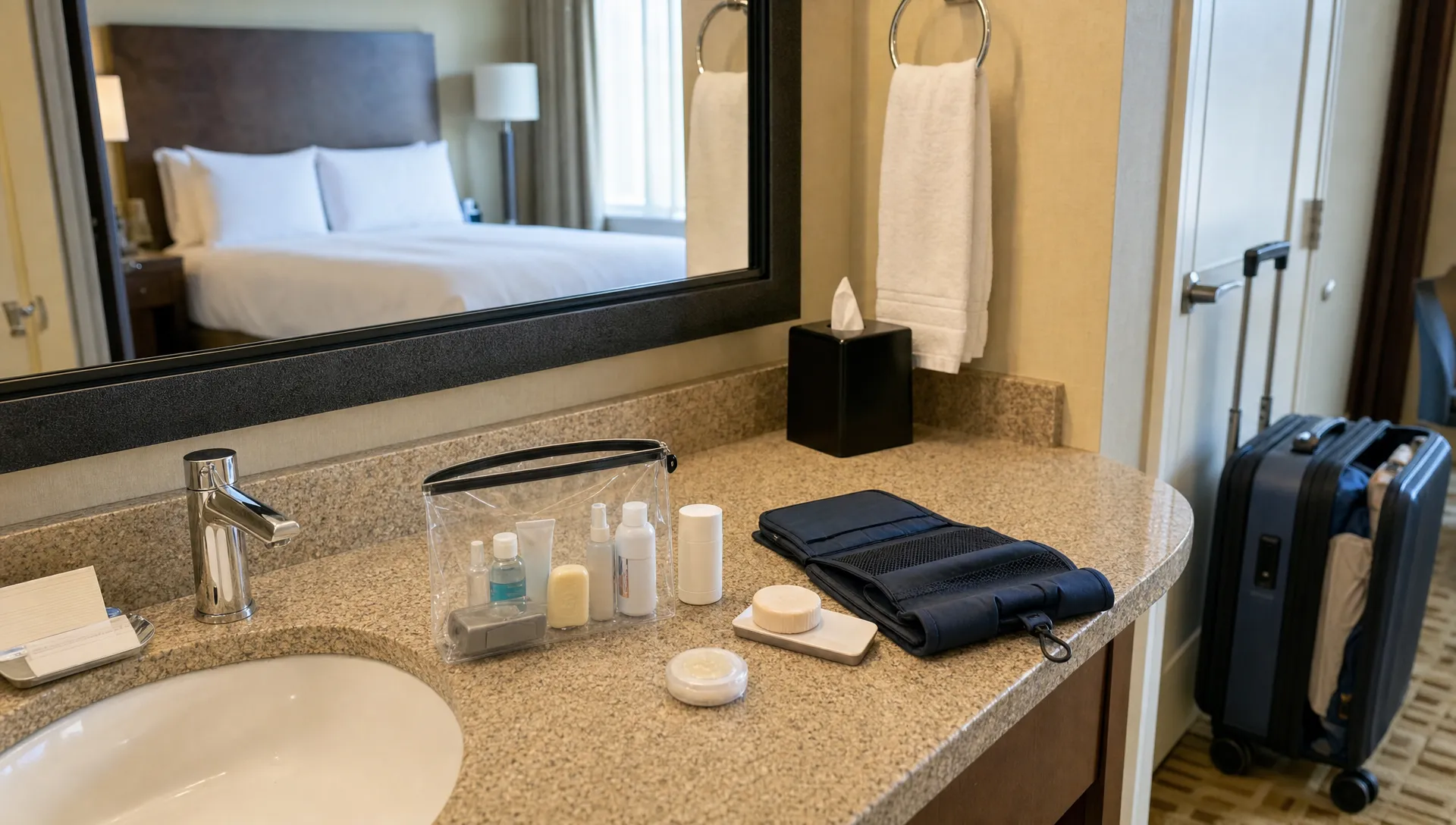
Packing toiletries in hand luggage gets confusing because airport security does not sort products the way bathroom shelves do. Toothpaste, mascara, shaving foam and sunscreen may look unrelated, yet all can fall under the same liquid, gel, paste or aerosol rule.
The safest way to think about toiletries you can take in hand luggage is by product texture, then by airport rule. If it can be poured, sprayed, spread, squeezed or smeared, assume it belongs in your liquids bag unless your airport confirms a larger allowance.
This product-by-product guide groups the toiletries you can take in hand luggage by type, so you can pack faster and avoid having a full-size bottle pulled at screening.
The basic hand luggage toiletries rule
At many airports, cabin liquids are limited to containers of 100 ml, or 3.4 oz, and those containers must fit into one clear resealable bag. The US Transportation Security Administration calls this the 3-1-1 liquids rule, while the UK government describes a similar 100 ml container limit on its hand luggage restrictions page.
The container size matters more than the amount left inside. A 150 ml shampoo bottle that is nearly empty can still be refused because the printed capacity is over the limit. Decanting into a 100 ml travel bottle is usually safer than bringing the original packaging.
Rules are not identical everywhere. Some airports with newer screening equipment may advertise larger liquid allowances, but that does not mean your connection, destination or return airport will accept the same items. If one airport on your route still applies the 100 ml rule, pack to that stricter rule.
Quick answer: toiletries you can take in hand luggage by type
The table below summarizes common toiletries you can take in hand luggage and how security usually treats them. Always check your exact airports before flying, especially if you are relying on a larger liquid allowance.
| Product type | Usually counts as a liquid, gel, paste or aerosol? | Hand luggage packing tip |
|---|---|---|
| Toothpaste | Yes | Use a 100 ml or smaller tube under standard rules |
| Mouthwash | Yes | Travel-size bottle only, unless an airport allows more |
| Shampoo and conditioner | Yes | Decant into small bottles or use solid bars |
| Body wash and shower gel | Yes | Pack in the clear liquids bag |
| Bar soap | No | Usually fine outside the liquids bag |
| Face cream and moisturizer | Yes | Creams count, even if they are thick |
| Sunscreen lotion or spray | Yes | Use a compliant container and protect it from leaks |
| Deodorant stick | Usually no | Solid sticks are usually easier than roll-ons or sprays |
| Roll-on deodorant | Yes | Treat as a liquid |
| Aerosol deodorant or hairspray | Yes | Must meet liquid size limits and have a cap |
| Mascara and lip gloss | Yes | Put them in the liquids bag |
| Powder makeup | No | May be screened separately if the container is large |
| Wet wipes | Usually no | Often allowed outside the liquids bag, but can be swabbed |
| Contact lens solution | Yes, often treated as medical | Larger amounts may be allowed, but expect separate screening |
| Nail polish | Yes | Keep it small and sealed because it is flammable |
Oral care: toothpaste, mouthwash and dental products
Toothbrushes, floss and interdental brushes are solid items, so they normally do not need to go in the liquids bag. Toothpaste is different. It is a paste, so security usually treats it like a liquid. The same goes for tooth whitening gel, gum gel, denture adhesive and many breath freshening sprays.
Mouthwash is straightforward because it is a liquid. A small travel bottle is the easiest option for short trips. For longer travel, buy it after arrival or pack a larger bottle in checked luggage if your airline and destination allow it.
If toothpaste is the only item you are unsure about, Liquid Limits has a dedicated guide to toothpaste in hand luggage that breaks down how different airport systems classify it.
| Oral care product | Cabin bag status under standard 100 ml rules |
|---|---|
| Toothbrush | Allowed outside liquids bag |
| Dental floss | Allowed outside liquids bag |
| Toothpaste | 100 ml or smaller in liquids bag |
| Mouthwash | 100 ml or smaller in liquids bag |
| Whitening gel | 100 ml or smaller in liquids bag |
| Denture adhesive | 100 ml or smaller in liquids bag |
Skin care: cleansers, creams, lotions and sunscreen
Skin care causes many hand luggage mistakes because creams and balms can feel solid in the pot. At airport security, face cleanser, toner, serum, moisturizer, body lotion, petroleum jelly, lip masks and hand cream are usually treated as liquids or gels.
Sunscreen also falls into this group. Cream, lotion, gel and spray sunscreens are normally subject to the liquid limit in hand luggage. Solid sunscreen sticks are often easier to pack, but they may not suit every skin type or destination. For more detail, check the Liquid Limits guide to sunscreen in hand luggage.
Wet wipes, makeup remover wipes and cleansing pads are usually not treated as liquids because the liquid is absorbed into the wipe. Even so, security officers may swab them, especially if you pack a large quantity.
Hair care: shampoo, conditioner, oils and styling products
Shampoo and conditioner are among the most common toiletries you can take in hand luggage, but they still need to meet the liquid rule at many airports. This includes liquid shampoo, conditioner, leave-in conditioner, hair masks, curl creams, scalp treatments and hair oils.
Styling products also count when they are gel, cream, mousse, wax in a soft paste, spray or aerosol. A small hair gel is usually fine in the liquids bag. A full-size mousse can or hairspray can is likely to be rejected from hand luggage under standard rules because it exceeds the container limit.
Solid swaps work well for hair care. Shampoo bars, conditioner bars and some solid styling sticks can travel outside the liquids bag, leaving more room for items that have no solid alternative.
Deodorant, perfume and aerosols
Deodorant depends on the format. A solid stick is usually not counted as a liquid. Roll-on deodorant, gel deodorant, cream deodorant in a pot and spray deodorant are usually counted. If the container is larger than 100 ml, do not rely on the fact that it is half empty.
Perfume, cologne and aftershave are liquids. Small atomizers are useful, but check that the atomizer itself is 100 ml or smaller and closes securely. Duty-free perfume bought after security may be allowed in a sealed tamper-evident bag, especially with a receipt, but connections can complicate this. A perfume that was fine at the departure airport can be questioned when you transfer.
Aerosols need extra care. Toiletry aerosols such as deodorant, hairspray, shaving foam and dry shampoo are often allowed in small compliant containers, but they should have a protective cap to prevent accidental release. Do not pack non-toiletry aerosols such as spray paint or camping gas in hand luggage.
Makeup and cosmetics
Makeup is one of the easiest categories to mispack because the rule changes by texture. Liquid foundation, concealer, primer, setting spray, mascara, liquid eyeliner, lip gloss, cream blush and cream highlighter usually belong in the liquids bag. Powder foundation, pressed powder, powder blush, eyeshadow palettes and most pencil eyeliners usually do not.
Lipstick is often treated as a solid, while lip gloss is treated as a liquid or gel. Mascara almost always counts because it is a liquid product inside a tube, even though the container looks small.
If your liquids bag is already full, switching a few products to powder or stick versions can make a big difference. Solid perfume, powder cleanser, bar soap and stick sunscreen can free up space for the items that truly need to be liquid.
Shaving, grooming and nail products
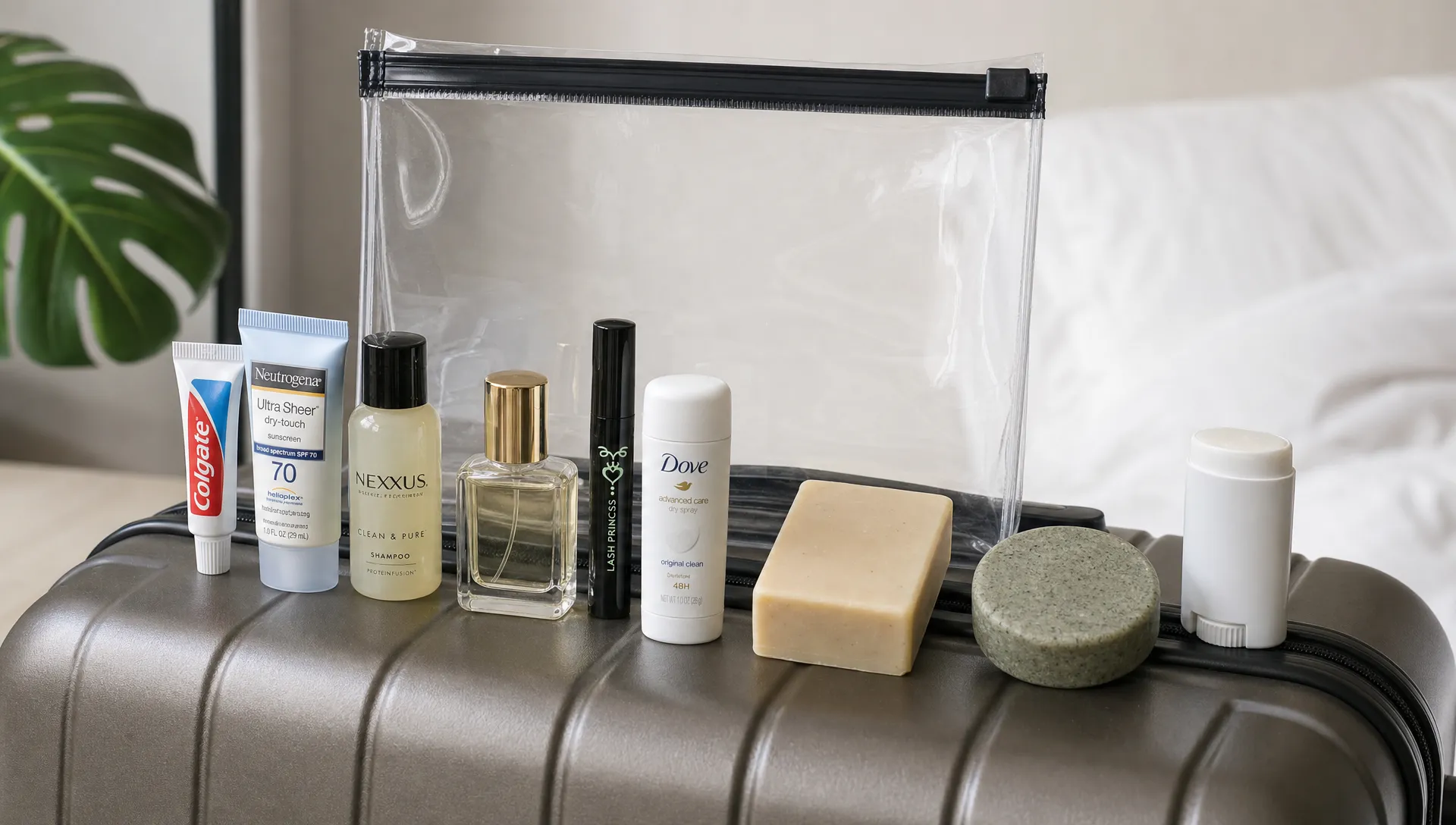
Shaving cream, shaving gel and aerosol shaving foam are treated as liquids or aerosols. Beard oil, aftershave balm and styling pomade are also likely to count if they can be poured, spread or squeezed. Disposable razors and cartridge razors are commonly allowed in cabin bags, but loose razor blades and some safety razor blades are restricted in many places.
Nail polish and nail polish remover are liquids, and they are also flammable. Small bottles for personal use are usually easier to justify than large bottles. Strong acetone remover is more likely to raise questions, so pack only what you need and make sure the cap is tight.
Nail clippers, tweezers and small grooming scissors may be allowed, but blade length rules vary by country. If an item has a sharp edge, check the airport rule rather than assuming it is allowed because it lives in your toiletry bag.
Medical, baby and accessibility toiletries
Some personal care items are toiletries in everyday language but medical items at security. Contact lens solution, eye drops, prescription creams, liquid medication, medical gels and special dietary liquids may be allowed in amounts above the usual liquid limit, depending on the airport and the circumstances.
The same is often true for baby milk, formula, sterilized water and baby food when you are traveling with an infant or child. These items normally need to be removed from your bag and presented separately for screening. Officers may test containers, ask questions or require documentation for prescription products.
Do not bury essential medication at the bottom of your hand luggage. Keep it accessible, keep labels on original packaging when possible and check both departure and return rules before you travel.
How to pack toiletries by product type
A good packing method separates products by screening treatment, not by bathroom routine. This makes it easier to remove only what security wants to see.
- Put liquids, gels, aerosols, creams and pastes in one clear resealable bag if your airport uses the standard liquid rule.
- Keep every container at 100 ml or smaller unless your specific airport and route confirm a larger allowance.
- Pack solid toiletries outside the liquids bag, including bar soap, solid deodorant, shampoo bars and powder makeup.
- Place exempt medical, baby or accessibility liquids separately so you can present them without unpacking everything.
- Protect leak-prone products with tightened caps, tape, small zip bags or reusable silicone sleeves.
- Recheck rules for your return airport, not just the airport where your trip begins.
This approach also helps when airports apply different technologies. If your outbound airport allows larger liquids but your return airport does not, you can still travel without throwing away products before the flight home.
The strictest airport on your route matters
The toiletries you can take in hand luggage are not always decided by your first flight. Round trips, layovers and separate tickets can expose you to different screening rules. A route that starts at an airport with relaxed liquid limits may return through an airport that still enforces the 100 ml rule.
This is especially relevant for travelers who buy full-size toiletries after security or at their destination. A large bottle of shampoo bought abroad might be fine in checked luggage, but it can be refused in hand luggage on the return trip.
Before you pack, check the exact airport, item and route. Liquid Limits is built for that situation because it compares airport liquid rules for the whole trip, includes last-checked dates and links to sources where available.
Frequently Asked Questions
Can I take full-size toiletries in hand luggage? Usually not if your airport applies the standard 100 ml rule. The container must normally be 100 ml or smaller, even if there is only a little product left inside. Some airports allow larger amounts with newer scanners, but you should verify the exact airport and route first.
Do solid toiletries need to go in the liquids bag? Usually no. Bar soap, solid deodorant, shampoo bars, conditioner bars, powder makeup and most lipsticks can normally stay outside the liquids bag. If a product is a soft cream, gel or paste, treat it as a liquid.
Are wipes counted as liquids at airport security? Wet wipes, face wipes and makeup remover wipes are usually allowed outside the liquids bag because the liquid is absorbed into the material. Large packs may still be checked or swabbed by security.
Can I bring aerosol deodorant or hairspray in hand luggage? Often yes, but only in a small compliant container under standard liquid rules. The aerosol should be a personal toiletry, not a hazardous aerosol, and it should have a cap or other protection against accidental spraying.
What toiletries you can take in hand luggage without using the liquids bag? Solid toiletries are the best choices. Common examples include toothbrushes, floss, bar soap, solid deodorant, shampoo bars, dry powder cosmetics, razors that comply with local blade rules and nail clippers where permitted.
What if my outbound airport allows 2 liters of liquids? Check every airport on your route, including your connection and return airport. If any airport still applies the 100 ml rule, pack to the stricter limit or move larger toiletries to checked luggage.
Check your toiletries before you pack
The easiest way to avoid losing products at security is to check the specific item and airport before you zip your bag. Use Liquid Limits to confirm the toiletries you can take in hand luggage for your route, including the return flight, with updated airport guidance and source links where available.