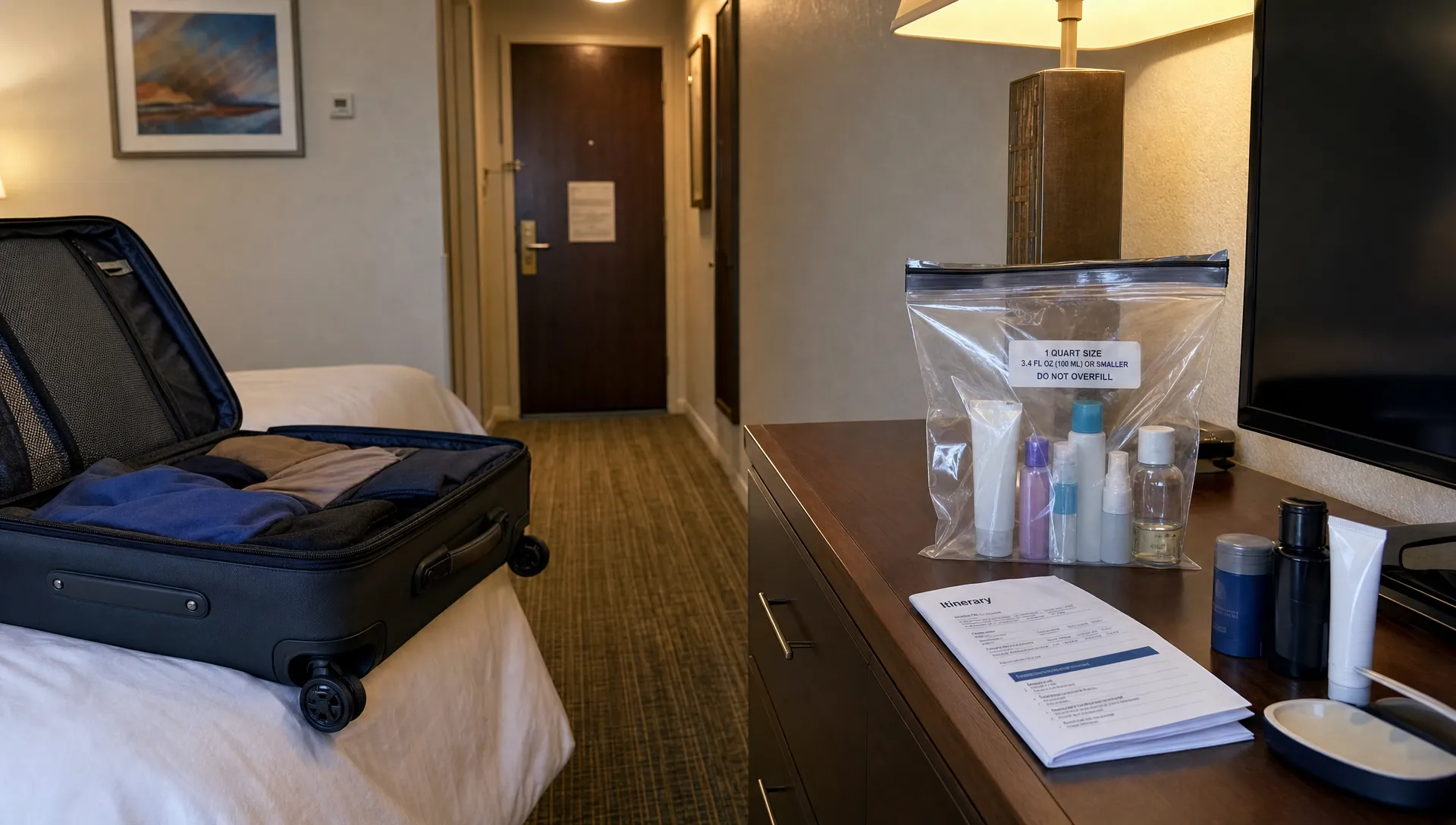
Packing liquids should not be the last thing you do before leaving for the airport. It should be a short, repeatable check that happens before your bag is zipped, because airport rules can depend on the airport, the item, the security checkpoint and sometimes the direction of travel.
A good travel airport liquids routine does three things: it confirms the strictest rule on your route, separates cabin liquids from checked baggage and catches the awkward items that do not look like liquids until a security officer treats them as one. The goal is not to memorize every rule worldwide. The goal is to leave home with no surprises in your toiletry bag.
Why a pre-departure routine matters
Many travelers pack based on the airport they depart from and forget the rest of the trip. That works only when every security checkpoint follows the same liquid limit. In practice, your return airport, transfer airport or secondary screening point may be stricter than your first departure airport.
The common cabin rule in many places is still built around small containers. The TSA liquids rule, for example, limits liquids, aerosols, gels, creams and pastes in carry-on bags to containers of 3.4 oz or 100 ml, all fitting in one quart-size bag. UK government guidance also explains the standard 100 ml container approach for hand luggage under hand luggage restrictions. Other airports may use different equipment or local procedures, but you should not assume a more generous allowance applies unless you have checked that airport specifically.
This is where a travel airport liquids routine saves time. Instead of asking, “Can I take this?” while standing at security, you answer it the day before, using the strictest rule that applies to the full route.
48 hours before departure: map the checkpoints, not just the flights
Start two days before you fly, especially if you are taking an international trip, connecting through another airport or returning from a different city. Open your itinerary and identify every place where you might go through security with your cabin bag.
That usually includes your departure airport, any airport where you leave the secure area during a connection and your return airport. If you buy duty-free liquids, it may also include a transfer checkpoint later in the journey.
Liquid Limits is built for this exact step. You can check airport liquid rules before you pack by airport, item or route, then compare the stricter cabin rule for your outbound and return trips. The tool includes daily updates, source links and last-checked dates, and it defaults to the stricter 100ml rule when a rule is unclear.
Use this first check to make one simple decision: will your cabin liquids be packed for 100ml, a route-specific larger allowance or checked baggage instead?
| Timing | What to check | What to decide |
|---|---|---|
| 48 hours before | Departure, connection and return airports | Which checkpoint has the strictest cabin rule |
| 24 hours before | Toiletries, foods, medicines and purchases | What stays in cabin baggage |
| Night before | Container sizes and liquid bag fit | What must be decanted, checked or left behind |
| Morning of travel | Last-minute items from bathroom or fridge | What gets removed before leaving home |
If one airport on the trip still requires 100ml containers, pack as if every airport does. That is usually easier than rebuilding your toiletry kit during a connection or before the return flight.
24 hours before departure: sort liquids by destination
The day before travel, gather every liquid-like item in one place. Do not start with the bag. Start with the items, because liquids are often scattered across the bathroom, medicine cabinet, kitchen, gym bag and coat pockets.
Sort each item into one of four destinations: cabin bag, checked bag, buy after security or leave at home. This is the fastest way to avoid the common mistake of packing a full-size product in carry-on because it was already in your wash bag.
| Item type | Cabin bag approach | Better option if oversized |
|---|---|---|
| Shampoo, conditioner, body wash | Use containers within the applicable cabin limit | Pack in checked baggage or buy on arrival |
| Toothpaste, gel deodorant, creams | Treat as liquids or gels | Use travel-size versions |
| Peanut butter, jam, soft cheese, dips | Treat as spreadable liquids | Pack in checked baggage if allowed |
| Perfume and aftershave | Check container size and total bag fit | Choose a smaller bottle |
| Contact lens solution | Check size rules and medical allowances | Pack backup in checked baggage |
| Duty-free alcohol or cosmetics | Keep sealed with receipt if required | Avoid if you have another security checkpoint |
Borderline items cause many problems because travelers think “liquid” means water, shampoo and drinks only. Airport security often treats gels, aerosols, creams, pastes and spreadables as liquids for cabin screening. If you want a deeper item-by-item breakdown, Liquid Limits has a guide to airport security liquid limits for common items.
A practical rule helps: if it can be poured, sprayed, squeezed, smeared or spread, check it before you pack it in your cabin bag.
The night before: build your cabin liquid kit
The night before travel is when the routine becomes physical. Put your approved cabin liquids into their clear bag or designated pouch and make sure every container is within the applicable size limit. A half-empty 200ml bottle is still a 200ml container at many checkpoints, so the printed container capacity matters more than how much product remains inside.
For a 100ml route, use proper travel containers with readable labels where possible. Security officers need to make quick decisions. A plain unmarked bottle is not automatically forbidden, but a bottle with no visible capacity can invite extra screening or disposal if the officer cannot verify it.
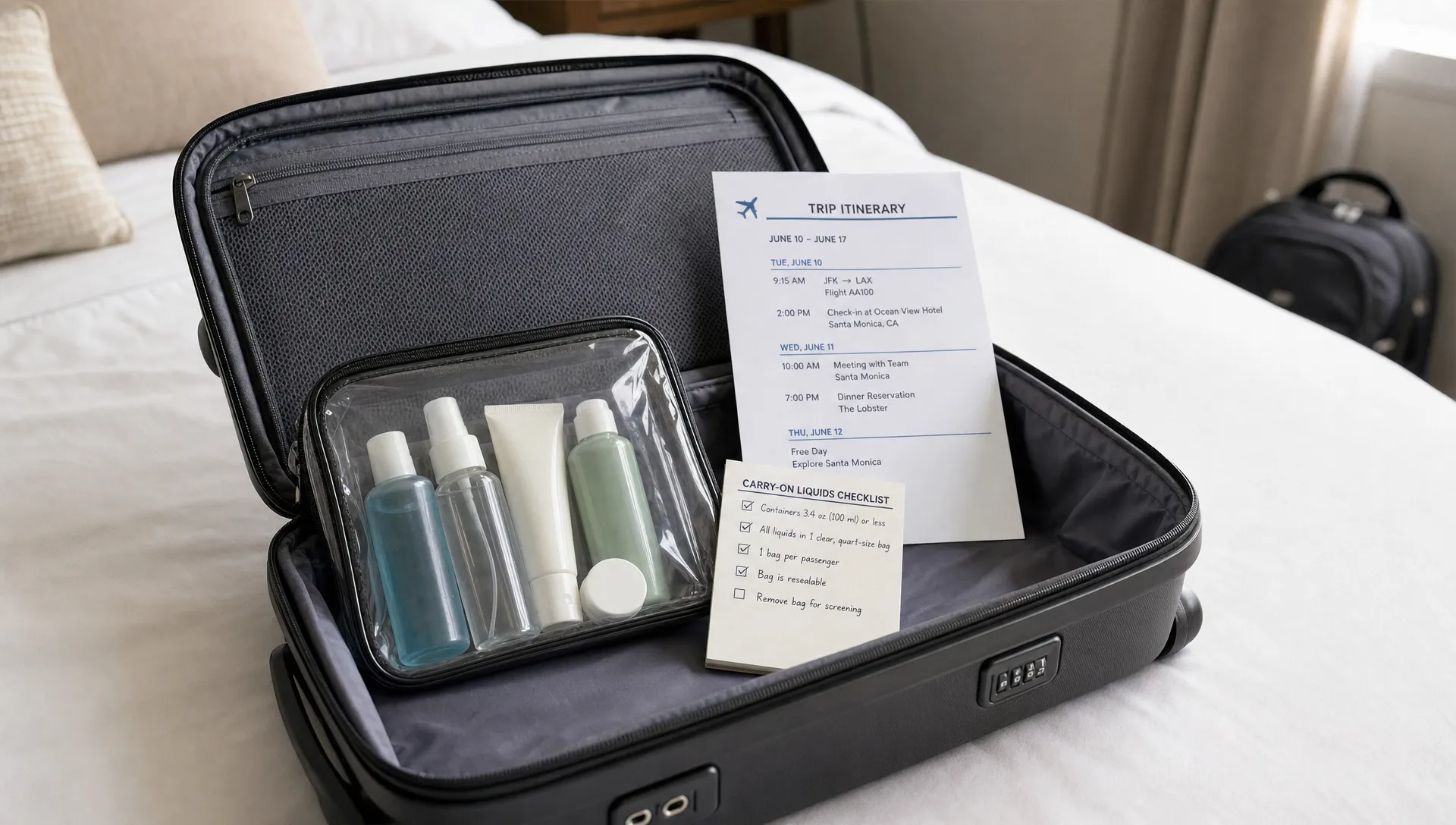
This travel airport liquids step should also include a fit check. Do not wait until the airport to discover that your liquids bag will not close. Remove anything you do not truly need during the journey, then move backups and full-size products to checked baggage if you are checking a bag.
Prioritize the items you might need before arrival: hand cream, lip balm, medication, contact lens solution, small toothpaste, deodorant and a minimal skincare routine. Most travelers overpack liquids because they pack for their full bathroom routine instead of the travel day.
Morning of travel: the 10-minute final sweep
The final sweep catches the liquids that enter your bag after the main packing is done. These are often the items you used that morning and forgot to re-check: toothpaste, sunscreen, makeup, perfume, hair gel, face mist, hand sanitizer or a drink bottle.
Before leaving home, do a quick scan of three places: bathroom counter, bedside table and kitchen. Empty reusable bottles unless you know you can take them through empty and refill them after security. Check jacket pockets and small personal bags, too. A full-size hand cream in a purse can cause the same problem as one in a suitcase.
This is also the moment to confirm that your return trip has not changed. If you saved your itinerary in a trip tool, re-open it and check the latest status. Airport liquid rules can change, and flight disruptions can reroute you through a different airport with a stricter checkpoint.
Return trips need their own liquid check
Many travelers are careful on the outbound flight and careless on the way home. Return trips create new liquid risks because you may have bought cosmetics, sunscreen, wine, olive oil, perfume, sauces or gifts during the trip.
Do not pack your return liquids based on what passed at your home airport. Check the departure airport for the return journey and any transfer airports. If your trip includes multiple airports, this guide to packing cabin bag liquids for every airport on your route explains why the strictest checkpoint should drive your packing plan.
For souvenirs, decide before you buy. If the item is liquid, gel, paste, cream or spreadable, ask yourself whether it can go in checked baggage, whether it meets the cabin limit and whether you will pass another security checkpoint after purchase. Duty-free sealed bags can help in some situations, but they are not a universal pass for every route.
A return-focused travel airport liquids routine is especially useful on city breaks, where travelers often fly out with one small bag and return with more products than they planned to carry.
What to do when an item does not fit the rule
If an item fails your liquid check, you still have options. The right choice depends on how essential the item is, whether you are checking a bag and whether the item is replaceable at your destination.
| Option | Best for | Watch out for |
|---|---|---|
| Decant into a smaller container | Toiletries used in small amounts | Label the container if possible |
| Move to checked baggage | Full-size products and souvenirs | Protect against leaks and breakage |
| Buy after security | Drinks and some travel essentials | Rules may still apply at transfers |
| Buy on arrival | Common toiletries | Not ideal for late arrivals or remote destinations |
| Leave at home | Nonessential products | Saves space and reduces screening risk |
Checked baggage usually gives you more flexibility for liquids, but it is not a free-for-all. Airlines and governments may restrict hazardous items, aerosols, flammable products or alcohol by strength and quantity. If an item is unusual, expensive or regulated, verify it before you pack.
Medicines, baby items and special needs
Some liquids may be allowed in larger amounts when they are medically necessary or needed for infants and young children. These exceptions vary by country and airport, and they often require you to present the item separately for screening.
Do not bury essential medication under clothes or mix it with regular toiletries. Keep it accessible, ideally in original packaging when practical, and carry supporting documentation if the route or item makes that sensible. For baby milk, formula, sterilized water or special dietary liquids, check the exact airport rule before departure because procedures can differ.
The key is to treat exceptions as a separate part of your travel airport liquids routine, not as an afterthought. “Allowed” does not always mean “screened the same way as everything else.” Give yourself extra time and make the items easy to inspect.
A simple pre-departure packing routine you can reuse
Use the same sequence every time you fly. It takes a few minutes once you know the pattern, and it is far more reliable than trying to remember rules from your last trip.
- Check every security checkpoint on the outbound and return route.
- Identify the strictest cabin liquid rule and pack to that standard.
- Gather all liquids, gels, aerosols, creams, pastes and spreadables in one place.
- Sort each item into cabin bag, checked bag, buy later or leave at home.
- Confirm container sizes, not just how much product is left inside.
- Keep exceptions like medication and baby items accessible for screening.
- Do a final bathroom, kitchen and pocket sweep before leaving.
For an even more detailed list, you can compare your routine with this travel liquids checklist for stress-free security. The checklist approach works well if you pack for a family, a long-haul trip or a route with several airports.
Frequently Asked Questions
What counts as a liquid at airport security? Many airports treat liquids, gels, aerosols, creams, pastes and spreadable foods as liquids for cabin screening. That can include toothpaste, mascara, sunscreen, peanut butter, soft cheese and hair gel.
Should I pack to the departure airport rule or the return airport rule? Pack to the strictest rule across the whole trip, including your return airport and any connection where you may pass through security again. This is the safest approach for travel airport liquids because rules can differ by airport.
Can I bring a half-empty full-size bottle in my carry-on? At many checkpoints, the container size matters. A half-empty 200ml bottle may still be refused if the cabin limit is 100ml per container.
Are duty-free liquids always allowed through connections? No. Duty-free liquids may need to stay sealed in approved security bags with proof of purchase, and transfer rules can vary. If you have another security checkpoint, check the route before buying.
Do medicines have to follow the 100ml rule? Medically necessary liquids may have exceptions in many places, but screening procedures vary. Keep them separate, accessible and supported by documentation when appropriate.
Check once, pack with confidence
A strong travel airport liquids routine is not complicated. Check the full route, pack for the strictest checkpoint and separate anything that needs special handling before you leave home.
Before your next flight, use Liquid Limits to compare airport rules, item guidance and route restrictions with source links and last-checked dates. It is a small pre-departure step that can prevent a rushed repack at security.