
Packing toiletries should not feel like a legal exam. Yet travel limits on liquids can get confusing fast, especially when one airport advertises newer scanners, another still enforces 100ml containers, and your return flight leaves from a different country.
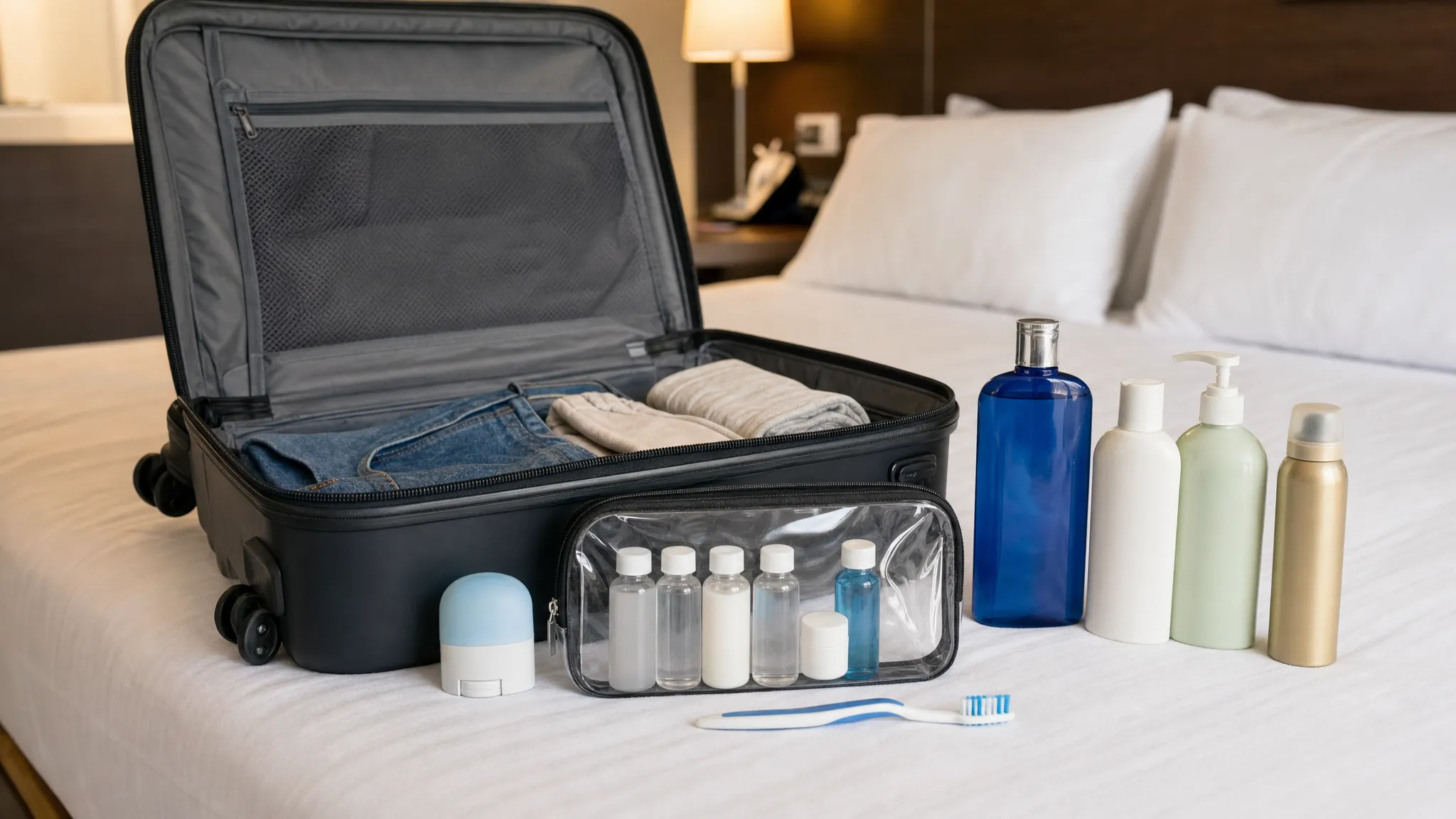
The simplest approach is this: pack for the strictest airport security rule you will face on the whole trip. That usually means 100ml, or 3.4 oz, containers in a small clear liquids bag. Some airports and lanes may allow larger containers where approved scanners are in use, but you should not assume that rule applies to every flight, connection, or return journey.
This guide breaks down the cabin bag rules in plain English, explains what counts as a liquid, and shows you how to avoid losing toiletries, food gifts, drinks, or makeup at security.
The simple cabin liquid rule to remember
For most travelers, the safest default is the familiar 100ml rule. Under the TSA 3-1-1 liquids rule, liquids, gels, aerosols, creams, and pastes in carry-on bags must be in containers of 3.4 oz, or 100ml, or less. Those containers must fit inside one quart-sized clear bag.
Many other countries use a similar rule. In the UK, for example, GOV.UK hand luggage guidance says liquids in hand luggage are generally limited to containers of 100ml or less, placed in a single transparent resealable plastic bag.
Here is the practical version:
- Each liquid container should be 100ml, 3.4 oz, or smaller.
- The size printed on the container matters, not how much product is left inside.
- A half-empty 200ml shampoo bottle is still treated as a 200ml container.
- Containers usually need to fit inside one clear resealable bag, around 1 liter or one quart.
- If an airport officer says an item is a liquid, gel, paste, cream, or aerosol, treat it as one.
That last point matters because airport security definitions are broader than many travelers expect. Peanut butter, mascara, toothpaste, jam, soft cheese, sunscreen, hair gel, and liquid foundation can all fall under the liquid rules.
What counts as a liquid in a cabin bag?
Airport security is not only looking for water, perfume, or shampoo. The rules normally cover liquids, aerosols, gels, creams, and pastes, often shortened to LAGs. If an item can be poured, spread, squeezed, sprayed, smeared, or scooped, it may be treated as a liquid for cabin screening.
This is why travelers are sometimes surprised when a food souvenir or beauty product is stopped at the checkpoint. A solid lipstick is usually different from liquid lip gloss. Powder blush is usually different from liquid foundation. A hard cheese is different from soft spreadable cheese.
| Item | Usually treated as a cabin liquid? | What to do |
|---|---|---|
| Shampoo, conditioner, shower gel | Yes | Use 100ml containers or pack full sizes in checked baggage |
| Toothpaste and mouthwash | Yes | Keep within the cabin liquid limit |
| Perfume and cologne | Yes | Use travel-size bottles and check airline aerosol or flammable rules if relevant |
| Mascara, liquid foundation, lip gloss | Yes | Pack small containers in the liquids bag |
| Solid lipstick, powder makeup | Usually no | Pack normally, unless local screening says otherwise |
| Jam, honey, peanut butter, sauces | Yes | Use small containers or put larger jars in checked baggage |
| Bottled water and drinks | Yes | Empty before security unless bought airside |
| Medication in liquid form | Often exempt when necessary | Declare it and carry supporting information if appropriate |
| Baby milk, formula, or baby food | Often exempt in reasonable quantities | Be ready for extra screening |
Makeup is a common gray area because some products are solid, while others are gels, liquids, creams, or pastes. If you are flying internationally with cosmetics, a route-specific check can help. For example, Liquid Limits has a dedicated guide for taking makeup from the UK to the USA, which separates cabin, checked baggage, and TSA considerations.
Food gifts create similar surprises. A sealed jar may look harmless in your bag, but if it is spreadable or spoonable, security may treat it as a liquid or paste. That is why a souvenir such as jam often needs to follow the 100ml cabin rule, as shown in this guide to taking jam from the UK to the USA.
Why some airports mention 2L liquid limits
Newer airport security scanners can inspect cabin bags in more detail. At some airports, this has allowed larger liquid containers, sometimes up to 2 liters, and passengers may not need to remove liquids or laptops from bags.
The problem is consistency. Scanner upgrades do not happen everywhere at once. Even within the same airport, one terminal, checkpoint, or lane may operate differently from another. Rules can also change while authorities test equipment, update procedures, or respond to safety notices.
That creates a simple travel risk: your outbound airport may allow a larger container, but your return airport or connecting airport may not.
For example, you might leave from an airport using newer scanners, buy full-size toiletries, then return through an airport that still requires 100ml containers. Or you might connect through a hub where transfer security applies the stricter rule. In that case, the bottle that was allowed on your first flight could be refused later.
This is where checking your whole route matters. Instead of asking, “What is the liquid limit at my departure airport?” ask, “What is the strictest liquid limit across every airport where my cabin bag will be screened?” You can use Liquid Limits to check airport liquid rules before you pack, including route and return-flight differences.
A quick packing method that works almost everywhere
If you do not want to research every airport, pack as if the 100ml rule will apply. It is not always the most generous rule, but it is usually the safest fallback for cabin bags.
Use this method before you zip your bag:
- Put full-size shampoo, conditioner, sunscreen, body lotion, perfume, sauces, drinks, and spreadable foods in checked baggage when possible.
- Move must-have toiletries into bottles labeled 100ml, 3.4 oz, or smaller.
- Choose solids where you can, such as bar soap, solid deodorant, solid shampoo, powder makeup, and balm sticks.
- Keep your liquids bag easy to remove, even if your airport says liquids can stay inside your bag.
- Check the return airport, not only the outbound airport.
- If the rule is unclear, assume the stricter 100ml limit.
This method is especially useful for multi-city trips. A traveler flying New York to London to Rome and back from Madrid does not just need one airport’s policy. They need the rule for every security checkpoint where the cabin bag may be screened.
Exemptions: medicine, baby items, and special dietary needs
The 100ml rule is not meant to prevent passengers from carrying essential medical or baby items. Many security authorities allow exceptions for medically necessary liquids, baby milk, baby formula, baby food, and special dietary liquids in reasonable quantities.
However, “exempt” does not mean “no screening.” You may need to remove these items from your bag, tell the officer what they are, and allow extra checks. In some countries, security may ask for proof, such as a prescription, doctor’s note, pharmacy label, or explanation of why the item is needed during the journey.
Good practice is simple. Keep essential liquids in their original packaging where possible, carry only what you reasonably need for the trip, and allow extra time at security. If you are traveling with a baby, pack baby liquids together so they are easy to present.
Do not hide exempt liquids inside a general toiletries bag and hope they pass unnoticed. Declaring them calmly is usually smoother than waiting for a bag search.
Duty-free liquids are not always problem-free
Duty-free alcohol, perfume, and cosmetics bought after security are often allowed onto the aircraft because they were purchased airside. For international journeys, many airports place these items in a sealed security tamper-evident bag, often called a STEB, with the receipt inside.
The catch is connecting flights. If you have to pass through transfer security, your sealed duty-free liquids may be checked again. Some airports accept properly sealed bags from recognized retailers, while others may apply stricter rules or additional screening.
If you are buying expensive perfume, spirits, or cosmetics on a trip with connections, check the rules for your transfer airport before you buy. Keep the receipt visible inside the sealed bag and do not open the bag until you reach your final destination.
Alcohol also has airline, customs, and safety considerations beyond liquid screening. For instance, cabin security, checked baggage, and import allowances are separate topics when bringing alcohol home. Liquid Limits covers those differences in route guides such as taking wine from Spain to the UK.
Cabin liquid limits vs checked baggage rules
Cabin liquid limits are airport security rules. Checked baggage rules are different. In checked luggage, you can often pack larger toiletries and many liquid foods, but that does not mean every liquid is allowed without limits.
| Question | Cabin bag | Checked bag |
|---|---|---|
| Are 100ml container limits common? | Yes, unless a newer local rule allows more | Usually no for ordinary toiletries |
| Can officers inspect or remove items? | Yes, at passenger security | Yes, during baggage screening |
| Do customs rules still apply? | Yes | Yes |
| Do airline dangerous goods rules apply? | Yes | Yes |
| Best use | Essentials needed during travel | Full-size toiletries, larger foods, nonessential liquids |
Checked baggage is usually the best place for large bottles of shampoo, sunscreen, sauces, jams, oils, and drinks, as long as they are legal to transport and import. Pack them carefully in sealed bags to prevent leaks, especially if the container is glass.
Be more cautious with aerosols, flammable liquids, high-strength alcohol, fuel, solvents, and chemicals. These may be restricted by aviation safety rules, not just airport liquid limits. If an item is pressurized, flammable, corrosive, or toxic, check the airline and official dangerous goods guidance before packing it anywhere.
The most common liquid-rule mistakes
Most checkpoint problems come from a few simple misunderstandings. If you avoid these, you are already ahead of many travelers.
- Packing a 200ml bottle that is “almost empty” and expecting it to count as under 100ml.
- Forgetting that gels, creams, pastes, sprays, and spreadable foods count too.
- Checking the outbound airport but not the return airport.
- Assuming a 2L scanner rule applies at every airport on the journey.
- Buying duty-free liquids before a connection without checking transfer rules.
- Packing liquid medication deep inside a bag instead of presenting it clearly.
- Bringing homemade or unlabeled liquids that are hard for officers to identify.
The safest mindset is to treat the 100ml rule as your baseline, then upgrade only when you have verified that a more generous rule applies to every relevant screening point.
How to check the rule before you fly
Airport websites, national transport authorities, and security agencies are the best official sources. The challenge is that travelers often need to compare several pages, especially for round trips and routes with connections.
When checking liquid rules, look for four details:
- The maximum container size allowed in cabin baggage.
- Whether liquids must fit inside a clear bag.
- Whether newer scanner rules apply to your terminal or all terminals.
- Whether your return and transfer airports use the same rule.
Liquid Limits is built around that exact problem. It checks airport, item, and route liquid rules, shows source links and last-checked dates, and defaults to the stricter 100ml rule when the rule is unclear. That conservative fallback is useful because the cost of being wrong is usually losing the item at security.
Frequently Asked Questions
What are the travel limits on liquids for cabin bags? The safest general rule is containers of 100ml, or 3.4 oz, or less, placed in a small clear resealable bag. Some airports with approved newer scanners may allow more, but you should verify the rule for every airport where your cabin bag will be screened.
Does the 100ml rule mean 100ml left in the bottle? No. Security normally looks at the container’s marked capacity. A 200ml bottle with only a small amount left can still be refused because the container is larger than 100ml.
Are creams, gels, and pastes treated as liquids? Yes, they usually are. Toothpaste, hair gel, sunscreen, liquid makeup, mascara, jam, honey, sauces, and peanut butter can all be treated as liquids, gels, pastes, or creams for cabin screening.
Can I bring liquid medicine over 100ml? Often yes, if it is medically necessary for your journey, but it may need extra screening. Keep it easy to access, carry supporting information when possible, and declare it to security officers.
Can I bring baby milk or baby food over 100ml? Many airports allow baby milk, formula, and baby food in reasonable quantities, but they can be screened separately. Rules and procedures vary by country, so check your departure and return airports.
What if my airport allows 2L liquids? You may be able to carry larger containers from that airport, but only if the rule applies to your terminal and screening lane. Check your return and transfer airports too, because a later checkpoint may still enforce 100ml.
Should I put liquids in checked baggage instead? Put nonessential full-size liquids in checked baggage when possible, especially toiletries, sauces, jams, and larger cosmetics. Still check airline safety rules, customs rules, and leak protection.
Check your liquid limit before you pack
Liquid rules are simple when you know the strictest checkpoint on your trip. Before you pack, use Liquid Limits to compare airport, item, and route rules, including the return flight. You will see verified guidance with source links and last-checked dates, so you can decide what goes in your cabin bag and what belongs in checked luggage.