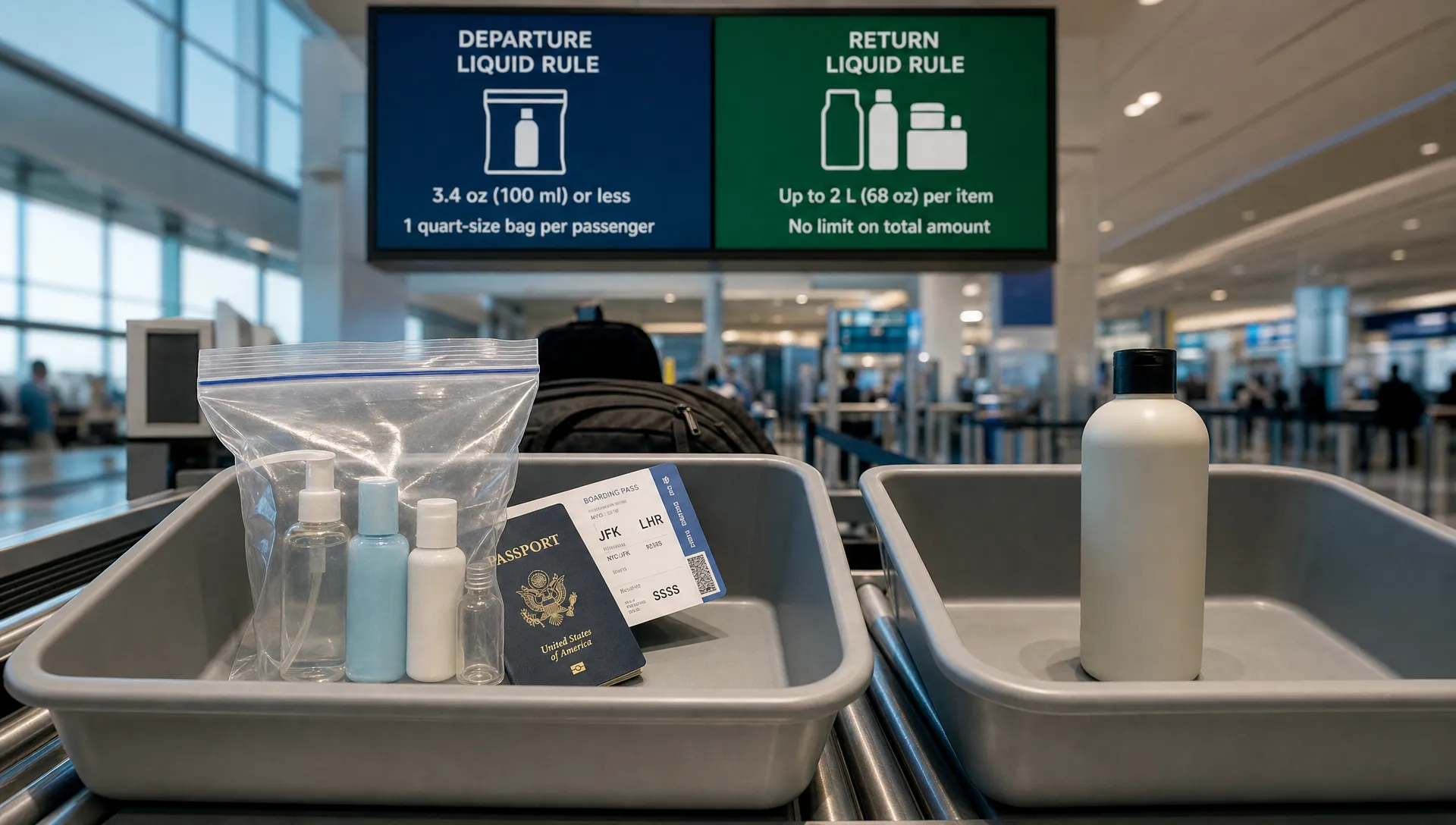
Travel liquid guidelines are easiest to follow when you think in terms of security checkpoints, not just flights. Your airline may sell you one round-trip ticket, but airport security can treat each departure, connection, and return leg as a separate screening event with its own rules.
That matters because the liquid rule you see at your home airport may not be the rule you face on the way back. Some airports use newer screening equipment and may allow larger containers in certain lanes or terminals. Others still apply the familiar 100 ml, 3.4 oz cabin limit. Some routes involve transfer screening, while others do not. If you pack only for the most generous rule, you risk losing toiletries, cosmetics, drinks, sauces, or duty-free purchases before your return flight.
The safest approach is simple: pack for the strictest liquid rule on your whole trip unless every checkpoint clearly allows more.
The core rule: the strictest checkpoint wins
Airport liquid rules are enforced where your cabin bag is screened. That usually means the airport where you start your flight, but it can also include a connection airport, a self-transfer, or the airport where your return flight begins.
For many travelers, the practical baseline is still the 100 ml rule. Under the TSA liquids rule, carry-on liquids, gels, and aerosols are generally limited to containers of 3.4 oz, 100 ml, that fit in one quart-size bag. UK government guidance also lists a 100 ml container limit for many hand luggage liquids under hand luggage restrictions.
Some airports have introduced advanced scanners that can change how liquids are screened. In certain places, passengers may be told they can leave liquids inside bags or carry larger containers. But these allowances can vary by country, airport, terminal, lane, equipment status, and date. They can also change after security policy updates.
That is why the strictest-checkpoint mindset is so useful. If any airport on your route still requires 100 ml containers, pack cabin liquids as if the whole trip requires 100 ml containers.
Where liquid rules can change on a trip
A return trip can include more screening points than people expect. Even if your outbound flight is simple, your return may start at an airport with different rules. If you connect through another airport, you may be screened again before boarding the next flight.
The table below shows the checkpoints travelers should check before packing.
| Trip situation | Liquid rule to check | Why it matters |
|---|---|---|
| Nonstop outbound flight | Departure airport | This is where your cabin bag is first screened. |
| Nonstop return flight | Return departure airport | The return airport may apply a stricter or different rule. |
| Connection on one ticket | Origin airport and any transfer screening airport | Some connections require passengers to clear security again. |
| Self-transfer between airlines | Every airport where you exit and re-enter security | Collecting bags or changing terminals can create a new screening event. |
| Stopover or overnight connection | The airport where you restart the journey | Once you leave the secure area, you are screened again. |
| Duty-free purchase before a connection | Purchase airport and connection airport | Liquids may need to remain sealed with proof of purchase. |
The most overlooked checkpoint is the return airport. A traveler may depart from an airport that allows larger liquids, buy full-size toiletries during the trip, and then discover that the return airport still enforces 100 ml rules. If those items are in cabin baggage, they may be refused at security.
For a deeper explanation of why round trips can create different liquid limits, see this guide to rules for liquids on flights and return trips.
What counts as a liquid at airport security
Airport security does not only mean water bottles and shampoo. In most screening systems, “liquids” includes gels, creams, pastes, aerosols, and spreadable substances. If it can be poured, squeezed, sprayed, smeared, or spread, treat it as a liquid unless official guidance says otherwise.
| Item type | Common examples | Cabin packing advice |
|---|---|---|
| Liquids | Water, perfume, mouthwash, liquid foundation | Use containers of 100 ml or less unless every checkpoint allows more. |
| Gels | Hair gel, aloe gel, gel deodorant | Treat as liquid for security screening. |
| Creams and lotions | Sunscreen, moisturizer, hand cream | Container size usually matters, not how much is left inside. |
| Pastes | Toothpaste, peanut butter, spreads | Pack small containers in your liquids bag. |
| Aerosols | Deodorant spray, shaving foam, hairspray | Follow liquid limits and check airline or hazardous materials rules. |
| Food-like liquids | Yogurt, jam, sauces, honey | Treat as liquids if carried through security. |
A common mistake is bringing a half-empty full-size bottle. If a 200 ml bottle contains only 50 ml of shampoo, security may still reject it because the container capacity is over the limit. Decanting into travel-size bottles is usually safer.
Cabin bag, checked bag, and duty-free liquids are different
The 100 ml rule is mainly a cabin baggage screening rule. Checked baggage is not screened in the same passenger lane, so larger toiletries and liquids can usually go in checked luggage. However, checked baggage has its own limits for hazardous materials, flammable items, aerosols, alcohol strength, and airline-specific restrictions. For potentially hazardous products, the FAA’s PackSafe guidance is a useful reference for U.S. travelers.
Duty-free liquids are another category. Many international security systems allow duty-free liquids over 100 ml if they are packed in a sealed, tamper-evident bag with the receipt visible. But this is not a universal guarantee. If you have a connection, transfer screening may still inspect the bag, and rules can depend on where the liquid was purchased and where you are connecting.
| Where the liquid is packed | Typical rule | Best use |
|---|---|---|
| Carry-on bag | Often limited to 100 ml containers in a clear bag | Essential toiletries, medicine, small cosmetics. |
| Checked bag | Larger containers usually allowed, subject to safety limits | Shampoo, sunscreen, gifts, wine, sauces, full-size products. |
| Duty-free sealed bag | May be allowed through some transfers if sealed with receipt | Airport purchases after security, especially international flights. |
| Personal medical or baby items | Often exempt from standard size limits when reasonable and declared | Medication, baby milk, formula, special dietary liquids. |
If an item would be expensive or difficult to replace, do not rely on a generous interpretation at security. Put it in checked baggage when possible, or verify the exact route rules before you travel.
Build your return-trip liquid plan before you leave
The best time to think about your return flight is before your outbound flight. That way, you know whether you can buy full-size liquids during your trip, whether you should bring checked baggage, and whether your duty-free purchases are likely to survive transfer screening.
Start by listing every airport where your cabin bag may be screened. Include the outbound departure airport, any connection airport where you might pass through security again, the return departure airport, and any return connection airport. Then check the liquid rules for each airport, not just the first one.
Next, separate your liquids into three groups: must-have cabin items, optional toiletries, and liquids you can buy after arrival. Must-have cabin items should be small, clearly packed, and easy to remove if required. Optional liquids are better in checked baggage. Purchases made during the trip should be planned around the return airport’s rule.
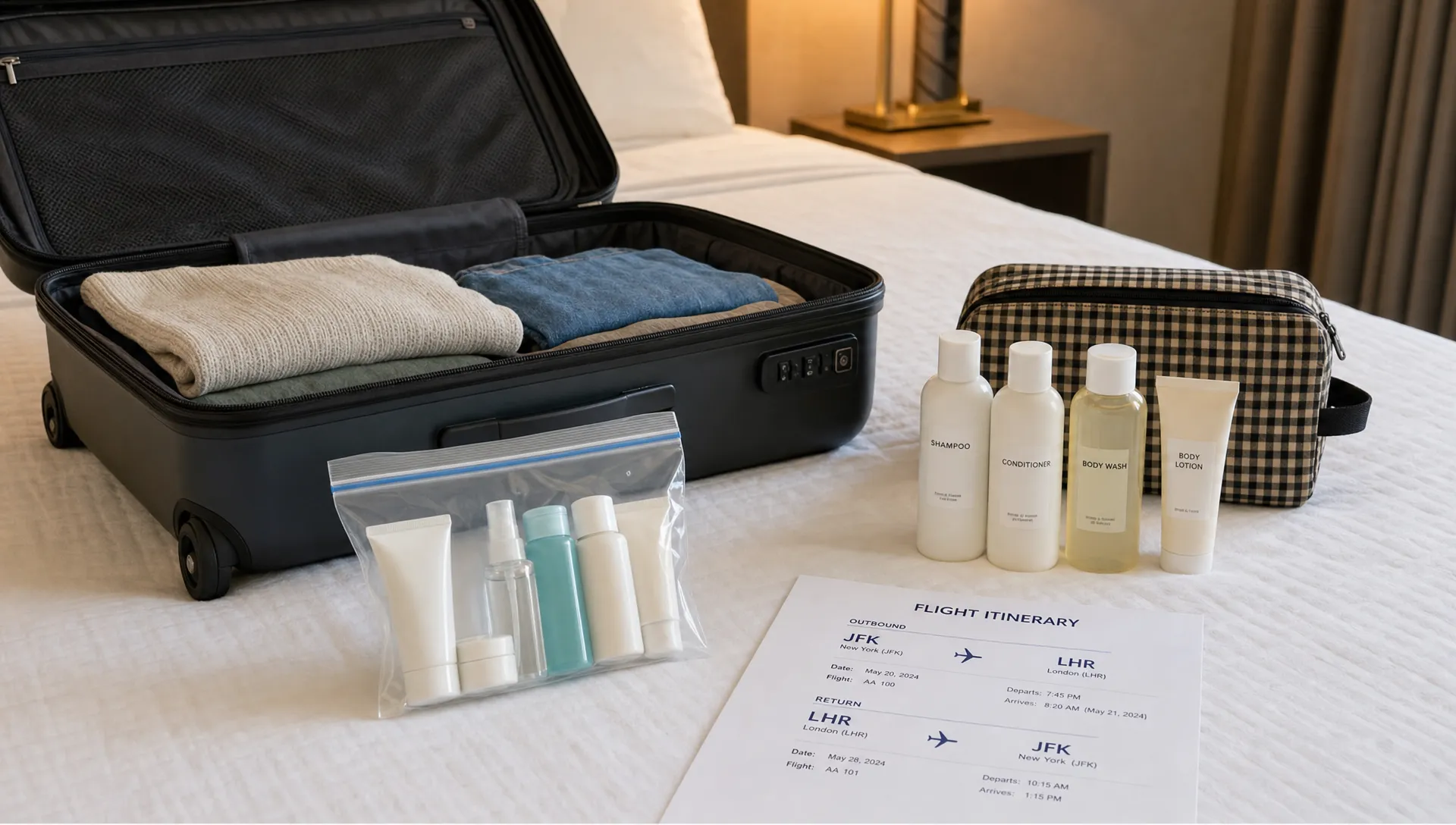
A simple rule helps: if you are not sure whether a full-size liquid will be allowed on the return, assume it will not be allowed in your cabin bag. This prevents the classic return-trip problem, where someone buys sunscreen, perfume, sauce, or skincare abroad and has to abandon it at security.
A strictest-route packing table
Use this decision table when the rules on your route are mixed or unclear.
| What you find when checking your route | How to pack cabin liquids | Why |
|---|---|---|
| Every airport clearly allows larger cabin liquids | Follow the most restrictive published allowance among those airports | Rules may still differ by terminal or screening lane. |
| One airport still lists the 100 ml rule | Pack all cabin liquids in 100 ml containers | That airport can reject larger containers. |
| A connection may require transfer screening | Keep transfer liquids within the strictest connection rule | You may face security again before the next flight. |
| The return airport rule is unclear | Use the 100 ml fallback | Unclear guidance is not worth the risk of confiscation. |
| You need full-size liquids | Put them in checked baggage when allowed | Checked baggage avoids the passenger liquid bag limit. |
This table is especially useful for multi-city trips. The more airports you pass through, the less useful a single airport’s rule becomes. Your real limit is the tightest rule that applies before the last time your cabin bag is screened.
Special cases that deserve extra attention
Medicines, baby food, infant milk, and special dietary liquids are commonly treated differently from ordinary toiletries. Many security authorities allow reasonable quantities when they are needed during the journey, but travelers may need to present them separately, declare them, or provide supporting information. Rules differ, so check the airport or national authority before flying.
Contact lens solution is another item people forget. If you only need a small amount, a 100 ml travel bottle is often easiest. If you need more for medical reasons, check the relevant airport guidance and keep it accessible at screening.
Food souvenirs can also cause trouble. Honey, jam, olive oil, hot sauce, nut butter, soup, and soft cheese may be treated as liquids, gels, or pastes. If the container is larger than the applicable cabin limit, pack it in checked baggage. If you are traveling internationally, also check customs and agricultural rules, because being allowed through airport security does not automatically mean the food can be imported.
Aerosols need two checks. First, they may count toward your cabin liquid allowance. Second, some aerosols are restricted because they are pressurized or flammable. Toiletry aerosols are often treated more leniently than industrial sprays, but limits can apply in both cabin and checked baggage.
How to verify airport liquid rules without relying on outdated advice
Liquid rules have changed repeatedly as airports test and deploy newer screening technology. A blog post, forum answer, or old social media video may not reflect the rule that applies today. Even airport press releases can become outdated if security authorities pause or revise scanner policies.
When checking rules, prioritize official airport pages, national aviation security authorities, and current airport signage. Look for the date of the guidance, the specific terminal, the container size limit, whether liquids must be removed from bags, and whether the rule applies to all passengers or only certain lanes.
This is where a route-based tool can save time. Liquid Limits helps travelers check airport liquid rules before packing, including round trips where the return airport may be different. It provides airport, item, and route checks with verified source links, last-checked dates, and daily updates. When rules are unclear, it defaults to the stricter 100 ml rule so you can pack conservatively.
If you prefer a practical pre-flight list, use a travel liquids checklist for stress-free security alongside your route check.
Pre-flight checklist for liquids and return trips
Before you zip your bag, run through these checks:
- Confirm the liquid rule at your outbound departure airport.
- Confirm the liquid rule at your return departure airport.
- Check whether any connection involves transfer security.
- Put cabin toiletries in containers of 100 ml or less if any rule is unclear.
- Move full-size liquids to checked baggage when allowed.
- Keep medicines, baby liquids, and special dietary items easy to present.
- Keep duty-free liquids sealed with receipts if you have a connection.
- Recheck rules close to departure because airport policies can change.
This may seem cautious, but it is faster than repacking at security or throwing away something you wanted to keep.
Frequently Asked Questions
Do travel liquid guidelines apply to the return flight too? Yes. Your return flight starts with a new security screening at the return airport, so that airport’s liquid rules apply even if your outbound airport allowed something different.
Can I bring a 2L liquid if my departure airport has new scanners? Only if every security checkpoint where your cabin bag will be screened clearly allows that size. If your return airport or connection airport still uses the 100 ml rule, pack for 100 ml or put the item in checked baggage.
What happens if my connection airport has stricter liquid rules? If you go through transfer security, the connection airport can enforce its own rules. Larger liquids, including duty-free items, may be inspected or refused if they do not meet the transfer rules.
Are medicines included in the 100 ml liquid limit? Many airports allow medically necessary liquids in reasonable quantities, but you may need to declare them or present them separately. Check the airport or national security authority before flying.
Do checked bags have the same liquid limits as carry-ons? No. The 100 ml rule usually applies to cabin screening, not checked baggage. However, checked bags still have safety restrictions for aerosols, flammable liquids, alcohol, and other hazardous materials.
Should I follow the airport rule or the airline rule? Follow both. Airport security decides what can pass through the checkpoint, while airlines may have baggage, weight, and hazardous goods policies. If the two seem to conflict, use the stricter requirement or ask before you travel.
Check your route before you pack
The simplest way to avoid liquid confusion is to check your whole journey, not just your first airport. Before you leave, compare your outbound airport, return airport, connections, and the items you plan to bring.
Use Liquid Limits to check the strictest cabin liquid rule for your trip, including the return flight, with airport-specific guidance, source links, and last-checked dates. If the rules are unclear, pack to the 100 ml fallback and travel with fewer surprises at security.