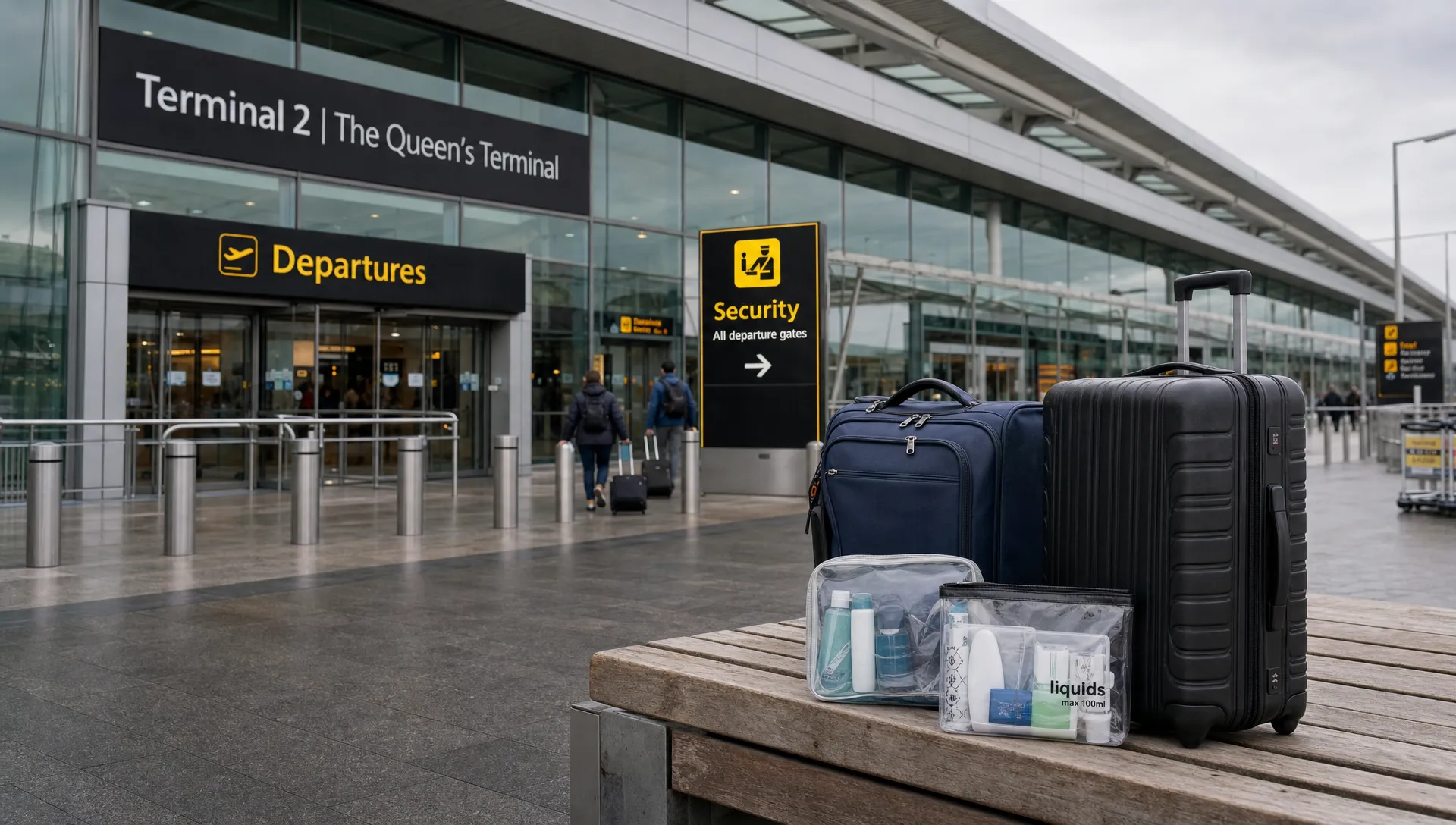
Traveling with liquids in the UK used to feel like one simple rule: 100ml containers, one clear plastic bag and no exceptions unless you had medicine or baby supplies. That rule still matters, but the airport you depart from can now change the experience in ways that are easy to miss.
Some UK airports have newer security scanners, some are still rolling them out and some may apply different instructions by terminal or lane. On top of that, national security directions can temporarily bring stricter limits back even where newer equipment exists. For travelers, the practical answer is not just "What are the UK liquid rules?" It is "What does my airport require today, for my exact trip?"
The short answer: airport rules can differ, but 100ml is the safest fallback
For cabin bags, the standard UK liquid rule remains the one most travelers know: liquids should be in containers of 100ml or less, placed in a single transparent resealable plastic bag. The UK government lists the usual liquid categories and restrictions on its GOV.UK hand luggage restrictions page.
What can change by airport is the screening process. At an airport with approved next-generation scanners, passengers may be told they can keep liquids inside their bag or carry larger containers, often up to 2L, if the local rule is active. At an airport without that setup, or where the airport is applying a temporary stricter rule, the 100ml limit still applies.
That means two UK airports on the same day can feel different at security. One might ask you to remove your clear liquids bag. Another might let items stay inside your cabin bag. A third might have newer scanners in some areas but still ask passengers to follow the older 100ml process because that is the rule in force.
If you do not have a confirmed, current airport rule, pack to the 100ml standard. It is less convenient, but it is the least risky way to avoid losing toiletries, cosmetics, drinks or food at security.
What counts as a liquid at UK airport security?
The word "liquid" is broader than many travelers expect. Airport security usually treats the following as liquids for cabin baggage purposes:
- Drinks, including water, juice and alcohol
- Toiletries such as shampoo, conditioner, shower gel and toothpaste
- Cosmetics such as foundation, mascara, lip gloss and perfume
- Sprays and aerosols, including deodorant and hair spray
- Gels, pastes, creams, lotions and oils
- Semi-liquid foods such as jam, honey, soup, sauces and yogurt
The container size matters, not the amount left inside. A half-empty 200ml bottle of shampoo can still be refused under a 100ml rule because the container is bigger than the allowed size.
For a fuller explanation of the standard carry-on rules, the one-clear-bag requirement and common exemptions, Liquid Limits has a dedicated guide to UK airport liquids rules for carry-on bags.
What actually changes by airport?
When people ask about traveling with liquids in the UK, they often expect a list of airports that allow 2L and airports that allow 100ml. The problem is that the useful answer is more dynamic than a fixed list. Airport rules depend on equipment, approval status, operational instructions and sometimes the exact security lane you use.
Here are the main things that can change.
| What can vary | How it affects your liquids | What to do before you fly |
|---|---|---|
| Scanner technology | Newer scanners may allow a different screening process, including larger containers where approved | Check the airport rule for your departure date, not just old news about scanner installation |
| Terminal or lane | One terminal may operate differently from another, especially during phased rollouts | Follow the rule for your terminal and obey signs at security |
| Temporary restrictions | A stricter 100ml rule can apply even where newer scanners exist | Treat 100ml as the fallback if the airport notice is unclear |
| Route and return airport | Your outbound airport may differ from your return airport or transfer airport | Pack for the strictest security checkpoint on the whole trip |
| Item type | Medicines, baby milk and special dietary items can have different handling | Keep these items easy to show and carry supporting documentation when relevant |
| Duty-free purchases | Sealed duty-free liquids may be accepted differently during transfers | Keep receipts and do not open tamper-evident bags before your final destination |
The key point is that airport security is not controlled by your airline's baggage allowance. Your airline may allow a cabin bag of a certain size and weight, but that does not make a 150ml bottle acceptable at the security checkpoint.
Why some UK airports feel more relaxed than others
Newer CT-style security scanners can create a more relaxed experience because staff may not need every passenger to remove liquids and electronics from bags. When a larger liquid allowance is active, this is usually the reason.
But scanner installation alone is not the same as a permanent rule change. Airports can be at different stages of rollout. Equipment can be in some lanes but not others. Regulators can also require a stricter rule while testing, maintenance or security reviews take place.
This is why relying on memory is risky. A friend might have flown from a UK airport last month with a full-size sunscreen, while you fly from a different terminal and face the 100ml rule. Both experiences can be true.
A better habit is to check three things before packing:
- Your departure airport's current cabin liquid rule
- Your return airport's current cabin liquid rule
- Any transfer airport where you will pass through security again
This matters even on short European trips. If you fly out from a UK airport using a more flexible process but return from an airport applying 100ml, the larger bottle you took outbound may not come back in your cabin bag.
Do UK liquid rules change by airport or by destination?
Usually, the checkpoint that matters is the airport where you go through security. If you are departing Manchester, Birmingham, London Gatwick or Edinburgh, that airport's security rule controls what you can take through security there. Your destination does not normally make a 200ml shampoo acceptable at the UK checkpoint if the UK airport is applying 100ml.
The destination becomes important when you fly home or connect through another airport. Your return airport may have different liquid rules from your UK departure airport. Your connecting airport may also require you to clear security again, especially if you change terminals, enter a different security zone or transfer between separate tickets.
This is where travelers get caught out. They pack based on the outbound airport, then buy a full-size product on the trip and discover it cannot pass the return checkpoint. If you want to avoid that, plan around the strictest point on the journey. Liquid Limits explains this in more detail in its guide to liquid rules on flights and return trips.
What to check for major UK airports
Instead of asking whether all UK airports allow 100ml or 2L, check the specific airport and date. This is especially useful for larger airports where different terminals can have separate security operations.
For airports such as Heathrow, Gatwick, Stansted, Luton, Manchester, Birmingham, Edinburgh, Glasgow, Bristol, Belfast, Newcastle and London City, look for language on the airport's own site or a verified checker that answers these questions:
- Are cabin liquids limited to 100ml containers today?
- Is a clear resealable liquids bag required?
- Can liquids stay inside the cabin bag at security?
- Are larger containers allowed, and if so, up to what size?
- Does the rule apply to every terminal and every passenger?
- When was the rule last checked or updated?
If the airport says 100ml, follow 100ml. If the airport says larger liquids are allowed but your return airport does not, pack as if 100ml applies unless you are happy to put the item in checked luggage for the return.
If the rule is unclear, assume 100ml. That is the conservative approach used by Liquid Limits when airport guidance is unknown or ambiguous.
How to pack when UK airport rules differ
The easiest packing strategy depends on your risk tolerance. If you want the lowest chance of problems, use the classic 100ml setup for all cabin liquids. If your airport clearly allows larger containers and you have no stricter return or transfer checkpoint, you may choose to pack more flexibly.
For most trips, this approach works well:
- Put essential toiletries in 100ml containers, especially if you will not check a bag
- Keep medicines and medically necessary liquids separate and easy to show
- Pack larger liquids in checked luggage where allowed by airline and safety rules
- Avoid buying large liquids before a return flight unless you know the return airport rule
- Keep duty-free liquids sealed in the official security bag with the receipt inside
- Recheck the rule the day before travel, especially if flying from an airport with newer scanners
Be careful with items that do not look like liquids but are treated as liquids. Peanut butter, soft cheese, hummus, snow globes, hair wax, body butter and gel-based cosmetics can all create problems under a 100ml rule.
Also remember that water bottles are different from empty bottles. An empty refillable bottle can usually go through security, then be filled airside. A bottle containing water will normally need to be emptied before screening unless the airport's active rule clearly says otherwise.
Exceptions: medicine, baby supplies and special dietary liquids
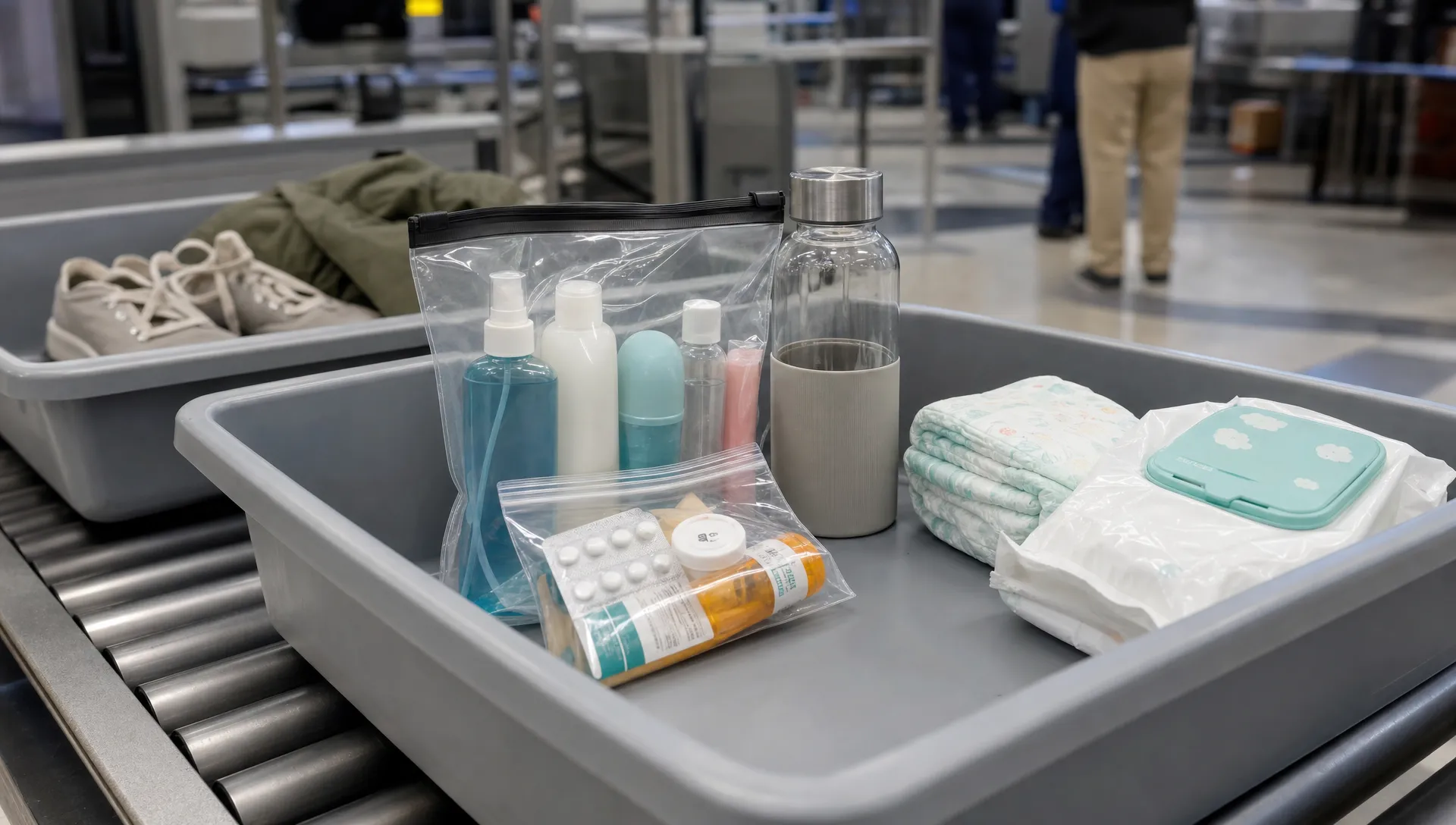
Some liquids are handled differently because they are needed during the journey. These commonly include essential medicines, baby milk, baby food and special dietary products. They may be allowed in quantities above 100ml, but they still need to be screened.
Do not bury these items at the bottom of your bag. Put them somewhere easy to access, tell security staff if needed and carry a prescription, doctor's letter or other supporting evidence for medicine when practical. For baby supplies, only carry what is reasonable for the journey.
The exact screening process can vary by airport, but the principle is consistent: an exemption is not a free pass to avoid screening. Security staff can inspect, test or refuse items if they cannot be cleared.
A simple decision guide before you leave home
If you are packing the night before a UK flight, use this quick logic:
If every airport security checkpoint on your route clearly allows larger cabin liquids, follow the airport's published instructions. If one airport on your route applies 100ml, pack cabin liquids in 100ml containers. If any airport rule is unclear, use the 100ml setup.
This may sound cautious, but it matches the reality of airport security. You only need one stricter checkpoint to lose a full-size product. For round trips, that checkpoint is often the return airport, not the UK airport you started from.
The best time to check is close to departure because airport security guidance can change. Old forum posts, social media updates and a friend's recent experience are useful clues, but they should not replace current airport guidance.
Frequently Asked Questions
Are UK airports using 100ml or 2L liquid rules? It depends on the airport, terminal and current security instruction. Some airports may have newer scanners, but the 100ml rule remains the safest fallback unless current guidance clearly says larger liquids are allowed.
Can I take a 150ml bottle if it is half empty? No, not under a 100ml rule. Security checks the container size, so a 150ml or 200ml bottle can be refused even if only a small amount remains inside.
Do Heathrow, Gatwick and Manchester have the same liquids rule? Not necessarily. Large UK airports can update rules at different times and may have terminal-specific instructions. Check the exact airport and terminal before you pack.
Do UK liquid rules apply to my return flight? UK rules apply when you go through UK airport security. Your return flight is controlled by the airport where you go through security on the way home, which may have stricter or different rules.
Can I bring duty-free liquids through a connecting airport? Often, duty-free liquids need to stay sealed in a tamper-evident security bag with the receipt inside. If you pass through another security checkpoint, the local airport rules decide whether the item can continue in your cabin bag.
Check your UK airport liquid rule before you pack
Airport liquid rules are no longer something to check once and remember forever. When traveling with liquids in the UK, the airport, terminal, route and return flight can all affect what is allowed in your cabin bag.
Before you close your suitcase, use Liquid Limits to check airport liquid rules for your trip. You can compare airport, item and route guidance, see last-checked dates and follow the stricter rule when guidance is unclear. That is the simplest way to know whether you should pack for 100ml, 2L or the most restrictive checkpoint on your journey.