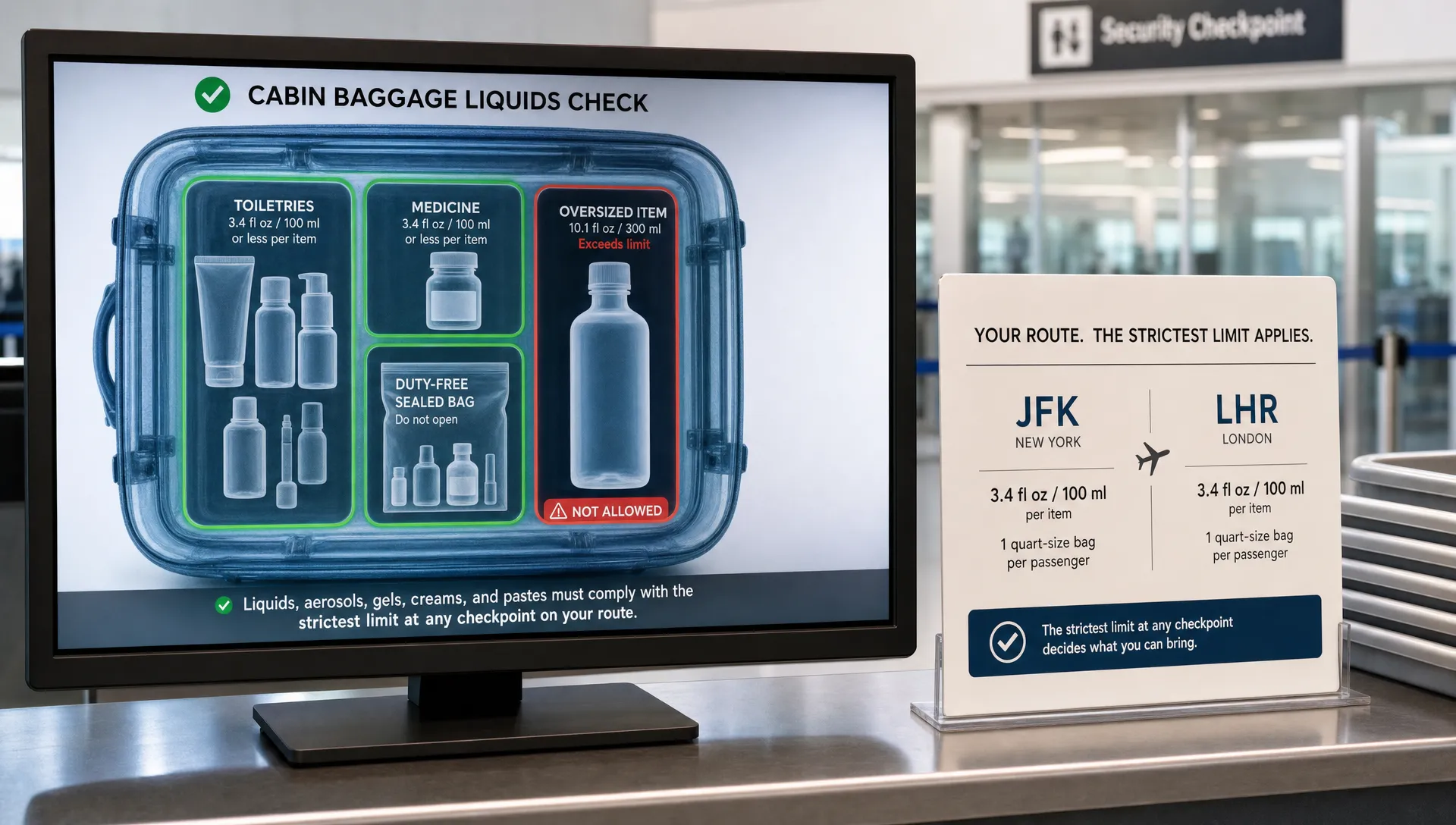
The short answer: for cabin bags, the safest rule is containers of 100ml, 3.4oz, or less, packed inside one clear resealable liquids bag. In checked baggage, the 100ml security rule usually does not apply, but airline weight limits and hazardous goods rules still do.
That sounds simple until you add connecting flights, return airports, baby supplies, medication, duty-free purchases, or airports with newer scanners. The real amount of liquid you can take on a plane depends on where you pack it, what the liquid is, and which airport security checkpoint you pass through.
Quick answer: the amount of liquid you can take on a plane
For most travelers flying with a carry-on bag, plan around the standard 100ml rule. This is the rule still used at many airports worldwide, including U.S. TSA checkpoints, many European airports, and airports that have not fully changed to newer cabin baggage screening rules.
| Where the liquid is packed | Typical amount allowed | What to remember |
|---|---|---|
| Carry-on cabin bag | Containers up to 100ml, 3.4oz, usually in one clear resealable bag | The container size matters, not how much liquid is left inside |
| Checked baggage | Larger liquids are generally allowed | Some items, especially aerosols and alcohol, have safety limits |
| Medicines and medical liquids | Often allowed above 100ml when needed for the trip | You may need to present them separately at security |
| Baby milk, formula, and baby food | Often allowed above 100ml in reasonable quantities | Rules vary by country and airport |
| Duty-free liquids | Often allowed if sealed in an approved tamper-evident bag | Connections and re-screening can create problems |
| Airports with approved newer scanners | Some may allow larger containers, sometimes up to 2L | Do not assume this applies to your whole trip |
If you want the least risky packing decision, use 100ml containers for cabin liquids unless you have confirmed that every relevant airport on your route allows more.
The 100ml rule: what it really means
The standard cabin rule is often described as “100ml per item,” but the important word is container. A 200ml shampoo bottle that is half empty is still treated as a 200ml container, so it can be rejected at security even if it only contains 80ml of shampoo.
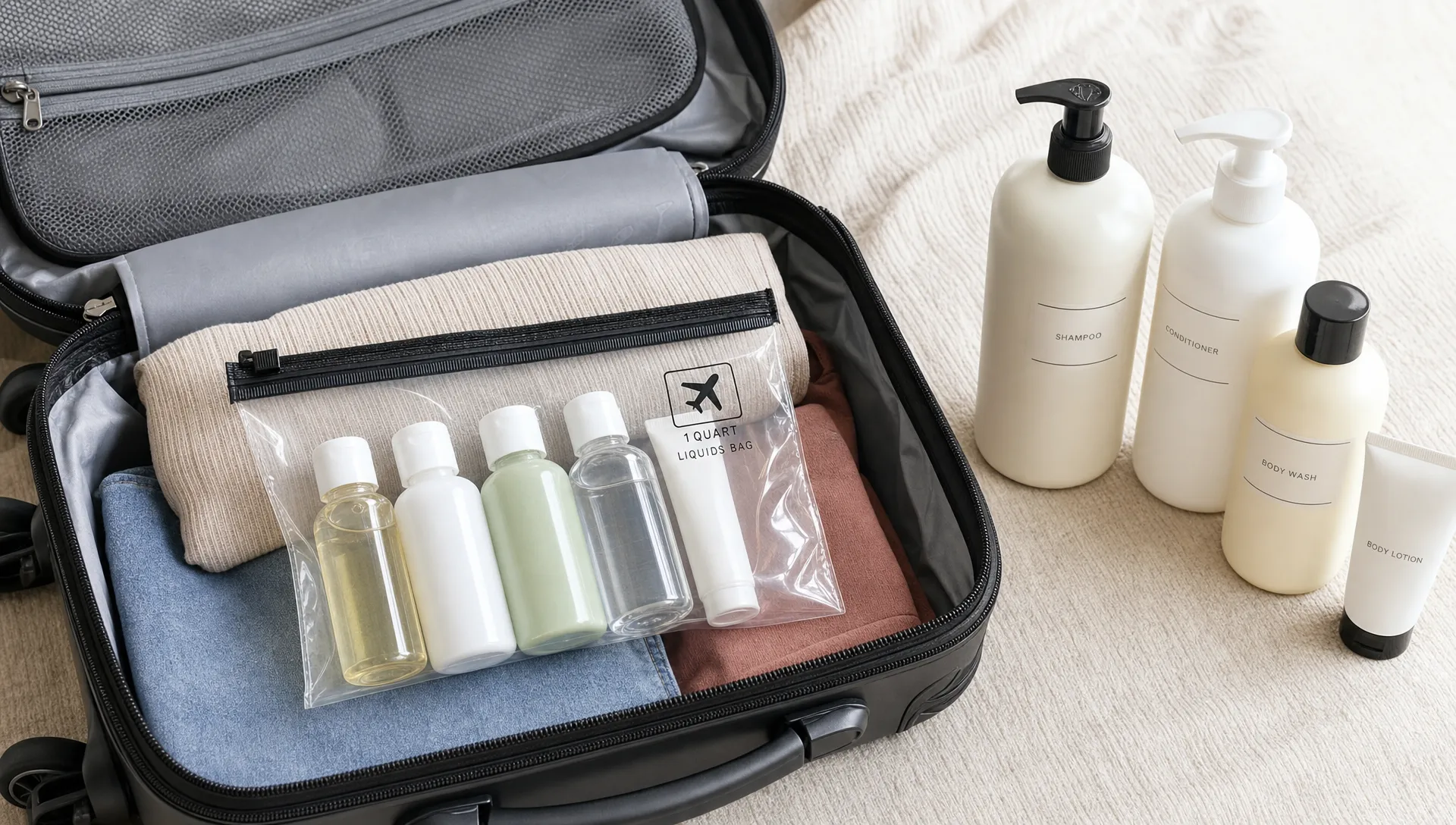
Under the TSA 3-1-1 liquids rule, liquids, gels, aerosols, creams, and pastes in carry-on bags must be in containers of 3.4oz, 100ml, or less, and they must fit in a quart-sized bag. Many other countries use a similar system, often with a one-liter clear resealable bag.
This means the total amount you can bring in the cabin is not usually stated as one exact number of bottles. It is limited by two things: each container must be small enough, and all containers must fit in the required liquids bag.
In practice, travelers often fit several travel-size toiletries in one bag, such as shampoo, conditioner, toothpaste, sunscreen, moisturizer, and liquid makeup. But if the bag will not close, or if your airport requires liquids to be presented separately, security may ask you to reduce what you are carrying.
What counts as a liquid at airport security?
Airport security uses “liquids” as a broad category. It usually includes more than drinks and toiletries. Gels, creams, pastes, sprays, foams, and semi-liquid foods are commonly treated as liquids for cabin baggage screening.
Common examples include:
- Shampoo, conditioner, body wash, lotion, sunscreen, and perfume
- Toothpaste, hair gel, shaving foam, deodorant spray, and mascara
- Soups, sauces, yogurt, honey, peanut butter, jam, and soft cheese
- Makeup products such as liquid foundation, concealer, lip gloss, and setting spray
- Aerosols such as dry shampoo, hairspray, and spray deodorant
If an item can be poured, spread, squeezed, sprayed, smeared, or is not fully solid, assume it may count as a liquid. For a deeper item-by-item breakdown, Liquid Limits has a guide to which liquids you can bring on a plane that explains how common toiletries, foods, and travel items are usually handled.
Can you take more than 100ml in your carry-on?
Sometimes, yes, but you should be careful before relying on it.
Some airports have introduced advanced CT scanners that can screen cabin baggage differently. Where these systems are approved and local rules allow it, passengers may be permitted to keep liquids in their bags or carry containers larger than 100ml. In some places, the stated limit may be up to 2 liters per container.
However, scanner rollouts have not been uniform. Even within the same country, one airport may have newer equipment while another airport still applies the 100ml rule. Rules can also change temporarily, and transfer security may be stricter than your departure airport.
This is why the practical answer is not just “what does my airline allow?” Liquid rules are enforced by airport security, not by the airline cabin crew. Your airline may fly the route, but the airport checkpoint decides whether your oversized sunscreen, bottle of lotion, or jar of sauce gets through.
If your trip includes a return flight, connection, or airport change, check both directions. Liquid Limits was built for exactly this problem: you can check airport liquid rules for your trip and compare the stricter rule before you pack.
Checked baggage: how much liquid can go in the hold?
The 100ml cabin limit is a security screening rule for carry-on baggage. It generally does not apply to checked baggage, so full-size toiletries, drinks, and other non-hazardous liquids can often go in your checked suitcase.
That said, “checked baggage allows more liquid” does not mean “unlimited liquid.” You still need to follow airline baggage weight limits, customs rules, and dangerous goods restrictions. Leaks are also common in the hold because pressure changes and rough handling can damage bottles.
For ordinary toiletries, the main concern is packaging. Use leakproof containers, tape caps if needed, and place bottles inside sealed plastic bags. For items that are flammable, pressurized, corrosive, or high in alcohol content, check official safety rules before packing.
The FAA PackSafe guidance is a useful reference for U.S. travelers because it explains limits for hazardous materials in baggage, including aerosols, alcohol, and other restricted items.
| Liquid type | Carry-on guidance | Checked baggage guidance |
|---|---|---|
| Shampoo, lotion, body wash | 100ml containers unless a local exception applies | Usually allowed in larger containers |
| Perfume and cologne | 100ml container in liquids bag | Usually allowed, but flammable product limits can apply |
| Aerosol toiletries | 100ml container in cabin liquids bag | Allowed in limited quantities when for personal care, with protected caps |
| Alcohol under 24% ABV | Subject to cabin liquid rules if carried on | Generally less restricted by hazardous materials rules |
| Alcohol 24% to 70% ABV | 100ml cabin rule applies unless purchased duty-free and accepted | Quantity limits apply in checked baggage |
| Alcohol over 70% ABV | Generally not allowed | Generally not allowed |
Exceptions: medicines, baby supplies, and special dietary liquids
Many countries allow exceptions for essential liquids, especially medicines and baby supplies. These are not treated the same way as regular toiletries or drinks.
Medical liquids may include prescription medication, liquid pain relief, insulin, contact lens solution, nutritional drinks, or medically necessary gels. Baby-related liquids may include breast milk, formula, sterilized water, baby food, and cooling packs needed to keep these items safe.
The key phrase is usually “reasonable quantity” for the journey. That does not always mean unlimited. Security officers may need to inspect, test, or screen the item separately. Keep these items easy to reach, leave prescription labels on when possible, and carry supporting documentation if your medical need is not obvious.
The UK government hand luggage restrictions and TSA guidance both recognize exemptions for essential medical and baby items, but the exact screening process can differ by airport. If you are flying internationally, check the airport and country rules rather than relying only on rules from your home airport.
Duty-free liquids: allowed, but not always simple
Duty-free liquids can be one of the most confusing parts of air travel. You may be able to buy a bottle of wine, perfume, or skincare product after security and bring it onboard, even if it is larger than 100ml. The catch is that it usually needs to stay sealed in a security tamper-evident bag with proof of purchase.
Problems can happen when you have a connecting flight. If you pass through another security checkpoint, especially in a different country, your duty-free liquid may be re-screened. If the bag has been opened, the receipt is missing, or the airport does not accept the packaging, the item may be confiscated.
For expensive duty-free purchases, ask the store whether the item is packed for international transfer security and whether your connection airport accepts it. If you are not sure, it may be safer to buy at your final airport or pack the item in checked baggage before your next flight, if you have access to your checked luggage.
Why your return flight may have a different liquid amount
A common mistake is checking only the outbound airport. But the amount of liquid you can take on a plane can change on the way home.
For example, your departure airport might allow larger liquids because it has approved newer scanners, while your return airport may still enforce the 100ml rule. Or you might fly out direct but return with a connection, adding another security checkpoint with stricter rules.
This matters most for travelers who buy full-size toiletries, local food, wine, olive oil, cosmetics, or souvenirs during a trip. An item that was fine in your cabin bag on the outbound flight may not be allowed through security on the return journey.
Liquid Limits explains this route-based issue in more detail in its guide to rules for liquids on flights and return trips. As a rule of thumb, pack for the strictest checkpoint on your route, not the most generous one.
How to calculate the right amount to pack
The best way to decide how much liquid to bring is to separate “must have in cabin” from “can go in checked baggage” and “can buy after arrival.” This keeps your liquids bag small and reduces the risk of losing something at security.
For a short trip with carry-on only, use travel-size containers and focus on products you truly need before you reach your accommodation. For longer trips, consider whether full-size toiletries are worth the space, weight, and security risk. Many travelers overpack liquids because they pack for every possible scenario instead of the actual trip length.
A simple packing approach works well:
- Put essential in-flight liquids in 100ml containers, such as hand sanitizer, medication, moisturizer, or contact lens solution.
- Move full-size toiletries to checked baggage when you have a checked suitcase.
- Buy bulky or easy-to-find items after arrival, such as shampoo, body wash, or sunscreen.
- Check local rules before packing food, alcohol, aerosols, or high-value duty-free liquids.
If you are flying carry-on only, choose solid alternatives where practical. Solid shampoo bars, solid deodorant, powder makeup, bar soap, and toothpaste tablets can reduce the number of items in your liquids bag. Just make sure the product is genuinely solid, not a balm, gel, paste, or cream.
Common mistakes that get liquids confiscated
Most liquid problems happen because travelers think about volume instead of rules. Security officers are looking at container size, item type, packaging, and checkpoint rules.
| Mistake | Why it causes trouble | Safer choice |
|---|---|---|
| Packing a half-empty 200ml bottle | The container is still over 100ml | Transfer it into a 100ml travel bottle |
| Bringing sauce, jam, or honey as a “food” | Spreadable foods often count as liquids | Pack in checked baggage or buy after security |
| Assuming the airline sets the rule | Airport security enforces liquid limits | Check the departure and transfer airport rules |
| Buying duty-free before a connection | The next checkpoint may re-screen it | Keep it sealed with receipt, or buy at the final airport |
| Forgetting the return airport | Rules may differ on the way home | Pack for the strictest airport on the full route |
So, what amount should you actually bring?
If you want the safest universal answer, bring cabin liquids in 100ml, 3.4oz, or smaller containers and keep them in the required clear resealable bag. Put larger non-hazardous liquids in checked baggage, and check special rules for aerosols, alcohol, medicines, baby supplies, and duty-free purchases.
If you know your airport allows larger cabin liquids, verify that the same is true for every security checkpoint on your trip, including the return flight. If there is any doubt, the 100ml rule is still the safest packing standard.
Frequently Asked Questions
How many 100ml bottles can I take on a plane? There is usually no fixed number of bottles. The limit is that each container must be 100ml, 3.4oz, or less, and all containers must fit inside the required clear resealable liquids bag.
Can I bring a 200ml bottle if it is half empty? Usually no. Airport security normally checks the container size, not the amount left inside. A half-empty 200ml bottle is still considered too large under the 100ml rule.
Can I take a full-size shampoo bottle on a plane? You generally cannot take a full-size shampoo bottle in your carry-on unless the airport has a verified exception. You can usually pack it in checked baggage if it is not a restricted or hazardous product.
Does toothpaste count as a liquid? Yes, toothpaste is usually treated as a paste, which falls under liquid rules for cabin baggage. Pack it in a 100ml, 3.4oz, or smaller tube if carrying it through security.
Can I bring an empty water bottle through security? Yes, an empty bottle is usually allowed. Fill it after you pass security, unless your airport has specific local restrictions.
Are liquid rules the same everywhere? No. Many airports use the 100ml rule, but some airports with newer screening equipment may allow more. Rules can also differ for your return flight or connection, so check the full route.
Check your liquid limit before you pack
The easiest way to avoid losing items at security is to check the rule for your actual trip, not just the airport you fly from first. Liquid Limits helps travelers compare airport liquid rules, item guidance, and route restrictions, including return flights where the rules may be different.
If a rule is unclear, Liquid Limits defaults to the stricter 100ml guidance so you can pack with less risk and fewer surprises at the checkpoint.