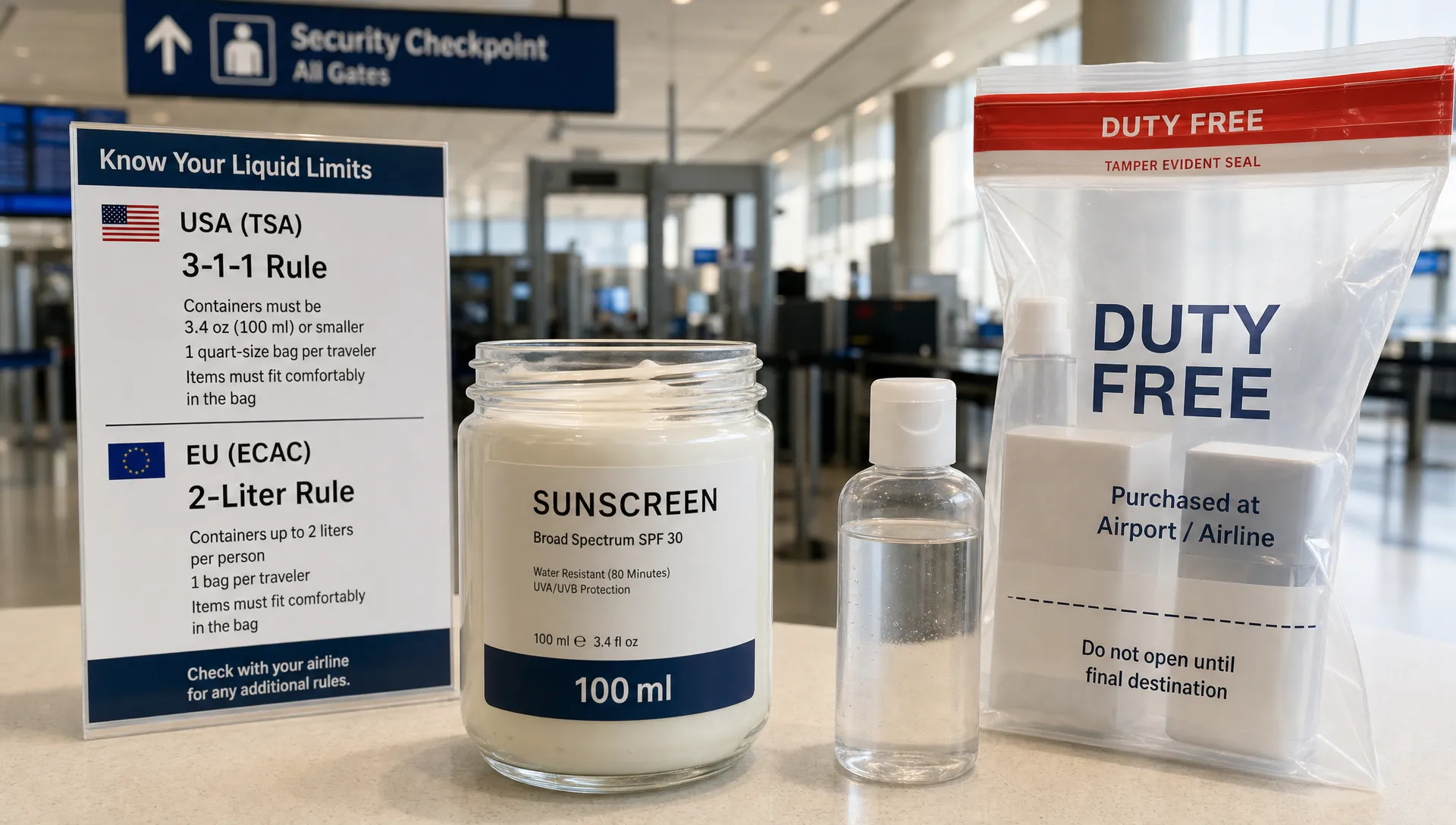
Need the safe answer first? For most travelers, the safest carry-on size is still 100 ml, or 3.4 oz, per container. Those containers should fit inside a clear, resealable liquids bag, usually about 1 liter or 1 quart.
Some airports with approved advanced scanners may allow larger liquid containers, sometimes described as up to 2 liters. But that is not a worldwide rule, and it may not apply to your return airport, connection airport, terminal, or security lane. If you want one rule that will work on the widest range of flights today, pack carry-on liquids in 100 ml containers.
The most important detail is this: airport security usually checks the container size, not how much liquid is left inside. A half-empty 200 ml shampoo bottle is still treated as a 200 ml bottle at a standard checkpoint.
Liquid sizes allowed on flights today: the numbers that matter
When travelers ask what liquid sizes are allowed on flights, they are usually comparing four different rules: the standard 100 ml carry-on rule, airport-specific larger-liquid rules, checked-bag rules, and exemptions for necessary items.
| Situation | Size to plan for | Key catch |
|---|---|---|
| Standard carry-on screening | 100 ml or 3.4 oz per container | Containers must usually fit in one clear resealable liquids bag |
| Airport with approved advanced scanners | Larger containers may be allowed, sometimes up to 2 L | Only rely on this if your exact airport and terminal currently confirms it |
| Checked baggage | Full-size liquids are usually possible | Hazardous materials, alcohol, customs, and airline rules still apply |
| Medicines and baby supplies | May exceed 100 ml when necessary | They may need separate screening and should be easy to explain |
| Duty-free liquids | May exceed 100 ml if sealed correctly | Connections and extra security checks can still create problems |
In the United States, the TSA liquids rule is still commonly known as the 3-1-1 rule: 3.4 oz or 100 ml containers, in one quart-sized bag, one bag per passenger. In the UK, GOV.UK hand luggage restrictions also treat liquids, creams, pastes, gels, and sprays as restricted cabin items, though airport technology and local instructions can affect how screening is handled.
If you want a more detailed explanation of the standard carry-on process, Liquid Limits has a separate guide to flying liquid requirements for carry-on bags.
Why 100 ml is still the safest default
The 100 ml rule remains the best default because it works across the largest number of airports. Even where new scanners are installed, rules can vary by country, airport, terminal, lane, and date. A traveler may depart from an airport that allows larger containers, then return from an airport that does not.
Advanced CT or C3 scanners can give security officers a more detailed view of cabin bags. That technology has led some airports to test or introduce more relaxed liquid procedures. But technology rollout is not the same as a guaranteed passenger rule. Airports can pause, reverse, or limit those policies.
A useful example is Europe. In 2024, the European Commission temporarily reintroduced restrictions on liquids at some EU airports using certain scanner systems. The lesson for travelers is simple: even if you saw news about 2 L liquids, you should check the current rule for your exact trip before packing full-size bottles in your cabin bag.
That is why Liquid Limits defaults to the stricter 100 ml rule when airport liquid rules are unclear. It is better to pack slightly smaller than to lose a product at security.
What counts as a liquid at airport security?
Airport liquid rules cover more than water, perfume, and shampoo. Security teams usually treat anything that can be poured, spread, sprayed, squeezed, smeared, or gelled as a liquid-type item.
Common restricted items include:
- Toiletries such as shampoo, conditioner, body wash, lotion, and sunscreen
- Cosmetics such as mascara, liquid foundation, lip gloss, setting spray, and liquid eyeliner
- Gels and pastes such as toothpaste, hair gel, shaving gel, and ointments
- Aerosols such as deodorant spray, hairspray, and dry shampoo
- Foods such as jam, honey, peanut butter, hummus, yogurt, soup, and sauces
- Souvenirs such as oils, vinegar, liquor, snow globes, and liquid-filled gifts
The gray area is often food. A sandwich is usually fine, but a jar of spread, a tub of sauce, or a creamy dessert may be treated like a liquid or gel. If it would not hold its shape outside the container, assume the 100 ml rule applies at a standard checkpoint.
Common items and the size that usually works
The table below assumes a standard 100 ml carry-on checkpoint. If your airport has a confirmed larger-liquid rule, your allowance may be different, but only for that checkpoint.
| Item | Carry-on size that usually works | Better packing choice if larger |
|---|---|---|
| Shampoo or conditioner | 100 ml or smaller | Pack full-size bottles in checked baggage |
| Toothpaste | 100 ml or smaller | Buy travel size or transfer to a small tube |
| Perfume or cologne | 100 ml or smaller | Keep expensive bottles protected in cabin if they meet the limit |
| Sunscreen lotion | 100 ml or smaller | Pack larger bottles in checked baggage or buy after security |
| Aerosol deodorant | 100 ml or smaller for standard carry-on screening | Check aerosol rules before packing larger cans |
| Water bottle | Empty bottle through security | Fill it after the checkpoint |
| Jam, honey, peanut butter, or hummus | 100 ml or smaller | Pack larger jars in checked baggage |
| Liquid medicine | May exceed 100 ml if necessary | Keep it separate and bring labeling or documentation if possible |
| Baby milk, formula, or baby food | May exceed 100 ml in reasonable quantities | Present it separately for screening |
| Duty-free alcohol or perfume | Can exceed 100 ml if sealed in an approved bag | Keep receipt and avoid opening before final security checks |
For a broader item-by-item view of what can go in the cabin, see the Liquid Limits guide to liquids in carry-on luggage.
Checked-bag liquid sizes are different
Checked baggage does not usually follow the same 100 ml airport security limit. You can often pack full-size toiletries, drinks, sauces, and cosmetics in checked luggage. But checked bags are not a free-for-all.
There are three issues to consider: leakage, hazardous materials, and customs. A large shampoo bottle may be allowed, but it can still burst under pressure or leak onto your clothes. Alcohol, aerosols, fuel-based products, solvents, and flammable liquids can be restricted or forbidden.
For U.S. flights, the FAA PackSafe guidance says medicinal and toiletry articles, including aerosols, are limited to a total of 2 kg or 2 L per passenger, with each container no larger than 0.5 kg or 0.5 L. The FAA also states that alcohol over 24 percent and up to 70 percent alcohol by volume is limited to 5 L per passenger in unopened retail packaging, while alcohol over 70 percent is not allowed. You can check the current U.S. dangerous goods guidance on the FAA PackSafe page.
| Product type | Checked-bag rule to verify | Important note |
|---|---|---|
| Regular toiletries | Usually allowed in full-size containers | Pack in leakproof bags |
| Toiletry aerosols | Often subject to per-container and total quantity limits | Caps or release buttons should be protected |
| Alcohol up to 24 percent ABV | Usually not limited as a hazardous material | Customs and airline rules can still apply |
| Alcohol over 24 percent and up to 70 percent ABV | Often limited to 5 L per passenger | Must usually be in unopened retail packaging |
| Alcohol over 70 percent ABV | Generally forbidden | Do not pack it in cabin or checked baggage |
| Fuels, thinners, solvents, and flammable liquids | Often forbidden | Check official dangerous goods rules before travel |
The strictest checkpoint on your trip is the rule that really matters
Liquid rules are not only about your departure airport. They are about every airport security checkpoint you will pass through.
You may need to follow a stricter rule if you:
- Connect through another airport and pass through security again
- Fly out from one airport but return from another country or terminal
- Buy duty-free liquids before a connection
- Depart from an airport with advanced scanners but return from one with standard screening
- Travel on separate tickets and need to re-clear security between flights
This is where many travelers get caught. A 500 ml lotion might be accepted at one airport with a confirmed relaxed rule, but it can still be refused on the way home. If you are flying round trip, the practical packing rule is simple: follow the strictest checkpoint on the whole route.
Liquid Limits was built for this exact problem. You can check an airport, item, route, or round trip, then compare the 100 ml and 2 L possibilities side by side with source links and last-checked dates. For more on why the return airport matters, read our guide to rules for liquids on flights and return trips.
How to pack if you want to avoid surprises
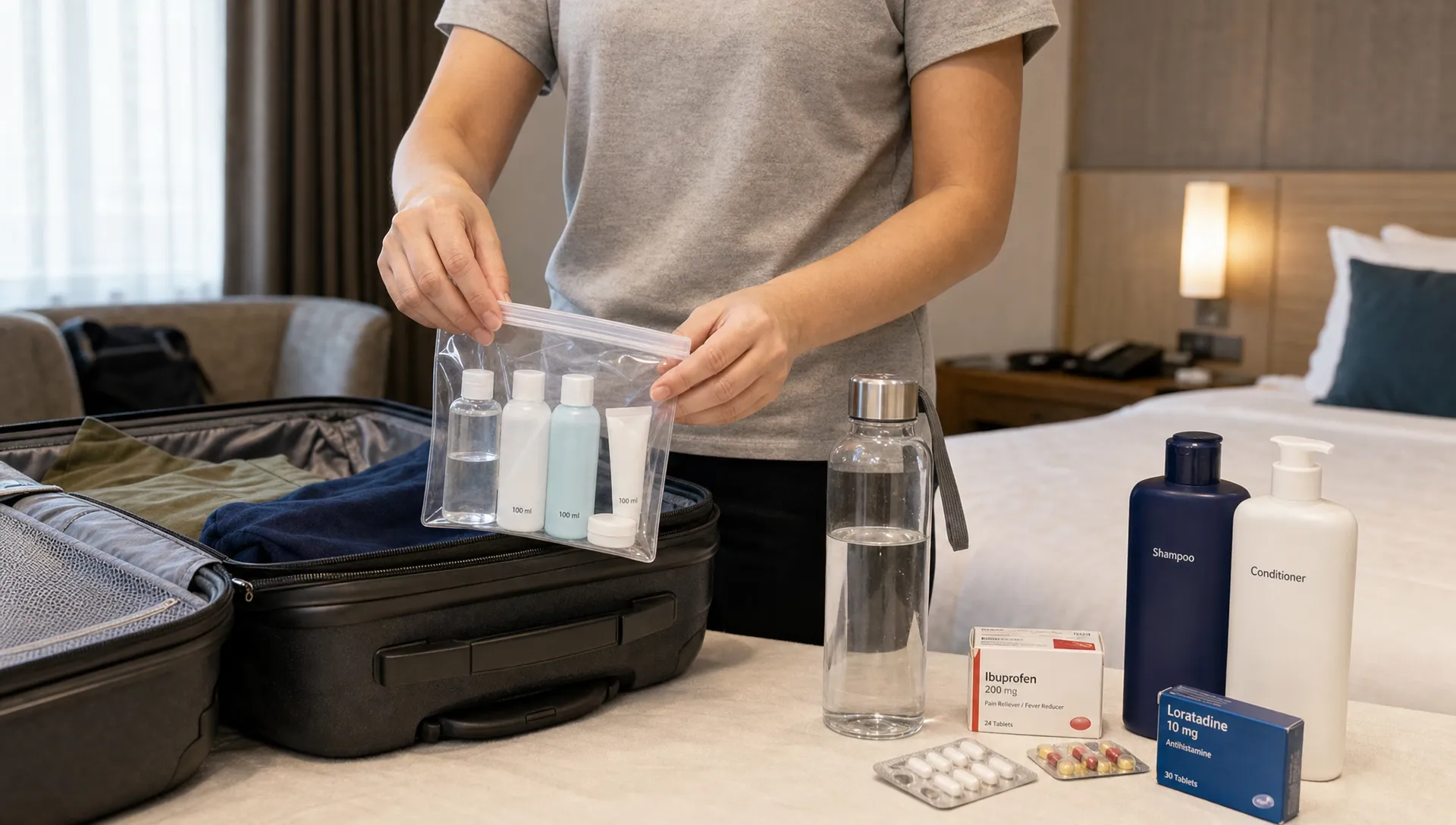
The easiest way to avoid losing liquids at security is to pack as if the 100 ml rule applies, then only use larger allowances when you have confirmed them for every relevant checkpoint.
Choose containers that are clearly marked 100 ml or 3.4 oz. Security officers may reject an unlabeled or oversized bottle even if you insist it contains less than 100 ml. If a product matters to you, do not rely on guessing.
Put your liquids bag near the top of your carry-on so you can remove it quickly if required. Some airports no longer ask passengers to remove liquids, but many still do. Being ready keeps the line moving and reduces the chance of a rushed mistake.
Move nonessential full-size liquids to checked baggage. This is usually the best choice for shampoo, conditioner, body lotion, sunscreen, sauces, and souvenirs. Use a sealed plastic bag or packing cube to protect clothes from leaks.
Carry an empty reusable water bottle. A full bottle over 100 ml is usually not allowed through a standard checkpoint, but an empty bottle is generally fine and can be filled after security.
Keep medicines, baby supplies, and special dietary liquids separate. These items may be allowed above 100 ml, but they are easier to screen when they are accessible and clearly identifiable.
A quick decision table before you zip your bag
| Question | Best decision |
|---|---|
| Is the container 100 ml or smaller? | It is usually acceptable for standard carry-on screening if it fits in your liquids bag |
| Is the container larger than 100 ml but partly empty? | Treat it as too large for standard carry-on screening |
| Does every airport on your route confirm a larger-liquid rule today? | If yes, you may be able to pack larger cabin liquids, but keep proof handy |
| Do you have a connection with another security check? | Use the strictest rule unless the connecting airport confirms otherwise |
| Is it medically necessary or for an infant? | Pack it separately and be ready for additional screening |
| Is it a full-size toiletry or food jar? | Put it in checked baggage unless your whole route supports larger cabin liquids |
| Is it duty-free? | Keep it sealed in the tamper-evident bag with the receipt |
Frequently Asked Questions
Are 200 ml bottles allowed if they are half empty? Usually not at a standard checkpoint. Security normally looks at the container size printed on the bottle, not the amount remaining inside.
Is 3.4 oz the same as 100 ml for flights? They are treated as the same practical limit in many airport liquid rules. If a container is marked 100 ml or 3.4 oz, it usually fits the standard carry-on size rule.
Can I bring full-size shampoo on a plane? In checked baggage, usually yes, subject to airline, hazardous goods, and customs rules. In carry-on baggage at a standard checkpoint, the shampoo container must be 100 ml or smaller.
Are toothpaste and makeup counted as liquids? Many are. Toothpaste, mascara, liquid foundation, lip gloss, gels, creams, and sprays are generally treated as liquid-type items for security screening.
What if my airport says liquids up to 2 L are allowed? Only rely on that if your exact airport, terminal, and travel date confirm it. Also check any connection and return airport, because the stricter checkpoint can still limit you to 100 ml.
Can I bring medicine over 100 ml? Medically necessary liquids are commonly allowed above 100 ml, but they may need separate screening. Keep them in original packaging when possible and bring supporting documentation for prescription items.
Do airlines decide liquid sizes? Liquid screening rules are usually set by government security authorities and airports, not airlines. Airlines can still set baggage weight, size, and dangerous goods policies.
Check your exact liquid rule before you pack
If you are packing today, do not rely on a single airport rumor or an old article about scanner upgrades. Check the rule for your full trip, including your return flight and any connection where you may clear security again.
Use Liquid Limits to check airport liquid rules, item-specific guidance, and route rules with daily updates, verified source links, and last-checked dates. When the official rule is unclear, Liquid Limits points you back to the safer 100 ml default so you can pack with fewer surprises.