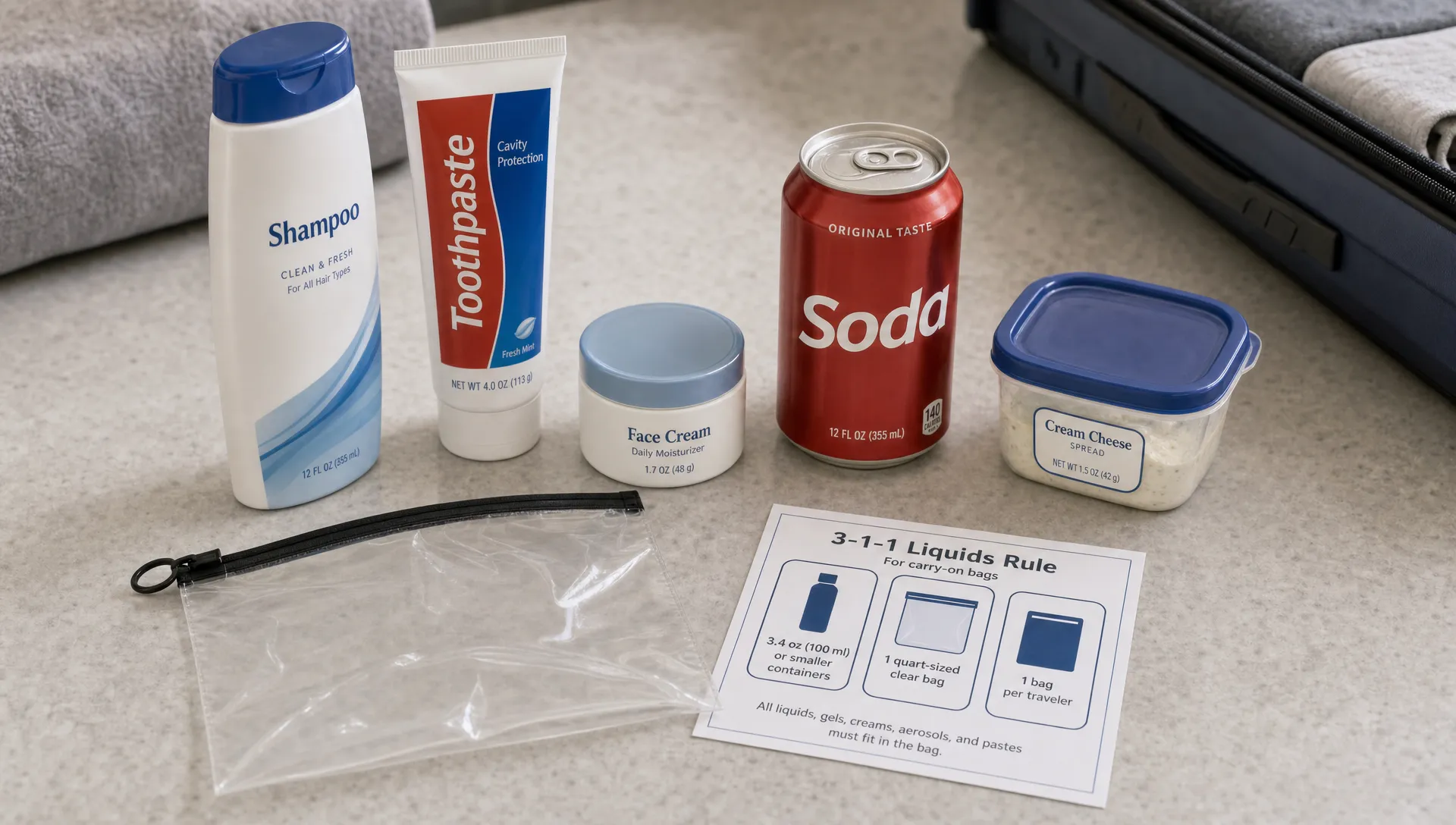
Most everyday liquids are allowed in carry-on luggage, but only if they are packed the way airport security expects. The confusing part is that airport rules do not only apply to obvious liquids like water or shampoo. They also cover gels, aerosols, creams, pastes, sprays, and spreadable foods.
In practice, the safest assumption is simple: if it can be poured, sprayed, squeezed, spread, or smeared, treat it as a liquid. That one habit prevents most checkpoint surprises.
The other key point is that liquid rules are set and enforced at airport security, not just by your airline. A bottle that passes at one airport may be refused at a connection or on your return flight, especially when different countries or scanner types are involved.
The short answer: which liquids are allowed?
The liquids allowed in carry-on luggage usually include toiletries, cosmetics, drinks, liquid foods, medicines, baby supplies, and some duty-free purchases. For ordinary non-exempt items, each container must typically be 100 ml / 3.4 oz or smaller and fit inside your clear resealable liquids bag.
Here is the quick version:
| Liquid type | Usually allowed in carry-on? | Main condition |
|---|---|---|
| Shampoo, conditioner, body wash | Yes | Container must meet the cabin liquid size limit |
| Toothpaste and mouthwash | Yes | Toothpaste counts as a paste and follows liquid rules |
| Perfume and cologne | Yes | Must fit the liquid limit unless bought duty-free after security |
| Liquid makeup and skincare | Yes | Foundation, mascara, gels, creams, and lotions count as liquids |
| Drinks | Yes | Only small containers before security, or larger bottles bought after security |
| Sauces, oils, spreads, and dips | Yes | Must follow liquid limits unless packed in checked baggage |
| Aerosol toiletries | Sometimes | Must be travel-size and not a prohibited hazardous aerosol |
| Prescription liquid medicine | Usually yes | May be exempt if medically necessary, but must be screened |
| Baby formula, breast milk, and baby food | Usually yes | Often allowed in reasonable quantities, but rules vary by airport |
| Duty-free liquids | Often yes | Must stay sealed in the approved tamper-evident bag with receipt |
Allowed does not mean unlimited. A full-size bottle of shampoo is still likely to be rejected at many checkpoints, even if shampoo itself is allowed.
How the 100 ml carry-on liquid rule works
At many airports, the standard cabin liquid rule is the familiar 100 ml / 3.4 oz container limit. In the United States, the TSA liquids rule is commonly described as 3-1-1: travel-size containers of 3.4 oz or less, packed in one quart-size bag, with one bag per passenger.
Many other countries use a similar system with a 100 ml container limit and a clear resealable bag, often around 1 liter in capacity. The European Commission guidance on liquids, aerosols and gels follows the same general liquid, aerosol, and gel framework for EU aviation security.
The important detail is container capacity. Security normally looks at the size printed on the bottle, tube, jar, or can. A 200 ml bottle with only a small amount left inside can still be refused because the container itself is larger than the permitted size.
Some airports have introduced newer CT scanners that can change how liquids are screened. However, scanner rollouts and liquid allowances have changed repeatedly in recent years, and rules can differ by terminal, lane, airport, and country. If you want a deeper explanation of how scanners and airport-specific policies affect packing, see this guide to carry-on liquid requirements.
What counts as a liquid at airport security?
Airport security uses a broader definition than most travelers do. The category usually includes liquids, aerosols, gels, creams, and pastes. That means many products that feel solid-ish in your bathroom still count as liquids at the checkpoint.
Common examples include toothpaste, mascara, lip gloss, hair gel, sunscreen, moisturizer, foundation, shaving cream, liquid deodorant, gel deodorant, and contact lens solution. Food can also fall under the rule. Peanut butter, hummus, yogurt, jam, honey, salsa, soup, and soft cheese can all be treated as liquids, gels, or spreads.
The TSA What Can I Bring database is useful for checking specific items, but the airport you depart from has the final say at screening.
Item-by-item guide to liquids allowed in carry-on luggage
Most carry-on liquid problems happen because the item is allowed, but the size or packaging is wrong. Use the table below to decide whether to pack it in your cabin bag, check it, or buy it after security.
| Item | Carry-on packing advice | Watch out for |
|---|---|---|
| Shampoo and conditioner | Use travel-size bottles of 100 ml / 3.4 oz or less | Oversized salon bottles, even if partly empty |
| Body wash and liquid soap | Pack with other liquids in the clear bag | Large pump bottles are usually too big |
| Toothpaste | Treat as a liquid or paste | Full-size tubes often exceed the limit |
| Sunscreen | Travel-size only before security | Spray sunscreen may also be subject to aerosol rules |
| Moisturizer and face cream | Small jars or tubes only | Thick creams still count as liquids |
| Mascara and liquid eyeliner | Pack in the liquids bag | Solid pencil eyeliner is usually easier |
| Foundation and concealer | Liquid products follow liquid rules | Powder makeup is usually not restricted as a liquid |
| Lip gloss and liquid lipstick | Treat as liquids | Solid lipstick is typically not a liquid |
| Perfume and cologne | Travel-size bottle or sample vial | Large glass bottles are better in checked luggage |
| Deodorant | Solid sticks are usually easiest | Gel, spray, roll-on, and liquid deodorants count as liquids or aerosols |
| Shaving cream | Travel-size only | Pressurized cans may have additional restrictions |
| Hand sanitizer | Treat as a liquid unless your airport states an exception | Rules and temporary exceptions can change |
| Contact lens solution | Small bottle is safest, larger medically necessary amounts may be allowed | Keep it separate if you need it for medical reasons |
| Drinks | Empty bottle before security, refill after screening | Sealed water bottles are still liquids |
| Soups and sauces | Small containers only before security | These often spill, so checked baggage may be safer |
| Honey, jam, nut butter, and hummus | Travel-size only in carry-on | Spreadable foods are a common checkpoint surprise |
| Aerosol toiletries | Small toiletry aerosols may be allowed | Non-toiletry aerosols and flammable products may be prohibited |
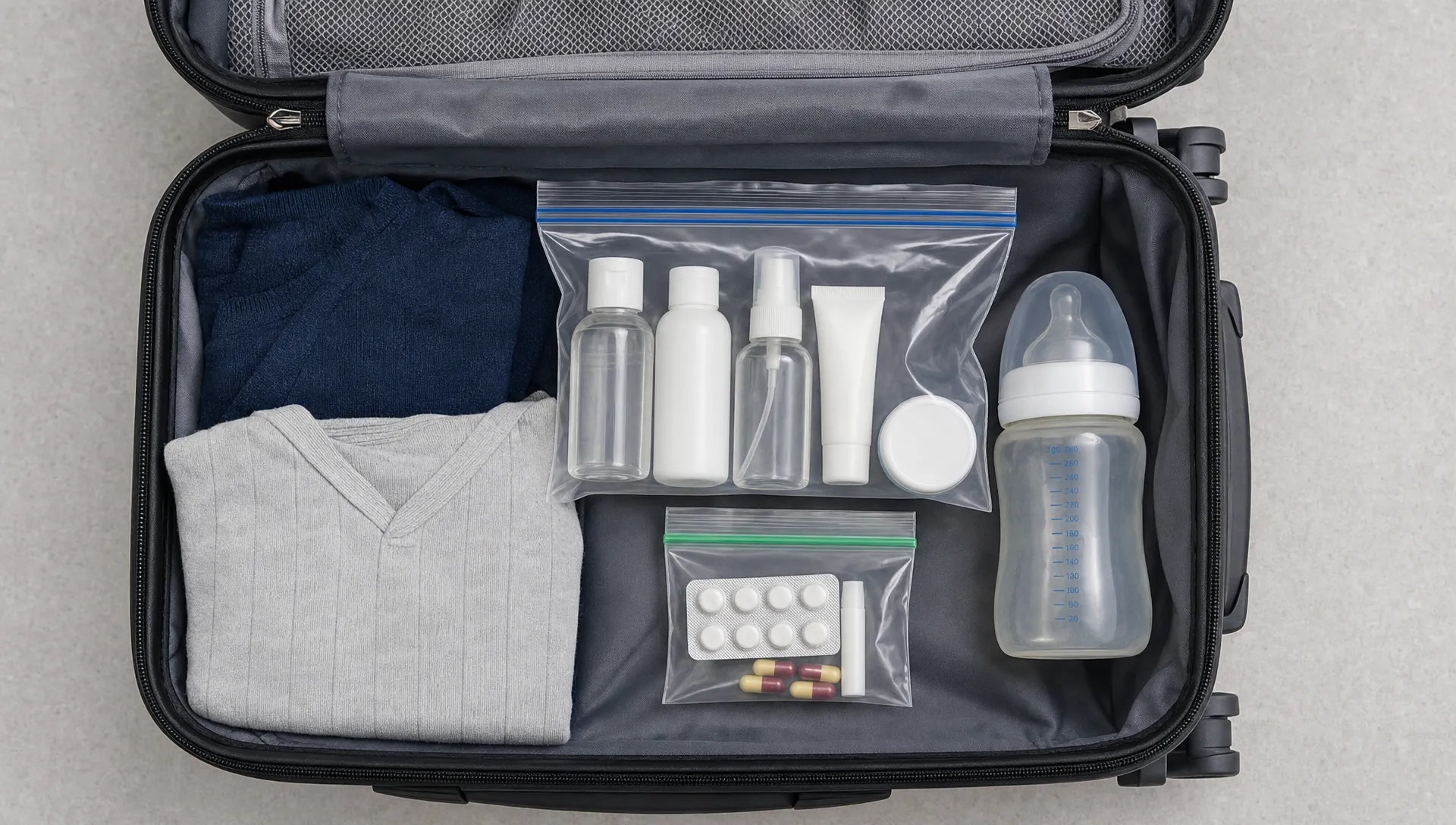
Medicines, baby liquids, and special diet items
Some liquids are allowed in carry-on luggage even when they exceed the standard 100 ml / 3.4 oz limit. These exceptions usually apply to medically necessary liquids, baby feeding items, and special dietary needs.
Prescription liquid medicine, over-the-counter liquid medicine, insulin, cooling gels, and medically required contact lens solution may be permitted in reasonable quantities. You should keep them accessible, separate them from your regular liquids bag, and tell the security officer before screening if required.
Baby formula, breast milk, toddler drinks, baby food pouches, and cooling packs for those items are also commonly treated as exceptions. The exact process can vary, but they may need additional screening. The UK government hand luggage restrictions also recognizes exemptions for essential medicines, special dietary requirements, and baby food or milk.
Do not bury exempt liquids deep in your bag. If an item needs to be inspected, making it easy to remove can save time and reduce stress at the checkpoint.
Duty-free liquids are allowed, but only if you keep them sealed
Duty-free liquids can be larger than 100 ml because they are usually purchased after security. This often includes wine, spirits, perfume, cosmetics, and other liquid gifts. The catch is that duty-free liquids become more complicated when you have a connection.
For international routes, duty-free liquids are often packed in a sealed tamper-evident security bag with a receipt. Keep that bag sealed until your final destination. If you open it during the trip, the liquid may be treated like any other oversized liquid at your next security checkpoint.
Even sealed duty-free liquids are not a universal guarantee. Some transfer airports may rescreen your cabin bag, and local rules can determine whether the item is accepted. If the item is expensive, fragile, or important, check your full route before buying.
Liquids that may not be allowed in carry-on luggage
Some products are not just liquids, they may also be hazardous materials. In those cases, the 100 ml rule is not the only rule that matters.
Flammable liquids, strong chemicals, fuels, paint thinners, many solvents, bleach, and certain industrial cleaners are generally not suitable for carry-on luggage. Some may also be banned from checked baggage. Aerosols can be especially tricky because aviation rules treat pressurized containers differently depending on the contents and purpose.
The FAA PackSafe program explains that dangerous goods rules apply in addition to ordinary security screening. If you are carrying unusual chemicals, camping products, beauty salon supplies, or work materials, check the FAA PackSafe guidance or the aviation authority for your country before packing.
Why your route matters more than your airline
Travelers often ask whether their airline allows a particular liquid, but airport security is usually the key checkpoint. Your airline may limit bag size or dangerous goods, but the liquid screening rule is enforced by the airport security authority.
That matters most on round trips, international connections, and multi-airport itineraries. You might depart from an airport using one scanner policy, connect through a second airport using stricter rules, and return from a third airport where 100 ml is still enforced. In that situation, the strictest rule wins.
If you are packing toiletries, cosmetics, medicine, baby supplies, or duty-free purchases for more than one airport, it is worth checking the full route rather than only your departure airport. Liquid Limits lets you check the strictest liquid rule for your whole trip, including the return flight, with airport, item, and route-based guidance.
A simple packing method that works almost everywhere
If you want the least risky approach, pack as if the 100 ml / 3.4 oz rule applies unless you have verified otherwise for every airport on your route.
Use one clear resealable bag for ordinary liquids and place it near the top of your carry-on. Choose solid alternatives when possible, such as shampoo bars, solid deodorant, powder makeup, and toothpaste tablets. Keep medicines, baby liquids, and special diet items separate from regular toiletries so they are easy to present for screening.
Before you leave, check container sizes rather than estimating. Travel-size bottles should have capacity markings when possible. If a product is expensive or hard to replace, do not gamble with an oversized container. Put it in checked baggage if allowed, transfer a small amount into a compliant bottle, or buy it after security.
For travelers who want to maximize what fits in the bag, this companion guide explains how much liquid you can really bring in carry-on without relying on guesswork.
Frequently Asked Questions
Can I bring shampoo in carry-on luggage? Yes. Shampoo is allowed in carry-on luggage if the container meets the airport liquid size limit, usually 100 ml / 3.4 oz, and fits in your clear resealable liquids bag.
Can I bring a full-size bottle if it is almost empty? Usually no. Airport security typically checks the container capacity, not the amount left inside. A 250 ml bottle may be rejected even if it only contains a small amount.
Do wet wipes count as liquids? Wet wipes are usually not treated like bottled liquids and are generally easier to pack in carry-on luggage. Liquid makeup remover, cleansing balm, and micellar water still follow liquid rules.
Are prescription liquid medicines limited to 100 ml? Medically necessary liquid medicines are often exempt from the standard size limit, but they may need extra screening. Keep them separate, labeled if possible, and declare them when required.
Can I take coffee, water, or soda through security? Only if it is within the permitted liquid size before screening. Most travelers bring an empty bottle through security and refill it after the checkpoint, or buy drinks airside.
Are liquid foods allowed in carry-on luggage? Yes, but spreadable or pourable foods such as yogurt, soup, peanut butter, jam, salsa, and honey usually count as liquids or gels. Pack small containers in your liquids bag or place larger amounts in checked luggage if allowed.
Can I bring duty-free perfume or alcohol on a connecting flight? Often yes, but only if it stays sealed in the approved tamper-evident bag with the receipt. Transfer airport rules can still affect whether it passes the next checkpoint.
Pack liquids by rule, not by rumor
The safest carry-on strategy is to check the rule for your actual airports, items, and route before you pack. This is especially important if you have a connection, a return flight from a different airport, or a liquid that is expensive to lose.
Liquid Limits helps travelers compare airport liquid rules, item-specific guidance, and route restrictions with verified source links and last-checked dates. If a rule is unclear, the tool defaults to the stricter 100 ml approach so you can pack with less risk and fewer checkpoint surprises.