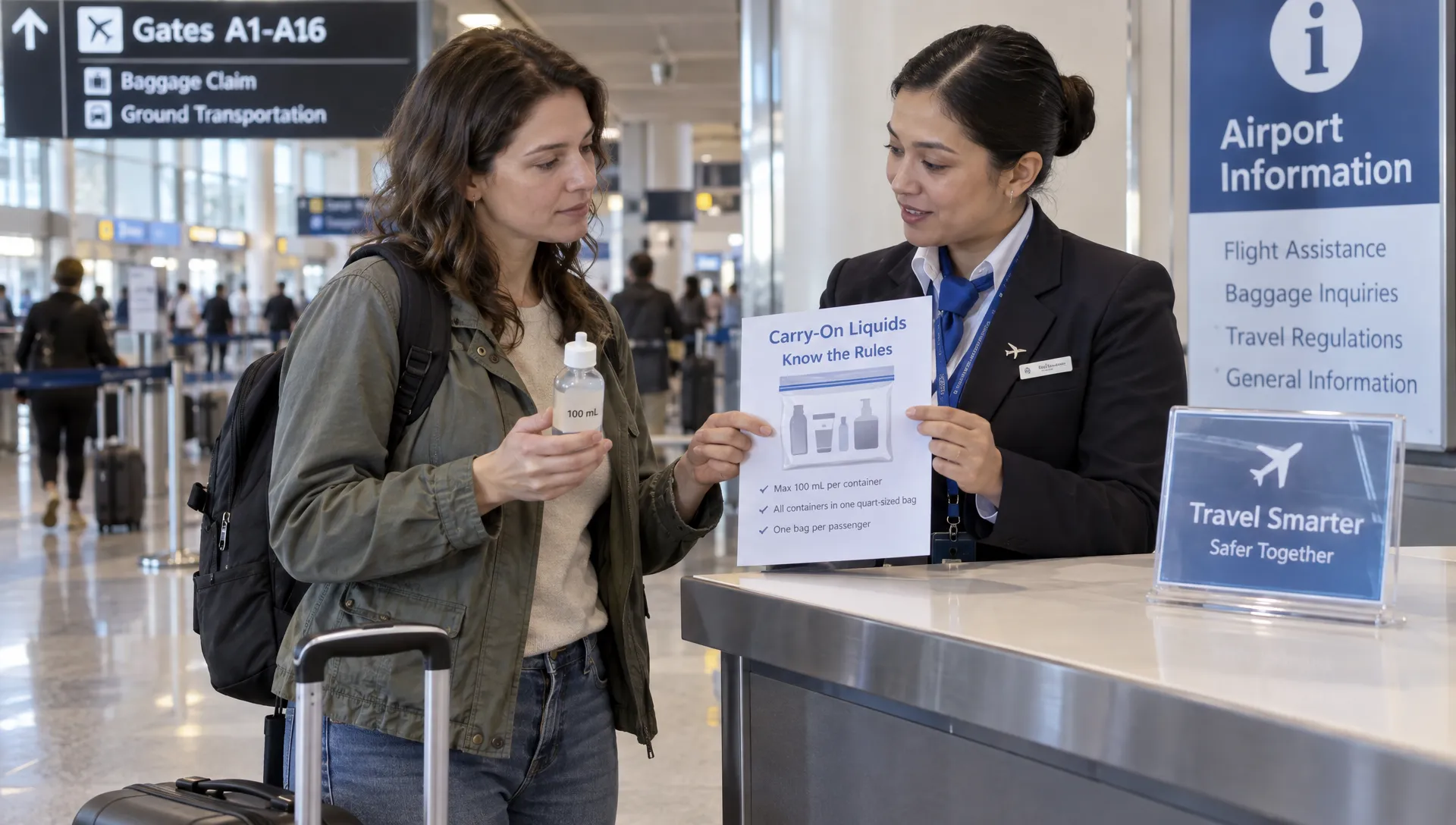
The toiletries rules for flying that apply to your cabin bag depend mainly on where you pass through airport security, what each product contains and the capacity printed on its container. Your airline’s baggage allowance is a separate check. A bottle accepted on your outbound journey may still be rejected when you return from an airport with stricter restrictions.
For ordinary liquid toiletries, the practical fallback is simple: use containers no larger than 100ml and prepare a clear, resealable liquids bag. Only pack larger containers when you have verified that every relevant checkpoint permits them.
Start with the standard 100ml rule
At checkpoints applying the standard restriction, each liquid container must hold no more than 100ml. That includes products you squeeze, spread or spray, not just liquids you can pour.
For US departures, the TSA’s liquids rule allows containers of 3.4 fluid ounces (100ml) or less in one clear, quart-sized, resealable bag per passenger. The allowance is not a separate liquids bag for each piece of cabin luggage.
Other countries may specify a one-liter bag or different presentation requirements. Follow the local instructions rather than assuming a US-compliant bag meets every airport’s requirements.
Container capacity matters more than how much product remains. A half-empty 200ml shampoo bottle does not meet a 100ml container limit.
Which toiletries rules for flying apply at your departure airport?
Start with the airport where your cabin bag will be screened. For a direct flight, this is normally your departure airport. Your destination’s departure-security rules become relevant when you fly home, not simply because you are arriving there.
Some airports permit larger liquid containers, sometimes up to 2 liters, while others retain the 100ml limit. The UK government’s hand luggage guidance directs travelers to check their departure airport because liquid allowances can differ.
Do not use the presence of a new scanner as proof that larger bottles are allowed. Container limits, liquids-bag requirements and whether toiletries must be removed from your luggage are separate instructions.
Check the airport’s current guidance for your terminal where applicable. Look for an explicit maximum container size rather than relying on an old news report about scanner installation.
Check connections and the return flight separately
The toiletries rules for flying must be checked again wherever your itinerary requires another security screening. A connection does not always involve rescreening, but a terminal change, airport change or local transfer procedure may require it.
For example, imagine your departure airport explicitly allows a 500ml bottle, but your return airport uses a 100ml limit. You can take the bottle outbound under the first airport’s rules, yet cannot bring that same container through the return checkpoint as an ordinary cabin liquid, even if it is nearly empty.
If you want one toiletries kit that works throughout the trip, pack to the strictest verified checkpoint rule. This also avoids buying larger products abroad that you cannot bring home in your cabin bag.
For more detail on mapping those checkpoints, the guide to cabin liquids rules for direct and return flights explains why the outbound allowance is only part of the check.
Classify toiletries by their form, not their name
When applying toiletries rules for flying, treat creams, gels, pastes and sprays as liquid-category products unless the airport’s guidance says otherwise. A product does not escape the restriction because its packaging calls it makeup, skincare or dental care.
This distinction helps you decide what needs space in your liquids bag and what can usually stay elsewhere in your cabin luggage.
| Toiletry | Usual treatment at a standard 100ml checkpoint | Packing implication |
|---|---|---|
| Shampoo, conditioner and body wash | Liquid or gel | Use containers no larger than 100ml |
| Toothpaste | Paste, included in liquid restrictions | Check the tube’s stated capacity |
| Moisturizer, sunscreen and liquid foundation | Cream or liquid | Include in the liquids bag |
| Perfume and mouthwash | Liquid | Use compliant containers |
| Roll-on or gel deodorant | Liquid or gel | Include in the liquids bag |
| Aerosol deodorant or shaving foam | Aerosol, with additional safety restrictions | Check both size and item restrictions |
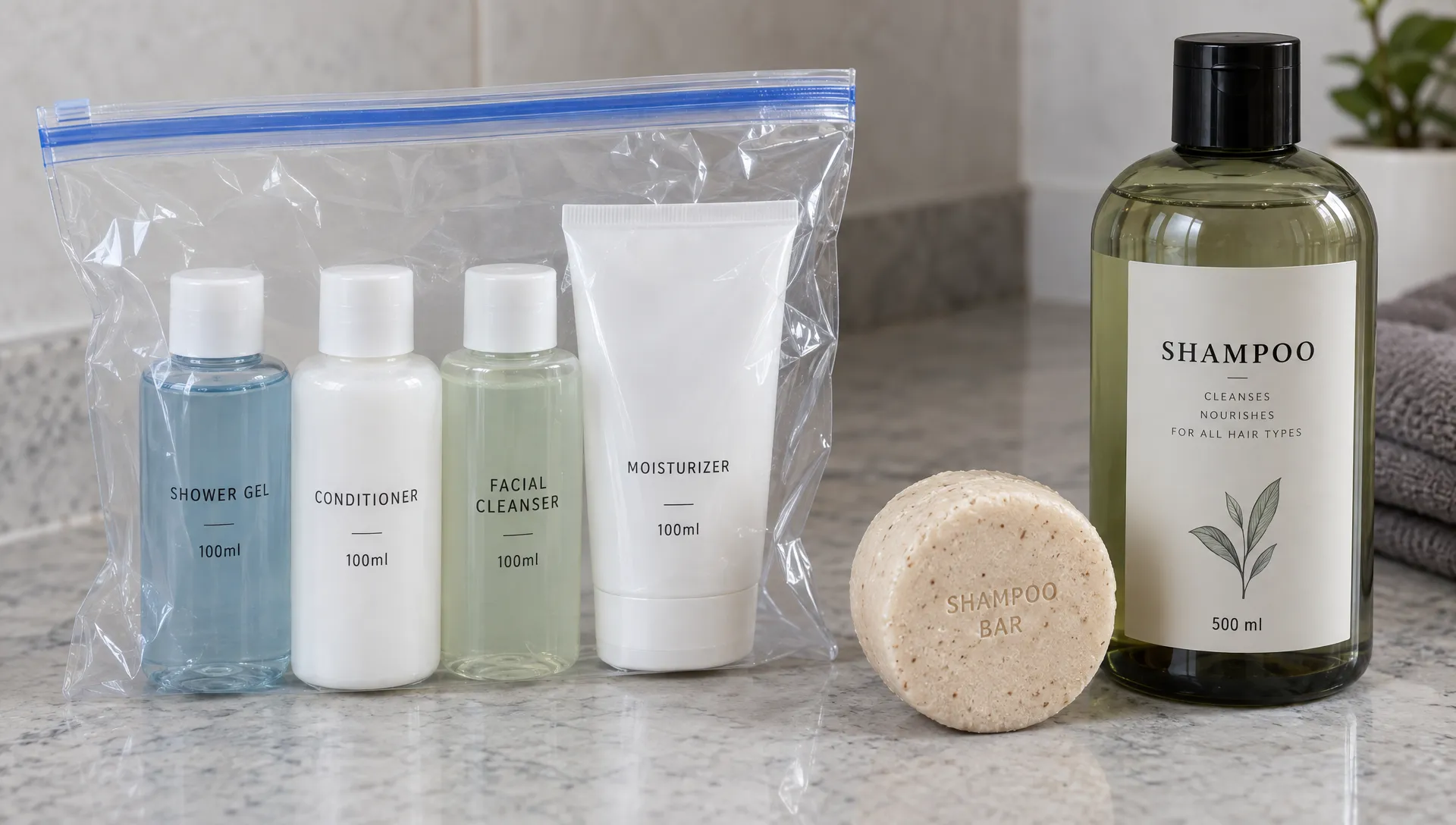
| Solid soap, solid shampoo and solid stick deodorant | Generally outside the liquids restriction | Pack separately from liquid toiletries |
| Disposable razor | Not a liquid | Check blade restrictions separately |
A solid stick deodorant and a gel deodorant may serve the same purpose, but they are packed differently. The same applies to a shampoo bar versus bottled shampoo.
Solid alternatives can free up bag space, but confirm that the product is genuinely solid. A soft cream in a tub is not exempt merely because it does not pour easily. Products outside the liquids rule can still be inspected.
Read the container capacity before packing
The toiletries rules for flying are easiest to apply when you check every bottle and tube before putting it in your bag. At a 100ml checkpoint, a container marked 150ml is too large for an ordinary toiletry, even if only a small amount remains.
Two 50ml bottles are different from one partly filled 200ml bottle: the smaller containers meet the individual capacity limit, provided they fit within the permitted liquids-bag allowance.
“Travel size” is a marketing description, not a security standard. Check the actual label, especially on sunscreen, toothpaste and gift-set products. If a refillable bottle has no visible capacity marking, choosing a clearly marked alternative can make the check simpler.
Keep the bag comfortably closable rather than stretching it around too many products. You may need to present it separately, depending on the checkpoint’s instructions.
Containers that do not comply can go in checked baggage only if the product is permitted there. Moving an item out of the cabin bag does not remove dangerous-goods restrictions.
Keep medical exceptions separate from ordinary toiletries
Some medically necessary liquids can exceed the standard container limit. This is an exception based on medical need and the checkpoint’s rules, not a general allowance for personal-care products.
In the US, TSA permits medically necessary liquids in reasonable quantities above 3.4 ounces. Travelers should declare them for inspection; they do not need to fit inside the standard quart-sized liquids bag. Additional screening may be required.
Elsewhere, check whether you need supporting documentation and how to present the item. A prescription cream may qualify under applicable medical rules, while an everyday cosmetic moisturizer does not become exempt simply because you prefer that brand or formulation.
Keep essential products identifiable, preferably in their original labeled packaging, and accessible for inspection. If a medical liquid is essential to your journey, verify the requirements for each screening airport rather than relying on general toiletries advice.
For medically necessary products, the toiletries rules for flying therefore require a separate check: establish whether the exception applies before packing a larger container.
Liquid permission does not settle aerosol or blade restrictions
A checkpoint that allows a larger shampoo bottle does not necessarily allow an equally large aerosol. Toiletry aerosols are also subject to aviation safety rules, including applicable quantity limits and protection against accidental release.
Check deodorant sprays, hairspray and shaving foam as specific items. Do not assume that a household spray or another aerosol is permitted just because it fits inside the liquids bag.
Razors follow a different set of restrictions because the concern is the blade, not liquid volume. Disposable and cartridge razors are treated differently from loose blades and some other razor types.
The guide to airport toiletries rules for aerosols, razors and gels covers these product-specific distinctions. Use it alongside the airport’s container limit, not instead of it.
Make a final cabin-bag check
Before departure, apply the toiletries rules for flying to your whole journey rather than checking only your first flight. This short process helps separate airport restrictions from product restrictions and airline baggage limits.
- Identify every security checkpoint: Include departure, any connection requiring rescreening and the return airport.
- Verify the liquid allowance: Confirm maximum container capacity, bag requirements and screening instructions for each airport.
- Sort products by form: Separate liquids, gels, creams, pastes and aerosols from genuinely solid toiletries.
- Inspect the packaging: Check printed capacities, secure lids and make sure the liquids bag closes properly.
- Review exceptions and safety limits: Verify medical liquids, aerosols and blades individually.
- Check your airline allowance: Make sure the packed cabin bag still meets the airline’s size, weight and piece limits.
Recheck shortly before travel if you plan to use a larger-container allowance. Where rules are unclear, 100ml containers are the conservative choice for ordinary liquid toiletries, alongside the required liquids bag.
Frequently asked questions
Do toiletries rules for flying depend on the airline or airport? Airport security determines the liquid-screening requirements at that checkpoint. Your airline sets cabin-bag size, weight and piece allowances. Product safety restrictions also apply, so passing the liquid-size check is not the only requirement.
Can I take a 200ml bottle if it contains less than 100ml? Not as an ordinary liquid toiletry through a checkpoint applying a 100ml container limit. The bottle’s capacity is what matters. Transfer the product into a compliant container or pack it in checked baggage if permitted.
Does toothpaste count as a liquid? Yes. Toothpaste is a paste and falls within standard liquid restrictions. The same principle applies to gels and creams such as hair gel, moisturizer and many sunscreens.
Can I leave toiletries inside my cabin bag during screening? Follow the checkpoint’s instructions. Some screening procedures allow liquids to stay inside the bag, while others require separate presentation. This does not, by itself, tell you whether larger containers are allowed.
Check your trip before choosing bottle sizes
Use Liquid Limits to check airport rules, route restrictions and individual items before you pack. Include your return airport and any connection where you expect another security check.
The trip checker provides source links and last-checked dates, with daily rule updates. When rules are unclear, it defaults to the stricter 100ml allowance. That gives you a practical starting point for deciding whether larger toiletries belong in your cabin bag or should stay at home.