Airport hand luggage rules can change halfway through your journey. A bottle allowed through your departure airport may be refused at a transfer checkpoint, and changing terminals does not tell you whether you will face security again. The safest approach is to identify every likely screening point, then pack ordinary liquids for the strictest rule on that route, including the return trip.
A terminal change does not always mean another security check
The important distinction is whether your connection stays airside, within the airport’s controlled passenger area, or takes you landside, into its public areas. Even an airside transfer can include another security check.
A terminal number alone cannot answer this. Airports connect terminals through different combinations of corridors, trains, buses and public transport.
| Transfer arrangement | What it means for your hand luggage |
|---|---|
| Airside connection without rescreening | You normally do not encounter another liquids checkpoint during that transfer. |
| Airside connection with transfer security | Your bag must meet the rules at that checkpoint. |
| Landside terminal change | Expect security screening before entering the next departure area. |
| Transfer between different airports | Expect a new departure security check at the second airport. |
Check the airport’s instructions for your exact arrival and departure terminals. Having both flights on one booking does not guarantee a security-free transfer.
How airport hand luggage rules apply at the next checkpoint
Passing security once does not give your belongings automatic clearance for every later flight. If your connection includes rescreening, the next checkpoint applies its own requirements.
At a checkpoint using the standard 100 ml container limit, an ordinary liquid must be in a container with a capacity of 100 ml or less. A half-empty 200 ml bottle still exceeds that limit. Bag requirements also matter: many airports specify a transparent resealable bag of up to one liter, while the US Transportation Security Administration (TSA) specifies a quart-sized bag.
Some airports permit larger containers, but that permission does not carry over to another airport. New scanners at your departure terminal are not evidence that your connection has the same allowance. The UK government’s liquids guidance, for example, directs travelers to check airport-specific requirements and their connecting airports.
For airport hand luggage, the practical rule is to use the lowest confirmed ordinary-liquid allowance among the checkpoints you expect to pass. If departure permits two-liter containers but transfer security allows only 100 ml containers, pack for 100 ml.
Exemptions for necessary medicines, baby supplies and certain dietary needs are separate from ordinary toiletries. Check their requirements at each screening point rather than assuming the first airport’s decision will settle the matter everywhere.
Separate tickets and baggage collection change the transfer plan
A self-transfer needs more investigation than simply checking whether the terminals are connected. You may need to collect checked baggage, enter the country, check in again and pass departure security.
Separate tickets do not always force you landside. A carry-on-only passenger with an onward boarding pass may be able to use an airside connection where the airport and airlines allow it. Conversely, flights booked together can still require baggage collection or rescreening.
Before departure, establish these facts:
- Whether checked baggage is tagged through to the final destination or must be collected during the connection.
- Whether you can obtain the onward boarding pass without visiting a landside check-in desk.
- Whether the terminal connection stays airside and whether it includes transfer security.
- Whether immigration permission, a transit visa or other entry documents are required for your transfer arrangement.
Checked-through baggage is not proof that your cabin bag avoids another search. An international-to-domestic transfer can also involve arrival formalities, although preclearance and local arrangements may change the sequence.
Your airport hand luggage plan should therefore follow the actual passenger route, not just the baggage tag or booking reference. Allow time for baggage delivery, terminal transport, check-in deadlines and security queues. An airline’s published minimum connection time is not a promise that an independently booked self-transfer will work.
Duty-free liquids need their own transfer check
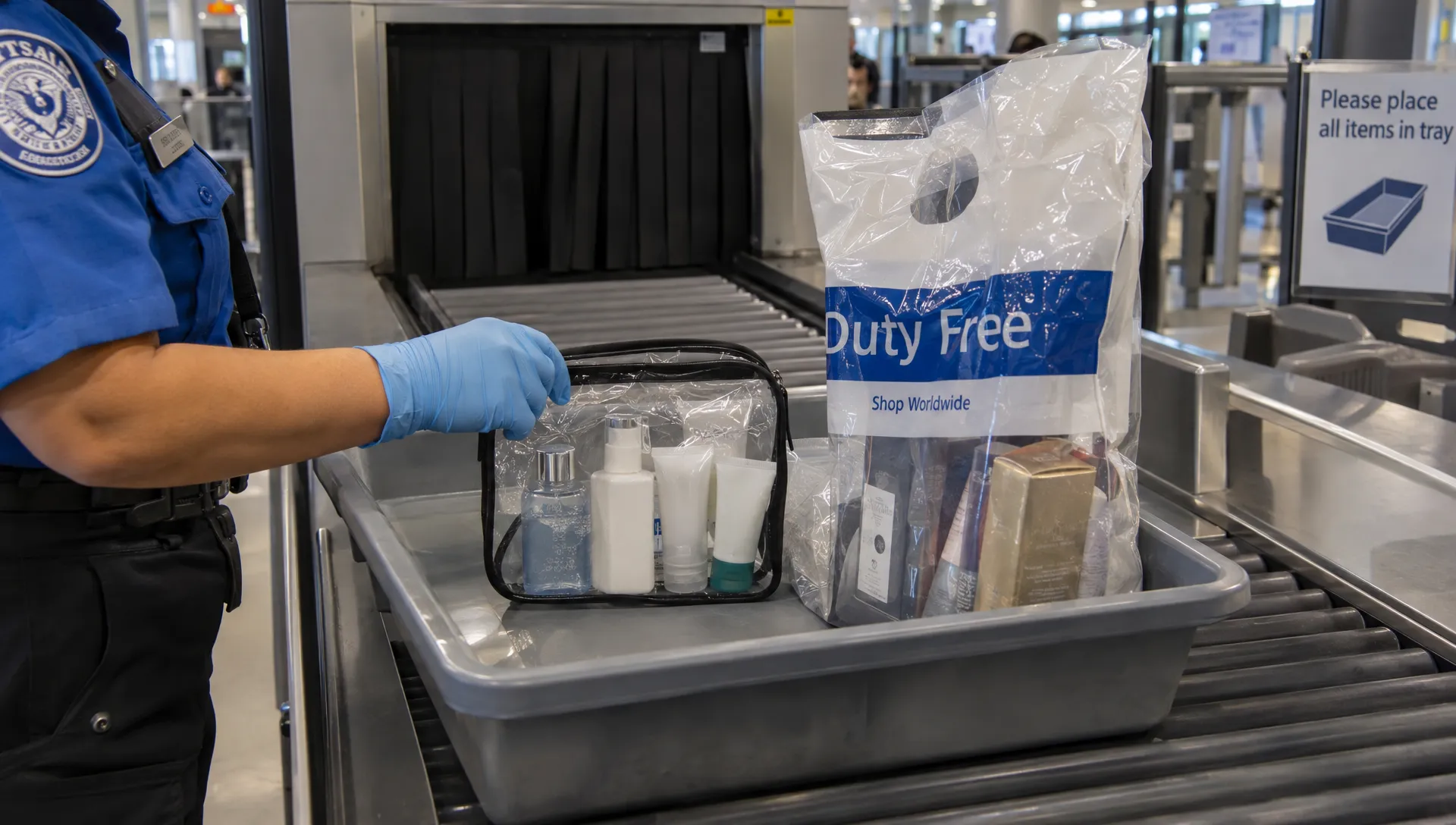
A purchase made after departure security can still face inspection at your connecting airport. This includes perfume, alcohol and other liquids bought in an airport shop or on board.
Where a transfer authority accepts larger duty-free liquids, it may require a recognized security tamper-evident bag, proof of purchase and additional screening. An ordinary shopping bag is not equivalent. Ask the retailer about suitable transfer packaging, keep the receipt and leave the security bag unopened.
Airport hand luggage rules for duty-free purchases are not universal, so a sealed bag is not a guarantee of acceptance. Check every transfer point before buying something you cannot afford to lose. Separate customs allowances may also apply at your destination.
A specific example: connecting through the United States
The TSA’s liquids rule allows certain duty-free liquids over 3.4 ounces or 100 ml when passengers enter the United States with a connecting flight. The stated conditions include international purchase, a transparent secure tamper-evident bag supplied by the retailer, no signs of tampering and the original receipt showing purchase within 48 hours.
The liquids must also clear screening. Meeting the packaging conditions does not guarantee that every bottle will be permitted through the checkpoint.
This is a specific US provision, not a worldwide duty-free standard. If your route includes another country afterward, check that country’s transfer requirements separately.
Map the checkpoints across the entire trip
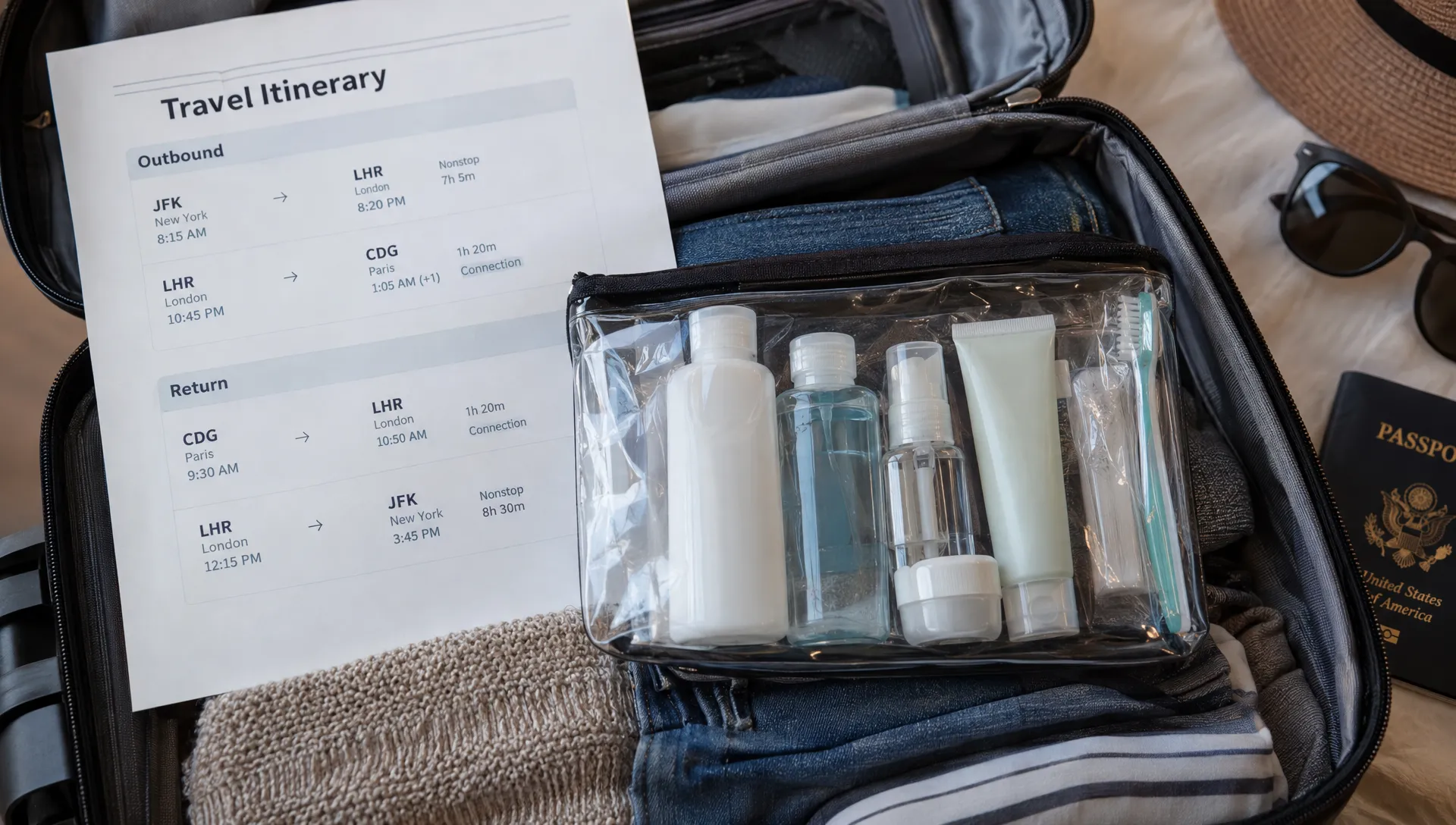
Build a simple checkpoint map before deciding which liquids to pack. Include the outbound departure, any connection that involves screening, the return departure and any return transfer. Do not treat the destination’s arrival airport as a departure checkpoint unless your itinerary actually takes you through security there.
Consider this hypothetical round trip:
| Journey stage | Confirmed screening arrangement | Packing consequence |
|---|---|---|
| Outbound departure | Larger ordinary-liquid containers permitted | Larger bottles may pass here, subject to local requirements. |
| Outbound connection | Transfer security with a 100 ml container limit | Larger ordinary-liquid bottles will not meet this checkpoint’s limit. |
| Return departure | A 100 ml container limit | Toiletries bought during the trip need to comply too. |
| Return connection | Airside transfer without another checkpoint | No additional liquid screening is expected on this segment. |
The route’s practical limit is 100 ml per ordinary-liquid container, despite the more generous starting airport. Bag requirements still need checking separately.
For airport hand luggage, this checkpoint map is more useful than a list of airport names alone. Consult the airport’s official connection guidance to confirm the route. For example, Heathrow’s connecting-flight information helps passengers investigate their transfer arrangements rather than infer them from terminal numbers.
Pack for uncertainty without giving up essentials
If you cannot confirm whether a transfer involves security, ordinary toiletries in containers of 100 ml or less are a conservative choice. Follow the applicable liquids-bag requirement too. This avoids depending on a larger-container allowance that may not apply to your connection.
Keep the liquids bag accessible. An empty reusable water bottle is generally simpler to take through screening than a full one, although it remains subject to inspection. If you fill it after departure security, empty it before another checkpoint where its contents would exceed the allowance.
Carry necessary medication where you can reach it and check the relevant exemption process. Supporting documents or original packaging can help explain what you are carrying, but requirements vary. Do not decant medication merely to fit a toiletry rule without checking whether that is appropriate.
Airport hand luggage planning also needs a fallback if your cabin bag is checked at the gate. Keep travel documents and essential medication with you, and follow airline instructions for removing power banks and spare lithium batteries. Moving a liquid into checked baggage only helps if that item is permitted in the hold and you have access to a checked bag before the relevant checkpoint.
For container limits and bag requirements in more detail, use the guide to how much liquid is allowed in hand luggage. Recheck your route before traveling, especially if a flight or terminal changes.
Frequently asked questions
Do I go through security again when changing terminals? Sometimes. An airside connection may avoid another checkpoint, but some airside routes include transfer security. A landside terminal change normally requires departure security again. Confirm the airport’s instructions for your exact connection.
Can I keep a large water bottle bought after security? You can generally carry it onward if there is no further screening and no other applicable restriction. If you encounter another checkpoint with a 100 ml limit, the water can be refused. Empty a reusable bottle before that check.
Does one booking mean the same rules apply throughout? No. One booking may simplify baggage handling and missed-connection arrangements, but it does not create a shared security policy. Airport hand luggage requirements still depend on the checkpoints along your journey.
Are duty-free liquids always allowed on connecting flights? No. Acceptance depends on the transfer authority’s rules, packaging, proof of purchase and screening. Keep eligible purchases in their unopened security bag, but verify the requirements before buying.
Should I check the return airport before packing outbound? Yes. A larger toiletry container that passes outbound security may not meet the return airport’s rules. Check return connections too, especially if they use different airports or terminals.
Check your liquids, then confirm your transfer route
Use Liquid Limits to compare airport liquid rules across your trip, including the return journey. Its trip and route checks provide source links and last-checked dates, with a stricter 100 ml fallback when rules are unclear.
Then confirm the passenger transfer route with your airport or airline. These checks answer different questions: Liquid Limits helps establish the liquid allowance, while the airport’s connection instructions establish where you will actually face screening. Together, they give you a clearer packing plan before you leave home.