
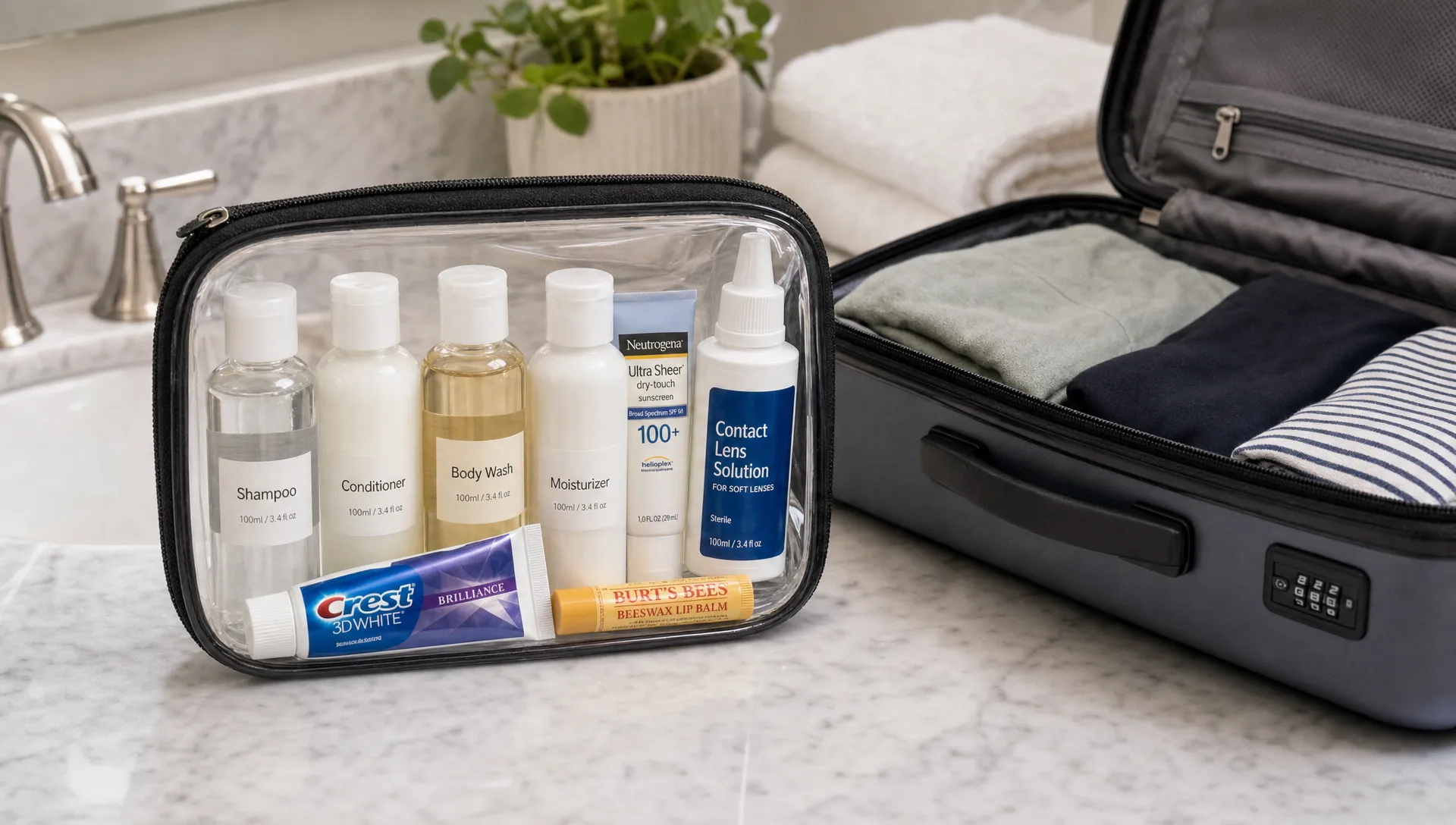
If you want the safest answer, plan for liquid containers of 100ml / 3.4oz or less in hand luggage, packed together in one clear, resealable liquids bag that is usually about 1 liter / 1 quart.
That rule is still the most widely enforced airport security standard for cabin bags. Some airports with newer scanners may allow larger containers, sometimes up to 2 liters, but you should not assume that applies unless it is confirmed for your exact departure airport, connection airport, and return flight.
In other words, the question is not only “how much liquid is allowed in hand luggage?” It is also “which airport will screen my bag, and what rule will they apply today?”
The standard hand luggage liquid allowance
For most trips, the practical rule is simple: each liquid container must be small enough, and all your small containers must fit in the permitted plastic bag.
| Question | Most common answer for hand luggage |
|---|---|
| Maximum size per liquid container | 100ml / 3.4oz |
| Total liquids bag size | About 1 liter / 1 quart |
| Number of liquids bags | Usually one per passenger |
| Does the bottle size or liquid amount matter? | The container size matters, not how much is left inside |
| Can larger liquids go in checked luggage? | Usually yes, unless safety rules restrict the item |
The U.S. Transportation Security Administration describes this as the TSA 3-1-1 liquids rule: 3.4oz containers, in one quart-sized bag, one bag per passenger. The UK government’s hand luggage restrictions use the similar 100ml container rule for liquids in cabin bags.
The key detail many travelers miss is that 100ml is the maximum container capacity, not the amount of liquid remaining. A 200ml shampoo bottle that is half empty can still be rejected because the bottle itself is too large.
What counts as a liquid?
Airport security uses “liquid” broadly. It usually includes anything that pours, spreads, sprays, smears, or has a gel-like texture. That means many items travelers think of as toiletries, makeup, food, or medicine may be treated as liquids at screening.
| Category | Common examples |
|---|---|
| Toiletries | Shampoo, conditioner, body wash, lotion, sunscreen, perfume |
| Gels and pastes | Toothpaste, hair gel, styling cream, lip gloss, balm-like products |
| Aerosols | Deodorant spray, shaving foam, hairspray, dry shampoo spray |
| Makeup | Mascara, liquid foundation, concealer, cream blush, setting spray |
| Food and drink | Water, juice, yogurt, jam, honey, sauces, soup |
| Health items | Contact lens solution, liquid medicine, antiseptic gel |
If you are unsure whether an item counts, assume it does until you verify otherwise. For example, toothpaste is commonly treated as a paste or gel, so it normally needs to follow the 100ml rule unless an exemption applies. For a more item-by-item overview, see this guide to what liquids are allowed in carry-on luggage.
Solid alternatives can make packing easier. A solid shampoo bar, stick deodorant, powder makeup, or bar soap usually avoids the liquids bag altogether, provided the item is genuinely solid and not a gel or cream in stick form.
When more than 100ml may be allowed
The 100ml rule has important exceptions, but they are not a free pass for unlimited liquids. Security staff may inspect, test, or ask you to separate these items from your regular liquids bag.
| Exception | What may be allowed | Smart packing advice |
|---|---|---|
| Liquid medicines | More than 100ml when medically necessary | Keep them accessible and bring a prescription, label, or medical note when possible |
| Baby milk and baby food | Reasonable quantities for the journey | Pack separately so security can screen them quickly |
| Special dietary liquids | More than 100ml when needed for medical or dietary reasons | Carry only what you need for the trip and be ready to explain it |
| Duty-free liquids | Larger bottles if sealed in an approved security bag | Keep the receipt and do not open the bag before your final security screening |
| Airport-specific scanner rules | Larger containers at some airports or lanes | Confirm the rule for that airport and your route before relying on it |
Medicines and baby supplies are the most common legitimate exceptions. In the U.S., TSA guidance allows medically necessary liquids in reasonable quantities above 3.4oz, but they must be declared for screening. Other countries have similar principles, but the exact process can vary.
Duty-free liquids are more complicated. A bottle bought after security may be fine for a direct flight, but it can become a problem if you connect through another airport and pass through security again. If you have an international connection, keep duty-free liquids sealed in the official tamper-evident bag with the receipt visible.
Why some airports mention 2L instead of 100ml
Newer computed tomography scanners can screen cabin bags differently from older X-ray machines. At some airports, this technology has supported larger liquid allowances or has allowed passengers to keep liquids inside their bags. That is why you may see references to 2L liquid limits in some travel guidance.
The problem is consistency. Rules can differ by country, airport, terminal, security lane, equipment status, and temporary government instruction. An airport may have new scanners but still enforce 100ml. Another may allow larger liquids on departure, while your return airport still uses the old rule.
This is why frequent travelers often pack to the strictest rule unless they have confirmed otherwise. If you can travel comfortably with 100ml containers, you reduce the risk of having items confiscated at the airport.
How to work out the real liquid allowance for your trip
The best answer depends on your itinerary, not just your airline. Airlines may publish cabin bag size and weight rules, but liquid screening is normally controlled by airport security and national aviation authorities.
Use this simple approach before you pack:
- Check your departure airport: This is the first place your hand luggage will be screened, so its liquid rule matters most at the start of your trip.
- Check connection airports: If you must clear security again during a layover, the connection airport’s rules may apply to everything in your cabin bag.
- Check your return airport: A round trip can have different liquid rules in each direction, especially if you fly home from a different country.
- Check specific items: Medicines, baby food, duty-free alcohol, aerosols, and gels can each have different handling requirements.
- Use the stricter rule when unclear: If guidance is missing, inconsistent, or outdated, pack as if the 100ml rule applies.
| Trip situation | Sensible packing assumption |
|---|---|
| Domestic U.S. flight | Follow the TSA 3-1-1 rule unless an exception applies |
| International flight with no checked bag | Pack all standard liquids in 100ml containers unless every airport confirms a larger limit |
| Round trip from different airports | Check both outbound and return airports before packing full-size items |
| Flight with a security rescreening connection | Assume the connection airport may enforce its own liquid rule |
| Airport says larger liquids are allowed | Confirm whether the rule applies to your terminal, lane, date, and destination |
This is where route-specific checking matters. Liquid Limits is built to help travelers check airport liquid rules before they pack, including round trips where the return airport may apply a different restriction. It also shows verified source links and last-checked dates, and defaults to the stricter 100ml rule when rules are unclear.
How much can you realistically fit in the liquids bag?
Even though the common container limit is 100ml, the real-world total is controlled by the bag. A 1-liter or quart-sized resealable bag does not always fit ten full 100ml containers, especially if the bottles are bulky, round, or oddly shaped.
A practical hand luggage liquids kit might include travel-size shampoo, conditioner, face wash, moisturizer, sunscreen, toothpaste, deodorant, and a small fragrance. If you add makeup, contact lens solution, hand sanitizer, and hair products, the bag fills quickly.
The safest strategy is to prioritize what you need during the flight and the first day after arrival. Put non-essential full-size toiletries in checked luggage if you have it, or plan to buy them after you land. If you are traveling with hand luggage only, choose compact containers and solid alternatives where possible.
For toothpaste specifically, remember that it is usually treated as a paste and must fit within the liquids allowance. If that is the item you are most worried about, this guide explains whether toothpaste is allowed in hand luggage and how different rules may apply.
What should go in checked luggage instead?
Checked luggage is usually the better place for larger toiletries, full-size sunscreen, large bottles of shampoo, and liquids you will not need during the flight. This keeps your cabin liquids bag small and reduces delays at security.
However, checked baggage is not a loophole for every liquid. Flammable liquids, fuels, certain chemicals, large aerosol quantities, and high-strength alcohol can be restricted or banned under dangerous goods rules. Airline and aviation authority rules may also limit how aerosols and alcohol are packed.
As a rule of thumb, pack everyday toiletries in checked luggage if they are too large for hand luggage, but check separately before packing anything flammable, pressurized, chemical, or unusually large.
Common mistakes that lead to confiscated liquids
Most liquid problems at security come from small misunderstandings, not from travelers trying to break rules. These are the mistakes to avoid:
- Packing a 150ml or 200ml bottle because it is only partly full.
- Forgetting that creams, pastes, gels, sprays, and liquid makeup count too.
- Assuming “travel size” automatically means 100ml or less.
- Bringing a full water bottle through security instead of an empty reusable bottle.
- Checking only the outbound airport and forgetting the return flight.
- Buying duty-free liquids before a connection where another security check may happen.
- Trusting a general airline page instead of the airport or security authority rule.
The simplest prevention is to pack liquids in clearly labeled 100ml containers, keep them together in one resealable bag, and check route-specific rules shortly before travel.
Frequently Asked Questions
Is the total liquid limit 100ml in hand luggage? No. In the most common rule, each container must be 100ml / 3.4oz or less. The total amount is limited by what fits inside the permitted clear resealable bag, usually about 1 liter or 1 quart.
Can I bring a 200ml bottle if it is half empty? Usually no. Security normally looks at the container capacity printed on the bottle, not the amount of liquid left inside. A half-empty 200ml bottle can still be rejected.
Are makeup and skincare products counted as liquids? Many are. Mascara, liquid foundation, concealer, cream blush, setting spray, moisturizer, sunscreen, and lip gloss are usually treated as liquids, gels, creams, or pastes.
Can I take water in hand luggage? You normally cannot bring a full bottle of water through security under the standard liquids rule. You can usually bring an empty reusable bottle and refill it after security, where airport facilities allow.
Are prescription liquids allowed over 100ml? Often yes, if they are medically necessary for the trip. Keep them separate from your regular liquids bag, declare them if required, and carry supporting documentation when possible.
Do hand luggage liquid rules depend on the airline? Usually the airport security rule matters more than the airline. Your airline controls cabin bag size, weight, and onboard policies, but liquid screening is generally handled by airport security authorities.
Check before you pack
For most travelers, the best default is still 100ml containers in one clear liquids bag. But if your airport uses newer scanners, you are carrying medicine, or you have a connection or return flight from another country, the real answer can change.
Before you leave for the airport, check the exact rule for your airport, item, and route. A two-minute check can save you from throwing away toiletries, repacking at security, or losing an expensive duty-free purchase.